 Write to the booksellers
-
Type
Art print (2)
Book (5881)
Magazine (20)
Manuscript (1)
Old papers (1)
Photographs (3)
-
Latest
Last 3 days (5)
Last month (27)
Last week (6)
-
Language
English (10)
French (5893)
German (1)
Greek (1)
Italian (1)
Latin (2)
-
Century
16th (2)
17th (9)
18th (246)
19th (886)
20th (2961)
21st (132)
-
Countries
Belgium (277)
Canada (3)
Côte d'Ivoire (13)
Denmark (1367)
France (3947)
Switzerland (301)
-
Syndicate
ALAC (3)
CLAM (3)
ILAB (4111)
NVVA (139)
SLACES (139)
SLAM (2582)
SNCAO (15)
Actes de l'Academie nationale des sciences, Belles Lettres et Arts 5,ème série tome 20 la fusion, esssence de l'univers
Non Renseigné. 1995. In-8. En feuillets. Bon état, Couv. convenable, Dos satisfaisant, Intérieur frais. Tiré à part de la page 57-67, illustré de schémas. . . . Classification Dewey : 530-Physique
Classification Dewey : 530-Physique

LES ENFANTS D'EINSTEIN. LA RELATIVITE GENERALE A L'EPREUVE DE L'OBSERVATION
INTEREDITIONS. 1988. In-8. Broché. Etat d'usage, Couv. convenable, Dos satisfaisant, Intérieur acceptable. 301 pages.. . . . Classification Dewey : 530-Physique
Traduit de l'américain par Françoise Balibar et Michel Biezunski. Préface de Jean Audouze. Classification Dewey : 530-Physique
The cosmic frontiers of general relativity
Little Brown and Company 1977 in8. 1977. Cartonné. illustrations en noir et blanc
sans jaquette bords insolés intérieur propre
Investigaciones experimentales sobre los espectros de la descarga oscilante. Tesis. Universidad Nacional de Buenos Aires.
Buenos Aires, Coni Hermanos 1915, 265x180mm, 232páginas, encad. percalina
5 placas p/b, Pour un paiement via PayPal, veuillez nous en faire la demande et nous vous enverrons une facture PayPal
Introduction Electrical Engineering. Circuits and Machines.
Princeton New Jersey, D. van Nostrand 1956, 235x155mm, 552pages, editor's binding.
Pour un paiement via PayPal, veuillez nous en faire la demande et nous vous enverrons une facture PayPal
Elements of X-Ray Crystallography.
Addison-Wesley Publishers Company, Inc. 1970, 235x160mm, IX - 256pages, editor's binding with jacket. Stained top edge and brown spots on top and bottom endpapers and name of previous owner on top of front page, otherwise a fine copy, clean interior.
Pour un paiement via PayPal, veuillez nous en faire la demande et nous vous enverrons une facture PayPal
"WILSON, C.T.R. - THE IMPROVED VERSION OF ""WILSONS CLOUD-CHAMBER"".
Reference : 46922
(1911)
On a Method of making Visible the Paths of Ionising Particles through a Gas.
London, Harrison and Sons, 1911. Small 4to. Contemp. full cloth. Spine gilt and with gilt lettering. A stamp to verso of titlepage and a few other leaves. In: ""Proceedings of the Royal Society of London. Series A."", Vol. LXXXV. XXIII,605,XXIV pp. and 11 plates. (Entire volume offered). Wilson's paper: pp. 285-288 a. 1 plate. Clean and fine.
First appearance of the paper which describes the final version of his invention, the famous Cloud-Chamber, - the first Cloud Chamber was invented by him in 1896 - for making visible and photographing the paths of charged particles, an invention for which Wilson received a share of the Nobel Prize in 1827. By using the Cloud Chamber he was here (1911) able to observe the track of an alpha ray by condensing water drops onto the ions produced by its passage.The Cloud Chamber, which Rutherford called ""the most original apparatus in the whole history of physics"", became standard equipment in physics laboratories, and made possible numerous important discoveries in the fields of particle and nuclear physicsAfter 1896 ""Wilson continued to experiment with ultraviolet radiation and other techniques for producing condensation effects, but soon concentrated on atmospheric electricity, not returning to the cloud chamber until December 1910. He designed an improved chamber with new methods of illumination and the possibility of photographing the results. At this time Wilson realized that it might be possible to reveal the track of an a ray by condensing water drops onto the ions produced by its passage. During March 1911 he saw this effect produced in his apparatus. Thus, the elucidation of phenomena seen in the Scottish hills led to the possibility of studying the processes of radioactivity, and the Wilson cloud chamber became an important piece of laboratory equipment. But it was in the study of cosmic rays that it achieved its full power, particularly in the refined form developed by Patrick Blackett, in which it was possible to study particles of very high energy and the production of electron-positron pairs with the chamber situated in a strong magnetic field."" (DSB).
"WILSON, C.T.R. - THE INVENTION OF THE WILSON ""CLOUD CHAMBER""
Reference : 42616
(1897)
Condensation of Water Vapour in the Presence of Dust-free Air and other Gases. Communicated by J.J. Thomson. Received March 15, - Read April 8, 1897.
(London, Harrison and Sons, 1897). 4to. No wrappers as extracted from ""Philosophical Transactions"" Year 1897, Volume 189 - Series A. - Pp. 265-307. Clean fine. Textillustrations, depicting Wilson's famous apparatus
First printing of this groundbreaking paper in which Wilson describes the invention which made it possible to view the track of a single atomic projectile or electron. The invenvention of the ""Dust-Chamber"" made it possible for J.J. Thomson in 1897 to calculate the charge of the electron, and thereby finding its mass, since the ratio between the two was known. In most cases it was found that the track of the particle is a straight, or nearly straight line.""C.T.R. Wilson had been developing his cloud-chamber, which was to provide the most powerfull of all methods of investigation in atomic physics. In moist air, if a certain degree of supersaturation is exceeded this can be secured by a sudden expansion of the air) condensation takes place on dust-nuclei, when any are present: if by preliminary operations condensation is made to take place on the dust-nuclei, and the resulting droplets are allowed to settle, the air in the chamber is thereby freed from dust. If now X-rays or radiation from a radioactive substance are passed into the chamber, and if the degree of supersaturation is sufficient, condensation again takes place: this is due to the production of ions by the radiation. Thus the tracks of ionising radiations can be made visible by the sudden expansion of a moist gas, each ion becoming the centre of a visible globule of water. Wilson showed that the ions produced by uranium radiation were identical with those produced by X-rays."" (Whittaker in ""A History of the Theories of Aether & Electricity"" II:p.4).
"WILSON, C.T.R. - THE MOST ORIGINAL AND WONDERFUL INSTRUMENT IN SCIENTIFIC HISTORY - WILSON'S CLOUD CHAMBER.
Reference : 45816
(1913)
Über die Expansionsapparat zur Sichtsbarmachung der Bahnen ionisierender Teilchen in Gasen, und über einige mittels dieses Apparats gewonnene Ergebnisse. Mit 23 Figuren im Text und auf 5 Tafeln. (Eingegangen 6. Oktober 1912). (On an Expansion Apparatu...
Leipzig, S. Hirzel, 1913. 8vo. Orig. printed wrappers, no backstrip. Wrappers loose. In ""Jahrbuch der Radioaktivität und Elektronik"", 10. bd., Heft 1. Pp. 1-138 (entire issue offered). Wilson's paper: pp. 34-54, textillustrations, showing apparatus and 5 photographic plates, showing ionizing by Alpha-, Beta- and Röntgen- radiation).
Together with the English version - published 1912 in the Proceedings of the Royal Society - this is Wilson's main paper relating ""that the track of an ionizing particle might be made visible and photographed by condensing water of the ions which is liberated"". The first trails were obtained in 1911 where he submitted a short note of this to the Proceedings. In the offered paper he published the first tracks made by the ionizing particles of alpha, beta and Röntgen-rays. This, Wilson Cloud-Chamber, became an extremely valuable instrument of fundamental research, the discovery of the positron in 1932 and the kaon in 1963 were made by using cloud chambers as detectors.""But the whole course of the particle appears infinitely more clearly by the method invented by C.T.R. Wilson in 1911 and named after him. The radiation is allowed to enter an expansion-chamber, containing a gas saturated with water vapour. A sudden expansion of the chamber cools the gas, and cloud-drops are then formed instantly around the ions produced along the tracks of the particles. By suitable illumination these tracks can be made to stand out clearly as if they had been described by luminous projectiles. The ""Altmeister"" of modern nuclear physics, Lord Rutherford, once called the Wilson chamber ""the most original and wonderful instrument in scientific history"".""Thomson Rees Wilson (1869-1959), a Scottish physicist, is credited with inventing the cloud chamber. Inspired by sightings of the Brocken spectre while working on the summit of Ben Nevis in 1894, he began to develop expansion chambers for studying cloud formation and optical phenomena in moist air. Very rapidly he discovered that ions could act as centers for water droplet formation in such chambers. He pursued the application of this discovery and perfected the first cloud chamber in 1911. In Wilson's original chamber the air inside the sealed device was saturated with water vapor, then a diaphragm is used to expand the air inside the chamber (adiabatic expansion). This cools the air and water vapor starts to condense. When an ionizing particle passes through the chamber, water vapor condenses on the resulting ions and the trail of the particle is visible in the vapor cloud. Wilson, along with Arthur Compton, received the Nobel Prize in Physics in 1927 for his work on the cloud chamber. (Wikipedia).
On the Condension Nuclei produced in Gases by the Action of Röntgen Rays, Uranium Rays, Ultra-violet Light, and other Agents. Received October 29, - Read November 24, 1898.
(London, Harrison and Sons, 1899). 4to. No wrappers as extracted from ""Philosophical Transactions"", Vol. 192 - Series A. Pp. 403-453. Textillustrations. Clean and fine.
First printing of Wilson's second importent paper describing his further experiments with his ""Cloud Chamber"".""To the period 1895-1912 belongs the development of an instrument which to my mind is the most original and wonderful in scientific history.I refer to the cloud or expansion chamber of C.T.R. Wilson...It was a wonderful advance to be able to se, so to speak, the details of the adventures of these particles in their flight through the gas....""(Lord Rutherford).""C.T.R. Wilson had been developing his cloud-chamber, which was to provide the most powerfull of all methods of investigation in atomic physics. In moist air, if a certain degree of supersaturation is exceeded this can be secured by a sudden expansion of the air) condensation takes place on dust-nuclei, when any are present: if by preliminary operations condensation is made to take place on the dust-nuclei, and the resulting droplets are allowed to settle, the air in the chamber is thereby freed from dust. If now X-rays or radiation from a radioactive substance are passed into the chamber, and if the degree of supersaturation is sufficient, condensation again takes place: this is due to the production of ions by the radiation. Thus the tracks of ionising radiations can be made visible by the sudden expansion of a moist gas, each ion becoming the centre of a visible globule of water. Wilson showed that the ions produced by uranium radiation were identical with those produced by X-rays."" (Whittaker in ""A History of the Theories of Aether and Electricity."" II, p. 4).
"WILSON, C.T.R. - THE ""WILSON-CLOUD-CHAMBER"" BROUGHT TO PERFECTION.
Reference : 47063
(1923)
Investigations on X-Rays and Beta-Rays by the Cloud Method.. Part I. - X-Rays. Part II. - Beta-Rays. (2 Papers).
London, Harrison and Sons, 1923. Royal8vo. Contemp. full cloth, gilt lettering to spine. A small stamp to verso of titlepage and on foot of a few leaves.. In: ""Proceedings of the Royal Society"", Series A, Vol. 104. VI,(6),676,XXXII pp., textillustr. and plates. (Entire volume offered). Wilson's papers: pp. (1-) 24 and 12 plates + pp. 192-212 and 9 plates.
First printing of the paper in which Wilson had brought his Cloud Chamber to perfection and showed the photographic tracks of the particles. The Cloud Chamber was the first detector of radioacticity and nuclear transmutations and it played an importent role in experimental particle physics e.g. the discovery of the positron. Wilson received the Nobel prize - together with Arthur Compton - in physics in 1927 for his work on the Cloud Chamber.""The 21 cloud chamber pictures of X-rays and beta-rays on coated stock printed recto only were the culmination of many years research by Wilson and at last showed the full potential of this method as a tool for particle physicists. Early in 1911 (Wilson) was the first person to see and photograph the tracks of individual alpha-particles and electrons. The event aroused great interest as the paths of the alpha-particle were just as W.H. Bragg had drawn them in publication some years earlier. But it was not until 1923 (the paperoffered) that the clous chamber was brought to perfection and led to his two, beautifully illustrated classic papers on the track of electron."" (The Nobel Foundation).
The Mysteries of the Atom.
London, Chapman & Hall, 1934. Orig. full cloth. Spine faded. Spine ends rubbed. X,146 pp.
First edition.
On the Electrical Conductivity of Flames Conatining Salt Vapours. Communicated by J.J. Thomson. Received March 19,- Read April 27, 1899.
(London, Harrison and Sons, 1899). 4to. No wrappers as extracted from ""Philosophical Transactions"" Year 1899, Volume 192 - Series A. - Pp. 499-528, textillustr. Clean and fine.
First printing of Wilson's paper in which he investigated the mobility of ions in flames, studying the electrical discharge in rarified gases...and following J.J. Thomson, made an attempt to determine the charge of the electron by using the cloud chamber. The experiment, in which he observed the fall of the condensation drops in the vertical electric fiels and its absence, was a forerunner of the more precise technique developed by Robert Millikan. (DSB 18, supplement II, p. 992).
L'énergie
Time LIFE. 1965. In-4. Cartonné. Bon état, Coins frottés, Dos satisfaisant, Intérieur frais. 199 pages avec de nombreuses illustrations et photographies en noir et blanc et en couleurs. Ouvrage réalisé avec la collaboration de scientifiques : René Dubos, Herny Marguenau et C.P. Snow.. . . . Classification Dewey : 530-Physique
Classification Dewey : 530-Physique
Handbuch der Physik I-III.
Breslau, Eduard Trewendt, 1891-93. Bound in 5 contemp. half calf bindings. Stamps on titlepages. Illustr.
Encyclopædie der Naturwissenschaften, III. Abtheilung.
Gedanken von den Eigenschaften, Wirkungen und Ursachen der Electricität, nebst einer Beschreibung zwo neuer Electrischen Maschinen.
Leipzig, Bernard Christoph Breitkopfs, 1744. Contemp. marbled boards. Titlelabel with gilt lettering. A paperlabel pastd on spine. (32),168 pp. and 3 folded engraved plate. Clean and fine.
First edition. Here Winkler for the first time shows that the electrical spark ignates alcohol. He also presents his invention of electrical machines. - The work treats ""Properties, effects and causes of electricity" two new frictional machines, pp. 10 , 18 size of leather cushion, p. 21" velocity of electrical transmission, p.70, effect of magnet on electrical sparks, p. 63."" (Wheeler Gift, No 313).Poggendorff II, 1337.
"WINKLER, JOHANN EINRICH. - KRATZENSTEIN, CHRISTIAN GOTTLIEB.
Reference : 51381
(1744)
Gedanken von den Eigenschaften, Wirkungen und Ursachen der Electricität, nebst einer Beschreibung zwo neuer Electrischen Maschinen. (+ Winkler:) Die Eigenschaften der Electrischen Materie und des Electrischen Feuers aus verschiedenen neuen versuchen e...
Leipzig, Breitkop, 1744. (+) Leipzig, Breitkop, 1745. (+) Halle, Hemmerde, 1745. 8vo. Bound in one contemp. hcalf. raised bands. A paperlabel pasted on top of spine. Stamps on the first title-page. An old name erased from title-page leaving a small hole, no loss of letters. (32),168 pp. - (28),164 pp. and 7 (numb. I-VII, the first 3 belongs to the first work, 4 to the second) folded engraved plates, referring to both works !) - 62 pp. a. 1 engraved plate. Internally clean, printed on good paper.
Both works by Winkler first editions. In the first Winkler for the first time shows that the electrical spark ignates alcohol. He also presents his invention of electrical machines. - The work treats ""Properties, effects and causes of electricity" two new frictional machines, pp. 10 , 18 size of leather cushion, p. 21" velocity of electrical transmission, p.70, effect of magnet on electrical sparks, p. 63."" (Wheeler Gift, No 313).The second work also contains descriptions of the invented electrical machines and in which for the first time a leather cushion is used, which is pressed against the glass globes by a spring. (Wheeler Gift, No 323, lacking the plates).Kratzenstein's work is a PIONEERWORK IN ELECTROTHERAPHY. He was the first to use electricity for therapeutical purposes. He details a method of treatment which consists of seating the patient on a wooden stool, electrifying him by means of a large revolving frictional glass globe and then drawing sparks from him through the affected body parts. (Not in Wheeler Gift).
Theory of Finite Systems of Particles. 1. The Green Function.
København, Ejnar Munksgaard, 1964. 4to. In the original printed wrappers. Offprint from ""Matematisk-fysisk Skfirter"" udgivet af ""Det Kongelig Danske Videnskabernes Selskab"", Bind 2, 8. Very fine and clean. 60 pp.
Offprint of Winter's extensive paper on the quantum mechanical aspects of the Green function.
Etudes théoriques sur la diffusion des ondes de De Broglie -- EDITION ORIGINALE
P., Masson, 1934, un volue in 8, broché, (l'envoi dans l'angle supérieur de la page de titre a été découpé), 106pp.
---- EDITION ORIGINALE ---- Thèse pour le doctorat ès sciences physiques**5309/M4
Cours Supérieur De Manipulations De Physique
Paris Gauthier-Villars et Fils 1897 In-8 Fort XVII+472 pp, 2ème édition. Exemplaire non coupé, dos insolé, frotté avec fines coupures sans manques sur les mors.
Bon État Général Broché à raba
Thermodynamique à l'usage des ingénieurs
Gauthiers-Villars et Cie. S.d.. In-12. Broché. Etat d'usage, Tâchée, Coiffe en pied abîmée, Intérieur bon état. 201 pp. Coiffe en pied fendue sur les mors et frottée, dos légèrement frotté et fané. Ouvragedu début du XX° siècle.. . . . Classification Dewey : 530-Physique
Classification Dewey : 530-Physique
Mémoires sur le Pendule. (Première - et seconde partie). Coll. de Mémoires relatifs à la Physique. (T. IV & V) Ens. 2 volumes.
Paris, Gauthier-Villars et Fils, 1889, 1891, gr. in-8vo, XLII + 216 + 226 / 429 p. + 1 planche dépl., reliure en demi-cuir originale. Plats en percaline verte avec supralibros dorés ‘Université de France / Lycée Condorcet’ Bel exemplaire.
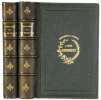
Contient: Première partie: Mémoires sur le pendule, précédés d’une bibliographie. XLII (Introduction historique par C. Wolf) + 1 f. (entre-titre) + 216 p. (bibliographie du pendule, chronologie depuis 1629 jusqu'a la fin 1885) + 226 p. (e.a.: M. de la Condamine: de la mesure du pendule à Saint-Domingue (Extr. des mém. de l'Académie royale des sc. 1735) - Borda & Cassini: Exp. pour connaître la longueur du pendule qui bat les secondes à Paris - Prony: Longueur du pendule simple - Henry Kater: Longueur du pendule à secondes à la latitude de Londres - Bessel F.-W.: Longueur du pendule simple qui bat la seconde obs. de Koenigsberg) + 7 planches gravées dépl.Seconde partie: 429 p. + 1 planche dépl. (contient env. 18 mémoires e.a.: Baily: Recherches sur la correction du pendule pour la réduction au vide acc. sur quelques remarques sur quelques anomalies observés dans l’exp. du pendule). (première partie, précédés d’une bibliographie) & Tome 5 (seconde partie). Publ. par la Societé Francaise de Physique. En 2 volumes. Image disp.

(SLACES, NVVA)
Phone number : 41 (0)26 3223808
Allerhand Nützliche Versuche, dadurch zu genauer Erkäntnis der Natur und Kunst der Weg gebähnet wird... Erster- (Dritter Theil). 3 Bde.
Halle im Magdeburgischen, Rengerischen Buchhandlung, 1727-29. 8vo. Bound in 3 contemp. full vellum. One corner a bit bumped. Backcover on vol. 2 with a small loss of vellum at front edge. 3 engraved frontispieces. Titlepages printed in red/black. (14),599,(9)(14),568,(8)(14),624,(8) pp. and 49 folded engraved plates with many figs each (17 + 14 + 18). One plate in vol. 2 with a minor loss in upper right corner, affecting 1 figure. On foot of forst titlepage a stamp (Greve Scheel). Internally fine.
Wolff's popular handbook dealing with the whole spectra of physics and technology, depicting experimental apparatus and technical inventions.Poggendorff II:1355.
[Typographie de Firmin-Didot et Cie] - WOLFF, Etienne ; ROSTAND, Jean
Reference : 70362
(1972)
Discours prononcés dans la séance publique tenue par l'Académie Française pour la réception de M. Etienne Wolff le jeudi 19 octobre 1972 [ Livre dédicacé par Etienne Wolff à Maurice Druon ] [ Contient : Discours de réception d'Etienne Wolff à l'Académie française - Réponse de Rostand Jean ]
1 vol. in-4 br. Institut de France, Académie Française, Typographie de Firmin-Didot et Cie, Paris, 1972, 41 pp.
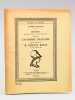
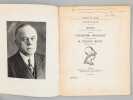
Important exemplaire de son discours de réception dédicacé par Etienne Wolff "Pour mon cher et admiré Maurice Druon, en témoignage de reconnaissance et de vive sympathie". Bon état pour ce remarquable exemplaire du tirage de l'Institut, dédicacé par Etienne Wolff, de superbe provenance : de la bibliothèque du grand écrivain et auteur des "Rois Maudits", Maurice Druon, futur Secrétaire Perpétuel de l'Académie Française de 1985 à 1999 et immortel auteur avec son oncle Joseph Kessel du texte du "Chant des Partisans". Le discours d'Etienne Wolff porte sur son prédécesseur le professeur Louis Pasteur Valléry-Radot. L'exemplaire est enrichi d'un tiré-à-part d'Etienne Wolff : "Une poétesse oubliée : Catherine Bernard nièce de Pierre Corneille" et d'une grande photo prise lors d'une séance à l'Académie : Maurice Druon présidant à la tribune, Maurice Genevoix sur la gauche, et peut-être Etienne Wolff descendant les marches.
Elements of photogrammetry with air photo interpretation and remote sensing
Singapour, MacGraw Hill Company, 1983, un volume in 8, broché, couverture imprimée, 11pp., 628pp., figures dans le texte
---- BON EXEMPLAIRE**8607/L5DE

