 Write to the booksellers
-
Type
Any type (1)
Artists book (5)
Autograph (2)
Book (17425)
Drawings (5)
Engraving (101)
Magazine (360)
Manuscript (5)
New book (1)
Old papers (5)
Photographs (183)
Reprint (1)
-
Latest
Last 24h (4)
Last 3 days (14)
Last month (136)
Last week (13)
-
Language
Dutch (2)
English (30)
French (18008)
German (9)
Italian (17)
Japanese (3)
Portuguese (7)
Russian (2)
Spanish (15)
Swedish (1)
-
Century
16th (2)
17th (8)
18th (51)
19th (775)
20th (5547)
21st (1155)
-
Countries
Belgium (2580)
Brazil (2)
Canada (27)
China (2)
Côte d'Ivoire (64)
France (13584)
Greece (2)
Italy (6)
Switzerland (1827)
-
Syndicate
ALAC (27)
CLAM (11)
CLAQ (3)
ILAB (4938)
NVVA (1087)
SLACES (1087)
SLAM (3691)
SNCAO (124)
LITTLE, Stephen, The demon Queller and the Art of Qiu Ying (Ch'iu Ying) / MEISTER, Michael W., Symbol and Surface: Masonic and Pillared Wall-Structures in North India / SRINIVASAN, Doris Meth, Johanna E. van Lohuizen-de Leeuw (1919-1983) (in Memoriam). // Artibus Asiae. Institue of fine Arts, New York University. Vol. XLVI, 1/2. This publication has been assisted by a grant from the Arthur M. Sackler Foundation, Washington D.C.
Ascona Switzerland, Artibus Asiae Publishers, 1935, gr. in-4to, 153 p. + 85 engraving + 2 p. publicity, original wrappers.

(SLACES, NVVA)
Phone number : 41 (0)26 3223808
Modèles de peinture monumentale chinoise en couleurs [Texte en chinois]. édité par le Comité d’arrangement des reliques culturelles de Pékin
Pékin, Maison d’édition populairedes Beaux-Arts, impr. Imprimerie locale de Shanghai gérée par l’état 1955 In-folio à l’italienne 76 x 101 cm. Sous coffret rigide brocart bleu avec fermoirs à la chinoise, orné d’une d’une vignette en couleurs contrecollée sur le premier plat, 36 planches contrecollées, légendées en chinois. Joint, in-folio 36 x 26cm, broché, un livret documentaire, 24 pp. en chinois. édition originale tirée à 2500 exemplaires. Exemplaire en très bon état.
Texte en chinois. Très bon état d’occasion
Painting Architecture in Early Renaissance Italy. Innovation and Persuasion at the Intersection of Artistic and Architectural Practice
, Brepols - Harvey Miller, 2024 Hardback, approx. 220 pages, Size:220 x 280 mm, Illustrations:3 b/w, 138 col., Language: English. ISBN 9781915487032.
Summary Why did artists include prominent architectural settings in their narrative paintings? Why did they labour over specific, highly innovative structural solutions? Why did they endeavour to design original ornamental motifs which brought together sculptural, painterly and architectural approaches, as well as showcasing their understanding of materiality? Painting Architecture in Early Renaissance Italy addresses these questions in order to shed light on the early exchanges between artistic and architectural practice in Italy, arguing that architecture in painting provided a unique platform for architectural experimentation. Rather than interpreting architectural settings as purely spatial devices and as lesser counterparts of their built cognates, this book emphasises their intrinsic value as designs as well as communicative tools, contending that the architectural imagination of artists was instrumental in redefining the status of architectural forms as a kind of cultural currency. Exploring the nexus between innovation and persuasion, Livia Lupi highlights an early form of little-discussed paragone between painting and architecture which relied on a shared understanding of architectural invention as a symbol of prestige. This approach offers a precious insight into how architectural forms were perceived and deployed, be they two or three-dimensional, at the same time clarifying the intersection of architecture and the figural arts in the work of later, influential figures like Giuliano da Sangallo, Raphael, Michelangelo and Baldassarre Peruzzi, whose work would not have been possible without the architectural experimentation of early fifteenth-century artists. TABLE OF CONTENTS INTRODUCTION The Architectural Imagination of Artists Pictorial Space and Architecture in Painting Visual Rhetoric The Case Studies All'antica Innovation and Paragone 1 A NEW ARCHITECTURAL CONSCIOUSNESS MASOLINO DA PANICALE AT CASTIGLIONE OLONA Masolino and Architecture Architecture as Cultural Currency Architecture, Nature and Encomiastic Ekphrasis 2 PERFORMING MAGNIFICENCE THE PELLEGRINAIO AT SANTA MARIA DELLA SCALA IN SIENA Ornament and Structure Architectural Portrait and Ex Novo Reinvention Building the Community The Pellegrinaio as a Stage 3 BUILDING LEGITIMACY FRA ANGELICO'S NICHOLAS V CHAPEL IN THE VATICAN PALACE Fra Angelico and Architecture Crafting Time and Place through Architecture Dignity and Authority Roman Echoes CONCLUSION Craftsmanship and Patronage Innovation and Self-promotion Disegno and Paragone Architectural Forms as Persuasion Appendix
Ars Romae Pittura.
S. l., Alterocca Terni, 1880 ; in-8 oblong, 20 pp., broché, couverture imprimée. 40 vues de peintures célèbres conservées à Rome.
Vies des premiers peintres du roi, depuis M. le Brun, jusqu'à présent.
Paris, Durand & Pissot, 1752 ; in-12, LXXX-178-150 pp., reliure demi-veau d'époque, dos lisse (état moyen, épidermures ça et là). Ce texte technique est attribué au graveur François-Bernard Lepicie qui fut secrétaire perpétuel et historiographe de l'Académie Royale de peinture et de sculpture. Le texte traite de Le Brun, Mignard, Coypel, Boullongne, Le Moyne, Pelligrini. État moyen.
Abrégé de la Vie des Peintres, avec la Notice de leurs ouvrages, orné de figures.
Paris, Chez Gay & Gide, anIV (1796) ; in-8 (136 x 205 mm), VIII-512 pp., + frontispice, 2-720-4 pp. + frontispice, relié plein cuir (veau), coloris naturel moucheté, dos orné de caissons et de fleurons à 5 nerfs, pièce de titre et de tomaison brun foncé, plats et chants ornés de frises dorées, tranches marbrées (coiffes usées, traces de frottement, épidermures, coins usés) (traces de mouillure). Les 2 volumes.
![Abrégé de la Vie des Peintres, avec la Notice de leurs ouvrages, orné de figures. . [LIVRES ANCIENS] - DARGENVILLE](https://static.livre-rare-book.com/pictures/OEC/_202100325_thumb.jpg)
![Abrégé de la Vie des Peintres, avec la Notice de leurs ouvrages, orné de figures. . [LIVRES ANCIENS] - DARGENVILLE](https://static.livre-rare-book.com/pictures/OEC/_202100325_2_thumb.jpg)
![Abrégé de la Vie des Peintres, avec la Notice de leurs ouvrages, orné de figures. . [LIVRES ANCIENS] - DARGENVILLE](https://static.livre-rare-book.com/pictures/OEC/_202100325_3_thumb.jpg)
LJUBA
Galerie De Seine Paris 1972 In-8 carré ( 210 X 160 mm ) de 61 pages, broché sous couverture illustrée rempliée. Edition originale de la préface de Mandiargues au catalogue de l'exposition Ljuba à la galerie de Seine en 1972. Autre préface par Etiemble. Illustrations couleurs et noir et blanc.
equipo crónica
Musée de Saint-Etienne, 1974. In-4, broché sous couverture illustrée en couleur, 83 pp. Equipe Cronica : La distanciation de la distanciation : une démarche sémiotique, par Tomas Llorens - Catalogue.
Nombreuses planches en noir et blanc. --- Plus d'informations sur le site archivesdunord.com
Phone number : 01 42 73 13 41
La pénétration française en Flandre une Ecole Préeyckienne inconnue
G Van Oest Bruxelles 1925
Bon état Ouvrage broché, couverture rempliée, dos de couverture trés légèrement fragilisé, texte complet et en trés bon état , 124 pages de texte + 85 planches en noir hors-texte des oeuvres de lécole préeyckienne gantoise , format: 29.5 x 23 cm, poids: 1.240kg - largeur/hauteur :x cm - poids : g - nombre de pages : p. - langue :
[Chez la Veuve Estienne & Fils, et Jean-Th. Herissant] - L**, M. ; [LACOMBE, Jacques ]
Reference : 66906
(1752)
Dictionnaire portatif des Beaux-Arts, ou Abrégé de ce qui concerne l'Architecture, la Sculpture, la Peinture, la Gravure, la Poésie & la Musique
Avec la Définition de ces Arts, l'explication des Termes & des choses qui leu appartiennent, Chez la Veuve Estienne & Fils, et Jean-Th. Herissant, Paris, 1752, 707 pp. et 1 f. n. ch.
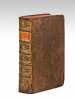
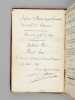
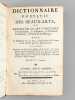
Exemplaire intéressant pour sa mention manuscrite en garde : "Académie de Peinture Sculpture Architecture de la Ville de Valenciennes" Première Classe de Dessin Troisième Prix Pierre Senez Délivré à Valenciennes en séance publique le 17 8bre 1814" et signée par le Secrétaire Perpétuel de l'Académie. Etat satisfaisant (reliure frottée avec mq. en coiffes et anciennes restauration).
Musée Memling Bruges
Crédit Communal, Ludion S.A., Bruxelles, 1987. In-4, broché sous couverture illustrée en couleur, 126 pp. Le musée Memling à l'hôpital Saint-Jean de Bruges - Le domaine de l'hôpital et les bâtiments historiques : le domaine de l'hôpital. - les bâtiments historiques. - les salles des malades et l'église. - le couvent des frères, l'ancienne apothicairerie ...
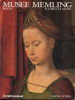
Nombreuses illustrations en couleur. --- Plus d'informations sur le site archivesdunord.com
Phone number : 01 42 73 13 41
Pietro da Cortona 1597-1669
Milan, Electa, 1997. In-4, 511 pp., broché, couverture originale illustrée (frottements).
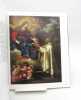
Monographie consacrée à Pierre de Cortone illustrée de nombreuses reproductions. * Membre du SLAM et de la LILA / ILAB Member. La librairie est ouverte du lundi au vendredi de 14h à 19h. Merci de nous prévenir avant de passer,certains de nos livres étant entreposés dans une réserve.
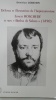
Défense et illustration de l'impressionisme. Ernest Hoschedé et son "Brelan deSalons" (1890)
L'Echelle de Jacob, 2008. In-8. Broché. Portrait en couverture. 260 pages. Avec catalogues des ventes Hoschedé. Index. Hormis une petite déchirure sur la 4ème de couverture réparée, ouvrage en bon état
LES BALLONS S'ENVOLENT, BIENTÔT SEULS !
Dessin textile original sur papier. Dimensions 73 x 48.5 cm. Cachet d'atelier au dos du dessin. Venez consulter l'ensemble de mes objets sur mon site antharedeschuyter.fr !
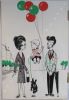
Envoi possible par Colissimo sous tube ou retrait direct à Genêts (Manche). Frais d'envoi R2 et d'emballage 12 . Coins froissés, trous de punaise dans les coins, une petite déchirure sans manque, état globalement correct. Remises possibles sur les achats en lot, achetez plusieurs objets à la fois ! Reçoit sur rendez-vous pour consultation des ouvrages.
LES DEUX CYGNES
Paris LOCATELLI XX° 75 X 50 cm Dessin textile, document de travail non destiné à être exposé. Signature divisée en deux parties, dans les deux coins opposés. Cachet d'atelier au dos. Venez consulter l'ensemble de mes objets sur mon site antharedeschuyter.fr !
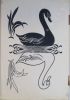
Envoi possible par Colissimo sous tube ou retrait direct à Genêts (Manche). Frais d'envoi R2 et d'emballage 12 . Coins froissés, trous de punaise dans les coins, état globalement correct. Remises possibles sur les achats en lot, achetez plusieurs objets à la fois ! Reçoit sur rendez-vous pour consultation des ouvrages.
LE TEMPS, LE TEMPS ...
Paris LOCATELLI XX° 75 X 50 cm Allégorie sur le temps qui passe, le temps qu'il fait... Dessin textile à la gouache sur papier, 75 X 50 cm Venez consulter l'ensemble de mes objets sur mon site antharedeschuyter.fr !
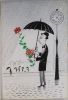
Envoi possible par Colissimo sous tube ou retrait direct à Genêts (Manche). Frais d'envoi R2 et d'emballage 12 . Coins légèrement froissés, état globalement correct Remises possibles sur les achats en lot, achetez plusieurs objets à la fois ! Reçoit sur rendez-vous pour consultation des ouvrages.
Piet Mondrian - Colour, Structure and Symbolism
Verlag Gachnang & Springer, Berne/Berlin, 1994. In-8, cartonnage éditeur illustré en couleurs, 93 pp. Composition A. - Reality. - Evolution. - Utopian Function. - Landscape. - Flower. - Experiments. - Change. - Frame and Title. - Contraction and Expansion. - Exchange with Bart van der Leck. - Lozenge Shape. - Elaborations. - Diagonals. - ...
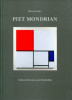
Avec 43 illustrations en noir et en couleurs en hors-texte.Ouvrage en langue anglaise (traduit du néerlandais par Michael Latcham). --- Plus d'informations sur le site archivesdunord.com
Phone number : 01 42 73 13 41
DEUTSCHE MALEREI IM 19. JAHRHUNDERT,
Darmstadt, Primus Verlag, 2005 Gebunden, Leinen mit Schutzumschlag, 205 x 275mm., 211S., illustriert. ISBN 3896785303.
Inhalt u.a.: Ein Jahrhundert deutscher Kunst; Monumentale Geschichtsmalerei; Biedermeierlicher Humor... Guter Zustand.
Deutsche Malerei im 19. Jahrhundert
Darmstadt, Wissenschaftliche Buchgesellschaft 2005 213pp.richly illustrated in colour & bl/w, 28cm., cart.cover, VG
La vie et l'oeuvre de M.C. ESCHER.
CHENE/HACHETTE 1981, reliure pleine toile d'éditeur avec jaquette illustrée, 25x31 cm, 349 pages, richement illustré en noir et blanc et couleurs. Biographie et bibliographie.
Jaquette légèrement défraichie .
BERNARD LOUEDIN.
1972 Aval Couverture souple 1972 BERNARD LOUEDIN. Editions d'Aval , 1972 . In8 broché , 38pp. Nombreuses illustrations . Etat neuf.
Bernard Louédin.
[s.l.], Edition d'Aval, 1972 1 volume 15 x 21,5cm Encollé sous couverture à rabats. 38p., 3 feuillets; illustrations en noir et en couleurs, vignettes et pleines pages. Bon état.
Texte de l'historien et critique de cinéma Giuseppe Maria LO DUCA (1905-2004) sur l'oeuvre du peintre, dessinateur et graveur Bernard Louedin (pseudonyme de Henri Bernard Rebout); reproductions en noir et en couleurs; citations de critiques d'auteurs divers (1963-1971) et d'extraits d'une interview donnée par l'artiste à Claude VAILLANT (1972); bio-bibliographie.
CLAUDE GOZLAN. Postface de Jean Ferré.
Paris Cygne 1982 Volume in-8° oblong, 85 (2) pp. Reliure ornée de l'éditeur pleine toile bleue. (quelques tâches au dos et au second plat, petit accroc en bordure de ce dernier). Nombreuses reproductions en couleurs.
De Rennes à Rennes
PARIS, Ed. Jean Picollec - 1986 - In-4 à l'italienne - Cartonnage éditeur frotté llustré en couleurs - Nombreuses illustrations NB et en couleurs de R.H. Martin - Signet - 125 pages
Erotique de l'art.
Paris, La Jeune Parque, 1966 - In-4 , Sous emboîtage - Reliure imitation cuir rouge d'éditeur -1er plat orné d'un décor de filets dorés avec titre imprimé - dos à caissons dorés - importante iconographie en noir et en couleurs, certianes illustrations PP - Edition originale hors commerce.- Ex. comme neuf.

