 Write to the booksellers
-
Type
Any type (2)
Art print (7)
Book (32053)
Disk (1)
Drawings (7)
Engraving (9)
Magazine (126)
Old papers (1)
Photographs (13)
Posters (1)
-
Latest
Last 24h (8)
Last 3 days (10)
Last month (860)
Last week (229)
-
Language
Dutch (4)
English (43)
French (32128)
German (6)
Italian (17)
Japanese (2)
Portuguese (9)
Spanish (11)
-
Century
16th (16)
17th (52)
18th (211)
19th (1538)
20th (9307)
21st (1841)
-
Countries
Belgium (10306)
Brazil (7)
Canada (108)
China (3)
Côte d'Ivoire (63)
Denmark (213)
France (18475)
Germany (1)
Greece (1)
Switzerland (3043)
-
Syndicate
ALAC (99)
CLAM (19)
CLAQ (94)
CNE (3)
ILAB (10649)
NVVA (1153)
SLACES (1153)
SLAM (8163)
SNCAO (9)
Les métamorphoses du patrimoine. Formes de conservation du construit et urbanité. Thèse.Université de Lausanne Faculté des Lettres Institut de Géographie.
öausanne, 1992, 295x210mm, 475pages, broché.
photos n/b, Pour un paiement via PayPal, veuillez nous en faire la demande et nous vous enverrons une facture PayPal
SÜE, Louis & André MARE [Roger de La Fresnaye - Jacques Villon - Marie Laurencin - Paul Véra - Dunoyer de Segonzac - Richard Desvallières - Jean-Emile Laboureur - J.-L. Boussingault - Bernard Boutet de Monvel]
Reference : 12871
1921. Architectures. Recueil publié sous la direction de Louis Süe et André Mare. Comprenant un dialogue de Paul Valéry et la présentation d'ouvrages d'architecture, décoration intérieure, peinture, sculpture et gravure contribuant depuis mil neuf cent quatorze à former le style français.
1 Paris, Édition de La Nouvelle Revue Française, 1921, in-folio (52x38 cm) de 1 f. blanc - 148 pp. -3 ff.n.ch.(achevé d'impr., 2 bl.),broché, couverture grise piquée ; pâles rousseurs ou piqûres, prononcées aux tout premiers feuillets.
Très nombreuses illustrations dintérieurs Art Déco conçus par Louis Süe et André Mare : 40 hors-texte, 10 en couleurs dont les tableaux de Roger de La Fresnaye et Marie Laurencin et 30 en noir, y compris le frontispice, traduits en gravure par Jacques Villon, dont le buste de Baudelaire de Raymond Duchamp-Villon. Et 28 gravures ornementales de Louis Süe, Reproductions dAndré Mare, Paul Véra, gravures de Chapron, Dunoyer de Segonzac (eau-forte originale), Richard Desvallières ferronnier d'art, Louis Süe, P. Poisson, Jean-Emile Laboureur (burin original). Les croquis figurant sur les planches sont de J.-L. Boussingault, Bernard Boutet de Monvel, Jacques Villon, Louis Süe, L.-A. Moreau, etc.Édition originale tirée à 500 exemplaires numérotés sur vélin de pur fil des papeteries Navarre, celui-ci le n° 110. Bel ouvrage.Après avoir préparé lEcole polytechnique, le bordelais Louis Süe entre en 1893 à lÉcole des Beaux-arts où il étudie dans latelier Laloux. Diplômé en 1901, il construit à partir de 1903, en collaboration avec Paul Huillard, des ateliers dartistes et des immeubles à Paris, rue Cassini, boulevard Raspail et boulevard du Montparnasse, et la maison de couture de Paul Poiret, av. dAntin (aujourd'hui av. Franklin-D.-Roosevelt), la villa pour Jeanne Paquin à Saint-Cloud (1912-1914). Peu avant la Première Guerre mondiale, il rencontre le peintre André Mare (1885-1932) qui expose, au Salon de 1912, sa Maison cubiste. Après la guerre, Louis Süe et André Mare réalisent ensemble, en 1919, le décor des Fêtes de la victoire à Paris, avec le peintre Gustave Jaulmes. Ils fondent en 1919, la Compagnie des arts français, entourés dartistes et dartisans maîtrisant plusieurs disciplines des arts décoratifs, et créent des ensembles en série ou des modèles uniques pour de luxueuses commandes. Ils publient les premières productions de meubles, papiers peints, tapisseries et modèles dorfèvrerie et de céramique sous le titre « Architectures. 1921 » pour lequel Paul Valéry écrit le dialogue « Eupalinos ou lArchitecte ». Ils participent ensemble à lExposition internationale de 1925, construisant un Musée dart contemporain et le pavillon Fontaine, sur lesplanade des Invalides. Leur dernière réalisation commune importante est le décor intérieur du paquebot Ile-de-France, en 1925. En 1927, Louis Süe et André Mare sont écartés de la Compagnie des arts français, acquise par le principal actionnaire des Galeries Lafayette. (CAPA - Centre darchives darchitecture contemporaine)
Les Grands Monuments N° 3 , La cité Interdite , La Muraille De Chine
Hachette 1979 In Plano Collection encyclopédique " Chefs-d'oeuvre de l'art - merveilles du monde " . Illustrée de nombreuses photographies en couleurs hors-texte , dessins , schémas . - 32 p. , 300 gr.
Couverture rigide Bon État .
Simples notions sur l'architecture religieuse.
Tours, Cattier, 1873, 1 br., dos et plat sup. Manquants. in-8 de 112-(18) pp., illustrations ;
Phone number : 06 80 15 77 01
La Sculpture religieuse à travers les âges au pays d'Alençon. du XIIe au XIXe siècle
[Alençon], Imprimerie Alençonnaise, s.d. (1922) in-4, 32 pp., agrafé, sous couverture.
Conférence faite le mercredi 18 janvier 1922 à la Société Historique & Archéologique de l'Orne. - - VENTE PAR CORRESPONDANCE UNIQUEMENT - LIEN DE PAIEMENT, NOUS CONSULTER.
Paris 1400: Les arts sous Charles VI
, Fayard, 2004 Couverture souple, 413 pages, 22,0 x 28,0 cm, FR. En bon état. ISBN 9782213620220.
Paris 1400: Les arts sous Charles VI
Traité pratique de la coupe des pierres, ou Manière de tracer les épures, couper les panneaux et faire la taille des pierres destinées à la construction des bâtiments, par E. Tachon, architecte. Sans le texte, planches seules.
- Chemise 23 x 32 cm contenant 112 planches.
Vieux papier. Librairie de la construction moderne, Vers 1914.
Plans sur papier calque du projet de stèle à la mémoire de Paul Taconnet,
professeur au collège de Thoissey, pour sa tombe, dont était responsable Charles Pinet qui fut son élève et ami ; L.A.S. d'un collègue de Pinet qui calcula les proportions de cette stèle, adressée à Pinet (signature illisible) ; gabarit de la stèle en papier découpé.
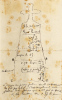
PRIX POUR L'ENSEMBLE DES 4 DOCUMENTS


Phone number : 06 60 22 21 35
TADAO ANDO
New York, London, Academy Editions, St-Martin Press, Architectural Monographs 14, 1990, in-4 softcover, 127 pp, nombreuses illustrations. In english. Cover in good condition, inside very good.
PALAIS DE VARSOVIE
INTERPRESS. 1985. In-4. Cartonnage d'éditeurs. Etat d'usage, Couv. convenable, Dos satisfaisant, Intérieur frais. 158 pages. Jaquette illustrée en couleurs, légèrement passée. Nombreuses photos en noir et blanc dans et hors texte par Edmund Kupiecki.. Avec Jaquette. . . Classification Dewey : 720-Architecture
Classification Dewey : 720-Architecture
Marcel Proust, L'écriture Et Les Arts
, Gallimard/Bibliothèque Nationale De France, 1999 Softcover, 311 pages, 29.5 x 24 cm, illustré, FR. *en bon état. ISBN 9782070116355.
Marcel Proust, L'écriture Et Les Arts : Exposition, Paris, Organisée Par La Bibliothèque Nationale De France
[Album photographique de ses oeuvres sculptées]
Roma 1886 In-f° (345 x 271 mm), [20] ff. montés sur onglet, percaline rouge, dos lisse muet, larges fleurons (plaques) en écoinçons sur les plats avec ex-dono, lieu et date sur le plat supérieur, tranches rouges (habillage de l'époque)
![[Album photographique de ses oeuvres sculptées]. TADOLINI (Giulio)](https://static.livre-rare-book.com/pictures/QNG/282_1_thumb.jpg)
![[Album photographique de ses oeuvres sculptées]. TADOLINI (Giulio)](https://static.livre-rare-book.com/pictures/QNG/282_2_thumb.jpg)
Un album photographique inédit des oeuvres du sculpteur romain Giulio Tadolini Album photographique figurant 15 uvres (20 photos) du sculpteur italien Giulio Tadolini (1849-1918), offert par l'artiste à Juan Sánchez Azcona (1843-1894), ministre mexicain en Argentine, au Brésil, en Italie et au Guatemala, et magistrat sous les gouvernements de Benito Juárez et de Porfirio Díaz. Mention sur la couverture : « A sua Eccelenza / Il Signore I Sanchez Azcona / Ministro del Messico / Giulio Tadolini Roma 1886 » Giulio Tadolini naquit à Rome en 1849 dans une famille de sculpteurs et hérita de l'atelier occupé avant lui par son grand-père, Adamo Tadolini, élève préféré de Canova, puis par son père Scipione Tadolini. C'est cependant dans un premier temps à la peinture qu'il choisit de se consacrer : formé aux Beaux-Arts de Rome, il étudia auprès de Cesare Fracassini puis, à la mort de maître, fréquenta l'atelier de Mariano Fortuny. Il s'orienta finalement vers la sculpture dans le milieu des années 1870, mêlant influences néoclassiques aux thèmes orientalistes qui infusaient déjà sa peinture. Tadolini jouit d'un grand succès de son vivant : élevé au rang de sculpteur de monuments nationaux, il fut également nommé membre de l'académie pontificale des beaux-arts et des lettres des virtuoses au Panthéon et de l'Académie des beaux-arts de Pérouse, chevalier de Saint-Grégoire et commandeur de la Couronne d'Italie. Aujourd'hui, on le connaît surtout pour 3 grands monuments publics : la statue équestre de Victor Emmanuel II à Pérouse (1890), le monument funéraire d'Umberto I d'Italie au Panthéon (1900), et enfin le tombeau du pape Léon XIII (basilique Saint-Jean de Latran, 1907). Comme son grand-père Adamo Tadolini, exécuteur d'une célèbre statue équestre de Simón Bolívar, Giuilo Tadolini nourrit avec l'Amérique latine des relations fructueuses : au Mexique, plus spécifiquement, il réalisa le monument de la famille Guzmán à Mexico (présent dans l'ouvrage). Sa figure en bronze de l'ascension de la vierge fut, à la demande de l'archevêque Eulogio Gillow, importée d'Italie au début du XXe siècle pour orner la cathédrale d'Oaxaca. Il remporta également un concours organisé par la ville de Morelia en 1903 pour un projet de statue de l'indépendantiste mexicain José María Morelos y Pavon ; le paiement demandé par Tadolini ayant été jugé trop important, la ville se rabattit finalement sur le projet du deuxième lauréat. Les uvres représentées dans l'ouvrage sont, dans leur ordre d'apparition : - « Pompejana dopo il bagno » (2 photos, trou à une photo) ; souvent retrouvée sous l'appellation « Odalisque » ou « Pauline », cette uvre en marbre fut présentée à l'exposition universelle de Paris en 1878, et recréée à plusieurs reprises par l'artiste l'une de ces « Odalisques » est exposée au Williamson Art Gallery & Museum de Birkenhead. - « Rebecca » (2 photos), marbre 1884. Conservé au musée Canova Tadolini. - « Giuditta », marbre, 1881 (conservée au Berkshire Museum) - « Cleopatra », marbre. La première statue de Tadolini documentée semble être une « Cleopatra davanti [« dinnanzi » selon certaines sources] a Cesare » (Cléopâtre devant César) signée et datée « 1875 ». Celle-ci, apparemment non-répertoriée, porte la signature du sculpteur et la date « 1872 ». - « Almorino » plâtre portant la mention « to my darling » sur le socle. - Monumento Marqse Gandara (2 photos représentant respectivement les figures « Fides » et « Charitas ») : ces sculptures ornent le monument de la famille Gandara au cimetière de San Isidro, Madrid. - Un buste du député mexicain Ramon Guzman (1834-1884) - 2 figures (manque marginal à une photo) pour la sépulture de la famille Guzmán à Mexico. - Le monument pour le tombeau de la famille Lovatelli au cimetière Verano de Rome (3 photos in situ). - « Monumento Depto Massari Bari » ; esquisse en plâtre pour le monument à Giuseppe Massari, homme politique et journaliste italien (1821-1884), réalisé en bronze en 1884 et situé Piazza Giuseppe Massari à Bari. - « Marocchina » (manques marginaux, tache), buste en bronze exposé dans un premier temps à Munich en 1883, puis à Turin en 1884. - « Nubiano », buste en bronze exposé dans un premier temps à Munich en 1883, puis à Turin en 1884. - Buste en bronze de Cecilia Metella, épouse de Crassus, réalisé en 1882 et exposé pour la première fois à Rome en 1883. Conservé à la National Gallery of Modern Art Rome. Les traits du modèle reparaîtront sur la figure de l'Ange surplombant la tombe de la famille Lovatelli. - « Nenella », esquisse en plâtre pour un buste en marbre qui ne sera réalisé qu'en 1901. Pièce curieuse de l'uvre d'un sculpteur qui se spécialisa dans les portraits de personnages importants, « Nenella » était une jeune fleuriste qui travaillait près de l'atelier de Tadolini. Le buste en marbre est conservé au musée Canova Tadolini, situé dans les anciens ateliers Tadolini de la Via del Babuino. - « Leone XIII », esquisse en plâtre pour un buste en marbre ; très apprécié du pape Léon XIII, Tadolini le sculpta d'après nature dès son élection en 1876 (Papi in posa, LXII). Il réalisa également son imposant monument funéraire. PROVENANCE : Famille Sanchez Azcona ("h. Sanchez-Azcona"), ex-libris à la devise "Veritas et stilus" sur le contreplat supérieur. Mouillures sur l'ensemble de la reliure. Rousseurs ; Anna Lisa Genovese, « Tadolini, Giulio » in Dizionario Biografico degli Italiani - Volume 94 (2019)
Vittorio Gregotti projets et architectures.
Paris, Electa Moniteur, 1982 ; in-8, (24 x 22 cm), broché. 149 pp. Très nombreuses illustrations dont 5 en couleurs. Couverture illustrée.
Monographie traduite de l'italien par Pierre-Alain Croset.
Vieilles Maisons Françaises n°65 Juillet 1975. Sommaire : Conservateurs régionaux des Bâtiments de France - L'abbaye de Belleperche (Tarn et Garonne) - Du nouveau à Jumilhac (Dordogne) par Tristan Latour - Les châteaux ouverts au public etc.
Vieilles Maisons Françaises. 1975. In-8. Broché. Bon état, Couv. convenable, Dos satisfaisant, Intérieur frais. 137 pages augmentées de nombreuses photos en noir et blanc dans le texte. Quelques pages publicitaires illustrées en noir et blanc.. . . . Classification Dewey : 720-Architecture
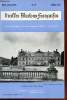
"Revue trimestrielle. Sommaire : Conservateurs régionaux des Bâtiments de France - L'abbaye de Belleperche (Tarn et Garonne) - Du nouveau à Jumilhac (Dordogne) par Tristan Latour - Les châteaux ouverts au public par Mlle B. de Andia - L'isolation et l'aménagment des combles sous couvertures en tuiles de terre cuite - Un jugement intéressant sur les dégâts commis par les ""bangs"" - La forteresse de Madaillan par Annie Van de Wiele - etc. Classification Dewey : 720-Architecture"
Notice sur l'ancienne Chartreuse de Dijon.
Dijon, Imprimerie Jacquot, Floret, sans date (XIXe). In-12 broché, couverture bleue imprimée (deux petits manques sur la couverture), 112 pages, une gravure sur double page en frontispice (lithographie de Fayolle). Bon état général.
ARCHITECTURES 1880 - 1920 : Images fin de siècle
Paris, Chêne, 1988. Grand in-4. Pleine toile noire de l'éditeur sous jaquette illustrée en couleurs. 263 pages. Photographies couleurs pleine page. Croquis in texte en noir. Index et bibliographie. Photographies Keiichi Tahara. Texte Riichi Miyake, traduit de l'anglais par Pierre Saint-Jean. Préface Caroline Mathieu, Conservateur au Musée d'Orsay. Bon état.
Une erreur s'est glissée sur la page de titre qui annonce 1980-1920 au lieu de 1880.
Dana, Catalogue Raisonné.
, 5 Continents, 2015 Hardcover in slipcase, 384 pages, 898 ills. 27,5 x 35,5 cm.Text in English, French.text, Texte en Francais Illustrations en couleurs en noir & blanc nombreuses illustrations dans et hors texte. NEUF/NEW. ISBN 9788874396962.
Cette monographie, rassemblée dans un élégant coffret en deux volumes, présente une rétrospective de l??uvre d?Yves Dana et dévoile la variété et la qualité des créations du sculpteur suisse d?origine égyptienne. Dans le premier volume, ses pierres, bronzes, fers et peintures sont révélés par de magnifiques photographies et accompagnés d?un texte poétique de Tahar Ben Jelloun. Dans la seconde partie, le catalogue raisonné de plus de 600 ?uvres est accompagné d?un texte critique de Matthias Frehner. Le lecteur découvre ses travaux sur fer, sur pierre et sur bronze, ainsi que ses peintures qui marquent les différentes étapes de son travail et montrent les directions prises par ses recherches. Yves Dana se consacre totalement à la sculpture à partir de 1981. Son travail est très vite reconnu par la galerie Alice Pauli qui, dès 1984, organise plusieurs expositions et fait connaître ses ?uvres en Suisse et à l?étranger. Les galeries Ditesheim et Krugier, à Genève et New York, poursuivent cet élan et contribuent à asseoir sa réputation. S?ensuivent plusieurs expositions personnelles et collectives, notamment au musée Guggenheim de Bilbao. Soutenu par divers galeristes, le sculpteur participe également à des foires internationales, comme ART Basel, ART Miami, FIAC Paris, Arco Madrid, KIAF Séoul. Il partage aujourd?hui son temps entre l?Orangerie de la Ville de Lausanne et son atelier en Toscane.
TAHCAN-Text(s) by Manuel Borja-Villel, Charlotte Friling, Dirk Snauwaert, foreword by Maria Gilissen-Broodhaer
Reference : 57241
MARCEL BROODTHAERS: INDUSTRIAL POEMS The Complete Catalogue of the Plaques 1968-1972
, WIELS, Brussels, 2021 hardcover, 285 x 235 mm, 400 pages. Eng. edition. ISBN 9783775751322.
Marcel Broodthaers's work is characterized by a complex exploration of the relationship of text and image. This catalog raisonné, prepared by WIELS and developed in close collaboration with the Marcel Broodthaers Succession, is the first to include all of the Belgian conceptual artist's industrial poems created between 1968 and 1972. Borrowing from the aesthetics of industrially manufactured plastic signs, Broodthaers's multi-layered, often enigmatic pictorial poems testify to his interest in the entanglements of language, punctuation, and symbols. In blurring the boundaries between word and image, painting and object, new levels of meaning are made visible. The index is supplemented by a collection of Broodthaers's drawings, writings and "open letters" as well as scholarly contributions that position the poems as a crucial group of works within the artist's oeuvre. MARCEL BROODTHAERS (1924-1976) developed his poèmes industriels simultaneously to his seminal work, the Musée d'Art Moderne, Département des Aigles. They form an important element in the development of his fictional museum, a central work of institutional critique.
Kunst im öffentlichen Raum Wien/ Public Art Vienna 2010-2013.#3.
, Verlag Fur Moderne Kunst 2015, 2015 Hardcover, 260 pages/seiten, English/Deutsch, fine copy/in sehr guten zustand, illustrations in colour and b/w,. ISBN 9783869845142.
Joseph brousseau - architecte limousin au temps des lumieres
Presse Universitaires De Bordeaux 1992
Très bon état Ouvrage toilé sous jaquette ( très bon état ) illustré de photos, plans et dessins. en raison de sa taille, envoi par colis nécessaire. architecture xviiie hist régio limoges argentré du plessis saint sylvain d ahun sées chateau fleuré bio j brousseau - largeur/hauteur : 17x25 cm - poids : 1140 g - nombre de pages : 533 p. - langue : Français
Le grand théâtre de Bordeaux- Miroir d'une société
CNRS. Non daté. In-8. Broché. Bon état, Couv. convenable, Dos satisfaisant, Intérieur frais. 127 pages. Nombreuses photos et illustrations en couleurs et en noir et blanc et en couleurs dans et hors texte.. . . . Classification Dewey : 720-Architecture
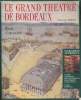
Caisse nationale des monuments historiques et des sites. Classification Dewey : 720-Architecture
Le grand théâtre de Bordeaux, miroir d'une société
CNRS editions. 2001. In-4. Broché. Etat passable, Couv. légèrement pliée, Dos satisfaisant, Fortes mouillures. 127 pages. Coins frottés. Pages partiellement collées (bas de pages). Nombreuses photos et illustrations en noir et blanc et en couleurs.. . . . Classification Dewey : 720-Architecture
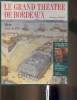
Classification Dewey : 720-Architecture
Roger Taillibert architect : recent works.
Paris Roger Taillibert 1985 1 vol. broché in-4, broché, 76 pp., nombreux plans et photos en noir et en couleurs. Présentation des projets et des réalisations de Roger Taillibert, spécialiste des équipements sportifs, entre 1966 et 1985.
Roger Taillibert.
Paris : Roger Taillibert, 1994. Un fort volume 28x27,5cm broché sous couverture illustrée, 147 pages sur papier glacé très abondamment illustrées de photographies en couleurs. Contributions de Marc Emery et René Huyghe en anglais, et un texte de Roger Taillibert en français. Exemplaire enrichi d'un bel envoi autographe signé de l'architecte. Exemplaire en bon état.
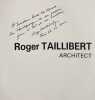
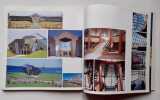
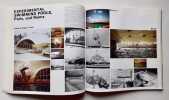
Au sommaire les différentes réalisations de Roger Taillibert (1926-2019) architecte réputé : Sport facilities (Parc des Princes, The Olympic Complex, Montréal, etc. ); Leisure complex (Officer's club and International conference center, Abu Dhabi, Hotel Complex, Montfleury, Cannes, etc); Schools and University Buildings (Academy of Music, Paris, etc.), Housing and residential (Codominium, Enghein, etc); Industrial buildings (Coca-Cola factory, Grigny, etc.). Tous nos livres sont visibles sur notre site : https://www.livrepoesie.com/
Roger Taillibert.
Paris : Roger Taillibert, 1994. Un fort volume 28x27,5cm broché sous couverture illustrée, 147 pages sur papier glacé très abondamment illustrées de photographies en couleurs. Contributions de Marc Emery et René Huyghe en anglais, et un texte de Roger Taillibert en français. Exemplaire en bon état.
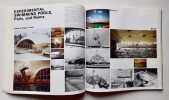
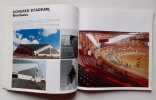
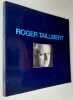
Au sommaire les différentes réalisations de Roger Taillibert (1926-2019) architecte réputé : Sport facilities (Parc des Princes, The Olympic Complex, Montréal, etc. ); Leisure complex (Officer's club and International conference center, Abu Dhabi, Hotel Complex, Montfleury, Cannes, etc); Schools and University Buildings (Academy of Music, Paris, etc.), Housing and residential (Codominium, Enghein, etc); Industrial buildings (Coca-Cola factory, Grigny, etc.). Tous nos livres sont visibles sur notre site : https://www.livrepoesie.com/

