 Write to the booksellers
474 books for « owen d i »Edit
-
Type
Autograph (2)
Book (463)
Magazine (2)
Music sheets (3)
Photographs (3)
Posters (1)
-
Latest
Last 3 days (2)
Last month (15)
Last week (1)
-
Language
English (2)
French (459)
German (1)
Latin (2)
Russian (10)
-
Century
17th (6)
18th (2)
19th (29)
20th (202)
21st (36)
-
Countries
Belgium (42)
Brazil (1)
Canada (2)
Denmark (16)
France (340)
Switzerland (61)
United States of America (12)
-
Syndicate
ALAC (2)
CLAM (2)
CLAQ (1)
ILAB (193)
SLAM (172)
SNCAO (1)
Topics
- Agriculture (2)
- Architecture (3)
- Aristotle (3)
- Australia (2)
- Baronian jean baptiste (2)
- Belgium (5)
- Bibliophilism (2)
- Brittany (5)
- Carpenter (1)
- Children’s books (2)
- China (6)
- Christianity (3)
- Christmas (2)
- Cinema (4)
- Comic strip (1)
- Cooking (1)
- Countryside (1)
- Culinary art (1)
- Decorative arts (1)
- Dedication (7)
- Déréal colette (1)
- Detective novels (9)
- Drawings (2)
- Dressmaking (1)
- Ecology (1)
- Economics (4)
- Elzevier (2)
- England (3)
- Englebert (1)
- English (10)
- Entomology (2)
- Essays (1)
- Fantastic (19)
- Fine arts (5)
- First edition (28)
- Flanders (3)
- Fox (3)
- Gastronomy (2)
- Geography (2)
- Grammar (1)
- Heine henri (2)
- History (11)
- Industrial arts & crafts - fine arts (2)
- Inventions (1)
- Iron (2)
- Latin (3)
- Leisure (1)
- Literature (14)
- Magazine (2)
- Memories (2)
- Mines & miners (3)
- Model building (1)
- Mongolia (2)
- Moreno dario (1)
- Navy (2)
- Newspapers press (1)
- Owen richard (1)
- Owen thomas (27)
- Pacific (3)
- Palaeontology (15)
- Palaeozoology (5)
- Philology (1)
- Photography (4)
- Poetry (2)
- Policy (3)
- Portugal (1)
- Posters (4)
- Radiology (2)
- Religions (4)
- Review (2)
- Reviews (2)
- Ruth (3)
- Sagan carl (1)
- Sciences (3)
- Scores (2)
- Shapes & colours (2)
- Socialism (2)
- Songs (1)
- Spying (5)
- Surrealism (2)
- Tea (7)
- Theatre (2)
- Theology (2)
- Trade (1)
- Translation (2)
- Travel (2)
- United kingdom (3)
- United states (2)
- Ussr (2)
- Various (5)
- War (8)
- Youth (4)
A New View of Society: Or Essays on the Principle of the Formnation of the Human Character, and the Application of the Principle to Practice. - [FOUNDING SOCIALISM]
London, 1813 (-1816). (Part I:) Cadell and Davies by Richard Taylor and Co., 1813 (Part II:) for Cadell and Davies, and Murray by Richard and Arthur Taylor, 1813 (Parts III & IV:) (Printed by Richard and Arthur Taylor), (1816). 8vo. Lovely contemporary full calf boards with blindstamped frames made of single lines and ornamental corner-pieces. Double gilt line-border to boards. Gilding on front board very vague. Ornamental blindstamped inner dentelles. Neatly rebacked in style of the boards, with gilt ornamentation ond gilt red morocco title-label. End-papers renewed. 24 (VI),39 pp." 1 f. (blank), 124 pp. Both half-titles to part III & IV included in the pagination. Some leaves evenly browned, but overall a very nice and clean copy (possibly washed).
Very scarce edition of Owen’s seminal four-part work, which constitutes “The Birth of Socialism”, parts I & II being the first printings, and II & IV presumably the second editions (after the privately printed 1814-edition of both parts, which were for private circulation), later used for the 1816 overall second edition of all four parts together (which is continuously paginated, 184 pp. in all). The copy corresponds to Kress B6194, where it is listed first, and Goldsmiths' 20855. Goldsmiths' notes “The first and second essays have separate title-pages and pagination. The third and fourth essays each have a half-title, but their pagination is continuous. There are a number of textual alterations in this edition of the third and fourth essays, most of which were adopted for the 1816 edition.” Parts I & II have separate title-pages and are separately paginated. The title-page of part I does not mention Owen, but the dedication to Wilberforce is signed Robert Owen in print on p. IV. The title-page of part II reads: A new View of Society, or, Essays on the Principle of the Formation of the Human Character, and the Application of the Principle to Practice. Essay Second. By Robert Owen of New Lanark. Parts III & IV each have a half-title, both included in the pagination, which is continuous. The half-title of Part III reads: Essay Third. The Principles of the Former Essays Applied to a Particular Situation, and states on verso: Printed by Richard and Arthur Taylor. The half-title of Part IV reads: Essay Fourth. The Principles of the Former Essays Applied to Government. ""The theory of socialism has a long and distinguished history [...] the first practical statement of socialist doctrine came not from a theorist but from one who based it on practical experiment. Robert Owen became the manager of a cotton mill at the age of nineteen. He was brilliantly successful, not merely as a manager, but as an innovator, introducing the first imported cotton from America and improving the quality of the yarn. Before he was thirty he already had the experience, and the confidence born of it, to undertake his great experiment."" (PMM). Having bought a factory with some of the poorest and workers’ quarters in the country and worst working conditions, Owen began improving conditions in all ways possible, including housing, working hours, education for the children (he founded infant schools in Great Britain), limitation of drinking, and he opened a store, where they could buy goods close to cost price. ""'The Lanard Experiment' was a great success, and the mill ran a profit"" nevertheless, Owen’s partners were dissatisfied at the cost of his social schemes and he was forced to dissolve the partnership and form a new company, in which Jeremy Bentham and William Allen, the Quaker philanthropist, were partners. It was at this juncture that A New View of Society came out. In it Owen laid down the principles which had determined his experiment. Having no belief in any kind of religion, he had thought out a new system of beliefs for himself. The chief points were that man's character is made not by but for him and that it has been formed by circumstances over which he has no control. The prime necessity in the right formation of character is therefore to place him under proper physical, moral and social influences from the very beginning. These principles - the fundamental irresponsibility of man and the effect of good early influence - lie at the root of Owen's theories and his practice. New Lanark continued to show their efficacy, and it became a model community, much visited by the statesmen of Europe… [T]he vitality of the word “socialism”, first coined by Owen about 1835, is testimony to the enduring value of his work"" (PMM). PMM 271" Kress B6194 Goldsmiths' 20855

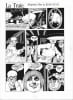
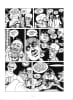
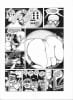
La Truie. Rare ensemble du " Bon à tirer " des 4 planches de l'adaptation en bande dessinée par Jean-Lucas, du conte fantastique de Thomas Owen. ( Tirage unique ).
La Truie. Rare ensemble du " Bon à tirer " des 4 planches de l'adaptation en bande dessinée par Jean-Lucas, du conte fantastique de Thomas Owen. Cette adaptation en bande dessinée du conte " La Truie " réalisé en 1985 en noir & blanc, au format 29,5 x 21 cm, par le peintre Jean-Lucas, fut publié dans le livre hommage, consacré à Thomas Owen, intitulé " Thomas Owen ou la saveur de l'insolite " édité en 1985 en tirage limité par le Veilleur de Nuit. Tirage unique, reproduit en bromure, ayant appartenu à Thomas Owen. Etat superbe. Rare.Jean-Lucas (souvent orthographié Jean Lucas) est un peintre, illustrateur et auteur de bande dessinée belge dont le travail est étroitement lié à l'écrivain de littérature fantastique Thomas Owen avec qui il a participé de nombreuses fois.
Vente exclusivement par correspondance. Le libraire ne reçoit, exceptionnellement que sur rendez-vous. Il est préférable de téléphoner avant tout déplacement.Forfait de port pour un livre 10 € sauf si épaisseur supérieure à 3 cm ou valeur supérieure ou égale à 100 €, dans ce cas expédition obligatoire au tarif Colissimo en vigueur. A partir de 2 livres envoi en colissimo obligatoire. Port à la charge de l'acheteur pour le reste du monde.Les Chèques ne sont plus acceptés.Pour destinations extra-planétaire s'adresser à la NASA.Membre du Syndicat Lusitanien Amateurs Morues
Photographie ayant appartenu à Thomas Owen, en tirage argentique. Portrait de Thomas Owen, pris en 1983.
Photographie ayant appartenu à Thomas Owen, en tirage argentique. Portrait de Thomas Owen, pris en 1983. Format 22 x 14,5 cm. Mention de la main de l'écrivain inscrite au verso : Thomas Owen, le 12 mars 1983.
Vente exclusivement par correspondance. Le libraire ne reçoit, exceptionnellement que sur rendez-vous. Il est préférable de téléphoner avant tout déplacement.Forfait de port pour un livre 10 € sauf si épaisseur supérieure à 3 cm ou valeur supérieure ou égale à 100 €, dans ce cas expédition obligatoire au tarif Colissimo en vigueur. A partir de 2 livres envoi en colissimo obligatoire. Port à la charge de l'acheteur pour le reste du monde.Les Chèques ne sont plus acceptés.Pour destinations extra-planétaire s'adresser à la NASA.Membre du Syndicat Lusitanien Amateurs Morues


Owen Robert Owen Robert. Eine neue Auffassung von der Gesselschaft. In German /
Owen Robert Owen Robert. Eine neue Auffassung von der Gesselschaft. In German /Owen Robert Ouen Robert. Eine neue Auffassung von der Gesselschaft. In German Berlin Akademie-Verlag 1989. We have thousands of titles and often several copies of each title may be available. Please feel free to contact us for a detailed description of the copies available. SKUalb89d6f4131eee0afd.
Correspondance d’édition.
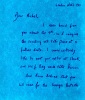
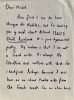
26 lettres et cartes postales manuscrites signées adressées à Michel Bulteau, écrites à l’encre violette entre octobre 1994 et avril 1998 sur papiers de couleurs : projets de traductions et publications en France, évocations littéraires, artistiques, pécuniaires, mélancoliques… Quelques extraits, 16-X-94 : « Dear Michel, I think you and I have very similar tastes in music, literature, art, decadence – and life itself. I shall send you some of my books. Is there anyone in French publishing who would be interested in my book about Lou Reed ‘Waiting for the Man’ – which Picador will publish here in November ? » 20-XI-94 : « I want to thank you so very much for the Baron Corvo books, your essay and the marvelously explicit Venetian letters. I feel we are already good friends, and I’m looking forward to the time when we can meet. (…) I don’t know if you could encourage Du Rocher to look at my very individual book about Rimbaud, and perhaps at my homocratic novel ‘Isidore’ which is about another of my heroes : Lautréamont, our legendary Ducasse. And by the way I love Corvo’s exotic style and eccentricities. We share very similar tastes in our pantheon of the stars. I find it so hard to exist from writing. I’m hugely prolific, and I make almost no money. It’s terrible. But we do it for love of the imagination and to proclaim the great, the bizarre, the beautiful. Thank you for being. With love and starlight, Jeremy. » 28-XII-94 : « Here is the gift of my Lou Reed book for you, how I wish we could find a French publisher for it, and that you could be the translator. End of the year blues. I always find Christmas/new year particularly melancholy, so much work done, sadness accumulated – but still there’s a brilliance attached to the moment, and I’m always working on new books, pushing the imagination beyond frontiers. I send you gold stars ». S. d. : « I would be so grateful if you would try Du Rocher with ‘Isidore’. It is an extraordinary beautiful and unusual novel, and I don’t think there are any other novels on Lautréamont. Life would have been so much easier for me if I had been born French, all my heroes are the anarchic French poets. The wild imagination, vibrant with images. » 1-II-95 : « I hope all is well with you. There are little tints of spring in the air, and I have pink hyacinths in my room. Their languid scent Is intoxicating. My book about Lou Reed is handled by agents. If they prove problematic, I would sell the book personally to a French publisher, so that you could translate it. I’m desperate for some money at present. Surely some French publisher would wish a book on Lou Reed. I’m currently writing a book about Marc Almond, called ‘The Last Star’. He’s my favorite torch singer. » 23-I-96 : « I’m working on a novel about Elvis Presley, ‘Heartbreak Hotel’, and I’ve also been performing and recording with David J, who used to be in ‘Bauhaus’. I will send you some tapes. Is there any new of ‘Isidore’ ? Peter Owen’s very disappointed not to have heard. Please do let him know. We should do a reading in Paris, you and I, at a venue where we could use our respective musicians. Let’s think about it. Much love and starlight, Jeremy. » 28-I-96 : « How I know that topology of hallucinated madness – it fuels both our works – but the suffering is huge. Buddhist chanting helps me through the intimate hells. I went through a terrible breakdown in 1990. As your work is close to Michaux’s, I imagine you suffer deeply. » 3-III-96 : « Wonderful to receive your letter, and I haven’t forgotten ‘Flowers’ (de Michel Bulteau, un livre consacré à Warhol). I’m going to work at finding a publisher for you here. An independent. We may be able to interest Peter Owen in your work. He likes you a lot, and is coming back to Paris in May. » 15-VI-97 : « I’m busy working on new poems, essays, fiction, etc. The usual galaxy of creative energies. And I’m sure you’re writing too, working the imagination towards apocalypse. » ‘Invention d’Isidore Ducasse’ est finalement paru aux Éditions de la Différence en 1996. On joint 9 lettres tapuscrites signées de l’éditeur anglais Peter Owen sur papiers à entête, contemporaines à ces projets de publications. 5-IV-95 : « Jeremy Reed has advised me of your interest in ‘Isidore’ and that your publishers La Difference want to buy it. I am awfully pleased that you wish to take on this exceptional author. » Puis, 12-IX-96 : « Sorry we missed – I got your message that you could be late but I wonder if you went to the La Nouvelle Agence office ? Anyhow, I am sorry I missed you. La Difference have not paid the advance. Jeremy is upset. Mary and I are very annoyed. They are, of course, illegal if they try to publish without the advance. Could you explain this to them and of course, if they do not pay none of us will ever want to deal with them again. The whole thing is very bad publishing practice and it has gone on so long ! Thank you for your help. Sincerely, Peter Owen. » Bon état.

A practical exposition of the CXXXth Psalm (...).
London, Printed for Nathanial Ponder, 1680. 4to. In contemporary full calf with four raised bands. Edges of boards gilt. Small paper-label pasted on to upper part of spine. Light wear to extremities. Corners bumped. Light occassional marginal browning, but generally a nice and clean copy. (8), 400 pp. Wanting the frontispiece (Erroneously paginated as follows: Pp. 1-167 & 176-400. Complete, except for frontispiece).
Later edition of Owen’s highly influential work on Psalm 130 also known as the ""De Profundis"" or ""Out of the Depths"". This work reflects Owen's commitment to both the rigorous study of Scripture and the practical application of biblical truths to the lives of believers. John Owen (1616-1683) was a prominent English theologian and minister in the Puritan tradition during the 17th century. He is widely regarded as one of the greatest theological minds in the Reformed tradition. Owen was born in Stadhampton, Oxfordshire, England, and he attended Queen's College, Oxford, where he studied classics and theology. Owen's theological writings covered a wide range of topics, including theology proper, soteriology, ecclesiology, and pneumatology. He was a staunch defender of Calvinism and Reformed theology, and he engaged in theological debates with various religious factions of his time, including Arminians and Socinians, two different branches of Pietism.
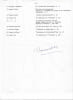
( Fantastique ) - Thomas Owen ( Gérald Bertot ) - Michel Tournier.
Reference : 33304
(1978)
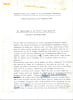
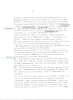
Académie Royale de Langue et Littérature Françaises - Séance publique du 16 décembre 1978. " Le Fantastique et le Mythe " : Deux réalités. Tapuscrit original de 16 pages avec de nombreuses annotations manuscrites et la signature de Thomas Owen en dernière page.
Chez l'auteur,1978. Rare tapuscrit original de 16 pages au format 27,5 x 21 cm, du discours de Thomas Owen : " Le Fantastique et le Mythe ": Deux réalités, donné à l'Académie Royale de Langue et Littérature Françaises de Belgique, lors de la séance publique du 16 décembre 1978, dédiée à la réception de Michel Tournier. Très nombreuses annotations manuscrites et signature de Thomas Owen en dernière page. Rarissime édition originale.
Vente exclusivement par correspondance. Le libraire ne reçoit, exceptionnellement que sur rendez-vous. Il est préférable de téléphoner avant tout déplacement.Forfait de port pour un livre 10 € sauf si épaisseur supérieure à 3 cm ou valeur supérieure ou égale à 100 €, dans ce cas expédition obligatoire au tarif Colissimo en vigueur. A partir de 2 livres envoi en colissimo obligatoire. Port à la charge de l'acheteur pour le reste du monde.Les Chèques ne sont plus acceptés.Pour destinations extra-planétaire s'adresser à la NASA.Membre du Syndicat Lusitanien Amateurs Morues
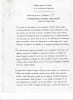
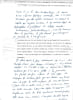
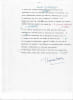
( Fantastique ) - Thomas Owen ( Gérald Bertot ) - Michel Tournier.
Reference : 33305
(1978)
Académie Royale de Langue et Littérature Françaises - Séance publique du 16 décembre 1978. " Le Fantastique et le Mythe " : Deux réalités. Manuscrit original ronéotypé de 17 pages, avec de nombreuses annotations et passages manuscrits, portant la signature de Thomas Owen en dernière page. On joint le texte définitif photocopié.
Chez l'auteur,1978. Rare Manuscrit original ronéotypé de 17 pages au format 27,5 x 21 cm, du discours de Thomas Owen : " Le Fantastique et le Mythe ": Deux réalités, donné à l'Académie Royale de Langue et Littérature Françaises de Belgique, lors de la séance publique du 16 décembre 1978, dédiée à la réception de Michel Tournier. Très nombreuses annotations et passages manuscrits, ainsi que la signature de Thomas Owen en dernière page. On joint le texte définitif photocopié. Rarissime édition originale.
Vente exclusivement par correspondance. Le libraire ne reçoit, exceptionnellement que sur rendez-vous. Il est préférable de téléphoner avant tout déplacement.Forfait de port pour un livre 10 € sauf si épaisseur supérieure à 3 cm ou valeur supérieure ou égale à 100 €, dans ce cas expédition obligatoire au tarif Colissimo en vigueur. A partir de 2 livres envoi en colissimo obligatoire. Port à la charge de l'acheteur pour le reste du monde.Les Chèques ne sont plus acceptés.Pour destinations extra-planétaire s'adresser à la NASA.Membre du Syndicat Lusitanien Amateurs Morues
"OWEN, RICHARD. - COINING THE NAME ""MEGALANIA PRISCA"" - THE GIANT EXTINCT GOANNA.
Reference : 42996
(1859)
Description of some Remains of a Gigantic Land-Lizard (Megalania prisca, Owen). Received May 13, - Read June 17, 1858.
(London, Taylor and Francis, 1859). 4to. No wrappers as extracted from ""Philosophical Transactions"" 1859 - Vol. 149 - Part I. Pp. 43-48 a. 2 lithographed plates.
First printing of this paper in which Owen named Magalania prisca, Owen.Megalania (""great roamer"")) is a giant extinct goanna or monitor lizard. It was part of a megafaunal assemblage that inhabited southern Australia during the Pleistocene, and appears to have disappeared around 40,000 years ago.The first aboriginal settlers of Australia may have encountered living Megalania.The name Megalania prisca was coined by Sir Richard Owen to mean ""Ancient Great Roamer"""" the name was intended to ""reference to the terrestrial nature of the great Saurian"".
Narrative of Voyages to explore the Shores of Africa, Arabia, and Madagascar performed in H.M. Ships Leven and Barracouta, under the Direction of Captain W.F.W. Owen. 2 Vols.
London, Richard Bentley, 1833. 2 contemp. hcalf. Richly gilt spines. Gilt lettering. Very light wear to top of spines with a small repair. 2 engraved frontispieces. XV,(1),434"VIII,420 pp., Errat-slip bound in. 3 engraved plates and 4 large folded engraved maps. Plates with some marginal brownspots, otherwise clean and fine.
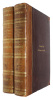
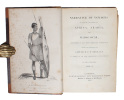
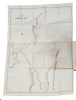
First edition. ""Owen mapped the entire east African coast from the Cape to the Horn of Africa between 1821 and 1826 in the sloop Leven and in company with the brig Barracouta. During this period, Owen established a one-man protectorate of Mombasa with the aim of disrupting the 'hellish trade' in slaves"" but Owen was forced to shut down under orders from the Crown after only three years. When he returned in 1826, with 300 new charts, covering some 30,000 miles of coastline, over half of his original crew had been killed by tropical diseases.""
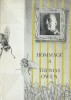
Hommage à Thomas Owen. ( Tirage numéroté à 500 exemplaires sur médicis ).
Editions Séries B / Mons 1985. In-8 broché de 68 pages au format 15 x 22 cm. Couverture illustrée. Dos carré. Plats et intérieur frais. Catalogue de l'exposition consacrée à Thomas Owen. Textes de Jean-Baptiste Baronian, Robert Frickx, A.Richter,etc. Photos, dessins. Entretien inédit avec Thomas Owen. Bio-Bibliographie. Tirage à 570 exemplaires sur médicis. Etat proche du neuf. Edition originale.
Vente exclusivement par correspondance. Le libraire ne reçoit, exceptionnellement que sur rendez-vous. Il est préférable de téléphoner avant tout déplacement.Forfait de port pour un livre 10 € sauf si épaisseur supérieure à 3 cm ou valeur supérieure ou égale à 100 €, dans ce cas expédition obligatoire au tarif Colissimo en vigueur. A partir de 2 livres envoi en colissimo obligatoire. Port à la charge de l'acheteur pour le reste du monde.Les Chèques ne sont plus acceptés.Pour destinations extra-planétaire s'adresser à la NASA.Membre du Syndicat Lusitanien Amateurs Morues
Thomas Owen - Lucien Deroisy - Nadine Forster - Gisèle Oudart - Lucien Salkin.
Reference : 8665
(1961)
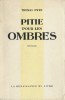
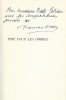
Pitié pour les Ombres. Nouvelles. ( Avec cordiale dédicace de Thomas Owen et deux photographies en tirage argentique extraites du film réalisé en 1967 par Lucien Deroisy, avec Nadine Forster, Gisèle Oudart et Lucien Salkin ).
Belgique, La Renaissance du Livre 1961. In-8 broché de 208 pages au format 14,2 x 20,5 cm. Couverture avec titre imprimé. Dos carré avec infimes traces de pliures de lecture. Plats très légèrement brunis, avec petites rousseurs éparses. Superbe état général. Rare édition originale ornée d'une cordiale dédicace autographe, signée, de Thomas Owen.On joint deux photographies en tirage argentique avec cachet du photographe extraites du moyen-métrage fantastique belge réalisé en 1967 par Lucien Deroisy, intitulé " Pitié pour une ombre ", adapté de la nouvelle fantastique " Pitié pour les ombres ". On trouve dans les rôles principaux la célèbre illustratrice et peintre Nadine Forster, Gisèle Oudart et Lucien Salkin.Format 13,5 x 11,5 cm. Sur les photos on trouve Nadine Forster, Gisèle Oudart, Lucien Salkin et Lucien Deroisy.

Vente exclusivement par correspondance. Le libraire ne reçoit, exceptionnellement que sur rendez-vous. Il est préférable de téléphoner avant tout déplacement.Forfait de port pour un livre 10 € sauf si épaisseur supérieure à 3 cm ou valeur supérieure ou égale à 100 €, dans ce cas expédition obligatoire au tarif Colissimo en vigueur. A partir de 2 livres envoi en colissimo obligatoire. Port à la charge de l'acheteur pour le reste du monde.Les Chèques ne sont plus acceptés.Pour destinations extra-planétaire s'adresser à la NASA.Membre du Syndicat Lusitanien Amateurs Morues
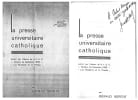
La Presse Universitaire Catholique. ( Micro tirage en photocopie, réalisé par l'auteur à quelques exemplaires, destinés à être offert, avec dédicace de Thomas Owen sous son vrai nom Gérald Bertot ).
Chez l'auteur, sans date. In-8 agrafé de 18 pages au format 24,5 x 15 cm. Micro tirage en photocopie, réalisé par l'auteur à quelques exemplaires, destinés à être offert, avec dédicace de Thomas Owen sous son vrai nom Gérald Bertot. Rare édition de ce texte extrait des Cahiers de la J.U.C. - Numéro de Décembre 1932 - " Les Etudiants et la Presse ".
Vente exclusivement par correspondance. Le libraire ne reçoit, exceptionnellement que sur rendez-vous. Il est préférable de téléphoner avant tout déplacement.Forfait de port pour un livre 10 € sauf si épaisseur supérieure à 3 cm ou valeur supérieure ou égale à 100 €, dans ce cas expédition obligatoire au tarif Colissimo en vigueur. A partir de 2 livres envoi en colissimo obligatoire. Port à la charge de l'acheteur pour le reste du monde.Les Chèques ne sont plus acceptés.Pour destinations extra-planétaire s'adresser à la NASA.Membre du Syndicat Lusitanien Amateurs Morues
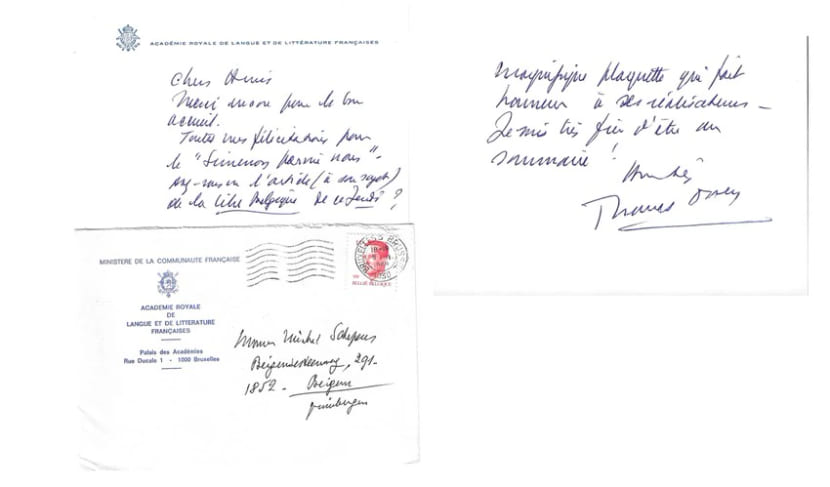
Superbe lot de 7 carte de voeux manuscrites, signées + une lettre manuscrite de Thomas Owen à Michel Schepens ( 4 sont sous enveloppes avec l'adresse et parfois la signature de l'écrivain ).
Superbe lot de 7 carte de voeux manuscrites, signées + une lettre manuscrite, de Thomas Owen à Michel Schepens ( 4 sont sous enveloppes avec l'adresse et parfois la signature de l'écrivain ). Rare ensemble en état parfait glissé sous grande enveloppe.Lot ayant appartenu à Michel Schepens, qui fut administrateur et secrétaire de l’Association Les Amis de Georges Simenon, mais aussi bibliophile et collectionneur.
Vente exclusivement par correspondance. Le libraire ne reçoit, exceptionnellement que sur rendez-vous. Il est préférable de téléphoner avant tout déplacement.Forfait de port pour un livre 10 € sauf si épaisseur supérieure à 3 cm ou valeur supérieure ou égale à 100 €, dans ce cas expédition obligatoire au tarif Colissimo en vigueur. A partir de 2 livres envoi en colissimo obligatoire. Port à la charge de l'acheteur pour le reste du monde.Les Chèques ne sont plus acceptés.Pour destinations extra-planétaire s'adresser à la NASA.Membre du Syndicat Lusitanien Amateurs Morues
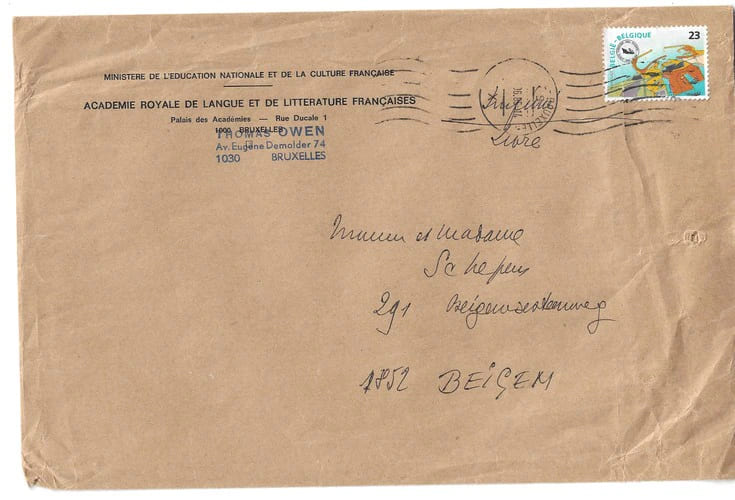
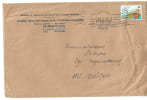
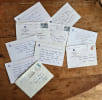
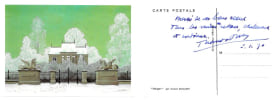
Superbe lot de 6 carte de voeux manuscrites, signées, de Thomas Owen à Michel Schepens, parlant de Georges Simenon, Bob Morane et Henri Vernes. ( 4 sont sous enveloppes avec l'adresse et parfois la signature de l'écrivain ).
Superbe lot de 6 carte de voeux manuscrites, signées, de Thomas Owen à Michel Schepens, parlant de Georges Simenon, Bob Morane et Henri Vernes. ( 4 sont sous enveloppes avec l'adresse et parfois la signature de l'écrivain ). Rare ensemble en état parfait.Lot ayant appartenu à Michel Schepens, qui fut administrateur et secrétaire de l’Association Les Amis de Georges Simenon, mais aussi bibliophile et collectionneur.
Vente exclusivement par correspondance. Le libraire ne reçoit, exceptionnellement que sur rendez-vous. Il est préférable de téléphoner avant tout déplacement.Forfait de port pour un livre 10 € sauf si épaisseur supérieure à 3 cm ou valeur supérieure ou égale à 100 €, dans ce cas expédition obligatoire au tarif Colissimo en vigueur. A partir de 2 livres envoi en colissimo obligatoire. Port à la charge de l'acheteur pour le reste du monde.Les Chèques ne sont plus acceptés.Pour destinations extra-planétaire s'adresser à la NASA.Membre du Syndicat Lusitanien Amateurs Morues
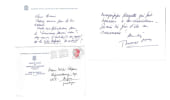
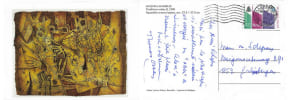
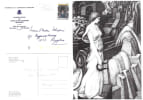
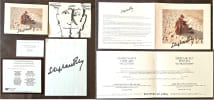
Gérald Bertot ( Thomas Owen ) sous le pseudonyme de Stéphane Rey - Collectif.
Reference : 33306
(1991)
Ensemble de documents de 1991, consacrés à Gérald Bertot ( Thomas Owen ) dit Stéphane Rey - Collectif.
Ensemble de documents de 1991, consacrés à Gérald Bertot ( Thomas Owen ) dit Stéphane Rey. Très nombreuses participations. Carte hommage des enfants de l'auteur. Edition originale.
Vente exclusivement par correspondance. Le libraire ne reçoit, exceptionnellement que sur rendez-vous. Il est préférable de téléphoner avant tout déplacement.Forfait de port pour un livre 10 € sauf si épaisseur supérieure à 3 cm ou valeur supérieure ou égale à 100 €, dans ce cas expédition obligatoire au tarif Colissimo en vigueur. A partir de 2 livres envoi en colissimo obligatoire. Port à la charge de l'acheteur pour le reste du monde.Les Chèques ne sont plus acceptés.Pour destinations extra-planétaire s'adresser à la NASA.Membre du Syndicat Lusitanien Amateurs Morues
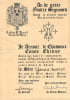
Carte de Chevalier de Gérald Bertot ( Thomas Owen ), remise par le Prévost et le Grand Maître de La Confrérie Saint-Arnoul du Comté de Chiny.
Carte de Chevalier de Gérald Bertot ( Thomas Owen ), remise et signée par le Prévost et le Grand Maître de La Confrérie Saint-Arnoul du Comté de Chiny en 1950. Format 30 x 21 cm. Pliée en son milieu. La Confrérie Saint-Arnoul du Comté de Chiny est une association folklorique et gastronomique belge fondée en 1967 à Bruxelles, mais ancrée dans l'histoire de la commune de Chiny située en Gaume ( province de Luxembourg ).Rôles et Traditions : Défense du terroir en promouvant les produits locaux de la région, en particulier le célèbre pâté gaumais qui une tourte à la viande de porc marinée ainsi que la bière locale la " Hotteuse ". Elle est la 4e plus ancienne confrérie de la province de Luxembourg avec une structure hiérarchique inspirée des traditions du comté de Chiny ( fondé en 980 ), elle se divise en trois ordres portant des tenues distinctes : La Prévôté, La Chevalerie et la Commanderie.
Vente exclusivement par correspondance. Le libraire ne reçoit, exceptionnellement que sur rendez-vous. Il est préférable de téléphoner avant tout déplacement.Forfait de port pour un livre 10 € sauf si épaisseur supérieure à 3 cm ou valeur supérieure ou égale à 100 €, dans ce cas expédition obligatoire au tarif Colissimo en vigueur. A partir de 2 livres envoi en colissimo obligatoire. Port à la charge de l'acheteur pour le reste du monde.Les Chèques ne sont plus acceptés.Pour destinations extra-planétaire s'adresser à la NASA.Membre du Syndicat Lusitanien Amateurs Morues
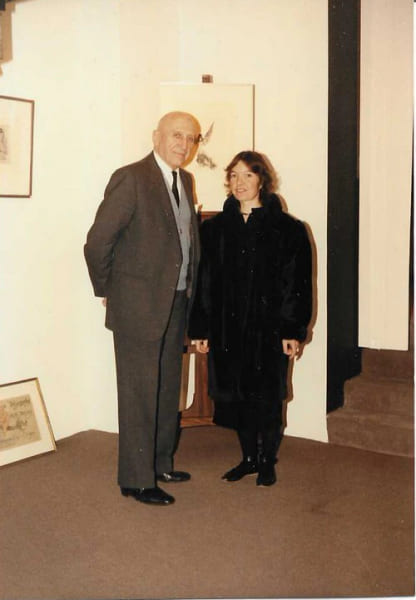
Photographie ayant appartenu à Thomas Owen, prise en 1984, le montrant aux cotés de l'écrivaine et réalisatrice belge, Nadine Monfils.
Photographie en couleurs, ayant appartenu à Thomas Owen, prise en 1984, le montrant aux cotés de l'écrivaine et réalisatrice belge, Nadine Monfils. Format 13 x 9 cm. Mention de la main de l'écrivain inscrite au verso : Thomas Owen et Nadine Monfils, 1984.
Vente exclusivement par correspondance. Le libraire ne reçoit, exceptionnellement que sur rendez-vous. Il est préférable de téléphoner avant tout déplacement.Forfait de port pour un livre 10 € sauf si épaisseur supérieure à 3 cm ou valeur supérieure ou égale à 100 €, dans ce cas expédition obligatoire au tarif Colissimo en vigueur. A partir de 2 livres envoi en colissimo obligatoire. Port à la charge de l'acheteur pour le reste du monde.Les Chèques ne sont plus acceptés.Pour destinations extra-planétaire s'adresser à la NASA.Membre du Syndicat Lusitanien Amateurs Morues
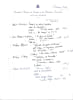
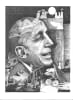
Liste de 5 livres de différents auteurs, rédigée et signée par Thomas Owen, sur une feuille à l'en-tête de l'Académie Royale de Langue et Littérature Françaises. On joint une photocopie d'un portrait fantastique de l'écrivain, réalisée par Murielle Briot en 1985.
Chez l'auteur, 1979. Liste de 5 livres de différents auteurs, rédigée et signée par Thomas Owen, sur une feuille à l'en-tête de l'Académie Royale de Langue et Littérature Françaises. On joint une photocopie d'un portrait fantastique de l'écrivain, réalisée par Murielle Briot en 1985.
Vente exclusivement par correspondance. Le libraire ne reçoit, exceptionnellement que sur rendez-vous. Il est préférable de téléphoner avant tout déplacement.Forfait de port pour un livre 10 € sauf si épaisseur supérieure à 3 cm ou valeur supérieure ou égale à 100 €, dans ce cas expédition obligatoire au tarif Colissimo en vigueur. A partir de 2 livres envoi en colissimo obligatoire. Port à la charge de l'acheteur pour le reste du monde.Les Chèques ne sont plus acceptés.Pour destinations extra-planétaire s'adresser à la NASA.Membre du Syndicat Lusitanien Amateurs Morues
( Lttérature Policière ) - Thomas Owen ( Gérald Bertot ) - Stanislas André Steeman.
Reference : 33311
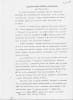
Stanislas André Steeman, dessinateur. Tapuscrit original de 4 pages avec des annotations manuscrites de Thomas Owen.
Chez l'auteur, sans date. Rare tapuscrit original de 4 pages au format 27,5 x 21 cm, consacrée à Stanislas André Steeman. Nombreuses annotations manuscrites de Thomas Owen en dernière page. Rare édition originale.
Vente exclusivement par correspondance. Le libraire ne reçoit, exceptionnellement que sur rendez-vous. Il est préférable de téléphoner avant tout déplacement.Forfait de port pour un livre 10 € sauf si épaisseur supérieure à 3 cm ou valeur supérieure ou égale à 100 €, dans ce cas expédition obligatoire au tarif Colissimo en vigueur. A partir de 2 livres envoi en colissimo obligatoire. Port à la charge de l'acheteur pour le reste du monde.Les Chèques ne sont plus acceptés.Pour destinations extra-planétaire s'adresser à la NASA.Membre du Syndicat Lusitanien Amateurs Morues
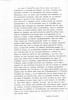
Tapuscrit original d'une page de Gaston Bogaert en hommage à Thomas Owen.
Chez l'auteur, sans date. Rare tapuscrit original d'une page au format 27,5 x 21 cm, avec magnifique texte inédit de Gaston Bogaert en hommage à Thomas Owen. Rare édition originale.
Vente exclusivement par correspondance. Le libraire ne reçoit, exceptionnellement que sur rendez-vous. Il est préférable de téléphoner avant tout déplacement.Forfait de port pour un livre 10 € sauf si épaisseur supérieure à 3 cm ou valeur supérieure ou égale à 100 €, dans ce cas expédition obligatoire au tarif Colissimo en vigueur. A partir de 2 livres envoi en colissimo obligatoire. Port à la charge de l'acheteur pour le reste du monde.Les Chèques ne sont plus acceptés.Pour destinations extra-planétaire s'adresser à la NASA.Membre du Syndicat Lusitanien Amateurs Morues
( Revue Bizarre - Jean Ray ) - Thomas Owen - Paul Gilson - Jacques Yonnet - René de Obaldia - Philippe Soupault - Camille Renault - Gérard Klein - Michel Carrouges - Mayo - Élie - Agnèse - Collectif.
Reference : 31676
(2019)
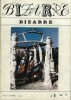
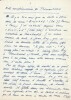
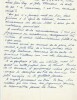
Revue Bizarre n° II. ( Exemplaire enrichi d'une magnifique lettre manuscrites de deux pages de Thomas Owen, qui est une note complémentaire concernant le texte sur Jean Ray, publié ici. On joint aussi une lettre manuscrite de Thomas sous enveloppe. Les lettres sont adressées à l'éditeur Pierre Aelberts ).
Editions Jean-Jacques Pauvert - Revue trimestrielle Bizarre n° II de 1955. In-4 broché de 96 pages au format 27 x 17 cm. Couverture illustrée. Dos carré. Plats et intérieur frais. Numéro avec textes, illustrations et photographies de Paul Gilson, Jacques Yonnet, René de Obaldia, Philippe Soupault ( Mort de Nick Carter ), Camille Renault, Thomas Owen ( Jean Ray l'nsaisissable ), Gérard Klein, Michel Carrouges, Mayo, Élie, Agnèse, etc. Edition originale en très bel état général. Rarissime et précieux exemplaire enrichi de deux magnifiques lettres manuscrites de Thomas Owen adressées à l'éditeur belge Pierre Aelberts. La première lettre de deux pages est une note complémentaire concernant le texte sur Jean Ray, publié dans cette revue et qui ne sera pas repris par Pierre Aelberts dans sa plaquette sur Jean Ray, parue chez Dynamo en 1965. L'autre lettre est sous enveloppe et concerne aussi Jean Ray. Les lettres sont pliées.
Vente exclusivement par correspondance. Le libraire ne reçoit, exceptionnellement que sur rendez-vous. Il est préférable de téléphoner avant tout déplacement.Forfait de port pour un livre 10 € sauf si épaisseur supérieure à 3 cm ou valeur supérieure ou égale à 100 €, dans ce cas expédition obligatoire au tarif Colissimo en vigueur. A partir de 2 livres envoi en colissimo obligatoire. Port à la charge de l'acheteur pour le reste du monde.Les Chèques ne sont plus acceptés.Pour destinations extra-planétaire s'adresser à la NASA.Membre du Syndicat Lusitanien Amateurs Morues
Raymond Jean Marie de Kremer, dit Jean Ray - Clerbois - Ambrose Bierce - Maurice Renard - Francisque Parn - Henri Heine - Erckmann-Chatrian - Apfel et Laun - Thomas Ingolsby - Catherine Crowe - Thomas Owen - Alice Sauton - Gustave Vigoureux - Alphonse Denouwe.
Reference : 4862
(1947)
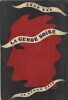
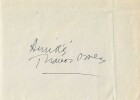
La Gerbe Noire. Les Meilleurs Récits des Maîtres de l'Epouvante, recueillis par Jean Ray. ( Avec dédicace de Thomas Owen sur feuille libre ).
Belgique, Editions La Sixaine 1947. In-12 broché de 230 pages au format 18,5 x 12,5 cm. Belle couverture illustrée par Clerbois, tirée en sérigraphie. Dos carré. Plats et intérieur frais, malgré d'infimes frottis aux coins. Exemplaire non coupé. Recueil de contes fantastiques choisis, préfacés et présentés par Jean Ray. Nouvelles de Ambrose Bierce, Maurice Renard, Francisque Parn, Henri Heine, Erckmann-Chatrian, Apfel et Laun, Thomas Ingolsby, Catherine Crowe, Thomas Owen, Alice Sauton, Gustave Vigoureux, Alphonse Denouwe et Jean Ray. Superbe état. Edition originale, peu courante, surtout dans un tel état de fraicheur. Exemplaire enrichi d'une dédicace de Thomas Owen sur feuille libre.
Vente exclusivement par correspondance. Le libraire ne reçoit, exceptionnellement que sur rendez-vous. Il est préférable de téléphoner avant tout déplacement.Forfait de port pour un livre 10 € sauf si épaisseur supérieure à 3 cm ou valeur supérieure ou égale à 100 €, dans ce cas expédition obligatoire au tarif Colissimo en vigueur. A partir de 2 livres envoi en colissimo obligatoire. Port à la charge de l'acheteur pour le reste du monde.Les Chèques ne sont plus acceptés.Pour destinations extra-planétaire s'adresser à la NASA.Membre du Syndicat Lusitanien Amateurs Morues
A reply to the communication addressed by M. Coste to the French Academy of Sciences, entitled "Mémoire en réponse à la lettre de M. R. Owen", in a letter addressed to M. Arago
S.l. 1838 in-8 dérelié
16 pp.Extrait du Magazine of Natural History, new series, 1838, p. 183.Célèbre zoologiste et paléontologue britannique, Richard Owen (1804-1892) répond ici à un mémoire du naturaliste Victor Coste (1807-1873) concernant l'embryologie du kangourou, un marsupial typique du continent australien Le mémoire en question est probablement l'Ovologie du Kanguroo, publié en réponse aux lettres adressées par Owen à l'Académie des sciences. Intéressant article relatif à une controverse entre deux naturalistes.Non mentionné au CCFr. Précieux exemplaire, comportant un envoi autographe en première page : "From the Author"

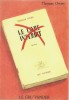
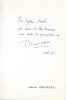
Le Livre Interdit. ( Avec belle dédicace de Thomas Owen ).
Editions Le Cri / Vander - Collection " Romanesque " 1982. In-8 broché de 212 pages au format 14 x 20 cm. Couverture à rabats, illustrée, reprenant celle de l'édition originale, parue chez De Kogge de 1944. Toutes petites rousseurs sur la tranche extérieure, sinon état superbe, proche du parfait. Edition ornée d'une belle dédicace autographe, signée, de Thomas Owen.
Vente exclusivement par correspondance. Le libraire ne reçoit, exceptionnellement que sur rendez-vous. Il est préférable de téléphoner avant tout déplacement.Forfait de port pour un livre 10 € sauf si épaisseur supérieure à 3 cm ou valeur supérieure ou égale à 100 €, dans ce cas expédition obligatoire au tarif Colissimo en vigueur. A partir de 2 livres envoi en colissimo obligatoire. Port à la charge de l'acheteur pour le reste du monde.Les Chèques ne sont plus acceptés.Pour destinations extra-planétaire s'adresser à la NASA.Membre du Syndicat Lusitanien Amateurs Morues

