 Write to the booksellers
20 books for « lavanchy j a »Edit
-
Century
19th (2)
20th (4)
-
Countries
Denmark (2)
France (3)
Switzerland (22)
-
Syndicate
ILAB (10)
NVVA (5)
SLACES (5)
SLAM (2)
Vérification expérimentale de la formule de Lorentz-Einstein par les rayons cathodiques de grande vitesse [19. July, 1915] (+) Errata. - [CONCLUSIVELY PROVING THE LORENTZ-EINSTEIN FORMULA]
(Paris, Bachelier" Genève, Pélisserie, 1915.) 4to. No wrappers. In: ""Comptes Rendus Hebdomadaires des Séances de L'Academie des Sciences"", Tome 161, No. 3 & No. 15 (Entires issues offered). Small stamp to top right corner of each issue. Pp. 45-60" Pp. 425-448. (Guye & Lavanchy's paper: Pp. 52-55" Pp. 447-8).
First appearance of Guye and Lavanchy's famous experimental confirmation the Lorentz-Einstein formula which eventually led to a full understanding and acceptance of Einstein's theory of relativity. Einstein himself, though known as not taking much interest in the experimental support of his conceptions, wrote eulogistic letters to Guye after the present paper had been published. In February 1906 Walter Kaufmann made public his conclusion on the experiments he had been performing since 1901 on the electric and magnetic deflections of beta-rays. He claimed that Lorentz' theory of the electron, and thus ""the possibility of founding physics on the principle of relative motion"", had to be rejected. Ten years had to pass until Guye and Lavanchy confirmed the Lorentz theory and thereby proving Kaufmann's measuring equipment for imprecise. In 1915 Guye and Lavanchy measured the deflection of cathode rays at 0.25c-0.5c. They used a tube with a cathode and anode in order to accelerate the rays. A diaphragm at the anode produced a beam which was deflected. A screen was placed at the end of the apparatus, at which the impacts were photographed by a camera. They subsequently computated the ratio of transverse electromagnetic mass mT and rest mass m0 indicated by the red and blue curve, and obtained good agreement with the Lorentz-Einstein formula. Their experiments were considered by many as conclusively proving the Lorentz-Einstein formula. ""Charles Lavanchy [and] Guye was able to develop very precise techniques for measuring particle deflections within carefully controlled electric and magnetic fields. In 1916 and 1921 Guye published these methods and pronounced results in favor of the Lorentzian formulas and Einsteinian theory. Thereafter his reputation rose as a most able experimenter among the world's physicists"". (DSB).
Vérification expérimentale de la formule de Lorentz-Einstein par les rayons cathodiques de grande vitesse [19. July, 1915] (+) Vérification expérimentale de la formule de Lorentz-Einstein par les rayons cathodiques de grande vitesse [October 1915]. - [CONCLUSIVELY PROVING THE LORENTZ-EINSTEIN FORMULA]
Paris, Bachelier" Genève, Pélisserie, 1915. 4to and 8vo. Both in the original wrapper. Offprints from ""Comptes Rendus Hebdomadaires des Séances de L'Academie des Sciences"", tome 161, P. 52, 19 juillet 1915 [4to] and ""Archives des Sciences physiques et naturelles"", Tome XL, October 1915 [8vo]. Paper from ""Compte Rendu"" folded in half and ""Archives des Sciences physiques"" has a few nicks to extremities, otherwise to very fine and clean copies. [4to:] 4 pp."" [8vo:] 11 pp.
Two fine offprint issues of Guye and Lavanchy's famous experimental confirmation the Lorentz-Einstein formula which eventually led to a full understanding and acceptance of Einstein's theory of relativity. Einstein himself, though known as not taking much interest in the experimental support of his conceptions, wrote eulogistic letters to Guye after the present paper had been published. In February 1906 Walter Kaufmann made public his conclusion on the experiments he had been performing since 1901 on the electric and magnetic deflections of beta-rays. He claimed that Lorentz' theory of the electron, and thus ""the possibility of founding physics on the principle of relative motion"", had to be rejected. Ten years had to pass until Guye and Lavanchy confirmed the Lorentz theory and thereby proving Kaufmann's measuring equipment for imprecise. In 1915 Guye and Lavanchy measured the deflection of cathode rays at 0.25c-0.5c. They used a tube with a cathode and anode in order to accelerate the rays. A diaphragm at the anode produced a beam which was deflected. A screen was placed at the end of the apparatus, at which the impacts were photographed by a camera. They subsequently computated the ratio of transverse electromagnetic mass mT and rest mass m0 indicated by the red and blue curve, and obtained good agreement with the Lorentz-Einstein formula. Their experiments were considered by many as conclusively proving the Lorentz-Einstein formula. ""Charles Lavanchy [and] Guye was able to develop very precise techniques for measuring particle deflections within carefully controlled electric and magnetic fields. In 1916 and 1921 Guye published these methods and pronounced results in favor of the Lorentzian formulas and Einsteinian theory. Thereafter his reputation rose as a most able experimenter among the world's physicists"". (DSB).
Le Diocèse de Genève (partie de Savoie) pendant la Révolution française, par M. l'abbé Jh-M. Lavanchy,...
1894 Annecy, C. Burnod, 1894; 2 forts volumes in-8°, brochés, couverture grise imprimée en rouge et noir au 1er plat et dos, armoiries au 1er plat; (10) - XIII - 711pp - (1)f. ; (6) - 789pp.
Très petits accrocs à la couverture, bon exemplaire. (GrG)

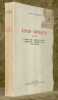
Essais critiques 1925-1935. L’oeuvre des Cahiers Vaudois. Giraudoux. Duhamel. Gide. Paul Morand.
Lausanne, Editions des Trois Collines 1939, 200x140mm, 239pages, broché. Bel exemplaire.
Pour un paiement via PayPal, veuillez nous en faire la demande et nous vous enverrons une facture PayPal
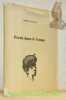
Perdu dans le temps.
Neuchâtel, Imprimerie Richème 1941, 255x195mm, 30pages, broché. Papier cristal d’origine conservé. Petits accrocs sur le haut et le bas du dos, autrement bel exemplaire.
Pour un paiement via PayPal, veuillez nous en faire la demande et nous vous enverrons une facture PayPal
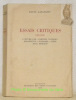
Essais critique 1925-1935. L’oeuvre des “Cahiers Vaudois”, Giraudoux, Duhamel, Gide, Paul Morand.
Lausanne, Editions des Trois Collines 1939, 200x140mm, frontispice, 239pages, broché. Bon état.
Pour un paiement via PayPal, veuillez nous en faire la demande et nous vous enverrons une facture PayPal
Les médailles du canton de Vaud.
Lausanne, chez l’auteur 1975, 240x170mm, 170pages, broché. Bon état.
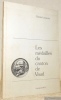
description de 604 médailles avec leur photographie en n/b, Pour un paiement via PayPal, veuillez nous en faire la demande et nous vous enverrons une facture PayPal
Ecrire sa mort, décrire sa vie. Testaments de laïcs lausannois 1400 - 1450. Cahiers Lausannois d’Histoire Médiévale 32.
Lausanne, Université de Lausanne 2003, 220x145mm, 381pages, broché. Exemplaire à l'état de neuf.
Pour un paiement via PayPal, veuillez nous en faire la demande et nous vous enverrons une facture PayPal
Le prix de revient du lait. Précis théorique et pratique. Préface de M. Pilet-Golaz.
Genève, Editions Radar 1952 230x160mm, 282 + 29pages, avec 6 cartes dépliantes, reliure toile de l’éditeur.
(appendice), Pour un paiement via PayPal, veuillez nous en faire la demande et nous vous enverrons une facture PayPal
Le prix du lait à la production. Aide-mémoire du producteur. Analyse du prix de revient du lait à la production.
Genève, Editions Radar 1952, 222x155mm, 183pages, nombreux tableaux, broché.
Pour un paiement via PayPal, veuillez nous en faire la demande et nous vous enverrons une facture PayPal
Maison Gillon-Rey fondé en 1922. (Plaquette de commémoration pour la „Commerce de Chaussures“, à Lausanne).
Lausanne, René Gillon & Cie, 1968, gr. in-8vo, 39 p., ill., photogr. Edouard Baumgartner, brochure originale, étui.

(SLACES, NVVA)
Phone number : 41 (0)26 3223808
Médailles de prix de l'Académie de Lausanne. / La médaille vaudoise d'utilité publique. Tiré à part de la Revue Hist. Vaudoise.
Lausanne, Cabinet des médailles, 1948, in-8vo, 19 p. + 4 planches h.-t. de médailles, brochure originale.
(SLACES, NVVA)
Phone number : 41 (0)26 3223808
(SLACES, NVVA)
Phone number : 41 (0)26 3223808
Etude et constructions des lignes électriques aériennes. 2e édition revue et mise à jour. Collection "Encyclopédie d'électricité industrielle"
Paris, Librairie Baillière et Fils, 1932, 1952, gr. in-8vo, 2 ff. de publ. de l’éditeur + 638 p., brochure originale illustrée. (dos renforcé en toile).
(SLACES, NVVA)
Phone number : 41 (0)26 3223808
[BOTANIQUE] - IOSSA - LAVANCHY (Mme Marguerite - Charles-Jules)
Reference : F0281
(1914)
Le développement de l'appareil conducteur dans les rhizomes des osmundacées et gleicheniacées / Contribution à l'étude de la flore bactérienne du lac de Genève.
Genève, Imprimerie Albert Kündig, 1914 ; 162 x 237 mm, 2-44-68 pp., broché. En langue française. Bon état.
Le Diocèse de Genève (partie de Savoie) pendant la Révolution française. Tome premier.
Annecy, Librairie C. Burnod, 1894. Fort (et lourd!) volume in-8 de 711 pages, couverture décorée (petit manque au coin supérieur). Non coupé.
Tome premier seul.
ETUDE ET CONSTRUCTION DES LIGNES ELECTRIQUES AERIENNES / ENCYCLOPEDIE D'ELECTRICITE INDUSTRIELLE.
J.B. BAILLIERE ET FILS. 1932. In-8. Broché. Bon état, Couv. convenable, Dos satisfaisant, Intérieur frais. 728 pages - quelques illustrations en noir et blanc dans et hors texte - 2 PHOTOS DISPONIBLES - . . . . Classification Dewey : 670-Fabrication industrielle
GRANDES ENCYCLOPEDIES INDUSTRIELLES J.B. BAILLIERE. / DIRECTEUR A. BLONDEL. Classification Dewey : 670-Fabrication industrielle
Perdu dans le temps.
[Neuchâtel, Imprimerie Richème, 1941. Pt. in-4°, 31p. Broché, couverture illustrée.
Edition originale. Exemplaire enrichi d'un envoi autographe signé de l'auteur (daté de 1952) en page de faux-titre et une petite notice du dédicataire sur l'auteur. Peu courant.
(SLACES, NVVA)
Phone number : 41 (0)26 3223808
Numismatique valaisanne : Èpoques antérieures - mérovingiennes et carolingiennes.
Sion, Vallesia, 1985 ; 8°,pp.61-100 + 20 planches.
Extrait de Vallésia, tome XL, Sion 1985

