 Write to the booksellers
435 books for « kierkegaard s »Edit
-
Type
Book (437)
Magazine (1)
-
Latest
Last month (7)
Last week (5)
-
Language
English (1)
French (409)
Russian (28)
-
Century
19th (74)
20th (158)
21st (8)
-
Countries
Belgium (30)
Canada (1)
Denmark (81)
France (254)
Germany (2)
Switzerland (42)
United States of America (28)
-
Syndicate
ALAC (1)
ILAB (189)
NVVA (1)
SLACES (1)
SLAM (104)
Topics
- Aesthetics (1)
- Belles lettres (1)
- Biblical studies (1)
- Christ (the) (1)
- Christianity (2)
- Colette (1)
- Constantius constantin (1)
- Death (1)
- Denmark (1)
- Diseases (1)
- Esotericism (1)
- Essays (3)
- Ethic (3)
- Exegesis (1)
- Existentialism (6)
- Faith (1)
- History (2)
- Japan (4)
- Kierkégaard (406)
- Literature (1)
- Marriage (2)
- Metaphysics (2)
- Newspaper (1)
- Newspapers press (1)
- Paris (2)
- Philosophy (8)
- Religions (16)
- Review (5)
- Reviews (1)
- Schopenhauer (1)
- Speeches (2)
- Theology (4)
- Theosophy (1)
Soeren Kierkegaard -
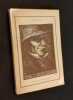
Traduit du danois par A. Nicolet et F.J. Billeskov Jansen - Préface de Denis de Rougemeont - Paris : Editions "Je Sers", 1934 - In-12 broché sous couverture illustrée d'un bois (portrait de Kierkegaard), 221 pages - bon état -
Tous nos livres sont visibles sur notre site : https://www.livrepoesie.com/
Kierkegaard, écrire ou mourir -
Paris : Presses universitaires de France (Coll. "Perspectives critiques"), 2007 - un volume in-8 broché de 145 pages - bon état -
Tous nos livres sont visibles sur notre site : https://www.livrepoesie.com/
Om Begrebet Ironi med stadigt hensyn til Socrates. Af S. A. Kierkegaard. - [A TRULY SPLENDID, COMPLETELY FRESH COPY IN THE DAINTIEST OF THE GIFT-BINDINGS]
Kjøbenhavn, P.G. Philipsens Forlag, 1841. 8vo. (8), 350 pp. Gift binding of elaborately blindpatterned full cloth with single gilt line-border to boards and single gilt lines to spine. All edges gilt and printed on fine paper. The slightest touch of wear to corners and capitals, but apart from that a complete fresh, clean, bright and tight copy. It looks like it has hardly been opened and seems like it just came from the binder. No markings of any kind.
A truly splendid copy of the first edition of Kierkegaard's dissertation, being a completely fresh copy in the daintiest of the gift-bindings, presumably one of the two daintily bound copies that Kierkegaard had in his own collection (nr. 2110-11 in the auction catalogue). The copy is with the Thesis, and both the day and the time has been filled in by hand. Kierkegaard's dissertationconstitutes the culmination of three years’ intensive studies of Socrates and “the true point of departure for Kierkegaard’s authorship” (Brandes). The work is of the utmost importance in Kierkegaard’s production, not only as his first academic treatise, but also because he here introduces several themes that will be addressed in his later works. Among these we find the question of defining the subject of cognition and self-knowledge of the subject. The maxim of “know thyself” will be a constant throughout his oeuvre, as is the theory of knowledge acquisition that he deals with here. The dissertation is also noteworthy in referencing many of Hegel’s theses in a not negative context, something that Kierkegaard himself would later note with disappointment and characterize as an early, uncritical use of Hegel. Another noteworthy feature is the fact that the thesis is written in Danish, which was unheard of at the time. Kierkegaard felt that Danish was a more suitable language for the thesis and hadto petition the King to be granted permission to submit it in Danish rather than Latin. This in itself poses as certain irony, as the young Kierkegaard was known to express himself poorly and very long-winded in written Danish. One of Kierkegaard’s only true friends, his school friend H.P. Holst recounts (in 1869) how the two had a special school friendship and working relationship, in which Kierkegaard wrote Latin compositions for Holst, while Holst wrote Danish compositions for Kierkegaard, who “expressed himself in a hopelessly Latin Danish crawling with participial phrases and extraordinarily complicatedsentences” (Garff, p. 139). When Kierkegaard, in 1838, was ready to publish his famous piece on Hans Christian Andersen (see nr. 1 & 2 above), which was to appear in Heiberg’s journal Perseus, Heiberg had agreed to publish the piece, although he had some severe critical comments about the way and the form in which it was written – if it were to appear in Perseus, Heiberg demanded, at the very least, the young Kierkegaard would have to submit it in a reasonably readable Danish. “Kierkegaard therefore turned to his old schoolmate H. P. Holst and asked him to do something with the language…” (Garff, p. 139). From their school days, Holst was well aware of the problem with Kierkegaard’s Danish, and he recounts that over the summer, he actually “translated” Kierkegaard’s article on Andersen into proper Danish. The oral defense was conducted in Latin, however. The judges all agreed that the work submitted was both intelligent and noteworthy. But they were concerned about its style, which was found to be both tasteless, long-winded, and idiosyncratic. We already here witness Kierkegaard’s idiosyncratic approach to content and style that is so characteristic for all of his greatest works. Both stylistically and thematically, Kierkegaard’s and especially a clear precursor for his magnum opus Either-Or that is to be his next publication. In many ways, Either-Or is born directly out of The Concept of Irony and is the work that brings the theory of Irony to life. Part One of the dissertation concentrates on Socrates as interpreted by Xenophon, Plato, and Aristophanes, with a word on Hegel and Hegelian categories. Part Two is a more synoptic discussion of the concept of irony in Kierkegaard’s categories, with examples from other philosophers. The work constitutes Kierkegaard’s attempt at understanding the role of irony in disrupting society, and with Socrates understood through Kierkegaard, we witness a whole new way of interpreting the world before us. Wisdom is not necessarily fixed, and we ought to use Socratic ignorance to approach the world without the inherited bias of our cultures. With irony, we will be able to embrace the not knowing. We need to question the world knowing we may not find an answer. The moment we stop questioning and just accept the easy answers, we succumb to ignorance. We must use irony to laugh at ourselves in order to improve ourselves and to laugh at society in order to improve the world. The work was submitted to the Philosophical Faculty at the University of Copenhagen on June 3rd 1841. Kierkegaard had asked for his dissertation to be ready from the printer’s in ample time for him to defend it before the new semester commenced. This presumably because he had already planned his sojourn to Berlin to hear the master philosopher Schelling. On September 16th, the book was issued, and on September 29th, the defense would take place. The entire defense, including a two hour long lunch break, took seven hours, during which ”an unusually full auditorium” would listen to the official opponents F.C. Sibbern and P.O. Brøndsted as well as the seven “ex auditorio” opponents F.C. Petersen, J.L. Heiberg, P.C. Kierkegaard, Fr. Beck, F.P.J. Dahl, H .J.Thue og C.F. Christens, not to mention Kierkegaard himself. The work appeared in two states – one with the four pages of “Theses”, for academics of the university, whereas the copies without the theses were intended for ordinary sale. These sales copies also do not have “Udgivet for Magistergraden” and “theologisk Candidat” on the title-page. The first page of the theses always contains the day “XXIX” of September written in hand, and sometimes the time “hora X” is also written in hand, but not always. In all, 11 presentation-copies of the dissertation are known, and of these only one is signed (that for Holst), all the others merely state the title and name of the recipient. As is evident from the auction catalogue of his collection, Kierkegaard had a number of copies of his dissertation in his possession when he died. Five of them were bound, and two of them were “nit. M. Guldsnit” (i.e. daintily bound and with gilt edges). These two copies were obviously meant as presentation-copies that he then never gave away. The gift copies of the dissertation were given two types of bindings, both brownish cloth, one type patterned, the other one plain, and some of them have gilt edges, but most of the plain ones do not. There exist two copies on thick vellum paper – one being Kierkegaard’s own copy, the other being the copy for H.C. Ørsted, discoverer of electromagnetism and then principle of the University of Copenhagen. “As already implied, two works of the authorship stand out in the sense that Kierkegaard sent his presentation-copies to a special circle of people: The dissertation from 1841...” (Posselt, Textspejle, p. 91, translated from Danish). Most of the copies were given to former teachers and especially to people who, due to leading positions, personified the university. “For this circle of initiated we can now, due to registered copies, confirm that Kierkegaard gave copies with handwritten dedications to the headmaster of the University H.C. Ørsted (printed on thick paper), Kolderup-Rosenvinge and to J.L. Heiberg. It is granted that Sibbern, Madvig and F.C. Petersen were also given the dissertation as a gift,... but these copies are not known (yet).” (Posselt, Textspejle, pp. 93-94, translated fromDanish). (N.b. We have since handled the copy given to Petersen and can thus confirm that it exists). Only a few months after Kierkegaard died (11th of November 1855), at the beginning of April 1856, his books were put up for sale. The sale was an event which created stir among scholars all over Denmark, and the event drew large crowds. Everyone wanted a piece of the recently deceased legend, and bidding was lively. The average price for the single items was nearly a rix-dollar, a very high price for that time. As the old Herman Lynge wrote in a letter on the 22nd of May (The Royal Library, Recent Letters, D.), to the famous collector F.S. Bang, “At the sale of Dr. Søren Kierkegaard’s books everything went at very high prices, especially his own works, which brought 2 or 3 times the published prices”.” (Rohde Auction Catalogue, p. LVIJ). Many authors, philosophers, and scholars were present in the auction room, which was completely full, as was the Royal Library, who bought ca 80 lots. “Many of the books, not only his own, were paid for with much higher prices than in the book shops” (In Morgenposten no. 99, 30. April 1856, written by “P.”, translated from Danish). ""Some books were bought by libraries where they still are today, others were bought by private people, who sometimes wrote their names in the front of the books and thus, indirectly, stated that they came from Kierkegaard’s book collection… The edition (of the auction catalogue, 1967) registers all books from Kierkegaard’s book collection that it has hitherto been possible to identify – either in public or in private ownership… All in all, nearly a couple of hundred volumes – i.e. ca. 10 % – of the Kierkegaardian book collection is said to be rediscovered…"" (Rohde). Thus, today, books from Kierkegaard’s library are of the utmost scarcity. Only very few are still possible to acquire, and they hardly ever appear on the market. Himmelstrup 8

Om Begrebet Ironi med stadigt hensyn til Socrates. Af S. A. Kierkegaard. - [KIERKEGAARD’S DISSERTATION IN THE ORIGINAL BINDING, WHICH IS OF THE UTMOST SCARCITY.]
Kjøbenhavn, P.G. Philipsens Forlag, 1841. 8vo. (4), 350 pp., 1 f. (blank), 2 pp. (advertisements). Completely uncut and partly unopened in the original brown cardboard binding. Rebacked with paper perfectly matching that of the boards. Corners restored. Title-page evenly browned and a few leaves with a bit of brownspotting, but overall in unusually nice condition, clean, fresh, and bright. Completely unmarked.
A fabulous copy of the first edition of Kierkegaard’s dissertation, here in the original binding, which is of the utmost scarcity. We have only seen it in this state once before. And of all the copies we have handled of the Irony over the last decades, we have only once before come across a copy with the advertisement-leaf in the back. This is virtually never present. This completely uncut copy is approximately 1 cm taller and wider than regular copies. The spines of the original Kierkegaard cardboard bindings are always just thin paper directly glued on the block, making them extremely fragile, especially on the thicker volumes. If one finds these original bindings, the spines are almost always more or less disintegrated. Kierkegaard's dissertation constitutes the culmination of three years’ intensive studies of Socrates and “the true point of departure for Kierkegaard’s authorship” (Brandes). The work is of the utmost importance in Kierkegaard’s production, not only as his first academic treatise, but also because he here introduces several themes that will be addressed in his later works. Among these we find the question of defining the subject of cognition and self-knowledge of the subject. The maxim of “know thyself” will be a constant throughout his oeuvre, as is the theory of knowledge acquisition that he deals with here. The dissertation is also noteworthy in referencing many of Hegel’s theses in a not negative context, something that Kierkegaard himself would later note with disappointment and characterize as an early, uncritical use of Hegel. Another noteworthy feature is the fact that the thesis is written in Danish, which was unheard of at the time. Kierkegaard felt that Danish was a more suitable language for the thesis and hadto petition the King to be granted permission to submit it in Danish rather than Latin. This in itself poses as certain irony, as the young Kierkegaard was known to express himself poorly and very long-winded in written Danish. One of Kierkegaard’s only true friends, his school friend H.P. Holst recounts (in 1869) how the two had a special school friendship and working relationship, in which Kierkegaard wrote Latin compositions for Holst, while Holst wrote Danish compositions for Kierkegaard, who “expressed himself in a hopelessly Latin Danish crawling with participial phrases and extraordinarily complicatedsentences” (Garff, p. 139). When Kierkegaard, in 1838, was ready to publish his famous piece on Hans Christian Andersen (see nr. 1 & 2 above), which was to appear in Heiberg’s journal Perseus, Heiberg had agreed to publish the piece, although he had some severe critical comments about the way and the form in which it was written – if it were to appear in Perseus, Heiberg demanded, at the very least, the young Kierkegaard would have to submit it in a reasonably readable Danish. “Kierkegaard therefore turned to his old schoolmate H. P. Holst and asked him to do something with the language…” (Garff, p. 139). From their school days, Holst was well aware of the problem with Kierkegaard’s Danish, and he recounts that over the summer, he actually “translated” Kierkegaard’s article on Andersen into proper Danish. The oral defense was conducted in Latin, however. The judges all agreed that the work submitted was both intelligent and noteworthy. But they were concerned about its style, which was found to be both tasteless, long-winded, and idiosyncratic. We already here witness Kierkegaard’s idiosyncratic approach to content and style that is so characteristic for all of his greatest works. Both stylistically and thematically, Kierkegaard’s and especially a clear precursor for his magnum opus Either-Or that is to be his next publication. The year 1841 is a momentous one in Kierkegaard’s life. It is the year that he completes his dissertation and commences his sojourn in Berlin, but it is also the defining year in his personal life, namely the year that he breaks off his engagement with Regine Olsen. And finally, it is the year that he begins writing Either-Or. In many ways, Either-Or is born directly out of The Concept of Irony and is the work that brings the theory of Irony to life. Part One of the dissertation concentrates on Socrates as interpreted by Xenophon, Plato, and Aristophanes, with a word on Hegel and Hegelian categories. Part Two is a more synoptic discussion of the concept of irony in Kierkegaard’s categories, with examples from other philosophers. The work constitutes Kierkegaard’s attempt at understanding the role of irony in disrupting society, and with Socrates understood through Kierkegaard, we witness a whole new way of interpreting the world before us. Wisdom is not necessarily fixed, and we ought to use Socratic ignorance to approach the world without the inherited bias of our cultures. With irony, we will be able to embrace the not knowing. We need to question the world knowing we may not find an answer. The moment we stop questioning and just accept the easy answers, we succumb to ignorance. We must use irony to laugh at ourselves in order to improve ourselves and to laugh at society in order to improve the world. The work was submitted to the Philosophical Faculty at the University of Copenhagen on June 3rd 1841. Kierkegaard had asked for his dissertation to be ready from the printer’s in ample time for him to defend it before the new semester commenced. This presumably because he had already planned his sojourn to Berlin to hear the master philosopher Schelling. On September 16th, the book was issued, and on September 29th, the defense would take place. The entire defense, including a two hour long lunch break, took seven hours, during which ”an unusually full auditorium” would listen to the official opponents F.C. Sibbern and P.O. Brøndsted as well as the seven “ex auditorio” opponents F.C. Petersen, J.L. Heiberg, P.C. Kierkegaard, Fr. Beck, F.P.J. Dahl, H .J.Thue og C.F. Christens, not to mention Kierkegaard himself. Two weeks later, on October 12th, Kierkegaard broke off his engagement with Regine Olsen (for the implications of this event, see the section about Regine in vol. II). The work appeared in two states – one with the four pages of “Theses”, for academics of the university, whereas the copies without the theses were intended for ordinary sale. These sales copies also do not have “Udgivet for Magistergraden” and “theologisk Candidat” on the title-page. The present copy is one of the sales-copies without theses. Himmelstrup 8 The present copy is no. 11 in Girsel's ""Kierkegaard"" (The Catalogue) which can be found here.
Enten – Eller. Et Livs=Fragment udgivet af Victor Eremita. Anden Udgave. Første Deel, indeholdende A.’s Papirer + Anden Deel, indeholdende B.’s Papirer, Breve til A. - [A TRULY MAGNIFICENT COPY SPLENDIDLY PRESERVED IN COMPLETELY ORIGINAL CONDITION]
Kjøbenhavn, Reitzel, 1849. 8vo. XIV, (2), 320" (4), 250 pp + final blank. Both volumes in one – the original blue cardboard binding (“hollanderet bind”) with the original printed paper title-label (preserved in its entirety) to the spine. Slight loss to the paper to upper capital and to lower front hinge, but amazingly well preserved, fresh, and crisp. Completely uncut (23,5 x 14,5 cm., making it ab. 1,5 + 1 cm larger than other well margined copies). Some brownspotting (as always), mostly quite light. Old owner’s name to inside of front board. Housed in a beautiful marbled paper box with a richly gilt red Morocco spine. The gilding is in the style of Kierkegaard’s most lavishly decorated full calf bindings and with the title in gilt Gothic lettering. The box is signed “Anker Kysters Efterf. And the gilding by Hagel Olsen. Front board with the gilt super ex libris of the previous owner.
A truly magnificent copy of the second issue of Either-Or truly splendidly preserved in completely original condition. The spines of the original Kierkegaard cardboard bindings are always just thin paper directly glued on the block, making them extremely fragile, especially on the thicker volumes (as Enten-Eller and Afsluttende uvidenskabelig Efterskrift). If one finds these original bindings, the spines are almost always more or less disintegrated, and the original paper-labels are hardly ever preserved. Here, we not only have an extremely well-preserved copy with very little of the paper missing of an original binding on the bulkiest Kierkegaard-title there is, with the original printed paper title-label preserved in its entirety, we have the second issue of Either-Or in its completely original condition, bound in one volume, as evidently it came from the publishers. This is an extreme rarity! Over the decades, we have been able to locate two copies of the first edition of Either-Or in the original bindings, but we have never come across a copy of the seminally important second issue in the original binding. This is possibly a unique preservation. Kierkegaard’s magnum opus Either-Or is considered the foundational work of existentialism and doubtlessly the most famous work by the greatest Scandinavian philosopher of all times, who ""is now generally considered to be, however eccentric, one of the most important Christian philosophers"" (PMM 314). Kierkegaard's monumental magnum opus seminally influenced later as well as contemporary philosophy and ranks as one of the most important works of philosophy of modern times. Either-Or is the earliest of Kierkegaard’s major works and the work with which he begins his pseudonymous authorship. Kierkegaard’s pseudonymity is an entire subject unto its own. The various cover names he uses play a significant role in his way of communicating and are essential to the understanding of his philosophical and religious messages. And it all properly begins here, with his groundbreaking magnum opus. Conjuring up two distinctive figures with diverging beliefs and modes of life – the aesthetic “A” of Part One, and the ethical B (note that this is the first “pseudonym” that Kierkegaard uses, in his earliest articles – no. I above)/Judge Vilhelm of Part Two, Kierkegaard presents us with the most basic reflections on the search for a meaningful existence, seen from two completely different philosophical views. This masterpiece of duality explores the foundational conflict between the ethical and the aesthetical, providing us along the way with the now so famous contemplations on music (Mozart), drama, boredom, pleasures, virtues, and, probably most famously, seduction (and rejection – The Seducer’s Diary). It is primarily Judge Vilhelm from Part Two of Either-Or that has bestowed upon Kierkegaard the reputation as the Father of Existentialism. His emphasis on taking ownership of oneself and the importance of making choices has made him the (first) personification of Existentialism and the idea that one does not passively develop into the self that he or she should be or ought to become. Kierkegaard went to great lengths to ensure that the public would not know the identity of the author was of Either-Or. He even had the draft of the work done by several hands, so that employees at the printer’s would also be deceived. Despite his efforts, however, it did not take long for the public to guess that Kierkegaard had written this astounding work. But Kierkegaard himself kept up the façade and did not accept authorship until several years later. Nothing Kierkegaard did was left to chance, which his carefully chosen pseudonyms also reflect. This also spills over in his presentation-inscriptions, which follow as strict a pattern as the pseudonyms themselves – he never signed himself the author, if his Christian name was not listed as the author on the title-page. And seeing that he had not accepted authorship of Either-Or and is not mentioned by name anywhere on the title-page (also not as the editor nor publisher as with the other pseudonymous works), he was not able to give away copies of his magnum opus, which is why no presentation-copy of the first edition exists. The appearance of the second edition of this monumental work was, naturally, carefully planned. Either-Or first appeared in 1843, and due to the great demand for the work, which had originally only been printed in ca 525 copies, it had quickly been sold out" but Kierkegaard refused to have it reprinted. In 1849, finally, he decided to let it appear again, in a textually unchanged version. When the second edition appeared (recte second issue), Kierkegaard had meanwhile owned up to the authorship of Either-Or. He had done so in 1846, in his Concluding Unscientific Postscript to The Philosophical Fragments (own translation): “For the sake of manners and etiquette I hereby acknowledge, what can hardly in reality be of interest to anybody to know, that I am, as one says, the author of Either-Or (Victor Eremita), Copenhagen in February 1843...”. Now, finally, Kierkegaard could give away his magnum opus! In his Papers from 1849, Kierkegaard states (own translation): “The poets here at home each received a copy of Either-Or. I thought it my duty and now I was able to do it because now one cannot reasonably claim that a conspiracy is made concerning the book. -because the book is now old and its crisis over. Of course they were given the copy from Victor Eremita...” (Pap., X1A 402). Naturally, because “as little as I in Either-Or is the Seductor or the Assessor, as little am I the publisher Victor Eremita, exactly as little he is a poetically-real subjective thinker, as he is also found in “in vino veritas.” “ (the postscript to the Postscript, 1846) But he only sent few copies to very choice people, fewer than he did most of his other works, and only three copies have been identified (to Henrik Hertz, Christian Winther, and Hans Christian Andersen). Three further copies in gift-bindings corresponding to these have been identified, but in these copies, the leaf with the presentation-inscription has also been torn out. He must have given away yet another copy – one presumably not being on vellum-paper, as, according to his own notes, he had asked the printers for six copies on vellum paper (see Pap., Vol. X, part five, p. (203).) -, making the total known (albeit not all identified) number of copies seven. “Two copies in a binding corresponding to Hertz’s copy have been traced, but in both, the front free end-paper has been torn out. It leads one to think that the completely unusual presentation inscription (signed by Victor Eremita!), for the immediate posterity has been of such a curious nature that it has tempted autograph hunters on several occasions.” (Tekstspejle, p. 97, translated from Danish). “The other book, of which the recipients stand out is the second edition of Either-Or, which appeared in May 1849. The first edition from 1843 had been sold out for several years, but Kierkegaard had refused to have it reprinted. In our context we must remember that in 1843, he was unable to send gift copies of the first edition… When, in 1843, he lets Either-Or be reprinted in textually unaltered form, he has meanwhile (1846) admitted to authorship of the work. But the wording on the title-pages of the two leaves does not allow him to sign the dedication “from the Author” or “from the publisher” or the like.” (Tekstspejle p. 96, translated from Danish). Either-Or is now not only the title of Kierkegaard’s most famous and widely read work, it is also a phrase that summarizes much of the thinking for which he is best known and a cornerstone of what we now characterize as Existentialism. The first edition caused a sensation. The second issue (termed “edition”, although it is textually unaltered) is not only the first edition of the work to appear after Kierkegaard had acknowledged authorship of it and thus also confirmed being one and the same with his most famous pseudonym, it is also the first of Kierkegaard’s works to appear in a second edition or issue. The second edition of the work is thus also of the utmost importance and is one of the only important second editions of any of Kierkegaard’s works. PMM: 314 Himmelstrup 21
Atten opbyggelige Taler af S. Kierkegaard. - [EXCEEDINGLY SCARCE IN THE ORIGINAL BINDING, WITH THE ORIGINAL TITLE-LABEL]
Kjøbenhavn, Philipsen, 1843-45. 8vo. (4), 52 + 62 (+ 1 blank leaf) + 84 + 59 (including the blank leaf between the title-page and the preface!) + 70 (+ 1 blank leaf) + 111 pp. Completely uncut in the original brownish grey boards with original printed title-label to spine (fully intact). Boards a bit brownspotted and a larger damp stain to top of front board. A couple of smaller stains (lacquer or wax) to spine. A few horizontal creases to spine with paper almost invisibly glued back on to hold tight. Occasional brownspotting, mostly to the first and last leaves. But overall splendidly preserved.
A truly magnificent copy of the first edition of this very scarce Kierkegaard-title, in completely original condition with all of the original printed title-label preserved, and fully complete with the joint title-page, contents, all the half-titles, dedications, blanks, etc. This Kierkegaard-title is rare in itself, with much less than 278 copies printed in all, but it is utterly amazing to find this exceedingly rare book in original state like here. Only very few copies are left in the original binding, which we have only seen once before. The spines of the original Kierkegaard cardboard bindings are always just thin paper directly glued on the block, making them extremely fragile. If one finds these original bindings, the spines are almost always more or less disintegrated. The present copy is a rare exception that furthermore has the original title-label, which is of the utmost scarcity. To our knowledge, only one other copy in the original binding has been located. Apart from the other copy we have seen of this work in the original binding, the present copy is also the only original Kierkegaard-binding we have seen that is not in the usual blue “hollanderet” cardboard binding, but plain brown. No other such copy has been registered for sale, and no other such copy, to our knowledge, is registered in any institution. Furthermore, this seems to be the only copy to have surfaced so far, which has preserved the original printed title-label in its entirety. As far as we know, it has been recorded no-where, due to its extreme scarcity. Kierkegaard’s Upbuilding (or Edifying) Discourses were published over the course of two years, in 1843 and 1844. In all, 18 Upbuilding Discourses were published, divided over six publications, namely: Two Upbuilding Discourses from 1843 Three Upbuilding Discourses from 1843 Four Upbuilding Discourses from 1843 Two Upbuilding Discourses from 1844 Three Upbuilding Discourses from 1844 Four Upbuilding Discourses from 1844 Each of these publications accompanied one of the main pseudonymous works, beginning with Either-Or in 1843. As opposed to his major philosophical works, the religious upbuilding discourses actually bear the name of the author on the title-page. Of course, this was by no means incidental. While the pseudonymous works could raise the question of the religiousness of the author, the parallelly written religious discourses stress the fact that we are dealing with an author, who was religious from the very beginning – an essential fact that Kierkegaard wished to stress for those interested in his authorship. In his journals, Kierkegaard clearly states that the religious discourses are as significant in his oeuvre as a whole as are the larger pseudonymous works, “I began with “Either-Or” and two upbuilding discourses...” he says, and explains that he intended the upbuilding, the religious, to advance, and that he wanted to show “that the writer was not an aesthetic author who in the course of time grew older and for that reason became religious”. (Journals, IX A 227). He was religious all along, also during all of the major philosophical publications that were not written in his name. The fact that every major pseudonymous work – up until Concluding Unscientific Postscript appeared and revealed the identity of the real author – was accompanied by one of these small Upbuilding Discourses, bears testament to the pivotal role they play in Kierkegaard’s philosophical development. Furthermore, while Kierkegaard could not present anyone with copies of his pseudonymous works (as explained above), he could indeed give away presentation-copies of his accompanying Upbuilding Discourses, which he then did. The Upbuilding Discourses are particularly interesting in several regards, one being that it is in the course of the printing of these that Kierkegaard changes his publisher. Ever since Kierkegaard had chosen to publish his first book himself, he had had his books on commission with the leading Copenhagen publisher Reitzel (the sole exception being his thesis, the Irony). That was also the case with Two Upbuilding Discourses from 1843. But for some reason, the following five publications of Upbuilding Discourses did not appear with Reitzel, but with P.G. Philipsen instead. We do not know the exact reason for this change in publishers, as the commission was exactly the same for the two. Whereas Two Upbuilding Discourses from 1843 had sold relatively well, the Three and Four Upbuilding Discourses from 1843 did not sell well. A mere 102 and 104 copies respectively out of a commission issue of 300 were sold. In an attempt at making money on these discourses in spite of the poor sales numbers, Philipsen offers to buy the unsold copies of Two Upbuilding Discourses from 1843, buys a sales issue of 300 copies of the Two Upbuilding Discourses from 1844, and makes the same agreement with Kierkegaard for the following two Discourse-publications. Sales numbers are still poor, however, and in the spring of 1845, only ca 100 copies of each of the 1844 Discourse publications have been sold. The printing issue of each was about 500, and Philipsen’s sales issue 300 thus, both Philipsen and Kierkegaard had large numbers of each Discourse-publication left, and in May 1845, they make a new deal. Philipsen buys the remainder issues of all six Discourse-publications, including the 278 copies of Two Upbuilding Discourses from 1843 from Reitzel. Philipsen has a joint title-page printed, along with a contents-leaf, and now issues the seminal Kierkegaard-publication that is no. 85 in the bibliography (Himmelstrup), namely Eighteen Upbuilding Discourses – all six publications, constituting all eighteen Upbuilding Discourses collected in one book. Seeing that there were 278 copies left of the Two Upbuilding Discourses from 1843, a maximum of 278 copies of Eighteen Upbuilding Discourses can have been made, making it one of the scarcest Kierkegaard-books. The actual number is certainly lower than 278, though, probably quite a bit lower, seeing that Philipsen continued to sell the separate publications, all copies of which he then evidently did not include in the Eighteen Upbuilding Discourses. The individual pamphlets, of course, are even scarcer, with a maximum of 232 copies of Two Upbuilding Discourses from 1843 and somewhere between 100 and 150 copies of the others. We know from the Erindringsbog fra Bianco Luno 1844 that Kierkegaard had 506 copies of Four Upbuilding Discourses 1844 printed, six of them on fine paper for presentation. Seeing that we have already established the clear thread of identity throughout all six publications, we must assume that the other pamphlets were printed in the same numbers. And we have the record of the remainder issues that Philipsen buys in 1845, which lets us conclude of the Upbuilding Discourses, that, by that time, 222 copies of Two 1843 139 copies of Three 1843 130 copies of Four 1843 120 copies of Two 1844 92 copies of Three 1844 96 copies of Four 1844 were sold out of the total number of original issues. In other words, these are extremely scarce. Not least in the original wrappers or bindings. The scarcest Kierkegaard-title that exists, however, will be found in the continuation of the printing history of the Upbuilding Discourses. It is the mythically rare title of Sixteen Upbuilding Discourses, which Philipsen issued in 1852, when the Two Upbuilding Discourses had been sold out and it was no longer possible to collect Eighteen Upbuilding Discourses. Thus, Philipsen had yet another title-page printed, this time with Sixteen Upbuilding Discourses as the title and the year 1843-45 on it, along with a new index-leaf he issued this, the scarcest of all Kierkegaard-titles, in March 1852. “It is not known how large the issue was, but it cannot have been more than 83, seeing that that was what was left of Three Upbuilding Discourses from 1843.” (Tekstspejle p. 54, translated from Danish). The idea of the Eighteen Upbuilding Discourses (let alone the Sixteen) was not Kierkegaard’s. He had agreed to the Eighteen, but it was not his intended project with the Upbuilding Discourses. Therefore, he wished for the book not to be reviewed, and he naturally did not give away any copies of the Eighteen Upbuilding Discourses, and of course not the Sixteen either, only the individual pamphlets. In all, seven presentation-copies of the different Upbuilding Discourses are registered, all being for either Heiberg or Nielsen. Curiously, neither Eighteen nor Sixteen Upbuilding Discourses were to be found in Kierkegaard’s book collection after his death. All the individual pamphlets were, however, along with a copy of the first nine Upbuilding Discourses – i.e. the three publications from 1843 – bound together. For more on the conundrum of the actual number of copies of the Upbuilding Discourses, see the Preface by Flemming Chr. Nielsen in Girsel’s Kierkegaard-catalogue, p. 19. Himmelstrup 85
I. A: Ogsaa et Forsvar for Qvindens höie Anlæg. II. B: Kjøbenhavnspostens Morgenbetragtninger i Nr. 43 + III. B: Om Fædrelandets Polemik + IV. S. KIERKEGAARD: Til Hr. Orla Lehman. [printed in: Kjøbenhavns flyvende Post, Interimsblad Nr. 34, 76, 82/83 ... - [VERY RARE FIRST PRINTINGS OF KIERKEGAARD'S FIRST FOUR PUBLICATIONS]
Kjøbenhavn, 1834-1836. Large 4to. Interimsblade [i.e. Interim Papers] 1-100, with the joint title-page and the contents leaf, bound in a very nice contemporary brown half calf with gilt spine and marbled paper over boards. Spine with wear and hinges and corners bumped. Edges of boards with wear. Occasional brownspotting throughout, but all in all a fine and well preserved copy. Each “Interimsblad” takes up 4 pp. Kierkegaard’s contributions: I: ab. 1 p. II: 2 3/4 pp. III: 4 pp. IV: 4 pp.
Very rare first printings of Kierkegaard’s first four publications, including the very first publication in Kierkegaard’s own name, which constitutes a true milestone in the history of Kierkegaard’s opus, as does, of course, his very first publication. KIERKEGAARD’S VERY EARLIEST publications are the papers that he publishes in Kjøbenhavns Flyvende Post, before he publishes his famous first book, which is a polemic attack on Hans Christian Andersen. The first and fourth of these earliest periodical publications are arguably the most important, being the very first thing Kierkegaard publishes and the very first publication in Kierkegaard’s own name respectively" but all these four earliest papers (Himmelstrup 1,2,3, and 4) are significant, 2,3, and 4 dealing with contemporary press issues, primarily freedom of press. Danish politics in the 1830’es was dominated by the slow implementation of rules for election for and assembly of the Estates of the Realm. But as they were only advisory, the papers and periodicals were not allowed to publish their opinions. In response to this, a liberal opposition arose around the two polemic papers Kjøbenhavnsposten (The Copenhagen Post) and Fædrelandet (The Fatherland). The first point on the agenda for the Liberals was the fight for freedom of the press and the abolishment of censorship. This fight for freedom of the press was something that found resonance with Copenhagen academics, and it stirred up a lively activity in Copenhagen. In 1835, active Liberals had encouraged King Frederik VI to support freedom of press but had received an answer stating that he alone was able to evaluate what was truly the best for the people and the state. After this answer from the king, the “Society for the Correct Use of the Freedom of press” was founded by moderate liberals and young liberals, and at the end of the year almost 2.300 members had joined. It was in the midst of all this that the 21-year old Søren Kierkegaard, then a student of theology, had his debut, with political-literary articles in Kjøbenhavns flyvende Post, in Interimsbladende, which were published separately. But as opposed to the predominantly liberal views of almost all other contributors, Kierkegaard’s articles expressed distinctly conservative views. His first publication, Også et Forsvar for Qvindens høie Anlæg (Also a Defense of the High Abilities of the Woman) constitutes an unpolished ironic apology for the liberation of women. This article is published in December 1834 and is signed “A.”. As opposed to the following next three articles, this does not deal with freedom of press. Kierkegaard’s three following publications, however, all concern the question of freedom of press and constitute satirical polemics against the two liberal papers Kjøbenhavnsposten and Fædrelandet, against Orla Lehmann, the upcoming star of the liberal youth, and against all liberals in general. These three articles were published in February and April 1836. The two first are signed “B.”, and the third, signed “S. Kierkegaard”, constitutes the very first publication in his own name. As is well known, the names under which Kierkegaard later publishes come to play a significant role in his authorship and represent an extremely thorough and well-thought-out construction. The foundation of this play with the reader is thus laid in the present publications, in which he begins to develop the style for which he later gained worldwide renown. The “names” A and B, under which he here publishes, will most famously be used again in Either- Or, Part one of which consists in “A.’s Papers” and Part Two in “B.’s Papers, Letters to A.” Common for all four of his first publications is the attempt at polemic and satirical power, at literary elegance and at a masterful and ceremonious critique of the prose of the opponent – all dominant traits in his later writings. Kjøbenhavns flyvende Post (The Flying Post of Copenhagen) was one of the most important and most widely read cultural and literary periodicals of the period. It was edited and run by Johan Ludvig Heiberg (1791-1860), arguably the most famous cultural person during the Danish Golden Age. He played a more significant role than any other author or thinker during this period and was the leading character of literature and philosophy in the 19th century. He introduced many German thinkers to Denmark, most importantly Hegel – who Kierkegaard would later oppose –, and he was part of almost all intellectual discussions of the Danish Golden Age. He was also a patron for many leading figures of the era. Interestingly, several people thought that the first of the articles on the freedom of the press was written by Heiberg. This was of dubious merit to Kierkegaard himself, as he was opposed to the circles around Heiberg and the Hegelian environment, but it was still this article – and this miscomprehension – that gave him a claim to fame. Another paper claimed that this “priceless” article had been written by Heiberg himself, who “had written many witty things, but never anything as witty as this.” Also Kierkegaard’s professor of philosophy, Poul Martin Møller, to whom Kierkegaard was very devoted and to whom he dedicated Begrebet Angest (the only person outside of his family that Kierkegaard ever wrote a printed dedication for), loved the article and assumed that Heiberg had written it. “He (Kierkegaard) had a lifelong antipathy toward the press, though he himself published reviews in various papers. His mistrust of the press as a legitimate organ of communication was based on several observations, one of which was that the press was the voice of the masses, rather than that of the individual. He viewed that voice with great skepticism and sarcasm in later years, averring that the crowd... even if technically correct... is wrong by the very fact of being the crowd. The truth can only be stated and practiced as individuals, especially as individuals before God. Admittedly, Kierkegaard’s view of the masses was not well developed at this juncture.” (D. Antony Storm). Himmelstrup: 1, 2, 3 & 4. The present copy is no. 1 in Girsel's ""Kierkegaard"" (The Catalogue) which can be found here.
In vino veritas.
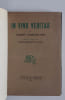
Traduit du danois par André Babelon et C. Lund. Paris : Editions du cavalier, 1933. In-12 basane vert empire à coins, dos à nerfs avec auteur et titre doré, couverture conservée, 185 pages. Ex-dono manuscrit sur la page de garde. Edition originale de traduction. bon état.
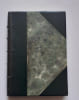
Tous nos livres sont visibles sur notre site : https://www.livrepoesie.com/
Enten – Eller. Et Livs=Fragment udgivet af Victor Eremita. Anden Udgave. Første Deel, indeholdende A.’s Papirer + Anden Deel, indeholdende B.’s Papirer, Breve til A.
Kjøbenhavn, Reitzel, 1849. 8vo. In contemporary half calf. Spine with wear and scratches. Back hinge partly split. Previous owner's name ""P. O. Bugge / 1852"". First and last leaves slightly browned, otherwise internally nice and clean. XIV, (2), 320" (4), 250 pp + final blank.
Second edition of Kierkegaard’s Either-Or, his magnum opus, widely regarded as a foundational work of existentialism and among the most celebrated writings of the greatest Scandinavian philosopher. Kierkegaard is “now generally considered to be, however eccentric, one of the most important Christian philosophers” (PMM 314). Kierkegaard's monumental magnum opus seminally influenced later as well as contemporary philosophy and ranks as one of the most important works of philosophy of modern times. Either-Or is the earliest of Kierkegaard’s major works and the work with which he begins his pseudonymous authorship. Kierkegaard’s pseudonymity is an entire subject unto its own. The various cover names he uses play a significant role in his way of communicating and are essential to the understanding of his philosophical and religious messages. And it all properly begins here, with his groundbreaking magnum opus. Conjuring up two distinctive figures with diverging beliefs and modes of life – the aesthetic “A” of Part One, and the ethical B (note that this is the first “pseudonym” that Kierkegaard uses, in his earliest articles – no. I above)/Judge Vilhelm of Part Two, Kierkegaard presents us with the most basic reflections on the search for a meaningful existence, seen from two completely different philosophical views. This masterpiece of duality explores the foundational conflict between the ethical and the aesthetical, providing us along the way with the now so famous contemplations on music (Mozart), drama, boredom, pleasures, virtues, and, probably most famously, seduction (and rejection – The Seducer’s Diary). It is primarily Judge Vilhelm from Part Two of Either-Or that has bestowed upon Kierkegaard the reputation as the Father of Existentialism. His emphasis on taking ownership of oneself and the importance of making choices has made him the (first) personification of Existentialism and the idea that one does not passively develop into the self that he or she should be or ought to become. Kierkegaard went to great lengths to ensure that the public would not know the identity of the author was of Either-Or. He even had the draft of the work done by several hands, so that employees at the printer’s would also be deceived. Despite his efforts, however, it did not take long for the public to guess that Kierkegaard had written this astounding work. But Kierkegaard himself kept up the façade and did not accept authorship until several years later. Nothing Kierkegaard did was left to chance, which his carefully chosen pseudonyms also reflect. This also spills over in his presentation-inscriptions, which follow as strict a pattern as the pseudonyms themselves – he never signed himself the author, if his Christian name was not listed as the author on the title-page. And seeing that he had not accepted authorship of Either-Or and is not mentioned by name anywhere on the title-page (also not as the editor nor publisher as with the other pseudonymous works), he was not able to give away copies of his magnum opus, which is why no presentation-copy of the first edition exists. The appearance of the second edition of this monumental work was, naturally, carefully planned. Either-Or first appeared in 1843, and due to the great demand for the work, which had originally only been printed in ca 525 copies, it had quickly been sold out but Kierkegaard refused to have it reprinted. In 1849, finally, he decided to let it appear again, in a textually unchanged version. When the second edition appeared (recte second issue), Kierkegaard had meanwhile owned up to the authorship of Either-Or. He had done so in 1846, in his Concluding Unscientific Postscript to The Philosophical Fragments (own translation): “For the sake of manners and etiquette I hereby acknowledge, what can hardly in reality be of interest to anybody to know, that I am, as one says, the author of Either-Or (Victor Eremita), Copenhagen in February 1843...”. Now, finally, Kierkegaard could give away his magnum opus! In his Papers from 1849, Kierkegaard states (own translation): “The poets here at home each received a copy of Either-Or. I thought it my duty and now I was able to do it because now one cannot reasonably claim that a conspiracy is made concerning the book. -because the book is now old and its crisis over. Of course they were given the copy from Victor Eremita...” (Pap., X1A 402). Naturally, because “as little as I in Either-Or is the Seductor or the Assessor, as little am I the publisher Victor Eremita, exactly as little he is a poetically-real subjective thinker, as he is also found in “in vino veritas.” “ (the postscript to the Postscript, 1846) Either-Or is now not only the title of Kierkegaard’s most famous and widely read work, it is also a phrase that summarizes much of the thinking for which he is best known and a cornerstone of what we now characterize as Existentialism. The first edition caused a sensation. The second issue (termed “edition”, although it is textually unaltered) is not only the first edition of the work to appear after Kierkegaard had acknowledged authorship of it and thus also confirmed being one and the same with his most famous pseudonym, it is also the first of Kierkegaard’s works to appear in a second edition or issue. The second edition of the work is thus also of the utmost importance and is one of the only important second editions of any of Kierkegaard’s works. PMM: 314 Himmelstrup 21
Frygt og Bæven. Dialektisk Lyrik af Johannes de Silentio. - [A SPLENDID COPY IN THE ORIGINAL BINDING]
Kjøbenhavn, Reitzel, 1843. 8vo. VIII, 135 pp. Completely uncut in the original blue cardboard binding. Spine and front hinge neatly restored, preserving part of the original printed title-label. Brownspotting as usual. Overall a very nice copy indeed. Old owners’ names to inside of front board (N. Pedersen 18/8 1879 and C. Wegener).
A splendid copy of one of Kierkegaard's most splendid and most sought-after works in the original binding, which is extremely rare. The spines of the original Kierkegaard cardboard bindings are always just thin paper directly glued on the block, making them extremely fragile, and the original paper-labels are hardly every preserved. Although Fear and Trembling is evidently printed in the same number of copies as almost all the other works by Kierkegaard (i.e. ca 525), this is one of the most difficult of his works to find in the first edition. Perhaps later research will show whether unsold copies were destroyed, which seems unlikely, however. We know that in July or August 1847, 321 copies of Fear and Trembling had been sold. What we also know is that it is highly sought-after by collectors and much less frequently on the market than most of Kierkegaard’s other works. It is very odd that not a single copy on special paper or in a gift-binding, presentation-copy or anything like that has been located or registered. For this title, a Kierkegaard-collector will have to make do with a “normal” copy. The present copy, in the original binding, and completely uncut, is the best copy we have come across over the last many decades. FEAR AND TREMBLING is one of Kierkegaard’s most important works. And it is also one of his most difficult. It deals – in forceful brevity – with the relationship between reason and faith and provides us with Kierkegaard’s most thorough exposition of the religious stage, which he considered the most meaningful form of existence. Setting the scene in his Preface with the punchy opening lines: “Not merely in the realm of commerce but in the world of ideas as well our age is organizing a regular clearance sale. Everything is to be had at such a bargain that it is questionable whether in the end there is anybody who will want to bid.”(Preface, Walter Lowrie’s translation, 1941), Kierkegaard begins the work with a rendering of the biblical tale of Abraham and Isak from the Old Testament, using it to illustrate how religious reasons can triumph over ethical. It is here that Kierkegaard introduces the “tragic hero” and contrasts it to the “Knight of Faith”, who both ignore their own wishes for a higher good. These two essential figures epitomize the ethical and the religious and pave the way for the understanding of these stages in Kierkegaard’s philosophy. It is arguably also here that the idea of the essential leap of faith is introduced for the first time. The Knight of Faith sacrifices his son at the command of God and thus sets aside an ethical demand in in order to attain a higher goal that exists beyond the ethical. This teleological suspension of the ethical requires a leap of faith that is only possible through faith in virtue of the absurd. In many ways, Fear and Trembling is the most forceful of Kierkegaard’s works, as is also indicated by the title. Kierkegaard himself also considered it one of his most significant productions and wrote in his posthumously published Notebooks: “Oh, once I am dead, Fear and Trembling alone will be enough for an imperishable name as an author. Then it will be read, translated into foreign languages as well. The reader will almost shrink from the frightful pathos in the book.” (NB 12:147, 1849). This splendidly dense work which so magnificently weaves together existential concerns with biblical interpretation is responsible for the introduction of many of the concepts that are most fundamental to Kierkegaard’s philosophy and is essential to the understanding of his thought. Not a single presentation-copy of the work is known to exist and none has ever been registered nor identified. We know from the auction catalogue that Kierkegaard had two copies in his collection, one in “dainty binding”, but neither copy has been located. Himmelstrup 48 The present copy is no. 18 in Girsel's ""Kierkegaard"" (The Catalogue) which can be found here.
Om Begrebet Ironi med stadigt Hensyn til Sokrates. - [KIERKEGAARD'S DISSERTATION]
Kjøbenhavn, P.G. Philipsen, 1841. 8vo. Elegant later (ca. 1920) brown half calf with four raised bands and gilt morocco title-label to gilt spine. With Paul Rubow's ownership signature to front free end-paper. Clean and fresh both in- and externally, with no signs of wear to the exterior and only faint brown spots to a few pages. (4), 350 pp.
First edition of Kierkegaard's dissertation, as it appeared in the normal trade, without the preliminary Theses, which were intended for academics attending the defence. Kierkegaard’s dissertation constitutes the culmination of three years’ intensive studies of Socrates and “the true point of departure for Kierkegaard’s authorship” (Brandes). The work is of the utmost importance in Kierkegaard’s production, not only as his first academic treatise, but also because he here introduces several themes that will be addressed in his later works. Among these we find the question of defining the subject of cognition and self-knowledge of the subject. The maxim of “know thyself” will be a constant throughout his oeuvre, as is the theory of knowledge acquisition that he deals with here. The dissertation is also noteworthy in referencing many of Hegel’s theses in a not negative context, something that Kierkegaard himself would later note with disappointment and characterize as an early, uncritical use of Hegel. Another noteworthy feature is the fact that the thesis is written in Danish, which was unheard of at the time. Kierkegaard felt that Danish was a more suitable language for the thesis and had to petition the King in order to gain permission to submit it in Danish rather than Latin. This in itself contains as certain irony, as the young Kierkegaard was known to express himself poorly and very long-winded in written Danish. Both stylistically and thematically, Kierkegaard’s dissertation is a seedbed of his subsequent work and especially a clear precursor for his magnum opus Either-Or that is to be his next publication. The year 1841 is a momentous one in Kierkegaard’s life. It is the year that he completes his dissertation and commences his sojourn in Berlin, but it is also the defining year in his personal life, namely the year that he breaks off his engagement with Regine Olsen. And finally, it is the year that he begins writing Either-Or In many ways, Either-Or is born directly out of “The Concept of Irony” and is the work that brings the theory of Irony to life. Part One of the dissertation concentrates on Socrates as interpreted by Xenophon, Plato, and Aristophanes, with a word on Hegel and Hegelian categories. Part Two is a more synoptic discussion of the concept of irony in Kierkegaard’s categories, with examples from other philosophers. The work constitutes Kierkegaard’s attempt at understanding the role of irony in disrupting society, and with Socrates understood through Kierkegaard, we witness a whole new way of interpreting the world open before us. Wisdom is not necessarily fixed, and we ought to use Socratic ignorance to approach the world without the inherited bias of our cultures. Kierkegaard's dissertation appeared in two states – one with the four pages of “Theses”, for academics of the university, whereas the copies without the theses were intended for ordinary sale. These sales copies also do not have “Udgivet for Magistergraden” and “theologisk Candidat” on the title-page. Himmelstrup 8.
Gjentagelsen. Et Forsøg i den experimenterende Psychologi af Constantin Constantius. - [A SPLENDID COPY IN THE ORIGINBAL BINDING]
Kjøbenhavn, Reitzel, 1843. Small 8vo. 157 pp. Original blue cardboard-binding. The spine has been restored, but it has the original printed paper title-label partly preserved. Hinges are a bit weak, and there is some edgewear. Browning and brownspotting, but not more than usual. Completely uncut. Housed in a nice custom-made half lather box in pastiche style with richly gilt spine.
The first edition in the very rare original blue binding with most of the original printed title-label preserved. REPETITION – not only the title of one of his most significant books, but also a key concept in the philosophy of Kierkegaard – was written during the same brief spell of feverish activity that also produced Fear and Trembling the two books were even published on the same day. ”Say what you will, this question will play a very important role in modern philosophy, for repetition is a crucial expression for what “recollection” was to the Greeks. Just as they taught that all knowing is a recollecting, modern philosophy will teach that all life is a repetition.” (Repetition, p. 3 – translation by Hong), Kierkegaard states in the beginning of his treatise, anticipating the importance that his concept of Repetition is to have for modern philosophy. Written in the narrative form of an experimental novel centered on two stories that are internally linked, Kierkegaard lets us understand what Repetition could be and what it is in his philosophy. The first story portrays Repetition as something empty and trivial, whereas the second portrays it as an ethical category that is inextricably linked to religion. Repetition is that which makes it possible for man to become and to remain present in the present. Kierkegaard’s explanation of his key concept of Repetition is exhausted in the present work, but it also plays a significant role throughout his later works and is considered one of the key concepts in his philosophy. The work is centered around the story of a young man, who has fallen in love with an innocent young girl to whom he has become engaged. But, finding himself unable to consummate the love because of poetic stirrings inside himself, he tries to understand what is going on inside him and whether or not he should break off the engagement. The elderly Constantin Constantius, one of Kierkegaard’s numerous pseudonyms, interferes with the emotions of our young man and begins to conduct speculative experiments with him that are meant to investigate whether a repetition (of the relationship with the girl, of the young man’s feelings, etc.) might be possible. At the end of the first part, the young man flees Copenhagen and leaves the girl, presumably at her wits’ end. Later, she marries someone else, and the young man transforms into the true poet that he could only be when unattached to the girl he loved. It does not take much of an imagination to link this story to the Kierkegaard’s own wildly famous love story and failed engagement to Regine Olsen. It all begins in 1837, when Kierkegaard meets the lovely young girl Regine Olsen at a visit to the widowed Cathrine Rørdam. Three years later, in September 1840, after having corresponded frequently with her and visited her on numerous occasions, Kierkegaard decides to ask for her hand in marriage. She and her family accept, but the following day, Kierkegaard regrets his decision and ends up finally breaking off the engagement in October 1841. Disregarding the scandal, the heartbreak (his own included), and the numerous pleas from family members and friends alike, Kierkegaard’s tortured soul, still searching for God and for the meaning of faith, cannot continue living with the promise of marriage. Later the same month, he flees Copenhagen and the scandal surrounding the broken engagement. He leaves for Berlin, the first of his four stays there, clearly tortured by his decision, but also intent on not being able to go through with the engagement. As is evident from his posthumously published Papers, Kierkegaard’s only way out of the relationship was to play a charming, but cold, villain, a charlatan, not betraying his inner thoughts and feelings. It is during his stay in Berlin, his first of four altogether, right after the rupture of the engagement, that he begins writing Either-Or, parts of which, like Repetition, can be read as an almost autobiographical rendering of his failed engagement. Repetition, more than any other work, lets us see how Kierkegaard came to be as an author through his tumultuous inner life during his engagement and the ending of it. Like Fear and Trembling, there are no presentation-copies known to exist of Repetition. Himmelstrup 53
Forord. Morskabslæsning for enkelte Stænder efter Tid og Leilighed af Nicolaus Notabene. - [KIERKEGAARD'S SARCASTIC ROASTING OF THE HEGELIAN SYSTEM]
Kjøbenhavn, Reitzel, 1844. Small 8vo. 110, (1) pp. Completely uncut in the original blue cardboard-binding. Minimal wear to capitals, and hinges with a tiny tear to front upper and back hinge. Minute paper loss to capitals, and minimal loss to one corner. The printed title-label preserved in its entirety. Brownspotting due to the quality of the paper.A truly magnificent copy in completely original state – almost looks like it came straight off the press.
First edition of Kierkegaard's most humorous book, Prefaces, in the very rare original blue binding in truly magnificent state and with the printed title-label preserved in its entirety. Published simultaneously with The Concept of Anxiety, Prefaces can be viewed as its companion piece. It represents an altogether different genre and is the most humorous of all of Kierkegaard’s works, but the two fictional authors of the works interestingly contrast each other. Although having been eclipsed by the now notoriously famous Concept of Anxiety, Prefaces was in fact more popular when it appeared and sold many more copies. Written under the pseudonym of Nicolaus Notabene, the “author” name indicates that despite its humorous approach, Prefaces is still something serious – something to be noted. And it certainly is. It is here that we find Kierkegaard’s sarcastic roasting of the Hegelian system and of the Danish Hegelians with Johan Ludvig Heiberg as the main representant. Through Notabene, he makes fun of Heiberg and Hegel, who both want to explain everything and want to be mediators of understanding. Just as Hafniensis in The Concept on Anxiety poses that “how sin came into the world each man understands solely by himself. If he would learn it from another, he would misunderstand it” (p. 51), so Notabene in Prefaces states that “My frame, my health, my entire constitution do not lend themselves to mediation” (p. 45). In Prefaces we also find Kierkegaard’s thoughts about the relationship between the reading public and the author and his fierce criticism of literary critics and reviewers, among these also Heiberg as well as Martensen, who famously reviewed Either-Or and Repetition respectively. And in the very amusing preface to the Prefaces, we are given another glimpse into Kierkegaard’s thoughts on marriage and the dilemma he found himself in with Regine – the inner struggle between he, who is the husband, and he, who is the author" can one be both? With its challenging notions on the idea of the book and the interaction of the book with its readers, his little ironic masterpiece is a clear forerunner of Postmodernism. “Kierkegaard’s ‘Prefaces’ is a brief though not unimportant work. Themes he develops elsewhere at greater length here are presented with characteristic insight and wit. This richly suggestive text has never received the attention it deserves. William McDonald’s fine translation now makes it possible to assess the importance of ‘Prefaces’ for Kierkegaard’s œuvre and to appreciate its significance for philosophical, literary, and theological issues that are still with us.” (From the review of William McDonald’s 1989 edition of Prefaces in English in the Kierkegaard and Postmodernism-series). Written under a pseudonym and without Kierkegaard’s name appearing as publisher or indeed as anything else, he was unable to give away presentation-copies of the work (due to his own strict set of rules for this). Thus, not a single presentation copy of the work exists. A single copy of the book was in the auction catalogue of his book collection after his death. Himmelstrup 70. The present copy is no. 28 in Girsel's ""Kierkegaard"" (The Catalogue) which can be found here.
Begrebet Angest. En simpel psychologisk=paapegende Overveielse i Retning af det dogmatiske Problem om Arvesynden. Af Vigilius Hafniensis. - [INTRODUCING ""ANGST"" IN PHILOSOPHY - A WONDERFUL COPY OF THE NOTORIOUSLY SCARCE FIRST EDITION]
Kjøbenhavn, Reitzel, 1844. 8vo. (8), 184 pp. Lovely contemporary brown half calf with richly gilt spine. Light wear to hinges, capitals, and corners, but overall very nice. First leaves with a bit of brownspotting, but also internally unusually nice.
An absolutely lovely copy in contemporary binding of this notoriously rare first edition. It is this classic of Existentialism that introduced the notion of “Angst” (anxiety) in philosophy. If Kierkegaard had written nothing else, The Concept of Anxiety alone would have cemented him as one of the most important thinkers since antiquity. Nowhere else can one find an account of the concept of anxiety that comes close in importance to the one Kierkegaard gives in the present work. Using the Fall in the Garden of Eden as the foundation of the analysis, he succeeds in describing what no-one has been able to before or since. “Long before modern psychology had entered puberty, Kierkegaard unfurled advanced psychological concepts that in many senses were Freudian before Freud was around. In his primary psychological work, The Concept of Anxiety, he presents his detailed analyses of the relationship of anxiety to phenomena such as freedom, sexuality, original sin, and history.” (The Søren Kierkegaard Research Centre). Being one of his most important and influential philosophical works, The Concept of Anxiety is essential to all later existentialist writers. It was arguably this work that more than any other influenced Existentialism. The work bears a printed dedication to his beloved Poul Martin Møller, one of the most beautiful and moving dedications in a philosophical work. Poul Martin Møller was his philosophy professor, but more than that he was a moral mentor and one of a few people that Kierkegaard truly admired and cared for. Poul Martin Møller died in 1838, leaving almost no published works behind" he is the only person outside of Kierkegaard’s immediate family (here including Regine), who had been honoured with a printed dedication in any of his books. Apart from the title Sixteen Upbuilding Discourses (the amputated Eighteen Upbuilding Discourses – without the two that were quickly sold out), The Concept of Anxiety is by far the scarcest of Kierkegaard’s works – “The Concept of Anxiety was only printed in 250 copies!” (Textspejle, p. 58, translated from Danish), which is ca half of most of the other works. It is, interestingly, the only one of the pseudonymous writings from the period that was reprinted, despite the poor sales numbers of the first issue. In the summer of 1847, when Reitzel buys the remainders of the first issue, a mere 165 copies of what is arguably now considered Kierkegaard’s most important work had been sold. The Concept of Anxiety is not only notorious for its pivotal importance in the history of philosophy and for essentially being the theoretical foundation of Existentialism among Kierkegaard collectors and bibliophiles in general, it is also notorious for its scarcity, having been printed in a mere ca 250 copies. Furthermore, like Fear and Trembling, not a single presentation-copy of the work is known to exist. Himmelstrup 62.
Philosophiske Smuler eller en Smule Philosophi. Af Johannes Climacus. Udgivet af S. Kierkegaard. - [A REMARKABLY FINE COPY IN THE ORIGINAL WRAPPERS]
Kjøbenhavn, Reitzel, 1844. Small 8vo. 164 pp. Completely uncut in the original printed light green wrappers with the text of the title-page repeated inside a frame to front board, printed author and title to spine, and the printing year within the same repeated frame to the back board. An almost untouched copy with just a tiny crease to the front wrapper and a tiny little nick to lower capital at back hinge. A bit of brownspotting due to the quality of the paper. Housed in an elegant green half morocco box with gilt lines and Gothic gilt lettering to spine. Green marbled paper boards and gilt super ex libris to front board (Anker Kysters Eftf. And gilt by Hagel Olsen).
A truly remarkable copy of the first edition, in completely original condition, in the fragile original wrappers, virtually untouched. We have seen copies in the original wrappers before, but never in this state. This is a truly amazing survival. In uncut state, the work is a lot larger than regular copies – more than a cm taller and also significantly wider. By many, Philosophical Fragments is considered Kierkegaard’s actual religious-philosophical main work. It is the first book written under the important pseudonym Johannes Climacus, and it is here that Kierkegaard unfolds the tension between philosophy and religion in an attempt to find a historical onset for eternal consciousness, opposing the ideological thought inherited by Plato, Aristotle and Hegel. Through Climacus, Kierkegaard contrasts the paradoxes of Christianity with Greek and modern philosophical thinking. He begins with Greek Platonic philosophy, exploring the implications of venturing beyond the Socratic understanding of truth acquired through recollection to the Christian experience of acquiring truth through grace. It is in Philosophical Fragments that Kierkegaard’s polemic against the philosophy of Hegel becomes most obvious, portraying clearly for the first time how the salvation of man can only be found through the paradoxical inversion of the rational values of speculative philosophy and through the “leap of faith” in the crucified Christ. It is here that we have the very root of Existentialism. In his preface, Kierkegaard hints at a possible “sequel [to Philosophical Fragments] in 17 pieces”" this sequel was published in 1846, namely as the 600 pages long Concluding Unscientific Postscript to the Philosophical Fragments (which is 83 pages long…). Only one single presentation-copy of Philosophical Fragments is known to exist. Himmelstrup: 62. The present copy is no. 23 in Girsel's ""Kierkegaard"" (The Catalogue) which can be found here.
Tre Taler ved tænkte Leiligheder. Af S. Kierkegaard. - [IN THE ORIGINAL PRINTED WRAPPERS]
Kjøbenhavn, Reitzel, 1844. 8vo. 100 pp. Completely uncut in the original printed brown wrappers with the text of the title-page repeated inside a frame to front board, printed author and title to spine, and the printing year within the same repeated frame to the back board. Lacking a bit of paper on the spine, but 2/3 of the original spineprinting preserved. Back wrapper lacking small piece of blank paper (ca. 2 x cm). Light brownspotting to wrappers as well as leaves. An excellent copy, housed in a beautiful custom-made half morocco box with richly gilt spine in contemporary style. Gilt super ex-libris to front.
The first edition in the exceedingly scarce original printed wrappers of Kierkegaard's religious accompaniment to his seminal philosophical stage work (Stages on Life's Way), Three Discourses on Imagined Occasions. As Stages on Life’s Way, Three Discourses... is divided into three sections: confession, marriage, and death – three crucial occasions in the life of each single individual. The three imagined discourses that constitute the present work – What It Means To Seek God, On the Occasion of a Confessional Service Love Conquers All, On the Occasion of a Wedding" The Decisiveness of Death, At the Side of a Grave – deal with fundamental questions such as guilt, sin, forgiveness, marriage, and death. They all involve the anxiety of making a decision, a theme that is central in Kierkegaard’s philosophical as well as religious thought, placing these imagined discourses centrally in Kierkegaard’s “first” authorship. Himmelstrup 76. The present copy is no. 30 in Girsel's ""Kierkegaard"" (The Catalogue) which can be found here.
Frygt og Bæven. Dialektisk Lyrik af Johannes de Silentio. - [FEAR AND TREMBLING - INTRODUCING THE LEAP OF FAITH]
Kjøbenhavn, 1843. 8vo. Contemporary dark brown half cloth with gilt lettering to spine. Capitals and a bit of the front hinge worn, but overall very nice and tight. Internally a bit of brownspotting (as always due to the quality of the paper), but less than usual. Old owner's signature to title-page. VIII, 135 pp.
![Frygt og Bæven. Dialektisk Lyrik af Johannes de Silentio. - [FEAR AND TREMBLING - INTRODUCING THE LEAP OF FAITH]. KIERKEGAARD, SØREN.](https://static.livre-rare-book.com/pictures/LLX/62092_1_thumb.jpg)
![Frygt og Bæven. Dialektisk Lyrik af Johannes de Silentio. - [FEAR AND TREMBLING - INTRODUCING THE LEAP OF FAITH]. KIERKEGAARD, SØREN.](https://static.livre-rare-book.com/pictures/LLX/62092_2_thumb.jpg)
![Frygt og Bæven. Dialektisk Lyrik af Johannes de Silentio. - [FEAR AND TREMBLING - INTRODUCING THE LEAP OF FAITH]. KIERKEGAARD, SØREN.](https://static.livre-rare-book.com/pictures/LLX/62092_3_thumb.jpg)
First edition of one of Kierkegaard's most important and sought-after works, Fear and Trembling, which is rather more difficult to find than most of his other works. Fear and Trembling is one of Kierkegaard’s most important works. And it is also one of his most difficult. It deals – in forceful brevity – with the relationship between reason and faith and provides us with Kierkegaard’s most thorough exposition of the religious stage, which he considered the most meaningful form of existence. It is here that Kierkegaard introduces the “tragic hero” and contrasts it to the “Knight of Faith”, who both ignore their own wishes for a higher good. These two essential figures epitomize the ethical and the religious and pave the way for the understanding of these stages in Kierkegaard’s philosophy. It is arguably also here that the idea of the essential leap of faith is introduced for the first time. The Knight of Faith sacrifices his son at the command of God and thus sets aside an ethical demand in in order to attain a higher goal that exists beyond the ethical. This teleological suspension of the ethical requires a leap of faith that is only possible through faith in virtue of the absurd. Himmelstrup 48.
Forord. Morskabslæsning for enkelte Stænder efter Tid og Leilighed af Nicolaus Notabene. - [KIERKEGAARD'S MOST HUMOROUS WORK - A FORERUNNER OF POSTMODERNISM]
Kjøbenhavn, C.A. Reitzel, 1844. 8vo. A splendid copy in contemporary full cloth with blindstamped decorations to boards and gothic gilt lettering to spine. Light damp stains to back board and a bit of wear to capitals. Internally unusually nice and clean. 110, (1) pp. With an inscription for Josephine Bidoulac (later married to Welhaven), from Emil Wedel, to front fly-leaf. Pencil annotations by Jonas Skovgaard to front free end-paper.
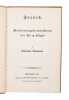
The uncommon first edition, in a lovely copy, of Kierkegaard's most humorous work. Published simultaneously with The Concept of Anxiety, Prefaces can be viewed as its companion piece. It represents an altogether different genre, but the two fictional authors of the works interestingly contrast each other. Although having been eclipsed by the now notoriously famous Concept of Anxiety, Prefaces was in fact more popular when it appeared and sold many more copies. Written under the pseudonym of Nicolaus Notabene, the “author” name indicates that despite its humorous approach, Prefaces is still something serious – something to be noted. And it certainly is. It is here that we find Kierkegaard’s sarcastic roasting of the Hegelian system and of the Danish Hegelians with Johan Ludvig Heiberg as the main representant. Through Notabene, he makes fun of Heiberg and Hegel, who both want to explain everything and want to be mediators of understanding. Just as Hafniensis in The Concept on Anxiety poses that “how sin came into the world each man understands solely by himself. If he would learn it from another, he would misunderstand it” (p. 51), so Notabene in Prefaces states that “My frame, my health, my entire constitution do not lend themselves to mediation” (p. 45). In Prefaces we also find Kierkegaard’s thoughts about the relationship between the reading public and the author and his fierce criticism of literary critics and reviewers. And in the very amusing preface to the Prefaces, we are given another glimpse into Kierkegaard’s thoughts on marriage and the dilemma he found himself in with Regine – the inner struggle between he, who is the husband and he, who is the author can one be both? With its challenging notions on the idea of the book and the interaction of the book with its readers, his little ironic masterpiece is a clear forerunner of Postmodernism Himmelstrup 7.
Stadier paa Livets Vei. Studier af Forskjellige. Sammenbragte, befordrede til Trykken og udgivne af Hilarius Bogbinder. - [""THE LEAP OF FAITH""]
Kjøbenhavn [Copenhagen], 1845. Lex8vo. Nice contemporary brown half cloth with gilt title to spine. Capitals worn and wear along upper front hinge. Corners worn. In spite of the wear, an attractive and tight copy. First and last leaves with a bit of brownspotting, otherwise only light occasional spotting. Old owner's signature to title-page. VIII, 383 pp.
![Stadier paa Livets Vei. Studier af Forskjellige. Sammenbragte, befordrede til Trykken og udgivne af Hilarius Bogbinder. - [""THE LEAP OF FAITH""]. ...](https://static.livre-rare-book.com/pictures/LLX/62096_1_thumb.jpg)
![Stadier paa Livets Vei. Studier af Forskjellige. Sammenbragte, befordrede til Trykken og udgivne af Hilarius Bogbinder. - [""THE LEAP OF FAITH""]. ...](https://static.livre-rare-book.com/pictures/LLX/62096_2_thumb.jpg)
![Stadier paa Livets Vei. Studier af Forskjellige. Sammenbragte, befordrede til Trykken og udgivne af Hilarius Bogbinder. - [""THE LEAP OF FAITH""]. ...](https://static.livre-rare-book.com/pictures/LLX/62096_3_thumb.jpg)
First edition of one of Kierkegaard's main works, ""Stages on Life's Way"", his pivotal sequal to his main work, ""Either-Or"", in which he had presented the first two stages, the aesthetic and the ethical. In ""Stages on Life's Way"", he continues his work on these stages and moves on to present also the religious stage, which takes up ab. two thirds of the work. The religious stage is that in which man attains a personal relationship with God and that in which man only truly begins to exist, as the aesthetic and ethical stages are inadequate. It is in this foundational work, in the religious stage, that Kierkegaard first properly describes what is now known as the ""Leap of Faith"" (in fact a ""leap to faith""), namely the leap that involves willing and belief in stead of reason and knowledge, the leap that you make in order to connect to God and which requires that which he calls ""the suspension of the ethical"". Stages on Life’s Way is one of Kierkegaard’s most important works. Not only does it sum up and explain some of the most important themes of Kierkegaard’s previous works, utilizing the characters and pseudonymous authors of the earlier works to do so" it goes beyond these foundational themes, introduces the religious stage, and points to the further development of the central themes in Kierkegaard’s philosophy, most of which are only fully developed in Concluding Unscientific Postscript.
Af en endnu Levendes Papirer. Udgivet mod hans Villie. - [KIERKEGAARD'S FIRST BOOK]
Kjøbenhavn, 1838. Ubeskåret, i et senere blankt omslag. Gennemgående skjold i øverste venstre hjørne, overvejende ganske svagt. Første og sidste blade mest påvirkede. X, 79pp.
Originaludgaven af Kierkegaards debut, -værket i hvilket han skarpt kritiserer H.C. Andersen, og i hvilket inspirationen fra Poul Martin Møller (til hvem han dedikerede værket ""Begrebet Angest"" - den eneste uden for familien, der er blevet beæret med en trykt dedikation af Kierkegaard) formenlig er tydeligst at spore. Den specielle titel kan med en vis rimelighed siges at hentyde til en villet videreførelse af den beundrede og på tidspunktet for udgivelsen netop afdøde Poul Martin Møllers nærmest upublicerede produktion. Den ""endnu Levende"" skulle således være ""Danmarks Gæde i Glæden over Danmark"", ""Mindet i den danske Sommer"", Poul Martin Møller, den mand, der ved sin person har inspireret Kierkegaard mere end nogen anden. Himmelstrup 6.Uncut in a very nice later halfleatherbdg. of dark red morocco w. green marbled paper and dark red gilt leather-title-label on front board. Gilt lines to back. (Oscar Jacobsen). Some brownspotting. X + 79pp.First edition of Kierkegaard's first work" -the work in which he sharply critisizes Hans Christian Andersen and ridicules the genre of fairy tales in general.
Atten opbyggelige Taler.
K., 1843-1845. 8vo. Smukt lidt senere hldrbd.m. rig rygforgyldn., ophøjet ""bind"", dannet af heftesnoren. 2. blad (indhold) repareret. Pp 1-50 m. svagt skjold for neden, ellers pæn. (Iv)+52+62+84+59+70+111pp.
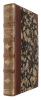
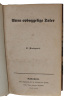
Originaludgave. Himmelstrup 85.First edition of Kierkegaard's important eighteen upbuilding discourses, which comprise his two, three, and four upbuilding discourses from the years 1843-45, with the joint title-page of all eighteen. The work constitutes Kierkegaard's religious works, which supplement his theological and philosophical ones.The first upbuilding discourses were published the same year as Either-Or, and it is interesting to note that in opposition to his major philosophical works, the religious upbuilding discourses actually bear the name of the author on the title-page, -a fact that was by no means incidental. While the pseudonymous works could make one doubt the religiousness of the author, the parallelly written religious discourses stress the fact that we are dealing with an author, who was religious from the very beginning, -a fact that Kierkegaard also wished to establish himself"" in his journals he clearly states that the religious discourses bear as much significance for his work as a whole as do the larger pseudonymous works, ""I began with ""Either-Or"" and two upbuilding discourses..."" he says, and explains that he intended the upbuilding, the religious, to advance, and that he wanted to show ""that the writer was not an aesthetic author who in the course of time grew older and for that reason became religious"" (Journals, IX A 227).The importance of the upbuilding discourses and the close relationship they have with the major works and Kierkegaard's philosophical development also becomes evident with the fact that every pseudonymous work was accompanied by a little collection of ""upbuilding discourses"" until ""Concluding Postscript"" appeared.
Atten opbyggelige Taler. - [THE UPBUILDING DISCOURSES]
Kjøbenhavn [Copenhagen], 1843-1845. 8vo. Near contemporary half calf with richly gilt spine. Binding with very light wear. Front free end-paper with the ownership-inscription of Michael Bentzon and his acquisition date of 1855 (the same year that Kierkegaard died). Some brownspotting here and there and the first couple of leaves of ""To opbyggelige Taler, 1844"" with a damp stain. Neat underlinings in the text as well as several marginalia, mostly in pencil. A very good copy indeed. (IV), 52, 62, 84, 59, 70, 111pp. Complete with all the half-titles and the joint title-page (without the blank leaf after the preface of ""To opbyggelige Taler, 1844"" - which is not called for and hardly ever present).
![Atten opbyggelige Taler. - [THE UPBUILDING DISCOURSES]. "KIERKEGAARD, SØREN.](https://static.livre-rare-book.com/pictures/LLX/53093_1_thumb.jpg)
![Atten opbyggelige Taler. - [THE UPBUILDING DISCOURSES]. "KIERKEGAARD, SØREN.](https://static.livre-rare-book.com/pictures/LLX/53093_2_thumb.jpg)
First edition of Kierkegaard's important Eighteen Upbuilding Discourses, which comprise his two, three, and four upbuilding discourses from the years 1843-45, with the joint title-page of all eighteen. The work constitutes Kierkegaard's religious works, which supplement his theological and philosophical ones.The first upbuilding discourses were published the same year as Either-Or, and it is interesting to note that in opposition to his major philosophical works, the religious upbuilding discourses actually bear the name of the author on the title-page, -a fact that was by no means incidental. While the pseudonymous works could make one doubt the religiousness of the author, the parallelly written religious discourses stress the fact that we are dealing with an author, who was religious from the very beginning, -a fact that Kierkegaard also wished to underline himself"" in his journals he clearly states that the religious discourses bear as much significance for his work as a whole as do the larger pseudonymous works, ""I began with ""Either-Or"" and two upbuilding discourses..."" he says, and explains that he intended the upbuilding, the religious, to advance, and that he wanted to show ""that the writer was not an esthetic author who in the course of time grew older and for that reason became religious"" (Journals, IX A 227).The importance of the upbuilding discourses and the close relationship they have with the major works and Kierkegaard's philosophical development is also stressed by the fact that every pseudonymous work was accompanied by a little collection of ""upbuilding discourses"" until ""Concluding Postscript"" appeared.Himmelstrup 85.
Atten opbyggelige Taler.
Kjøbenhavn [Copenhagen], P. G. Philipsens Forlag, 1843-1845. 8vo. Bound uncut in a recent pastiche cardboardbinding, imitating the original brown cardboard binding, in which it was issued. Printed pastice paper label to spine. Some brownspotting as always, due to the paper quality. (4), 52, 62, 84, 59 (recte 57 pp., i.e. without the blank leaf between the title-page and the preface), 70, 111 pp. Complete with all the titles and the joint title-page (without the blank leaf after the preface of ""To opbyggelige Taler, 1844"" - which is not called for and hardly ever present).
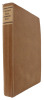
First edition of Kierkegaard's important eighteen upbuilding discourses, which comprise his two, three, and four upbuilding discourses from the years 1843-45, with the joint title-page of all eighteen. The work constitutes Kierkegaard's religious works, which supplement his theological and philosophical ones.The first upbuilding discourses were published the same year as Either-Or, and it is interesting to note that in opposition to his major philosophical works, the religious upbuilding discourses actually bear the name of the author on the title-page, a fact that was by no means incidental. While the pseudonymous works could make one doubt the religiousness of the author, the parallelly written religious discourses stress the fact that we are dealing with an author, who was religious from the very beginning, a fact that Kierkegaard also wished to establish himself"" in his journals he clearly states that the religious discourses bear as much significance for his work as a whole as do the larger pseudonymous works, ""I began with ""Either-Or"" and two upbuilding discourses..."" he says, and explains that he intended the upbuilding, the religious, to advance, and that he wanted to show ""that the writer was not an esthetic author who in the course of time grew older and for that reason became religious"" (Journals, IX A 227).The importance of the upbuilding discourses and the close relationship they have with the major works and Kierkegaard's philosophical development also becomes evident with the fact that every pseudonymous work was accompanied by a little collection of ""upbuilding discourses"" until ""Concluding Postscript"" appeared.Himmelstrup 85.
Atten opbyggelige Taler.
Kbh., 1843-45. Et nydeligt samtidigt hshirtbd. m. stregforgyldn. på ryg. Brunplettet. M. alle deltitelblade samt det fælles titelbl. (4), 52, 62, 84, 59, 70, 111 pp.Nice contemporary half cloth with single gilt lines to spine. Fully complete with all half titles and the joint title-page.
Originaludgave. Himmelstrup 85.First edition of Kierkegaard's important eighteen upbuilding discourses, which comprise his two, three, and four upbuilding discourses from the years 1843-45, with the joint title-page of all eighteen. The work constitutes Kierkegaard's religious works, which supplement his theological and philosophical ones.The first upbuilding discourses were published the same year as Either-Or, and it is interesting to note that in opposition to his major philosophical works, the religious upbuilding discourses actually bear the name of the author on the title-page, - a fact that was by no means incidental. While the pseudonymous works could make one doubt the religiousness of the author, the parallelly written religious discourses stress the fact that we are dealing with an author, who was religious from the very beginning, -a fact that Kierkegaard also wished to establish himself" in his journals he clearly states that the religious discourses bear as much significance for his work as a whole as do the larger pseudonymous works, ""I began with ""Either-Or"" and two upbuilding discourses..."" he says, and explains that he intended the upbuilding, the religious, to advance, and that he wanted to show ""that the writer was not an esthetic author who in the course of time grew older and for that reason became religious"" (Journals, IX A 227).The importance of the upbuilding discourses and the close relationship they have with the major works and Kierkegaard's philosophical development also becomes evident with the fact that every pseudonymous work was accompanied by a little collection of ""upbuilding discourses"" until ""Concluding Postscript"" appeared.Himmelstrup 85.
Af en endnu Levendes Papirer. Udgivet mod hans Villie. - [KIERKEGAARD'S FIRST BOOK]
Kjøbenhavn [Copenhagen], 1838. Lille 8vo. Pænt samtidigt halvlæderbind med enkelte, diskrete stregforgyldninger på ryg. False slidte, ellers ren og frisk. X + 79pp. Small 8vo. Nice contemporary half calf with discreet gilt lines to spine. Hinges with wear, but fine and tight. A large and unusually clean copy. X + 79pp.
Originaludgaven af Kierkegaards debut, -værket i hvilket han skarpt kritiserer H.C. Andersen, og i hvilket inspirationen fra Poul Martin Møller (til hvem han dedikerede værket ""Begrebet Angest"" - den eneste uden for familien, der er blevet beæret med en trykt dedikation af Kierkegaard) formenlig er tydeligst at spore. Den specielle titel kan med en vis rimelighed siges at hentyde til en villet videreførelse af den beundrede og på tidspunktet for udgivelsen netop afdøde Poul Martin Møllers nærmest upublicerede produktion. Den ""endnu Levende"" skulle således være ""Danmarks Gæde i Glæden over Danmark"", ""Mindet i den danske Sommer"", Poul Martin Møller, den mand, der ved sin person har inspireret Kierkegaard mere end nogen anden. Himmelstrup 6.First edition of Kierkegaard's first work" -the work in which he sharply critisizes Hans Christian Andersen and ridicules the genre of fairy tales in general.

