 Write to the booksellers
2650 books for « j michelet »Edit
-
Type
Any type (7)
Autograph (6)
Book (2707)
Magazine (1)
Old papers (1)
-
Latest
Last 24h (2)
Last 3 days (1)
Last month (209)
-
Language
French (2721)
Russian (1)
-
Century
19th (473)
20th (859)
21st (202)
-
Countries
Belgium (77)
Canada (2)
Côte d'Ivoire (1)
Denmark (5)
France (2502)
Germany (7)
Greece (2)
Switzerland (125)
United States of America (1)
-
Syndicate
ALAC (2)
CLAM (2)
CLAQ (1)
CNE (1)
ILAB (1089)
NVVA (21)
SLACES (21)
SLAM (1055)
SNCAO (5)
Topics
- Age (9)
- Agriculture (14)
- Animals (8)
- Archaeology (7)
- Autographs (21)
- Bible (5)
- Biography (44)
- Birds (13)
- Brittany (5)
- Children’s books (19)
- Colette (4)
- Cooking (4)
- Dedication (13)
- Early printed books (27)
- Economics (7)
- Education (11)
- Education - morals (9)
- Entomology (16)
- Europe (5)
- Family (6)
- Farmers (5)
- Feminism (5)
- First edition (31)
- Foulquier (6)
- Genealogy (11)
- Geography (29)
- Giacomelli (10)
- Hachette (6)
- Helvética (8)
- History (284)
- Industrial arts & crafts - fine arts (6)
- Iron (4)
- Jesuits (6)
- Joan of arc (10)
- Law (12)
- Limousin (6)
- Literature (587)
- Literature 19th century (5)
- Magazine (7)
- Manuscripts (6)
- Memories (7)
- Michelet claude (315)
- Michelet edmond (12)
- Michelet jules (644)
- Michelet marcel (5)
- Middle ages (19)
- Mountain (5)
- Navy (7)
- Newspapers press (11)
- Occult (5)
- Ornithology (14)
- Papus (7)
- Paris (10)
- Philosophy (13)
- Photography (10)
- Pléiade & album de la (9)
- Poetry (12)
- Poland (5)
- Policy (11)
- Protestantism (5)
- Reform (6)
- Regionalism (9)
- Religions (19)
- Reliure (10)
- Review (11)
- Reviews (10)
- Revolution 1789 (21)
- Romanticism (6)
- Russia (10)
- Saga (5)
- Sciences (13)
- Scores (6)
- Short stories (6)
- Social sciences (6)
- Sociology (12)
- Switzerland (10)
- Symbolism (6)
- Teaching (4)
- Theology (4)
- Various (180)
- War (19)
- Witchcraft (6)
- Women (the) (6)
- Woods & woods’ price lists (9)
- Youth (4)
L'Oiseau
Paris.Hachette & Cie.1867.In-4 en plein maroquin vert signé Mercier,successeur de son père,1914..210 vignettes par Giacomelli.er tirage sur vélin teinté auquel il a été ajouté en frontispice,une aquarelle originale sur Japon,une seconde aquarelle originale,et une lettre autographe de Jules Michelet datée de 1862. Etat exceptionnel.Reliure sous étui,aux plats ornés de 6 filets brisés, de rangs de perles,de rosaces mosaiquées,dos à l'identique.Les doublures en maroquin blanc ont un semis de violettes,feuilles,fleurs,boutons dorés.Les gardes sont en faille verte.Tranches dorées.Lettre manuscrite de Jules Michelet.Dorure de Maylander.


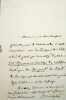
Lettre autographe signée au poète Pongerville
Jules Michelet (1798-1874), historien. L.A.S., sd [1839], 1p in-8. Au poète Jean-Baptiste Sanson de Pongerville (1782-1870). « monsieur et cher confrère, permettez-moi de recommander à votre bienveillance une traduction très belle et très élégante qui concourt pour le prix : Job, Psaumes et Cantique des Cantiques trad. par M. Dargaud. La trad. du Cantique particulièrement me paraît digne d'obtenir votre suffrage. Recevez monsieur et cher confrère l'assurance de mon dévouement. Michelet ». Jean-Marie Dargaud (1800-1866) avait en effet publié ces différentes traductions en 1838-1839. [493]
MON PERE EDMOND MICHELET MICHELET, CLAUDE
ROBERT LAFFONT Pliures au dos, coins cornés, aspect jauni.
Merci de nous contacter à l'avance si vous souhaitez consulter une référence dans notre boutique à Authon-du-Perche.
Michelet. Le Peuple : . Introduction et notes par Robert Casanova [Unknown Binding] Michelet, Jules and Casanova, Robert
Jaunissement des bords des pages. Collection littérature n°28. Taches rousses sur le bord externe du recto de couverture.
Merci de nous contacter à l'avance si vous souhaitez consulter une référence dans notre boutique à Authon-du-Perche.
J. Michelet. La Mer : . 8e édition [Unknown Binding] Michelet, Jules
RELIURE DE RANDEYNES. DEMI CHAGRIN. RELIE. 1882. 428 PAGES. COINS DE LA COUVERTURE FROTTES. QUELQUES ROUSSEURS SUR LES PAGES. PHOTOS SUR DEMANDEPHOTOS SUR DEMANDE
Merci de nous contacter à l'avance si vous souhaitez consulter une référence dans notre boutique à Authon-du-Perche.
J. Michelet. La Mer : . 8e édition [Unknown Binding] Michelet, Jules
Photo sur demande. Demi-reliure cuir marron cinq nerfs, titres et décors dorés.
Merci de nous contacter à l'avance si vous souhaitez consulter une référence dans notre boutique à Authon-du-Perche.
[Revue La Plume, Collectif dont] Papus, Stanislas de Guaita, Emile Michelet, Jules Bois, Cazals, etc.,
Reference : 021352
La Plume, Littéraire, Artistique et Sociale - n°78 du 15 juillet 1892 ) numéro exceptionnel consacré à la Magie, sous la direction de Papus.
[Revue La Plume, Collectif dont] Papus, Stanislas de Guaita, Emile Michelet, Jules Bois, Cazals, etc., La Plume, Littéraire, Artistique et Sociale - n°78 du 15 juillet 1892 ) numéro exceptionnel consacré à la Magie, sous la direction de Papus. Paris, 1892. In-8, paginé 317 à 338. Fameuse revue Fin-de-Siècle publiant essentiellement de l'inédit. Portrait de Papus (compris dans la pagination). Broché. [I]


[Revue La Plume, Collectif dont] Papus, Stanislas de Guaita, Emile Michelet, Jules Bois, Cazals, etc.,
Reference : 021353
La Plume, Littéraire, Artistique et Sociale - n°78 du 15 juillet 1892 ) numéro exceptionnel consacré à la Magie, sous la direction de Papus.
[Revue La Plume, Collectif dont] Papus, Stanislas de Guaita, Emile Michelet, Jules Bois, Cazals, etc., La Plume, Littéraire, Artistique et Sociale - n°78 du 15 juillet 1892 ) numéro exceptionnel consacré à la Magie, sous la direction de Papus. Paris, 1892. In-8, paginé 317 à 338. Fameuse revue Fin-de-Siècle publiant essentiellement de l'inédit. Portrait de Papus (compris dans la pagination). Broché. Bon exemplaire. [II]


[Revue La Plume, Collectif dont] Papus, Stanislas de Guaita, Emile Michelet, Jules Bois, Cazals, etc.,
Reference : 021354
La Plume, Littéraire, Artistique et Sociale - n°78 du 15 juillet 1892 ) numéro exceptionnel consacré à la Magie, sous la direction de Papus.
[Revue La Plume, Collectif dont] Papus, Stanislas de Guaita, Emile Michelet, Jules Bois, Cazals, etc., La Plume, Littéraire, Artistique et Sociale - n°78 du 15 juillet 1892 ) numéro exceptionnel consacré à la Magie, sous la direction de Papus. Paris, 1892. In-8, paginé 317 à 338. Fameuse revue Fin-de-Siècle publiant essentiellement de l'inédit. Portrait de Papus (compris dans la pagination). Broché. Couvertures détachées, première couverture déchirée doublée au japon. [III]


Histoires des paysans de France Michelet, Claude
Seine Edition de 1996, traces sur verso, coins cornés, intérieur propre.
Merci de nous contacter à l'avance si vous souhaitez consulter une référence dans notre boutique à Authon-du-Perche.
Présence d'esprit Michelet, Frederic
PHOTOS SUR DEMANDE
Merci de nous contacter à l'avance si vous souhaitez consulter une référence dans notre boutique à Authon-du-Perche.
La Grande muraille Michelet, Claude
Robert Laffont PHOTOS SUR DEMANDE
Merci de nous contacter à l'avance si vous souhaitez consulter une référence dans notre boutique à Authon-du-Perche.
IAD - CENT PLUS BEAUX CHANTS T MICHELET, CLAUDE
Le Cherche Midi Couverture très légèrement cornée.
Merci de nous contacter à l'avance si vous souhaitez consulter une référence dans notre boutique à Authon-du-Perche.
Précis de l'histoire de France MICHELET, JULES
TEMPUS PHOTOS SUR DEMANDE
Merci de nous contacter à l'avance si vous souhaitez consulter une référence dans notre boutique à Authon-du-Perche.
La sorcière Michelet
Attention edition est de 1982.
Merci de nous contacter à l'avance si vous souhaitez consulter une référence dans notre boutique à Authon-du-Perche.
HISTOIRE DE LA REVOLUTION FRANCAISE DU XIX SIECLE. [Paperback] MICHELET JULES
cartonné. léger choc à la coiffe.
Merci de nous contacter à l'avance si vous souhaitez consulter une référence dans notre boutique à Authon-du-Perche.
Quand ce jour viendra [Paperback] Claude Michelet
Robert Laffont PHOTOS SUR DEMANDE
Merci de nous contacter à l'avance si vous souhaitez consulter une référence dans notre boutique à Authon-du-Perche.
Mon pere edmond michelet. [Paperback]
PHOTOS SUR DEMANDE
Merci de nous contacter à l'avance si vous souhaitez consulter une référence dans notre boutique à Authon-du-Perche.
Les abeilles de Virgile Michelet, Jules
Sequences PHOTOS SUR DEMANDE
Merci de nous contacter à l'avance si vous souhaitez consulter une référence dans notre boutique à Authon-du-Perche.
Les copains d'Aristide : Histoires d'ici et d'ailleurs Michelet, Claude
France loisirs POCHE EN TRÈS BON ÉTAT.
Merci de nous contacter à l'avance si vous souhaitez consulter une référence dans notre boutique à Authon-du-Perche.
Des grives aux loups Michelet, Claude
Seine BROCHE EN TRES BON ETAT. Seine, 1992.
Merci de nous contacter à l'avance si vous souhaitez consulter une référence dans notre boutique à Authon-du-Perche.
Précis de l'histoire de France MICHELET, JULES
TEMPUS POCHE EN TRES BON ETAT.
Merci de nous contacter à l'avance si vous souhaitez consulter une référence dans notre boutique à Authon-du-Perche.
Rue Jean Jaurès [Paperback] Michelet, Frederic
L'Entretemps Editions BROCHE
Merci de nous contacter à l'avance si vous souhaitez consulter une référence dans notre boutique à Authon-du-Perche.
Quand ce jour viendra [Paperback] Claude Michelet
Robert Laffont BROCHE
Merci de nous contacter à l'avance si vous souhaitez consulter une référence dans notre boutique à Authon-du-Perche.
histoire de france [Hardcover] michelet jules
PHOTOS SUR DEMANDE
Merci de nous contacter à l'avance si vous souhaitez consulter une référence dans notre boutique à Authon-du-Perche.

