 Write to the booksellers
2072 books for « f p wilson »Edit
-
Type
Any type (1)
Autograph (1)
Book (2043)
Disk (1)
Magazine (1)
Music sheets (16)
New book (2)
Postcards (7)
-
Latest
Last 24h (1)
Last 3 days (13)
Last month (7)
Last week (4)
-
Language
Dutch (1)
English (21)
French (2040)
German (1)
Italian (2)
Russian (6)
Spanish (1)
-
Century
14th (1)
16th (1)
18th (14)
19th (42)
20th (979)
21st (255)
-
Countries
Belgium (102)
Canada (20)
China (1)
Côte d'Ivoire (4)
Denmark (20)
France (1746)
Germany (2)
Greece (1)
Netherlands (7)
Switzerland (157)
United Kingdom (6)
United States of America (6)
-
Syndicate
ALAC (16)
CLAM (7)
CLAQ (11)
ILAB (862)
NVVA (14)
SLACES (14)
SLAM (782)
SNCAO (1)
Topics
- Anticipation (11)
- Archaeology (15)
- Architecture (20)
- Army (8)
- Australia (6)
- Belgium (6)
- Biography (8)
- Buddhism (6)
- Chemistry (5)
- Children’s books (28)
- China (7)
- Christianity (6)
- Cinema (5)
- Civilisation (6)
- Collections (7)
- Comic strip (79)
- Cooking (77)
- Culinary art (53)
- Detective novels (14)
- Dickens charles (7)
- Drawings (25)
- Drink (13)
- Early printed books (5)
- Economics (6)
- Egypt (8)
- England (14)
- English (55)
- Entomology (12)
- Erotic (8)
- Esotericism (8)
- Ethnology (9)
- Europe (8)
- Fantastic (11)
- Fantasy (9)
- Fine arts (17)
- First edition (27)
- Flora (7)
- Fox (10)
- Gastronomy (10)
- Geography (8)
- Germanic languages (6)
- Germany (5)
- Grey-wilson christopher (5)
- Hackney (16)
- History (54)
- Hunting (5)
- Industrial arts & crafts - fine arts (5)
- Jazz (11)
- Joyce james (11)
- Linguistics (5)
- Literature (188)
- Medicine (8)
- Military arts (6)
- Mitchell margaret (14)
- Museums (10)
- Navigation (5)
- Navy (9)
- New caledonia (5)
- Pacific (8)
- Painting (6)
- Paris (6)
- Philippines (5)
- Philosophy (26)
- Photography (21)
- Physics (9)
- Poetry (7)
- Policy (6)
- Postcards (7)
- Psychology (12)
- Quebec (12)
- Religions (18)
- Review (9)
- Reviews (6)
- Robin (6)
- Rock (10)
- Rock (10)
- Romance (11)
- Science fiction (38)
- Sciences (12)
- Scores (21)
- Shipwreck (6)
- Songs (17)
- Spain (7)
- Spying (7)
- Tahiti (5)
- Tea (13)
- Testimonies / stories (7)
- Theatre (9)
- Theology (10)
- Translation (11)
- Travel (8)
- United kingdom (14)
- United states (14)
- Various (18)
- Vocabulary (6)
- War (28)
- Williams tennessee (12)
- Wilson edmund (16)
- Youth (19)
- Zen (6)
A History of British Quadrupeds including the cetacea. Second edition revised an partly re-written bin the author, assisted by Robert F. Tomes and Edward Richard Alston.
London, John van Voorst 1874. Gross-8°. XVIII, 474 S., 2 n.n. S.Anzeigen. Mit 160 Xylographien im Text. Dunkelgrüner Originalleinwandband.
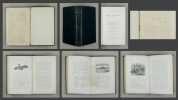
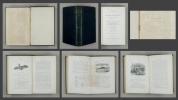
Überarbeitete Fassung der Ausgabe von 1837. - Wellcome 2, 138 (dort mit 1836 und only part III) des erfolgreichen populären zoologischen Werkes. - Auf dem fliegenden Vorsatz mit dem handschriftlichen Besitzvermerk "Edward A. Wilson. Oct. 1905", auf dem fliegenden Vorsatz, darunter von anderer Hand in Bleistift "Scott's last expedition. This book was taken to the Antarctic by E.A.Wilson 1910 - 1913". Obwohl die Innenfälze des Vorder- und Hinterdeckels angebrochen sind, das obere Kapital leicht angerissen und der Einbandbezug leicht fleckig, scheint mir persönlich der Zustand des Exemplares zu gut erhalten für einen Artefakten der berühmten Geschichte von Scotts 2. Antarktik Expedition, bei der Edward A. Wilson, zusammenn mit Scott und Henry „Birdie" Bowers am 29. März 1912 verstarb. Wilson (1872-1912), Mediziner und Zoologe, war bereits an der Discovery-Expedition von 1901-1904 als wissenschaftlicher Leiter beteiligt. Zurück von der mehrjährigen Reise erholte er sich im Sommer 1905 in Irland von den Strapazen der unzähligen öffentlichen Auftritten, Vorträgen und Einladungen. Dabei kam er in Kontakt mit dem Naturalisten Barrett-Hamiltonn der ihn als Illustrator für eine neue Monografie der " A History of British Mammals" engagierte. Wilson lebte im Herbst 1905 in Bushey, einem Künstlerort in der Nähe von London. Obwohl er keine akademische Kunstausbildung besass, wurden seine zoologischen Illustrationen zu Standards der Naturgeschichte Grossbritanniens. Über den Verbleib seiner Bibliothek scheint nichts bekannt zu sein. - Revised version of the 1837 edition - Wellcome 2, 138 (there with 1836 and only part III) of the successful popular zoological work. - With the handwritten ownership note 'Edward A. Wilson. Oct. 1905', on the flyleaf, underneath in another hand in pencil 'Scott's last expedition. This book was taken to the Antarctic by E.A.Wilson 1910 - 1913'. Although the inner folds of the front and back cover are cracked, the upper capital slightly torn and the cover slightly stained, the condition of the copy seems to me personally too well preserved for an artefact of the famous history of Scott's 2nd Antarctic expedition, during which Edward A. Wilson, together with Scott and Henry 'Birdie' Bowers, died on 29 March 1912. Wilson (1872-1912), a physician and zoologist, had already been involved in the Discovery Expedition of 1901-1904 as scientific director. After travelling for several years, he returned to Ireland in the summer of 1905 to recover from the strain of countless public appearances, lectures and invitations. He came into contact with the naturalist Barrett-Hamiltonn, who engaged him as an illustrator for a new monograph of 'A History of British Mammals'. In the autumn of 1905, Wilson was living in Bushey, an artists' village near London. Although he had no academic art training, his zoological illustrations became standards in the natural history of Great Britain. Nothing seems to be known about the whereabouts of his library.

"WILSON, C.T.R. - THE MOST ORIGINAL AND WONDERFUL INSTRUMENT IN SCIENTIFIC HISTORY - WILSON'S CLOUD CHAMBER.
Reference : 45816
(1913)
Über die Expansionsapparat zur Sichtsbarmachung der Bahnen ionisierender Teilchen in Gasen, und über einige mittels dieses Apparats gewonnene Ergebnisse. Mit 23 Figuren im Text und auf 5 Tafeln. (Eingegangen 6. Oktober 1912). (On an Expansion Apparatu...
Leipzig, S. Hirzel, 1913. 8vo. Orig. printed wrappers, no backstrip. Wrappers loose. In ""Jahrbuch der Radioaktivität und Elektronik"", 10. bd., Heft 1. Pp. 1-138 (entire issue offered). Wilson's paper: pp. 34-54, textillustrations, showing apparatus and 5 photographic plates, showing ionizing by Alpha-, Beta- and Röntgen- radiation).
Together with the English version - published 1912 in the Proceedings of the Royal Society - this is Wilson's main paper relating ""that the track of an ionizing particle might be made visible and photographed by condensing water of the ions which is liberated"". The first trails were obtained in 1911 where he submitted a short note of this to the Proceedings. In the offered paper he published the first tracks made by the ionizing particles of alpha, beta and Röntgen-rays. This, Wilson Cloud-Chamber, became an extremely valuable instrument of fundamental research, the discovery of the positron in 1932 and the kaon in 1963 were made by using cloud chambers as detectors.""But the whole course of the particle appears infinitely more clearly by the method invented by C.T.R. Wilson in 1911 and named after him. The radiation is allowed to enter an expansion-chamber, containing a gas saturated with water vapour. A sudden expansion of the chamber cools the gas, and cloud-drops are then formed instantly around the ions produced along the tracks of the particles. By suitable illumination these tracks can be made to stand out clearly as if they had been described by luminous projectiles. The ""Altmeister"" of modern nuclear physics, Lord Rutherford, once called the Wilson chamber ""the most original and wonderful instrument in scientific history"".""Thomson Rees Wilson (1869-1959), a Scottish physicist, is credited with inventing the cloud chamber. Inspired by sightings of the Brocken spectre while working on the summit of Ben Nevis in 1894, he began to develop expansion chambers for studying cloud formation and optical phenomena in moist air. Very rapidly he discovered that ions could act as centers for water droplet formation in such chambers. He pursued the application of this discovery and perfected the first cloud chamber in 1911. In Wilson's original chamber the air inside the sealed device was saturated with water vapor, then a diaphragm is used to expand the air inside the chamber (adiabatic expansion). This cools the air and water vapor starts to condense. When an ionizing particle passes through the chamber, water vapor condenses on the resulting ions and the trail of the particle is visible in the vapor cloud. Wilson, along with Arthur Compton, received the Nobel Prize in Physics in 1927 for his work on the cloud chamber. (Wikipedia).
"WILSON, C.T.R. - THE ""WILSON-CLOUD-CHAMBER"" BROUGHT TO PERFECTION.
Reference : 47063
(1923)
Investigations on X-Rays and Beta-Rays by the Cloud Method.. Part I. - X-Rays. Part II. - Beta-Rays. (2 Papers).
London, Harrison and Sons, 1923. Royal8vo. Contemp. full cloth, gilt lettering to spine. A small stamp to verso of titlepage and on foot of a few leaves.. In: ""Proceedings of the Royal Society"", Series A, Vol. 104. VI,(6),676,XXXII pp., textillustr. and plates. (Entire volume offered). Wilson's papers: pp. (1-) 24 and 12 plates + pp. 192-212 and 9 plates.
First printing of the paper in which Wilson had brought his Cloud Chamber to perfection and showed the photographic tracks of the particles. The Cloud Chamber was the first detector of radioacticity and nuclear transmutations and it played an importent role in experimental particle physics e.g. the discovery of the positron. Wilson received the Nobel prize - together with Arthur Compton - in physics in 1927 for his work on the Cloud Chamber.""The 21 cloud chamber pictures of X-rays and beta-rays on coated stock printed recto only were the culmination of many years research by Wilson and at last showed the full potential of this method as a tool for particle physicists. Early in 1911 (Wilson) was the first person to see and photograph the tracks of individual alpha-particles and electrons. The event aroused great interest as the paths of the alpha-particle were just as W.H. Bragg had drawn them in publication some years earlier. But it was not until 1923 (the paperoffered) that the clous chamber was brought to perfection and led to his two, beautifully illustrated classic papers on the track of electron."" (The Nobel Foundation).
The Ephemera of Adrian Wilson : an annotated list, 1944-1988
Tuscany Alley | San Francisco 1994 | 27 x 39 cm | 2 volumes reliures en de l'éditeur, sous étui
Edition originale, un des 75 exemplaires numérotés sur Rives, seul tirage avec 10 également sur Rives signés par Adrian Wilson et 3 hors commerce. Reliures en pleine toile crème, dos lisses, exemplaire bien complet de son étui. Ouvrage illustré de nombreux bois originaux d'Adrian Wilson. Notre exemplaire est bien complet de sa chemise qui renferme une cinquantaine de pièces imprimées représentatives du travail d'imprimeur d' Adrian Wilson. Rare et très bel exemplaire. - Photographies et détails sur www.Edition-Originale.com -

- Wilson Brian,Wilson Carl,Wilson Dennis,Jardine Al - Wilson Brian,Jardine Al
Reference : 89324
(1968)
On the Condension Nuclei produced in Gases by the Action of Röntgen Rays, Uranium Rays, Ultra-violet Light, and other Agents. Received October 29, - Read November 24, 1898.
(London, Harrison and Sons, 1899). 4to. No wrappers as extracted from ""Philosophical Transactions"", Vol. 192 - Series A. Pp. 403-453. Textillustrations. Clean and fine.
First printing of Wilson's second importent paper describing his further experiments with his ""Cloud Chamber"".""To the period 1895-1912 belongs the development of an instrument which to my mind is the most original and wonderful in scientific history.I refer to the cloud or expansion chamber of C.T.R. Wilson...It was a wonderful advance to be able to se, so to speak, the details of the adventures of these particles in their flight through the gas....""(Lord Rutherford).""C.T.R. Wilson had been developing his cloud-chamber, which was to provide the most powerfull of all methods of investigation in atomic physics. In moist air, if a certain degree of supersaturation is exceeded this can be secured by a sudden expansion of the air) condensation takes place on dust-nuclei, when any are present: if by preliminary operations condensation is made to take place on the dust-nuclei, and the resulting droplets are allowed to settle, the air in the chamber is thereby freed from dust. If now X-rays or radiation from a radioactive substance are passed into the chamber, and if the degree of supersaturation is sufficient, condensation again takes place: this is due to the production of ions by the radiation. Thus the tracks of ionising radiations can be made visible by the sudden expansion of a moist gas, each ion becoming the centre of a visible globule of water. Wilson showed that the ions produced by uranium radiation were identical with those produced by X-rays."" (Whittaker in ""A History of the Theories of Aether and Electricity."" II, p. 4).
"WILSON, C.T.R. - THE INVENTION OF THE WILSON ""CLOUD CHAMBER""
Reference : 42616
(1897)
Condensation of Water Vapour in the Presence of Dust-free Air and other Gases. Communicated by J.J. Thomson. Received March 15, - Read April 8, 1897.
(London, Harrison and Sons, 1897). 4to. No wrappers as extracted from ""Philosophical Transactions"" Year 1897, Volume 189 - Series A. - Pp. 265-307. Clean fine. Textillustrations, depicting Wilson's famous apparatus
First printing of this groundbreaking paper in which Wilson describes the invention which made it possible to view the track of a single atomic projectile or electron. The invenvention of the ""Dust-Chamber"" made it possible for J.J. Thomson in 1897 to calculate the charge of the electron, and thereby finding its mass, since the ratio between the two was known. In most cases it was found that the track of the particle is a straight, or nearly straight line.""C.T.R. Wilson had been developing his cloud-chamber, which was to provide the most powerfull of all methods of investigation in atomic physics. In moist air, if a certain degree of supersaturation is exceeded this can be secured by a sudden expansion of the air) condensation takes place on dust-nuclei, when any are present: if by preliminary operations condensation is made to take place on the dust-nuclei, and the resulting droplets are allowed to settle, the air in the chamber is thereby freed from dust. If now X-rays or radiation from a radioactive substance are passed into the chamber, and if the degree of supersaturation is sufficient, condensation again takes place: this is due to the production of ions by the radiation. Thus the tracks of ionising radiations can be made visible by the sudden expansion of a moist gas, each ion becoming the centre of a visible globule of water. Wilson showed that the ions produced by uranium radiation were identical with those produced by X-rays."" (Whittaker in ""A History of the Theories of Aether & Electricity"" II:p.4).
Relation des Îles Pelew, situées dans la partie occidentale de l'Océan Pacifique ; composée sur les journaux et les communications du Capitaine Henri Wilson, et de quelques-uns de ses officiers, qui en Août Mil Sept Cent Quatre-Vingt-Trois, y ont fait naufrage sur l'Antelope, Paquebot de la Compagnie des Indes Orientales.
Paris, Maradan, 1793. 1788 2 vol. in-8° (195 x 131 mm) de : I. [2] ff., 280 pp., [1] f.bl. ; II. [2] ff., 272 pp., [2] ff. bl.; 1 portrait frontispice, 1 carte dépliante, 16 planches gravées. Plein maroquin rouge d'époque, dos lisse orné, pièces de titre et de tomaison de maroquin fauve, filet et frises encadrant des plats, roulette dorée sur les coupes, tranches dorées.
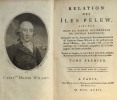
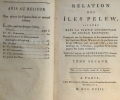
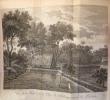
Seconde édition française, parue la même année que l'originale anglaise (EO: 1788). En 1783, le capitaine de vaisseau Henry Wilson (décédé en 1810) qui était au service de la compagnie des Indes fait naufrage près de la petite île, appelée Ouroulong, près des Pelew. Ce récit est la relation du séjour prolongé de ce groupe danglais sur les îles Pelew de Mindanao. Ce contact avec les insulaires donne lieu à des descriptions de leur comportement, de leurs murs, de leur mode de vie qui sont du plus haut intérêt. Aba-Thoulé, chef du pays, reçut Wilson avec beaucoup d'humanité, lui donna un petit bâtiment pour rentrer dans sa patrie et lui confia même son fils, Li-Bon pour l'éduquer et introduire dans les moeurs et les arts de l'Europe. Le jeune homme mourut de la petite vérole à la fin de 1784. Un vocabulaire de la langue Pelew occupe les pages 251 à 267. Boucher de la Richarderie est assez sceptique quant au portrait idyllique de ces îles brossé alors par lauteur : "L'existence de ces îles, où Wilson et son équipage ont trouvé un peuple dont les nations les plus civilisées de l'Europe pourraient envier les vertus morales, a paru douteuse à quelques personnes et surtout en France, malgré tous les droits que le rédacteur paraît avoir à la confiance à ses lecteurs. Mais ce doute pourrait bien ne tenir qu'à l'espèce de fatalité qui, depuis la publication en Angleterre du Voyage original, jusqu'à sa traduction en français, semble avoir toujours dérobé l'approche et la connaissance de ces îles aux navigateurs." L'ouvrage est illustré de dix-sept planches : frontispice représentant le capitaine Wilson d'après Russel et gravé par Mme Massard, des cartes, portraits, vues... Bel exemplaire. Cox III, 302-303 - Chadenat 3258: "Relation très recherchée" - Boucher de la Richarderie VI, 552. 2 vol. 8vo. 1 frontipiece portrait, 16 engraved plates. First French edition, published the same year than the London OE, of this classical relation of the shipwreck of Henri Wilson and his crew on Ouroulong, little island nearby the Pelew Islands. They stayed a long time there, long enough to bring back very precious ethnographical informations, and a description of an "idyllic" society, a people "from whom the most civilized European nations should envy their virtue." (Boucher de la Richarderie). Fine copy.
Catastrophes in Context. Disaster and Response in the Roman and Early Byzantine World
, Brepols, 2026 Hardback, Pages: xvi + 297, Size:216 x 280 mm, Illustrations:22 b/w, 58 col., 26 tables b/w., Language: English. ISBN 9782503623641.
Summary Catastrophes in Context: Disaster and Response in the Roman and Early Byzantine World explores how people in the ancient world lived through, reacted to, and recovered after major crises. From earthquakes and eruptions to shortages, plagues, and sudden environmental shifts, the book shows disasters not as stand-alone events but as moments that changed communities in lasting ways. Drawing on a wide mix of evidence such as archaeological remains, texts, landscapes, and scientific data, it brings together engaging case studies that highlight real human experiences of fear, loss, recovery, and resilience. The contributors offer new ways to understand how ancient societies coped with catastrophic events, what resources they relied on, and how they adapted to new realities. Comprehensive, engaging, and wide-ranging, this volume presents the ancient world through the lens of challenge and response, showing how crises shaped everyday life and long-term history. TABLE OF CONTENTS List of Illustrations List of Contributors Preface 1. Catastrophe and Response in the Ancient World Rubina Raja and Andrew Wilson 2. War and Urbanism: The Boudican Revolt and the Reconstruction of Londinium Lacey Wallace 3. Re-evaluating the Impact of the Earthquake(s) of AD 62/63 in Roman Pompeii Michael A. Anderson 4. The Catastrophic AD 79 Eruption of Vesuvius: Survivors and Post-eruption Intervention at the Local and Imperial Level in Four Communities Steven L. Tuck 5. The Economic Impact of the Antonine Plague Andrew Wilson 6. Catastrophes and Resilience: The Archaeology of Crises at Palmyra, 150-272 Olympia Bobou and Rubina Raja 7. Cyrenaica and the Plague of Cyprian Andrew Wilson 8. Catastrophes and the Dynamic Landscape of Thonis-Heracleion Damian Robinson and Franck Goddio 9. Catastrophic(?) Floods in the Roman North: Chronologies, Causes, and Contexts Tyler Franconi 10. Resilience in Late Fifth-Century Aphrodisias: An Archaeological Perspective from the Tetrapylon Street Ine Jacobs 11. The Environmental Context for the Outbreak of the Justinianic Plague in the Mediterranean Brandon McDonald, Andrew Wilson, and Arietta Papaconstantinou 12. Contextualizing Late Antique Natural Disasters: The Elements and Effects of the Late Antique Little Ice Age and the Justinianic Plague Brandon McDonald Errata to 'The Environmental Context for the Outbreak of the Justinianic Plague in the Mediterranean' (Brandon McDonald, Andrew Wilson, and Arietta Papaconstantinou) (https://doi.org/10.1484/M.STIA-EB.5.155908)
Relation des îles Pelew, situées dans la partie occidentale de l'océan Pacifique.
Paris Chez Maradan 1793 2 vol. relié 2 vol. in-8, basane tabac racinée, dos lisses avec pièces de titre et de tomaison de maroquin rouge et de filets, fleurons et dentelle dorés (mors supérieur fendillé sinon élégante reliure d'époque un peu usée), 280 et 272 pp. Seconde édition de la traduction française établie par le comte de Mirabeau. Notre exemplaire comporte 16 planches (sur les 17 annoncées) : un portrait-frontispice du navigateur Wilson (gravé par Mme Massard), les portraits d'Abba Thullé, roi de Koror, de l'une de ses épouses et du prince Lee Boo, la grande carte dépliante des îles Pelew et 11 planches dépliantes (dont 6 représentant des objets ethnographiques). Découvert par les Espagnols dès 1543, l'archipel Palaos (en Micronésie) a été décrit pour la première fois sous le nom d'Iles Pelew par le capitaine britannique Henry Wilson, qui fit naufrage en 1783 sur l'îlot d'Ulong entre Koror et Peleliu, et y séjourna le temps de réparer son navire avec l'aide du grand chef de Koror, Ibedul. Wilson put regagner Macao après un séjour de trois mois, accompagné de Lee Boo, le second fils du roi qui est de fait l'un des premiers océaniens à visiter l'Angleterre (cf. son beau portrait en habits européens). Hélas, Lee Boo mourut de la petite vérole cinq mois après son arrivée... Ce récit a largement contribué à conforter les mythes du bon sauvage et des îles paradisiaques. Un précieux lexique de vocabulaire de la langue Pelew occupe les pages 251 à 267. Il manque à notre exemplaire la planche-objet n° 1 (qui est souvent retranchée). On joint un tome I seul de la même édition auquel manquent la carte et deux planches mais dont on a très soigneusement aquarellé les portraits du capitaine Wilson, du roi de Thullé et un paysage. Bonne réunion en dépit des manques.
"WILSON, C.T.R. - THE IMPROVED VERSION OF ""WILSONS CLOUD-CHAMBER"".
Reference : 46922
(1911)
On a Method of making Visible the Paths of Ionising Particles through a Gas.
London, Harrison and Sons, 1911. Small 4to. Contemp. full cloth. Spine gilt and with gilt lettering. A stamp to verso of titlepage and a few other leaves. In: ""Proceedings of the Royal Society of London. Series A."", Vol. LXXXV. XXIII,605,XXIV pp. and 11 plates. (Entire volume offered). Wilson's paper: pp. 285-288 a. 1 plate. Clean and fine.
First appearance of the paper which describes the final version of his invention, the famous Cloud-Chamber, - the first Cloud Chamber was invented by him in 1896 - for making visible and photographing the paths of charged particles, an invention for which Wilson received a share of the Nobel Prize in 1827. By using the Cloud Chamber he was here (1911) able to observe the track of an alpha ray by condensing water drops onto the ions produced by its passage.The Cloud Chamber, which Rutherford called ""the most original apparatus in the whole history of physics"", became standard equipment in physics laboratories, and made possible numerous important discoveries in the fields of particle and nuclear physicsAfter 1896 ""Wilson continued to experiment with ultraviolet radiation and other techniques for producing condensation effects, but soon concentrated on atmospheric electricity, not returning to the cloud chamber until December 1910. He designed an improved chamber with new methods of illumination and the possibility of photographing the results. At this time Wilson realized that it might be possible to reveal the track of an a ray by condensing water drops onto the ions produced by its passage. During March 1911 he saw this effect produced in his apparatus. Thus, the elucidation of phenomena seen in the Scottish hills led to the possibility of studying the processes of radioactivity, and the Wilson cloud chamber became an important piece of laboratory equipment. But it was in the study of cosmic rays that it achieved its full power, particularly in the refined form developed by Patrick Blackett, in which it was possible to study particles of very high energy and the production of electron-positron pairs with the chamber situated in a strong magnetic field."" (DSB).
Photographs of Trossachs and Loch Lomond by G. W. Wilson & C°.
[Aberdeen]: G. W. Wilson & C°, n.d. [c. 1880] album leporello (12x15 cm) comprenant 10 tirages albuminés (8x10,5 cm) contrecollées sur cartons forts montés sur toile, chaque photo accompagnée d'une légende ou de quelque vers. Reliure percaline verte d'éd., titre, filets et motifs de fougère dorés sur le premier plat et même composition à froid sur le second plat, ruban de coton vert cassé, petites usures, petite salissure sur le carton de la 2ème photo, autrement très bon état. Détail des vues: Loch Lomond from Strone Brae, Luss - Inch Lonaig, Loch Lomond - Ben Lomond from Tarbet - The Cobbler Mountain from above Tarbet - Falls at Inversnaid, Loch Lomond - The Silver Strand, Loch Katrine - Ellen's Isle, Loch Katrine - The Trossachs Pier - Loch Achray and Benvenue - In the Pass of the Trossachs, looking towards Ben Venue. George Washington Wilson (1823-1893), photographe écossais, installa son studio à Aberdeen en 1852, réputé pour ses photos de paysages écossais et ses portraits de la famille royale.
Photographs of Trossachs and Loch Lomond by G. W. Wilson & C°. ([Aberdeen]: G. W. Wilson & C°, c. 1880). [M.C.: photographies documents, Ecosse, photographies originales]
Nancy Wilson-Pajic
Paris Centre Georges Pompidou 1991 In-4 Broché, couverture illustrée, étui
Second volume de la collection "Photographes contemporains", publié à l'occasion de l'exposition de la photographe du 16 janvier au 17 février au Musée d'Art Moderne. Préface d'Alain Sayag. 25 photographies hors texte de Nancy Wilson-Pajic sur le cirque, commentée par l'artiste. Tirage à 600 exemplaires numérotés. >>> UN DES 50 EXEMPLAIRES signés par la photographe, comportant encartée une EPREUVE ORIGINALE tirée en bleu à la gomme bichromatée. TRES BON ETAT 0
Valérie Lemercier Valérie Lemercier Lambert Wilson Catherine Deneuve Michel Aumont Mathilde Seigner Denis Podalydès Valérie Lemercier Valérie Lemercier Lambert Wilson Mathilde Seigner Catherine Deneuve Lambert Wilson Denis Podalydès Michel Aumont
Reference : 78714
(2006)
ISBN : 3333297938518
Palais royal
Gaumont Columbia Tristar 2006 19x14x2cm. 2006. DVD.
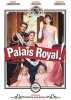
ZONE 2 EUROPE - Le dvd présente des marques d'utilisation mais reste en tres bon état d'ensemble - Expédition soignée sous blister dans une enveloppe à bulles depuis la France
Sérigraphie originale, signée et numérotée.
Paris : Blank Production, 1983. Sérigraphie originale en couleurs (20,5x29,5 cm) tirée sur Canson supérieur blanc, numérotée 5/120 et signée William Wilson. Sérigraphie originale parue dans le portefolio Blank Production, édité par Jissé en 1983. Une des premières planches de l'oeuvre de William Wilson en bel état. Une planche similaire est reproduite dans le livre d'Isabelle Jarry "William Wilson de 1983 à 1993" (page 18). JOINT : William Wilson de 1983 à 1993, par Isabelle Jarry : Paris : Comptoir Général d'Edition, 1993 - un volume cartonné (27,5x20,5 cm) illustré en couleur, 75 pages - abondamment illustré de reproductions en couleurs dans et hors texte - bon état -
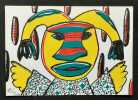
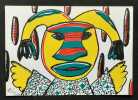
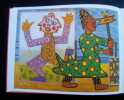
Tous nos livres sont visibles sur notre site : https://www.livrepoesie.com/
Collection [Tableaux Anciens & Modernes] De M. John W. Wilson, Exposee Dans La Galerie Du Cercle Artistique Et Littéraire De Bruxelles Au Profit Des Pauvres De Cette Ville - Troisieme Edition
1873 [Imprimerie De Jules Claye, Paris,1873 - IN FOLIO demi basane noire ,manques au haut du dos.Cet ouvrage expose la magnifique collection d'oeuvres d'art du collectionneur belge John W. Wilson. Sa collection classée par écoles et peintres anciens et modernes regroupe des oeuvres des plus grands maîtres tels que Watteau, Rubens, Delacroix, Géricault, Turner, Millet (dont l'Angélus du soir est aujourd'hui exposé au musée d'Orsay) etc. Cet ensemble expose le goût certain et les connaissances pointues en Histoire de l'Art de John W. Wilson.Text pristine & unmarked, crisp, tight to the spine - LIMITED EDITION, NUMBERED COPY. Text in French. Pages and plates not numbered. 68 plates (incl. Ports. ) , facsimile signatures of the artists whose works are represented ; 51 cm. Among the artists represented: F. Bol, N. Maas, Molenaar, Diaz, Rousseau, Milet, Plassan, and others. Decorated endpapers and edges.
![Collection [Tableaux Anciens & Modernes] De M. John W. Wilson, Exposee Dans La Galerie Du Cercle Artistique Et Littéraire De Bruxelles Au Profit Des ...](https://static.livre-rare-book.com/pictures/BRK/18235_1_thumb.jpg)
Troisième édition. Un des 200 exemplaires numérotés sur Hollande, complet des 68 gravures hors texte.texte frais bon tirage bien noir sur hollande,Eaux-fortes originales par Gaucherel, J. Jacquemart, Gustave Greux, A.J. Gilbert, Edmond Hedouin, Ch. Waltner, Adolphe Lalauze, N. Martinez, Aug. Lancon, F. Laguillermis, J.C. Lemaire, Marie Duclos, Adrien Didier, Leopold Flameng, Paul Le Rat, Ch. Courtry, Charles Deblois, A.P. Martial, Maxime Lalanne, Marie Louveau, A. Brunet-Debaines, Edmond Boilvin, Eugene Pirodon, Th. Chauvel, Alph. Masson & Aug. Mongin.Photo et description sur demande.Picture and description upon request. Remise de 20% pour toutes commandes supérieures à 200 €
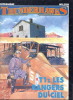
Thunderhawks n° 1 : Les rangers du ciel. ( Avec magnifique dessin original de Colin Wilson et dédicace en anglais ).
Editions Soleil 1992. In-4 cartonnage éditeur.Couverture & dessin de Colin Wilson sur scénario de François Corteggiani. Coins tassés, avec coin & tranche inférieur du 1er plat frottés. Accroc au mors du 4ème plat. Bel état général. Edition originale. Rare exemplaire orné d'un magnifique dessin original de Colin Wilson avec dédicace en anglais.
Vente exclusivement par correspondance. Le libraire ne reçoit, exceptionnellement que sur rendez-vous. Il est préférable de téléphoner avant tout déplacement.Forfait de port pour un livre 10 € sauf si épaisseur supérieure à 3 cm ou valeur supérieure ou égale à 100 €, dans ce cas expédition obligatoire au tarif Colissimo en vigueur. A partir de 2 livres envoi en colissimo obligatoire. Port à la charge de l'acheteur pour le reste du monde.Les Chèques ne sont plus acceptés.Pour destinations extra-planétaire s'adresser à la NASA.Membre du Syndicat Lusitanien Amateurs Morues
Robert Wilson : Mr Bojangles' Memory, og Son of Fire.
Paris Centre Georges Pompidou 1991 1 vol. relié in-4, cartonnage noir de l'éditeur, contreplats intégrant 3 fascicules de textes, photos et dessins, avec 1 CD audio et 1 cassette vidéo, chaque élément dans son emplacement creusé à l'intérieur d'un grand coffret en mousse noire avec titre en creux. Textes signés de Umberto Eco, Robert Wilson et Emilio Ambasz, légendes des "Meubles sculptures" par Heiner Müller, légendes des "Dessins" par John Cage. Le disque propose un environnement sonore de Hans Peter Kühn et la cassette deux créations vidéo de Robert Wilson. Publié à l'occasion de l'exposition au Centre Pompidou, novembre 1991 - janvier 1992. Très bonne condition.
La revanche
Filipacchi Denoël 1978 IN4. 1978. Album. La revanche est un recueil illustré par Gahan Wilson mêlant dessins humoristiques et textes inédits (poèmes prose récits). L'ouvrage explore des thèmes d'angoisse existentielle et de monstruosité avec un humour noir caractéristique dans un style grotesque rappelant Charles Addams
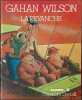
Bon état
WILSON (Robert). QUADRI (Franco). BERTONI (Franco). STEARNS (Robert).
Reference : 48153
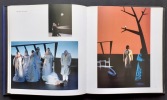
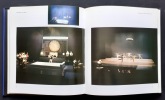
Robert Wilson.
Paris : Editions Plume, 1997. Un volume toilé sous jaquette illustrée (29x26 cm), 240 pages. "Vie et temps selon Robert Wilson" par Franco Quadri, "Une logique des sens : Wilson et les arts plastiques" par Robert Stearns. Abondamment illustré de photographies en noir et en couleurs. Bon état.
Tous nos livres sont visibles sur notre site : https://www.livrepoesie.com/
N Paris. 1840-1919. Homme politique franais. L.A.S. Wilson Mon cher Monsieur . Paris, 19 juin 1878. 1 p. in-4. En-tte imprim de la Chambre des Dputs.
19/06/1878 Daniel Wilson envoie cette lettre pour annoncer son correspondant que ...dans les runions prparatoires au Congrs des Transports qui doit avoir lieu du 22 au 27 juillet, au Trocadros, votre nom a t prononc pour faire partie de la Sous Commission charge detudier la 3me question du programme ci-joint...Dput, sous-secrtaire dEtat aux Finances, gendre de M. Grvy, Daniel Wilson est surtout connu pour avoir particip laffaire des dcorations et mdailles du Palais de lElyse.
N Paris. 1840 1919. Homme politique franais. L.A.S. Wilson Mon cher Collgue . S.l. [Paris], 16 juillet 1879. 1 p. in-8. En-tte imprim de la Chambre des Dputs.
16/07/1879 Daniel Wilson recommande son correspondant ...un jeune journaliste de mes amis, M. Grgoire, qui vous a entretenu de son dsir de devenir le rdacteur de votre excellent journal. (...). il connait son mtier fond est trs honorable et plein de zle... Il conclut la fin de sa lettre ...Notre collgue M. Rouvier connait trs particulirement M. Grgoire et vous fournira sur lui les meilleurs renseignements...Dput de la troisime circonscription dIndre-et-Loire, D. Wilson sige lAssemble du ct des partisans de Lon Gambetta, puis il intgre la gauche constitutionnelle dErnest Picard. Il est essentiellement connu pour tre lauteur dun trafic de haut vol de dcorations et de mdailles provenant du Palais de llyse. Cette infraction entranera la dmission de son beau-pre, Jules Grvy, prsident de la Rpublique, ainsi quune condamnation deux ans de prison.
Relation des Îles Pelew, situées dans la partie occidentale de l’océan Pacifique; composée sur les journaux et les communications du Capitaine Henri Wilson et de quelques-uns de ses officiers, qui, en août 1783, y ont fait naufrage sur l’Antelope, paquebot de la compagnie des Indes orientales.
Paris, Le Jay et Maradan, 1788. 2 vol. in-8 de [4]-282p. + [4]-274-[6] pages, demi-veau brun, dos lisses ornés de filets dorés, pièces de titre et tomaison beiges, salissure en marge des p. 28/29; excepté de minimes défauts, l'exemplaire est en parfaite condition. Ex-libris H. Tronchin.
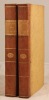
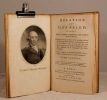
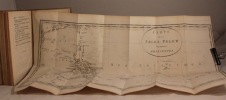
Illustré d'un portrait du Capitaine Wilson, d'une grande carte géographique et de 15 vues, portraits ou ornements. Hormis la carte géographique repoussée à la fin du 1er vol., toutes les planches sont reliées à leur place selon l'avis du relieur, et sont toutes parfaitement pliées. Première édition française (simultanément au format in-4 en 1 vol. et in-8 en 2 vol.) parue la même année que l'anglaise. Cet ouvrage connut un succès considérable, il contribua à l'image des îles paradisiaques et du bon sauvage. Publié la même année que Paul et Virginie. Les Palaos ou Palau est un pays d'Océanie situé en Micronésie, à l'est des Philippines, au nord de l'Indonésie, à l'ouest des États fédérés de Micronésie et occupant l'extrémité occidentale de l'archipel des îles Carolines. Bel exemplaire.
The Dramatic Works of John Wilson. With Prefatory Memoir, Introductions, and Notes.
Edinburgh / London William Paterson / H. Sotheran & Co. 1874 Première édition. Édition limitée imprimée pour les seuls abonnés. 1/450 sur petit papier. Reliure cartonnée en cartons recouverts de tissu crème. Étiquette en papier au dos, telle qu'elle a été produite. Les plats sont maintenant assombris et frottés, avec quelques salissures sur l'étiquette. Le contenu est propre, à l'exception d'une légère rousseur sur les pages préliminaires. Quelques pages ne sont pas coupées. Bon état général. John Wilson était un dramaturge anglais, un avocat et un ancien Recorder of Londonderry. Sa pièce The Cheats - incluse dans ce volume - fut l'une des premières produites après la Restauration. Elle a été jouée en 1663. Sont également inclus dans ce volume : Andronicus Commenius, The Projectors, et Belphegor. xvi, 401 pp. 210 x 130 mm
First edition. Limited edition printed for subscribers only. 1/450 on small paper. Hardback in cream cloth covered boards. Paper label to spine, as produced. Boards are now darkened, and rubbed, with some soiling to label. Contents are clean apart from some light foxing to prelims. A few pages remain uncut. Overall good. John Wilson was an English playwright, lawyer, and one time Recorder of Londonderry. His play The Cheats - included in this volume - was one of the first produced after the Restoration. This was staged in 1663. Also included here are: Andronicus Commenius, The Projectors, and Belphegor. xvi, 401 pp. 210 x 130 mm (8Πx 5 inches). .

