 Write to the booksellers
247 books for « euripides »Edit
-
Language
French (246)
Russian (1)
-
Century
17th (1)
19th (11)
20th (10)
21st (1)
-
Topics
Aristotle (1)
English (19)
Germanic languages (3)
Greek (206)
History (1)
Italy (1)
Latin (199)
Literature (3)
Philology (1)
Philosophy (1)
Religions (1)
Theatre (1)
Wagner richard (1)
Weil simone (1)
-
Countries
Belgium (1)
Denmark (3)
France (18)
Greece (1)
Netherlands (212)
Switzerland (11)
United States of America (1)
-
Syndicate
ILAB (23)
SLAM (15)
Euripides poeta, Tragicorum princeps, in Latinum sermonem conversus, adiecto e regione textu Graeco: cum annotationibus et praefationibus in omnes eius Tragoedias, autore Gasparo Stiblino. Accesserunt, Iacobi Micylli, De Euripidis vita, ex diversis autoribus collecta; item De Tragoedia & eius partibus 'prolegomena' quaedam. Item Ioannis Brodaei Turonensis Annotationes doctiss. nunquam antea in lucem editae. Ad haec, rerum & verborum toto opere praecipue memorabilium copiosus index. Cum Caes. Maiest. & Christianiss. Gallorum Regis gratia ac privilegio, ad decennium.
Basel (Basileae), Per Ioannem Oporinum, (1562) (Colophon at the end: 'Basileae, Ex officina Ioannis Oporini, Anno salutis humanae 1562, mense Martio')
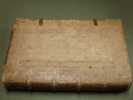
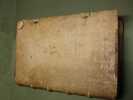
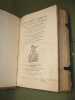
Folio. p. 1-667; col. 668-679, (1 p.), col. 680-845; (23 index) p. Contemporary blind-stamped pigskin over wooden boards. 34 cm. <Interesting signed binding. This Euripides edition is the first to offer a Greek text accompanied by a complete translation into Latin. Autograph dedication by the editor Stiblinus on the title>. (Ref: VD16 E 4217; Griechischer Geist aus Basler Pressen no. 200; Hoffmann 2,69; Schweiger 1,115; Dibdin 1,528; Moss 1,416; Brunet 2,1096; Ebert 7077; Graesse 2,519; USTC no. 654877) (Details: Signed binding, produced between 1562 and 1570 by Hans Rietzsch, and probably commissioned by Prince-Bishop of Würzburg, Friedrich von Wirsberg, or his chancellor Balthasar ab Hellu. (See below for the binder and his client) Back with 4 raised bands. Boards decorated with 3 rows of blind-stamped rolls, the first one with floral motives, the second and third comprising portraits of apostles and other biblical figures, and floral motives; the portraits are accompanied by short texts which are reasonably legible, e.g. King David, playing his harp, he has the text: 'De fructu ventris tui'; this refers to Psalm 131,11, where God promises David: 'iuravit Dominus David veritatem et non frustrabit eum de fructu ventris tui ponam super sedem suam'. Left and right of David's head the initials H and R. Another blind-stamped portrait depicts the apostle Paul, whose text is: 'Apparuit beningita(s)' (sic!), a quote from a letter of Paul to Titus. (Ep. Pauli ad Titum 3,4) The initials H.R. stand for 'Hans Rietzsch', a Würzburg bookbinder, of whom the University library of Würzburg holds a great number of bindings, which can be dated between 1555 and 1570. Rietzsch often used on 'his' boards rolls depicting King David, John the Baptist, the apostle Paul. (H. Endres, 'Die Zwickauer Buchbinder Hans Rietzsch und Gregor Schenck und ihre Beziehungen zu Würzburg', Archiv für Buchbinderei 26 (1926) p. 13-16). Woodcut printer's mark on the title of Oporinus, depicting Arion, who stands on the dolphin that saved him, he plays the violin. Woodcut initials. One woodcut text illustration. Text printed in 2 columns, Greek text with parallel Latin translation. Each play is concluded with a short 'praefatio' by Stiblinus, who added also short notes. The last 185 columns contain the commentary of Johannes Brodaeus) (Condition: Vellum age-toned, spotted, scratched, and worn at the extremes. Small piece gone at head of the spine. Leather of the lower corner of the backcover loosening and damaged. The lower clasp has been preserved, the upper one is partly gone. Small bookplate on the front pastedown. Ownership entry in ink on the same pastedown. Inscription on the blank lower margin of the title. The right edge of the title slightly thumbed. Paper sometimes yellowing) (Note: Euripides was one of the three great writers of tragedy in ancient Greece. This Euripides edition of 1562 is the first to offer a Greek text accompanied by a (complete) translation into Latin. Earlier editions of Euripides had only the bare Greek text. It furthermore is the first Euripides edition to have textual notes. The editor, the German humanist Gasparus Stiblinus (or Gaspar Stiblin, Caspar Stiblin, Kaspar Stiblin, Kaspar Stüblin), who was born in 1526 in the German village Amtzell addressed his 'Dedicatio' to the emperor Ferdinand I (1503-1564), who had supported his career. Stiblinus calls Euripides the best of the tragedians, and argues that his tragedies are an emperor worthy. He stresses that Euripides is excellent reading, especially for those in power and the wealthy, for the vicissitudes of fortune about which the tragedian writes, learn the rich and powerful to prepare for misfortune and to lead a virtuous life. The world of power and the republic of letters of the 16th century is a men's world, so Stiblinus draws the attention of the emperor to the uncertain and often cruel fate of Polynices, Eteocles, Theseus, Hercules, Menelaus, Agamemnon and Odysseus. After the dedication follows a preface (ad lectorem), dated 1558, in which Stiblinus tells the reader that the Basel publisher Oporinus urged him to produce for his press a new translation for a envisaged Euripides edition. Stiblinus honestly admits that he made some use of the Latin translation of Dorotheus Camillus, which had been published in 1555 in Basel by the same Oporinus. We may assume that Oporinus was not satisfied with the translation of Camillus, and asked Stiblinus to do a better job, for the translator boasts in the preface that his translation is more august, more reliable, and in smoother and more correct Latin (p. a4 verso) Stiblinus goes on to tell that while preparing the edition, the translation (which is more or less iambic) and the annotations, he was able to consult books from the library of the famous classical scholar Beatus Rhenanus (1485-1547). Stiblinus furthermore divided, he writes, each play into 5 acts to make the reading easier. He added also at the beginning of each play, and of every act, a short 'argumentum', a kind of plot-summary, and notes. He continues with the acknowledgment of his debt to Johannes Hartung, his teacher in Freiburg, who introduced him to Euripides. He thanks him for lending him his vast collection of notes on Euripides' tragedies and references to other authors. On page 630, at the beginning of the last play, the Electra, Stiblinus has added a second 'praefatio', now dated Freiburg I.Br. 1560, in which he tells the reader that he inserted into his commentary on the Electra many notes of Johannes Hartung, which he dictated to his students. Stiblinus' Latin translation of the Electra is the first to appear. This 1562 edition contains furthermore 2 short texts of Jacobus Micyllus (Molsheym) of Heidelberg, who died 1558, a biography of Euripides and a treatise on tragedy. Added is also a commentary to 11 plays produced by the French scholar Johannes Brodaeus (Brodeau) of Tours, of which the title states that it was never published before. It was however published previously in Paris in 1545. As a scholar and translator of Euripides however, Stiblinus met the ill fate of an Euripidean character. In the same year 1562, Holzmann published in Frankfurt a translation in prose of Euripides by the famous German humanist Philipp Melanchthon, a translation which was better. And the Dutch scholar Willem Canter, 1545-1572, published in 1571 a Greek text that made all earlier editions obsolete. Stiblinus' edition and translation were soon forgotten. Until 1963 little was known about Stiblinus. In 1559 Stiblinus was called by the Prince-Bishop of Würzburg, Friedrich von Wirsberg, 1507-1573, to teach Greek at a newly founded 'Paedagogium Illustre'. The bishop, who wanted to revive Greek and Latin studies in his town, did so on the advice of his chancellor Balthasar ab Hellu. After some delay, Stiblinus finally got his chair in Würzburg in spring 1561. His inaugural lecture, read before the bishop and other dignitaries, was on the Holy Spirit. Stiblinus died shortly after his appointment, probably in 1562, in Würzburg, about 36 years old. (source Firpo 1963, see below) Stiblinus, who was of humble origin, matriculated at the University of Freiburg i.Br. on January 19th 1548. He became 'magister artium' and was immediately appointed professor of Latin in 1551 at a modest salary of 15 florins a year. In 1553 he fled from the Plague and went to Schlettstatt in the Alsace, where he was the next 6 years in charge of the famous humanist school, where he taught Latin, and had also time to browse and study in the library of Beatus Rhenanus. There he wrote in the summer of 1553, free from dull lecturing, his 'De Eudaemonensium Republica Commentariolus', the description of a Happy City called Eudaemonia, 'Happinesham', in German 'Seligland', the capital of the utopian island Macaria, situated somewhere in the Indian Ocean. It was published by Oporinus in Basle in 1555. This treatise makes Stiblinus the first German Utopist, and the first to create a fictional island society after Thomas More's, who published his Utopia in 1516. If Stiblinus knew More's Utopia is not sure. Interest in this forgotten 'Utopia' of Stiblinus was revived some 50 years ago by Luigi Firpo, who blew the dust from it in an article in 'Les Utopies à la Renaissance, Colloque International (avril 1961)'. Bruxelles Paris 1963, p. 117-134) His article placed Stiblinus in the current and ongoing Utopia discussion, and paved the way for the admittance of the humanist Stiblin in the cultural and literary history of Germany. (J.J. Berns in 'Literatur und Kultur im deutschen Südwesten zwischen Renaissance und Aufklärung', Amsterdam 1995, p. 153/154. (See also: Killy Literaturlexikon, Berlin/Boston, 2011, Vol. 11, p. 259/61) The interest in Stiblinus as a classical scholar was revitalized by the American Euripides expert Donald Mastronarde in 2009, when he launched a blog 'Stiblinus Prefaces and Arguments on Euripides (1562)'. In it he argues that this 'rare edition is of considerable interest for the early scholarly reception of Euripides because it includes short prefaces and plot-summaries (Latin argumenta) for each play in addition to the Greek epitomes and prefatory material transmitted in the medieval manuscripts. In contrast, most other early printed editions of tragedy simply repeat the scholarly and pedagogical annotations from the manuscripts, if they do not simply confine themselves to the text of the plays themselves'. On this website Mastronarde offers Stiblinus prefaces and argumenta, accompanied by an English translation, 'so that they can be studied in connection with the reception of Euripides and tragedy in the 16th century'. (ucbclassics.dreamhosters.com/djm/stiblinus/stiblinusMain.html) (Provenance: 1. Autograph inscription of Gasparus Stiblinus on the title: 'Egregio et summae spei juveni D. Balthasari ab Hellu B.A.H. amico suo chariss.(imo) Gasparus Stiblinus D. D'. From this inscription we learn that Stiblinus donated this book to his good friend Balthasar ab Hellu. We assume that Stiblinus gave him the book to thank him for his chair in Würzburg. The name, 'Ab Hellu' or in Dutch 'Van Hellu' is found in the Dutch province of Gelderland, where Hellu was a centuries old Seigniory. Balthasar ab Hellu was a descendant of empoverished Dutch nobility. His father emigrated to the Elzas, where he found refuge in Hagenau. Balthasar was born there in 1518. He studied law in Freiburg i.Br., where he matriculated as 'Balthasarius de Heller ex Haganoia" and in 1555 he participated as 'Syndikus und Stadtschreiber' of the city of Colmar in the important 'Reichstag' of Augsburg of 1555. A year later he was appointed Chancellor of the Prince-Bishop of Würzburg. As Chancellor, which meant also Prime Minister, and diplomat he travelled a lot to promote the interest of the 'Landsberger Bund', a kind of defense organisation of several states in the South of Germany. His salary was 300 florins. (Archiv des Historische Vereins Unterfranken und Aschaffenburg, Würzburg 1840, p. 55) 'Ab 1570 musste er allerdings mehrfach Termine absagen wegen Erkrankungen, so im Oktober 1573 wegen Rückenschmerzen. Wahrscheinlich begann er aber bereits da an einem Geschwür zu leiden, denn im Oktober 1574 bezeichnete das Domkapitel den noch nicht 60jährigen bereits als 'unvermüglich und alt' und beriet über seine Ablösung'. (K. Karrer, 'Johannes Posthius, (1537-1597): Verzeichnis der Briefe und Werke', Wiesbaden 1993, p. 153/154). Ab Hellu had an operation in 1575, but remained at his post till the day he died, January 9, 1577. On the internet we found the following scattered data concerning Balthasar ab Hellu, especially in volume V of the correspondence of Petrus Canisius. ('Beati Petri Canisii Societatis Iesu Epistolae et acta' , Volume V, Freiburg.Br., 1910, edited by O. Braunsberger) This volume contains Canisius' correspondence between 1565 and 1567. Canisius does not mention Balthasar by name, he refers to him in a few letters (letter 1259, 1290 & 1309) as the 'Cancellarius' or 'Cancellarius Herbipolensis' (= Würzburg) of the Prince-Bishop of Würzburg, Friedrich von Wirsberg. From the letters and the commentary of Braunsberger, we collected the following: Balthasar was a jurist, and a strong defender of the Catholic church against the protestants. In a letter of 15 november 1565 Canisius complains that the funding of the new Collegium of the Jesuits in Würzburg did not make any progress, because the bishop was too parcimoneous (parcus, si non tenax). This was said to him by the 'Cancellarius', who asked him to convince his bishop to pump money into the project. (Letter 1259). In november 1566 we see Canisius during one of his visits to Würzburg cooperate with the 'Chancellor' in establishing the Collegium, and finding money for it. (Letter 1290) In February 1566 Canisius writes in a letter that the Chancellor opposed the plans of the bishop to mobilize troops for a war against the Turcs. This story does not end well, as we saw. We found the following epitaph for 'Balthasar de Hellu' among the occasional poetry of Johannes Posthius: 'Epitaphium D. BALTHASARIS AB HELLU, Cancellarii Wirzeburgici" / Balthasar hoc requiem ducit post fata sepulcro,/ Qui genus a claris nobile duxit avis./ Eloquio praestans, et rebus natus agendis,/ Non sine laude suo praefuit officio./ Novit id Herbipolis, novit Germania tota,/Huius et est magni Caesaris aula memor./ Haud senio fractus, rodente sed ulcere partem/Vesicae, lenta morte miser periit./ Nunc gravibus curis omnique dolore solutus/Spiritus astrigeri vivit in arce poli'. (Posthius, Johannes: 'Parergorum poeticorum pars altera', Heidelberg 1595, p. 201) From this epitaph we learn that Balthasar was considered to be of noble birth, known in Würzburg, yes, even through the whole of 'Germania'; that he spoke well, and performed his tasks to the satisfaction of his bishop and the emperor, and that he died a most horrible death (probably caused by prostate or bladder cancer). Now his soul lives on peacefully in the starry sky. No mention is made in the poem of wife or children. This poem is based on first hand knowledge, for Posthius was not only a poet, but also a medicin. He was the personal physician of the Prince-Bishop. In a letter of March 1575 (letter 45) Posthius tells his addressee Johannes Crato, the personal physician of the emperor, who had been treating 'Von Hellu', that his (Crato's) patient will pay with wine next autumn. (K. Karrer, 'Johannes Posthius, (1537-1597): Verzeichnis der Briefe und Werke', Wiesbaden 1993, p. 153) In December the next year (letter 74) Posthius writes the classical scholar Joachim Camerarius that Von Hellu is incurably ill. Posthius is looking for a physician who can operate him, for the Chancellor suffers from 'urina purulenta'. Three weeks after this letter the poor man died. That Baltasar ab Hellu was a nobleman, and that he never forgot that his roots lay in the Netherlands, is furthermore confirmed by the Dutch bibliographer Van der Aa. He records that one 'Balthasar van Hellu', Chancellor of Würzburg, tried several times to gain possession of the above mentioned Seigniory of Hellu in the 18th century (must be 16th century) on the ground that he had old family rights to that land. (A.J. Van der Aa, 'Aardrijkskundig woordenboek der Nederlanden', volume V, Gorichem, 1844, p. 395) We found indeed in the digital archive of the 'Hof van Gelre en Zutphen' a file (0124/2281) dated 1570, concerning the Chancellor's request to buy the seigniory of Hellu. This village, which lies west of Zaltbommel, was for centuries the family property of 'Van Hellu's'. Its nowadays called Hellouw,. A specimen of the Chancellor's handwriting can be admired in a letter of 1565 held in the Royal Archive in The Hague. The letter is addressed to Prince William of Orange, and in it he asks the Prince to recommend him to the Stadholder of Gelderland, because he wants to renew the ancestral ties of friendship of his father Adriaan van Hellu. (resources.huygens.knaw.nl/wvo/brief/4256) Bookplate of the German classical scholar Otto Jahn 1813-1869, cut by Ludwig Richter, pasted on the front pastedown. Jahn had published in 1852 a biographic sketch of this successful artist. (Mittheilungen über Ludwig Richter) To thank him Richter cut for Jahn a bookplate. (See O.Jahn, 'Biographische Aufsätze', Leipzig, 1866, p. 221-287) Name written on the front pastedown: 'Cary W. Bok, April 1928', an American magazine man (1904-1970), who unsuccessfully tried to run the Curtis Publishing Company (Lady's Home Journal etc.) (Collation: a-z6, A-Z6. Aa-Ss6, Tt8 (leaf Tt8 blank))
EURIPIDOU PHOINISSAI. Euripidis tragoedia Phoenissae. Interpretationem addidit H. Grotii; graeca castigavit e Mstis, atque adnotationibus instruxit, scholia subiecit Ludovicus Casp. Valckenaer.
Leiden (Lugduni Batavorum), Apud Samuelem et Joannem Luchtmans, 1802.
4to. 2 parts in 1 volume: (IV),23,(1 blank),452;196 p. Vellum. 26 cm. Prize copy (Ref: Hoffmann 2,77; Schweiger I,119; Brunet 2,1106; Dibdin I,545; Moss 1,424; Ebert 7102) (Details: Prize copy Utrecht, but without the prize. Back gilt and with 5 raised bands. Boards with gilt borders, and the gilt coat of arms of Utrecht, within a gilt rectangle adorned with corner pieces. The first part contains the introduction, the Greek text of Euripides' Phoenissae, with critical notes and the parallel Latin translation of Grotius, followed by the commentary of Valckenaer. The second part contains the Scholia to 'veterum grammaticorum in Euripidis Phoenissas. Ex codd. MStis praesertim Augustano, supplevit, emendavit, (...) editis locupletavit plus quam ducentis, notisque instruxit L.C. Valckenaer', accompanied by Valckenaer's commentary. At the end, before the index, the 'Scholia peri metrôn' on the Phoenissae, with notes in Latin. (p.166-182)) (Condition: Prize removed. Vellum age-tanned and slightly soiled. All four decorative fastening ribbons gone. Occasionally some pencil marginalia. The last 7 gatherings of the 2nd volume, p. 125/196, browning and foxing) (Note: 'With Sophokles Greek tragedy reaches its culmination. Euripides, great poet though he was, represents the first symptom of the inevitable decline, for in him we can recognize a certain impatience with the form he found ready to his hand'. This is how H.J. Rose started his chapter on Greek tragedian Euripides, ca. 480-406 B.C., some 80 years ago. (H.J. Rose, 'A history of Greek literature', 4th ed., London 1965, p. 177, first published in 1934) That opinion has now been superseded. Euripides' play 'The Bacchae', which drew little attention before 1900, 'has come to seem one of the defining models of Greek tragedy and even of tragedy itself, rivalling Aeschylus' Oresteia and Sophocles' Oedipus Tyrannus and Antigone'. (The Classical Tradition, Cambridge Mass. 2010, p. 347) For this, Euripides has to thank the German philosopher Friedrich Nietzsche. The upsurge was caused by his 'Die Geburt der Tragödie aus dem Geiste der Musik' (1872) in which he drew attention to the idea of 'the Dionysiac', a key element in the Bacchae. This idea 'has had a massive influence not only on understandings of tragedy, but on theories of theatrical performances itself'. (Idem, ibidem) Euripides' play 'Phoenissae' 'is a complex but well-organized dramatic structure. It does not concentrate solely on the strife and death of the sons of Oedipus, as the play's severest critics expected and demanded that it should. Rather, it engages a whole ensemble of figures from the families of Oedipus and Creon in exploring themes of selfishness and blindness, familial disaster, familial loyalty, political duties and loyalties, divine-human interaction, and the lability of human wisdom'. (D.J. Mastronarde, 'Phoenissae', Cambridge 1994, p. 3/4) This edition of 1802 is a reissue of the Phoenissae edition which was published in Franeker in 1755. The only difference seems to be that the commentary of Valckenaer is not printed below the text, but comes after the text. The publisher also decided to omit the 14 p. 'Prolegomena' to the Phoenissae by Hugo Grotius that accompanied the edition of 1755. Dibdin observes that of all the editions of the Phoenissae, in reference to critical apparatus, the edition of 1755 was the most copious and valuable. Added are scholia, part of which appeared in 1755 for the first time. The whole volume is enriched by every thing which can render it most acceptable to a critical student. The preface is full of learned information, Dibdin adds. The Frisian scholar Lodewijk Caspar Valckenaer, latinized Ludovicus Casparus Valckenarius, 1715-1785, was a pupil of Tiberius Hemsterhuis, a Frisian too, and after him the greatest Dutch classical scholar of the 18th century. Hemsterhuis was professor of Greek at the University of Franeker from 1717 till 1740, and from 1740 till 1765 at the University of Leiden. Hemsterhuis was the founder of a Dutch school of criticism, the so-called 'Schola Hemsterhusiana', which had in Valckenaer its best known disciple. Valckenaer studied Greek in Franeker under Hemsterhuis, and succeeded to his chair in 1741. In 1765 he left for Leiden, once again as successor of his beloved teacher. Both created a golden age of Greek studies in the Netherlands. Still a student he edited a Greek lexicon of the grammarian Ammonius, 'De adfinium vocabulorum Differentia', Leiden 1739. In Franeker he produced a revised and augmented edition of Fulvio Orsini's 'Virgilius illustratus', Leeuwarden 1747. This title is important for the history of scholarship for its inclusion of the text of the 22nd book of the Iliad of Homer, accompanied by an introduction, 'variae lectiones' and the 'editio princeps' of scholia of Porphyrius and other hellenistic and byzantine scholars. In 1755 Valckenaer published this Phoenissae edition, with his rich commentary, and a Latin translation by Hugo Grotius. Among his best works are two other Euripides editions, 'Diatribe in Euripidis perditorum dramatum reliquias', Leiden 1767, and 'Euripidis tragoedia Hippolytus', Leiden 1768. Valckenaer also produced editions of the Idylls of Theocritus, Leiden 1773, and of the complete works of bucolic poets Theocritus, Bion and Moschus, Leiden & Kampen 1779. His Callimachus edition was published posthumously by J. Luzac, Leiden 1799) (Collation: pi2, *-3*4 (leaf 3*4 verso blank); A-Kkk4, Lll2; A2, B-Bb4) (Photographs on request)
EURIPIDOU PHOINISSAI. Euripidis tragoedia Phoenissae. Interpretationem addidit H. Grotii; Graeca castigavit e Mstis, atque adnotationibus instruxit, scholia, partim nunc primum evulgata, subiecit Ludovicus Casp. Valckenaer.
Franeker (Franequerae), Typis et sumptibus, Iacobi Brouwer, 1755.
4to. XXIV,831,(19 index) p. Half calf 22.5 cm (Ref: STCN ppn 151473129; Hoffmann 2,76/77; Schweiger I,119; Brunet 2,1106; Dibdin I,545; Moss 1,424; Graesse 2,523: 'édition excellente'; Ebert 7102) (Details: Back with 5 raised bands, and a brown morocco lettershield; margins uncut. Greek text with facing Latin translation, commentary in two columns on the lower half of the page; p. 561-815 contain the scholia to the 'Phoenissae', accompanied by Latin commentary; at the end 14 p. 'Prolegomena' to the 'Phoenissae' by Hugo Grotius) (Condition: Back rubbed; head of spine slightly chafed; paper on covers somewhat scuffed) (Note: 'With Sophokles Greek tragedy reaches its culmination. Euripides, great poet though he was, represents the first symptom of the inevitable decline, for in him we can recognize a certain impatience with the form he found ready to his hand'. This is how H.J. Rose started his chapter on the Greek tragedian Euripides, ca. 480-406 B.C., some 80 years ago. (H.J. Rose, 'A history of Greek literature', 4th ed., London 1965, p. 177, first published in 1934) That opinion has now been superseded. Euripides' play 'The Bacchae', which drew little attention before 1900, 'has come to seem one of the defining models of Greek tragedy and even of tragedy itself, rivalling Aeschylus' Oresteia and Sophocles' Oedipus Tyrannus and Antigone'. (The Classical Tradition, Cambridge Mass. 2010, p. 347) For this, Euripides has to thank the German philosopher Friedrich Nietzsche. The upsurge was caused by his 'Die Geburt der Tragödie aus dem Geiste der Musik' (1872) in which he drew attention to the idea of 'the Dionysiac', a key element in the Bacchae. This idea 'has had a massive influence not only on understandings of tragedy, but on theories of theatrical performances itself'. (Idem, ibidem) Euripides' play Phoenissae 'is a complex but well-organized dramatic structure. It does not concentrate solely on the strife and death of the sons of Oedipus, as the play's severest critics expected and demanded that it should. Rather, it engages a whole ensemble of figures from the families of Oedipus and Creon in exploring themes of selfishness and blindness, familial disaster, familial loyalty, political duties and loyalties, divine-human interaction, and the lability of human wisdom'. (D.J. Mastronarde, 'Phoenissae', Cambridge 1994, p. 3/4) 'Of all the editions of the Phoenissae, in reference to critical apparatus, the present (of 1755) is the most copious and valuable. The version is that of Grotius. MSS. have been consulted; annotations are subjoined. The scholia (of which part appears for the first time) added; and the whole volume is enriched by every thing which can render it most acceptable to a critical student. (...) a volume, on all accounts, deserving of strong recommendation'. (Dibdin) The Frisian scholar Lodewijk Caspar Valckenaer, latinized Ludovicus Casparus Valckenarius, 1715-1785, was a pupil of his Tiberius Hemsterhuis, a Frisian too, and after him the greatest Dutch classical scholar of the 18th century. Hemsterhuis was professor of Greek at the University of Franeker from 1717 till 1740, and from 1740 till 1765 at the University of Leiden. Hemsterhuis was the founder of a Dutch school of criticism, the so-called 'Schola Hemsterhusiana', which had in Valckenaer its best known disciple. Valckenaer studied Greek in Franeker under Hemsterhuis, and succeeded to his chair in 1741. In 1765 he left for Leiden, once again as successor of his beloved teacher. Both created a golden age of Greek studies in the Netherlands. Still a student he edited a Greek lexicon of the grammarian Ammonius, 'De adfinium vocabulorum Differentia', Leiden 1739. In Franeker he produced a revised and augmented edition of Fulvio Orsini's 'Virgilius illustratus', Leeuwarden 1747. This title is important for the history of scholarship for its inclusion of the text of the 22nd book of the Iliad of Homer, accompanied by an introduction, 'variae lectiones' and the 'editio princeps' of scholia of Porphyrius and other hellenistic and byzantine scholars. In 1755 Valckenaer published this Phoenissae edition, with his rich commentary, and a Latin translation by Hugo Grotius. Among his best works are two other Euripides editions, 'Diatribe in Euripidis perditorum dramatum reliquias', Leiden 1767, and 'Euripidis tragoedia Hippolytus', Leiden 1768. Valckenaer also produced editions of the Idylls of Theocritus, Leiden 1773, and of the complete works of bucolic poets Theocritus, Bion and Moschus, Leiden & Kampen 1779. His Callimachus was published posthumously by J. Luzac, in Leiden, in 1799) (Provenance: On the front flyleaf: 'J.P. Ott, 1825'. (Collation: pi2, *-2*4; 3*2, A-4D4, 4E2, 4F-5P4 (minus blank leaf 5P4)) (Photographs on request)
Euripidis Quae Extant Omnia: Tragoediae Nempe XX. 2 parts. - [THE CELEBRATED BARNES-EDITION]
Cambridge, ex officina Johan. Hayes [...], 1694. Folio. In a nice a bit later full vellum binding over wooden boards with five raised bands with red leather title-label with gilt lettering to spine. With blindstamped ornamentation to boards. Title-page with a few dots and marks to upper margin. Pp. 1-30 in part 2 with brownspotting. Very light occassional marginal discolouration throughout, otherwise a very nice and clean copy. With parallel-text in Greek and Latin. (8), LVI, 330" (2), 529, (43) pp. + two engraved portraits depicting respectively Joshua Barnes and Euripides
![Euripidis Quae Extant Omnia: Tragoediae Nempe XX. 2 parts. - [THE CELEBRATED BARNES-EDITION]. EURIPIDES (+) JOSHUA BARNES (edt.).](https://static.livre-rare-book.com/pictures/LLX/60250_1_thumb.jpg)
![Euripidis Quae Extant Omnia: Tragoediae Nempe XX. 2 parts. - [THE CELEBRATED BARNES-EDITION]. EURIPIDES (+) JOSHUA BARNES (edt.).](https://static.livre-rare-book.com/pictures/LLX/60250_2_thumb.jpg)
![Euripidis Quae Extant Omnia: Tragoediae Nempe XX. 2 parts. - [THE CELEBRATED BARNES-EDITION]. EURIPIDES (+) JOSHUA BARNES (edt.).](https://static.livre-rare-book.com/pictures/LLX/60250_3_thumb.jpg)
First edition of Joshua Barnes’ famous Euripides-edition. ""The merits of all preceding editions are eclipsed by this celebrated one of Joshua Barnes. Fabricius observes that 'the text is accurately revised and printed, the metrical rules of Canter diligently corrected, and the entire ancient scholia on the first seven plays subjoined and enriched by excerpta from a manuscript in Corpus Christi College, Cambridge. The notes of various learned men, and those of Barnes accompany the scholia" the fragments of Euripides are carefully collected and displayed, with Greek and Latin notes as far as verse 2068" lastly, there are some epistles, attributed to Euripides.'""(Dibdin). “In 1694, Joshua Barnes, the eccentric British scholar (and poet) of Greek who the next year would become Regius Professor at the University of Cambridge, published his long-awaited Euripidis quae extant omnia. This was an enormous edition of Euripides’ works which contained every scrap of Euripidean material—dramatic, fragmentary, and biographical —that Barnes had managed to unearth.” (Hanink, The Life of the Author in the Letters of “Euripides”)

The Agamemnon. Translated from a revised text by W. HEADLAM. Ldn., Bell, 1904 (And:) The Choephoroe. Translated from a revised text by W. HEADLAM. (&:) The Medea of Euripides. Literally translated (...) by T. NASH. 3rd ed. revised. (&:) Literal translation of the Alcestis of Euripides. With introd., analysis, and short notes (...) by a first-class man of Balliol. Oxf., Shrimpton, 1898. (&:) Aristophanes. The Clouds. N.pl., n.d. (&) Aristotle's Poetics. Translated from the Oxford text with short notes by E.S. BOUCHIER. Oxf., Blackwell, 1907.
Oxf., Ldn., 1898 - 1907.
6 volumes in 1. together 378 p. Cloth. 18 cm (Cover worn at the extremes; contents inscribed on front flyleaf; name cut from first French title; name on some titles; the 4 last leaves of the Choephoroi transl. loose; title of the Aristophanes translation gone)
Euripides 1: Medea, Hecuba, Andromache, The Bacchae. (Translations by E. Wilner, M. Nelson, D. Junkins, D.M. Epstein) (And:) Euripides 2: Hippolytus, Suppliant women, Helen, Electra, Cyclops. (Translations by R. Moore, J.F. Nims, R. Hadas, E.S. Morgan, P. Bovie) Edited by D.R. Slavitt and P. Bovie.
Philadelphia, University of Pennsylavania Press, 1997.
2 volumes: XIV,298,2; XIV,360 p. Cloth 23.5 cm (Including dustjackets)(Penn Greek Drama Series)
A concordance to Euripides. (And:) Supplement to the Allen & Italie concordance to Euripides.
Berkeley etc., University of California Press, CUP, 1954. (And:) Groningen, Bouma, 1971.
2 volumes: XI,686; XX,52 p. Cloth. Volume 1: green cloth and 26 cm, volume 2: black cloth and 29 cm) (Back of first volume faded) (Heavy book, may require extra shipping costs)
Euripides. Transl. into English rhyming verse by G. MURRAY.
Lnd., Allen 1902.
LXVIII,355 p. Cl. (The Athenian drama III; transl. of Hipp., Ba., and the Ranae of Aristophanes)(Sl. foxed)
The Complete Greek Tragedies. Edited by D. GRENE & R. LATTIMORE. Euripides, IV: Rhesus, translated by R. LATTIMORE. The suppliant women, translated by F. JONES. Orestes, translated by W. ARROWSMITH. Iphigenia in Aulis, translated by Ch.R. WALKER.
Chicago, Ldn., Univ. of Chicago Press, (1958).
300 p. Pb. 20 cm (Translation only)
Euripides. Deutsch in den Versmassen der Urschrift von J.J.C. DONNER. 1. Band: (tr. of Hipp., Hec., Hel., Ph., Med. & Or.). 2. verb. Aufl.
Lpz., Heidelberg, Winter, 1859.
448 p. Brds.
Euripides. Deutsch in den Versmassen der Urschrift von J.J.C. DONNER. 3. Band: (tr. of T., Ion, El., HF, Supp. & Heracl.) 2. verb. Aufl.
Lpz., Heidelberg, Winter, 1859.
412 p. Brds.
The Medea of Euripides. Edited with introduction and notes by A.W. VERRALL.
London, MacMillan and Co., 1926.
XXXIII,127 p. Cloth. 17 cm (Text & commentary) (Backstrip partly split)
The Rhesus of Euripides. Edited with introduction & notes by W.H. PORTER. 2nd edition revised & enlarged.
Cambr., CUP, 1929.
LVIII,97 p. Hardb. 17 cm (Pitt Press)(Ink annotations & underlinings; added are 5 leaflets with annotations by C.B. Sneller, who wrote a dissertation on the Rhesus: De Rheso tragoedia. Amst., 1949. He probably used this booklet preparing his dissertation)
Die Troerinnen. Nach der Tragödie des Euripides (bearb. von) F. WERFEL.
München, Wolff, 1920.
135 p. Brds. (Rebound; first & last leaf sl. foxed)
The disorderly women.
Ldn., Methuen, 1969.
92 p. Pb. 19 cm (A play after Euripides' Bacchae)
Catastrophe survived. Euripides' plays of mixed reversal.
Oxford, Clarendon Press, 1971.
VIII,234 p. Cloth. 22 cm (Including worn dustjacket)
Euripides.
Oxf., Clarendon Press, 1981.
39 p. Wrs. (Greece & Rome, new surveys in the classics 14)
Euripides.
Oxford, Clarendon Press, 1981.
39 p. Stiff wrappers. 23.5 cm (Greece & Rome, New Surveys in the Classics, no. 14)
The scholia in the Jerusalem palimpsest of Euripides. A critical edition.
Heidelberg, Winter, 1979.
117 p. Wrs. 23 cm
The textual tradition of Euripides' Orestes.
Oxf., Clarendon Press, 1991.
XII,184 p. Hardb. 22 cm
Der Prolog der 'Bacchen' und die antike Überlieferungsphase des Euripides-Textes.
Heidelberg, Winter, 1981.
115 p. Wrs. 24 cm (SHAW)
Die Bakkchen und ihre Stellung im Spätwerk des Euripides.
Mainz, Verlag der Akademie der Wissenschaften und der Literatur in Mainz, 1955.
21 p. Wrappers. 25 cm (Offprint. Akademie der Wisschenschaften und der Literatur, Abhandlungen der Geistes- und Sozialwissenschaftlichen Klasse, 1955/5)

