 Write to the booksellers
4 books for « chytraeus david »Edit
-
Topics
History (3)
Protestantism (1)
-
Countries
Belgium (1)
Denmark (2)
France (1)
-
Syndicate
ILAB (3)
SLAM (1)
Chronicon Saxoniae & vicinarum aliquot Gentium: Ab Anno Christi 1500. usque ad M.D. XCIII. Appendix Scriptorum certis Chronici Locis inserandorum. Additus est Index Personarum & Rerum maximè insignium copiosiss. - [THE SAXON CHRONICLE]
Leipzig, (Michael Lanzenberger)/ Henning Grosius, (1593). Folio. Contemporary full vellum binding with visible spine bands at hinges. Small holes to boards, where the ties were attached. Handwritten name of the author on spine. Binding a little soiled and stained and with a small hole to middle of spine. Solid and sturdy. Old owner's names to title-page, all but one (J.B. Höserich) attempted erased (one of them leaving a small hole, not affecting printer's device or text) and a crowned ex library stamp. Last leaves with a small, marginal worm-hole. A mostly marginal damp stain throughout. Occasional marginal notes. Pasted-down end-papers with handwritten notes in brown ink, back end-paper with very extensive notes, including genealogical ones. Title-page with large woodcut printer's device. (2), XVIII, 969 pp., (11 - being 1 blank leaf + 10 leaves Index) ff.
First edition of Chytraeus' ""Chronicle of Saxony and its Neighbouring Tribes: From 1500 up to 1593"", which constitutes the continuation of and commentary on Albert Krantz’s (1448–1517) historiographical works Vandalia and Saxonia. David Chytraeus (1530-1600) was a Lutheran professor of theology at Rostock. He had been a disciple of Philip Melancthon, a German Lutheran reformer and collaborator with Martin Luther. Chytraeus attended the lectures of Martin Luther on Genesis.He mediated between the warring Lutherans, organized a Lutheran church in Austria, and gained great influence through a catechism, Bible interpretations, and not least his historical work Chronicon Saxoniæ (The Saxon Chronicle). ""The Chronicon Saxoniæ, written in the manner of annals from a religious point of view, was appreciated in all Europe. In his very carefully prepared geanological labours Chytræeus was encouraged by Duke Ulrich, and in general his historical writings bear, so to speak, the official stamp of the duchy of Mecklenburg, as, following the custom of his time, he preferred to give the result of his researches in academical lectures."" (Loesche, pp. 116-117). The work is compiled from archival records, diplomatic correspondence, and regional eyewitness testimonies, focusing on verifiable sequences of political, military, and ecclesiastical developments.See:Loesche, G. (2020). Chytræus. In Jackson, Samuel Macauley (Ed.). New Schaff-Herzog Encyclopedia of Religious Knowledge (Vol. III: Chamier-Draendorf, pp. 116-117). Adams, C 1575. - Graesse II, 154.

Chronicon Saxoniae & vicinarum aliquot Gentium: Ab Anno Christi 1500. usque ad M.D. XCIII. Appendix Scriptorum certis Chronici Locis inserandorum. Additus est Index Personarum & Rerum maximè insignium copiosiss.
Leipzig, (Michael Lanzenberger)/ Henning Grosius, (1593). Folio. Contemp. full richly blindtooled pigskin over wood. 5 raised bands. Neath repairs to upper and lower compartments of spine. With 2 catches and 1 of 2 clasps.Title-page with large printers wood-cut device. XVIII,969,(24) pp. Printers wood-cut device repeated on last leaf. Various browning of sheets. A few ink-and brownspots. On lower right corner in Suhm's hand ""Nidrosie/ 1757/ P.F. Suhm"" (see notes below).
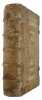
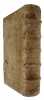
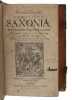
First edition of Chytraeus' ""Chronicle of Saxony and its Neighbouring Tribes: From 1500 up to 1593"", which constitutes the continuation of and commentary on Albert Krantz’s (1448–1517) historiographical works Vandalia and Saxonia. David Chytraeus (1530-1600) was a Lutheran professor of theology at Rostock. He had been a disciple of Philip Melancthon, a German Lutheran reformer and collaborator with Martin Luther. Chytraeus attended the lectures of Martin Luther on Genesis.He mediated between the warring Lutherans, organized a Lutheran church in Austria, and gained great influence through a catechism, Bible interpretations, and not least his historical work Chronicon Saxoniæ (The Saxon Chronicle). ""The Chronicon Saxoniæ, written in the manner of annals from a religious point of view, was appreciated in all Europe. In his very carefully prepared geanological labours Chytræeus was encouraged by Duke Ulrich, and in general his historical writings bear, so to speak, the official stamp of the duchy of Mecklenburg, as, following the custom of his time, he preferred to give the result of his researches in academical lectures."" (Loesche, pp. 116-117). The work is compiled from archival records, diplomatic correspondence, and regional eyewitness testimonies, focusing on verifiable sequences of political, military, and ecclesiastical developments.Peter Frederik Suhm (P.F. Suhm"" 1728-1798) was a Danish historian, writer and bibliophile. He lived in Trondheim (""Nidarosie"" in Old Norse), Norway, between 1751 and 1765. In 1752, he married Karen Angell (1732-88), daugher of a wealthy Norwegian merchant. While in Norway, he collected sources for a large, critical history of Denmark up to 1448. He continued these preparations after his return to Copenhagen. He also wrote numerous books on mythological and historical matters in the 1770s, as well as dramas and poetry inspired by them – as a young student he had written and translated comedies while studying at The University of Copenhagen, where Ludvig Holberg (1684-1754) had been his teacher. His monumental Historie af Danmark (History of Denmark), 1-14 (1782-1828) is characterized by extensive source references, as Suhm emphasized that authenticity takes precedence over the historian's own interpretations. In 1775, he opened his library for the public use – a dozen years before the Royal Library became publicly accessible in 1793. In 1796 he sold his approximately 90,000 books to the Royal Library.See:Loesche, G. (2020). Chytræus. In Jackson, Samuel Macauley (Ed.). New Schaff-Herzog Encyclopedia of Religious Knowledge (Vol. III: Chamier-Draendorf, pp. 116-117). Adams, C 1575. - Graesse II, 154.
Histoire de La Confession d’Auxpourg, Contenante Les principauls Traittez et Ordonnances, faittes pour la Religion, quand l'Electeur Jehan, Duc de Saxe avec les Citez et autres Princes Protestants présentèrent leur Confession de Foy (icy inserée) à l'Empereur Charles V. es Estats générauls de l'Empire tenus à Auxpourg, 1530. Recueullie Par le D. David Chytreus, Professeur des S. lettres, en l’Université de Rostoch, & nouvellement mise en François, par Luc le Cop.
Anvers, Arnould Coninx, 1582. In-4 de (8)-835-(5) pp. (sign. *4, A-Nnnnn4), vélin ivoire rigide à rabats, lacets (reliure de l'époque).
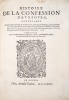
Deuxième édition française de la Confession d’Augsbourg établie sur l’édition latine de 1531 traduite par Luc Le Cop (ou Le Coq) et "insérée" dans le recueil du théologien luthérien et historien allemand David Chytraeus (1530-1600) publié une première fois en latin (1578) puis traduit en allemand (1580) enfin en français (1582).La première édition française de la Confession parut en 1561 sous le titre Confession de Foy présentée à l’Empereur Charles cinquième a la convocation d’Augsbourg (Brunet, II, 219).Confession de foi luthérienne, rédigée en grande partie par Melanchton, avec la collaboration de Luther, la Confession d’Augsbourg fut présentée par ce dernier à l’empereur Charles Quint lors de la diète d’Augsbourg le 25 juin 1530. Sur un ton modéré, elle exposait les dogmes nouveaux de la Réforme de manière à la rendre acceptable aux catholiques. Portée par l’appui de sept princes et de deux villes d’Empire, elle fut rejetée après six semaines d’examen par les théologiens catholiques, dont Jean Eck. Luther se raidit alors, déconseillant toute concession à Melanchton, ce qui provoqua la formation de la ligue protestante de Smalkalde. Atténuée par Melanchton en 1540 (Confessio variata) puis rétablie dans son texte et sa rigueur originels en 1580 (Confessio invariata), la Confession d’Augsbourg demeure le plus important formulaire de foi des églises luthériennes. Très bel exemplaire en vélin d’époque.Brunet I, 1897 : « Ce volume rare renferme un grand nombre de documents relatifs à l’histoire de la Réforme ».

Histoire de la confession d'Avxpovrg, contenante les principauls Traittez & Ordonnances, faittes pour la Religion, quand l'Electeur Iehan, Duc de Saxe avec Les Citez & autres Princes Protestants presenterent leur confession de foy (icy inserée) a l'Empereur Charles V, es Estats generauls de l'Empire, tenus a Auxpourg, 1530.
" Anvers (Antwerpen), Chez Arnould Coninx, 1582., in-4°, title with large woodcut vignette +(7) + 835 pp + (5) pp, full 18th century marbled calf , raised gilt back with title label, edges painted red, marbled endpapers, with an engraved ex-libris of the Bauffremont family with the caption; ''Dieu ayde au premier chretien et plus bas ; Plus de Deuil que de Joye'' pasted on the first pastedown fly leaf. Minimal damage at the headcap and at three corners of the binding, upper margin a bit shaved (never in the text), a fine copy. Belgica Typographica n°620, Graesse II, 154, not in Adams. USTC 5924. French translation of ''Historia Confessionis Augustanae'' first published in Rostock in 1576. This work includes many texts on the history and the organisation of the Reformation by Luther, Melanchton, Erasmus, etc. . David Chytreus (or Chytraeus)(1530-1600) studied in Tübingen and in Wittenberg with Melanchton. His real name was Kochhafe. He became professor at Rostock university and was also involved in the foundation of the Helmstedt university. This edition, published in Antwerp during the short period (1581-1585) when the reformists were in control of the town, is very rare. In 1585 the town was besieged and taken by the catholic Spanish troops. All protestants fled and the ensuing counter-reformation wiped out nearly all traces of protestantism. The first edition of this text was in Latin (1578). The translator Luc Le Cop was a Savoyard living in Antwerp."

