 Write to the booksellers
68 books for « cantor »Edit
-
Type
Book (45)
Music sheets (23)
-
Language
English (21)
French (47)
-
Century
19th (12)
20th (40)
21st (2)
-
Countries
Belgium (4)
Denmark (11)
France (51)
Switzerland (2)
-
Syndicate
ILAB (24)
SLAM (13)
Topics
- Architecture (2)
- Arnaud georges jean (1)
- Bacon francis (1)
- Bible (2)
- Biography (1)
- Education (2)
- Education - morals (2)
- Electricity (1)
- Europe (1)
- Geopolitics (1)
- Gold (1)
- Golf (1)
- Golf (1)
- History (4)
- Hygienics (3)
- Judith (1)
- Latin (3)
- Literature (3)
- Mathematics (12)
- Medicine (2)
- Mitchell margaret (1)
- Newspaper (1)
- Newspapers press (1)
- Philosophy (2)
- Physics (1)
- Physiology (1)
- Poincaré raymond (1)
- Poulenc (1)
- Psychology (1)
- Review (2)
- Reviews (1)
- Sciences (4)
- Sciences & technique (3)
- Scores (23)
- Solomon (1)
- Songs (23)
- Tea (3)
- Theology (3)
- Theory (1)
- Thomas henri (1)
- United states (1)
- War (3)
Über unendliche, lineare Punktmannichfaltigkeiten. - [THE THEORY OF SETS AND INFINITE SETS - THE SECOND PAPER]
Leipzig, B.G. Teubner, 1880. 8vo. Bound in a nice contemporary half calf with five raised gilt bands. Red leather title label with gilt lettering to spine. All edged gilt. In ""Mathematische Annalen"", Band 17, 1880. Entire volume offered. Corners with wear, otherwise a very fine and clean copy. Pp. 355-358. [Entire volume: IV, 576 pp.].
First printing of Cantor's important second paper of the landmark series consisting of a total of six papers which together constitute the foundation Theory of Sets (Mengenlehre) and Transfinite Set Theory. Cantor here introduces his new Set Theory with which he created an entirely new field of mathematical research and is widely regarded as being one of the most important mathematical conquests in the 19th century. ""Cantor's second paper of 1880 was brief. It continued the bricklaying work of the article of 1879, and it too sought to reformulate old ideas in the context of linear point sets. It also introduced for the first time an embryonic form of Cantor's boldest and most original discovery: the transfinite numbers. As a preliminary to their description, however, Cantor introduced several definitions. He also pointed out that first species sets could be completely characterized by their derived sets."" (Dauben, P. 80)Hilbert spread Cantor's ideas in Germany and praised Cantor's transfinite arithmetic as ""the most astonishing product of mathematical thought, one of the most beautiful realizations of human activity in the domain of the purely intelligible"". He is famously quoted for saying ""No one shall expel us from the paradise which Cantor created for us"". Bertrand Russel described Cantor's work as ""probably the greatest of which the age can boast"".""The major achievement of the ""Grundlagen"" was its presentation of the transfinite ordinal numbers as a direct extension of the real numbers. Cantor admitted that his new ideas might seem strange, even controversial, but he had reached a point in his study of the continuum where the new numbers were indispensable for further progress. Cantor had finally come to the realization that his 'infinite symbols' were not just indices for derived sets of the second species, but could be regarded as actual transfinite numbers that were just as real mathematically as the finite natural numbers."" (Grattan-Guinness, Landmark Writings in Western Mathematics, Pp. 604-5).Dauben: (Cantor)1880d.

Über unendliche, lineare Punktmannichfaltigkeiten. - [THE THEORY OF SETS AND INFINITE SETS - THE FINAL PAPER]
Leipzig, B.G. Teubner, 1884. 8vo. Bound in a nice contemporary half calf with five raised gilt bands. Red leather title label with gilt lettering to spine. All edged gilt. In ""Mathematische Annalen"", Band 23, 1884. Entire volume offered. Corners with wear, otherwise a very fine and clean copy. Pp. 453-488. [Entire volume: IV, 598, (2) pp.].
First printing of Cantor's seminal sixth paper in the landmark series consisting of a total of six papers which together constitute the foundation Theory of Sets (Mengenlehre) and Transfinite Set Theory. Cantor here introduces his new Set Theory with which he created an entirely new field of mathematical research and is widely regarded as being one of the most important mathematical conquests in the 19th century. ""Cantor published a sequel in the following year as a sixth in the series of papers on the Punktmannigfaltigkeitslehre (The present paper). Though it did not bear the title of its predecessor, its sections were continuously numbered, 15 through 19"" it was clearly meant to be taken as a continuation of the earlier 14 sections of the ""Grundlagen"" itself. In searching for a still more comprehensive analysis of continuity, and in the hope of establishing his continuum hypothesis, he focused chiefly upon the properties of perfect sets and introduced as well an accompanying theory of content"" (Dauben, P. 111)Hilbert spread Cantor's ideas in Germany and praised Cantor's transfinite arithmetic as ""the most astonishing product of mathematical thought, one of the most beautiful realizations of human activity in the domain of the purely intelligible"". He is famously quoted for saying ""No one shall expel us from the paradise which Cantor created for us"". Bertrand Russel described Cantor's work as ""probably the greatest of which the age can boast"".""The major achievement of the ""Grundlagen"" was its presentation of the transfinite ordinal numbers as a direct extension of the real numbers. Cantor admitted that his new ideas might seem strange, even controversial, but he had reached a point in his study of the continuum where the new numbers were indispensable for further progress. Cantor had finally come to the realization that his 'infinite symbols' were not just indices for derived sets of the second species, but could be regarded as actual transfinite numbers that were just as real mathematically as the finite natural numbers."" (Grattan-Guinness, Landmark Writings in Western Mathematics, Pp. 604-5).Dauben: (Cantor)1884a.
Über unendliche, lineare Punktmannichfaltigkeiten. - [THE THEORY OF SETS AND INFINITE SETS - THE FIRST PAPER]
Leipzig, B.G. Teubner, 1879. 8vo. Bound in a nice contemporary half calf with five raised gilt bands. Red leather title label with gilt lettering to spine. All edged gilt. In ""Mathematische Annalen"", Band 15, 1879. Entire volume offered. Corners with wear, otherwise a very fine and clean copy. Pp. 1-7. [Entire volume: IV, 576 pp.].
First printing of Cantor's seminal exceedingly important first paper in his landmark series of six papers which together constitute the foundation Theory of Sets (Mengenlehre) and Transfinite Set Theory. Cantor here introduces his new Set Theory with which he created an entirely new field of mathematical research and is widely regarded as being one of the most important mathematical conquests in the 19th century. Hilbert spread Cantor's ideas in Germany and praised Cantor's transfinite arithmetic as ""the most astonishing product of mathematical thought, one of the most beautiful realizations of human activity in the domain of the purely intelligible"". He is famously quoted for saying ""No one shall expel us from the paradise which Cantor created for us"". Bertrand Russel described Cantor's work as ""probably the greatest of which the age can boast"".""The major achievement of the ""Grundlagen"" was its presentation of the transfinite ordinal numbers as a direct extension of the real numbers. Cantor admitted that his new ideas might seem strange, even controversial, but he had reached a point in his study of the continuum where the new numbers were indispensable for further progress. Cantor had finally come to the realization that his 'infinite symbols' were not just indices for derived sets of the second species, but could be regarded as actual transfinite numbers that were just as real mathematically as the finite natural numbers."" (Grattan-Guinness, Landmark Writings in Western Mathematics, Pp. 604-5).Dauben: (Cantor)1879b.
Fondements d'une théorie générale des ensembles (+) Sur divers théorémes de la théorie des ensembles de points situs - dans un espace continu a n dimensions. - [SET THEORY]
[Berlin, Stockholm, Paris, F. & G. Beijer, 1883]. 4to. Without wrappers as extracted from ""Acta Mathematica. Hrdg. von G. Mittag-Leffler."", Bd. 2. Fine and clean. Pp. 381-414.
First French translation (and translation in general) of Cantor's fifth, thus most important, paper in his series of papers which founded set theory. (The first mentioned).It contained Cantor's reply to the criticism of the first four papers and showed how the transfinite numbers were a systematic extension of the natural numbers. It begins by defining well-ordered sets. Ordinal numbers are then introduced as the order types of well-ordered sets. Cantor then defines the addition and multiplication of the cardinal and ordinal numbers. In 1885, Cantor extended his theory of order types so that the ordinal numbers simply became a special case of order types. It was later published as a separate monograph.The concept of the existence of an infinity was an important shared concern within the realms of mathematics, philosophy and religion. Preserving the orthodoxy of the relationship between God and mathematics was long a concern of Cantor's. He directly addressed this relationship between these disciplines in the introduction to the present paper, where he stressed the connection between his view of the infinite and the philosophical one. To Cantor, his mathematical views were closely linked to their philosophical and theological implications-he identified the Absolute Infinite with God and he considered his work on transfinite numbers to have been directly communicated to him by God, who had chosen Cantor to reveal them to the world.
Bemerkung mit Bezug auf den Aufsatz: Zur Weierstrass'-Cantor'schen Theorie der Irrationalzahlen in Math. Annalen. Bd. XXXIII, p. 154. - [CANTOR ON NUMBER THEORY]
Leipzig, B.G. Teubner, 1889. 8vo. Original printed wrappers, no backstrip and a small nick to front wrapper. In ""Mathematische Annalen. Begründet 1889 durch Rudolf Friedrich Alfred Clebsch. XXXIII.[33] Band. 3. Heft."" Entire issue offered. Internally very fine and clean. [Cantor:] P. 476. [Entire issue: Pp. (1), 318-476, (1)].
First printing of Cantor's important comment to Illigens paper from the same year: ""Zur Weierstrass'-Cantor'schen Theorie der Irrationalzahlen"". He states that: ""The squareroot of 3 is thus only a symbol for number which has yet to to be found, but is not its definition. The definitions is, however, satisfactorily given by my method as, say (1.7, 1.73, 1.732, ...). [From the present paper]. Cantor is famous for his work on infinite numbers.
Cantor Eddie - Handman Lou,Turk Roy,Cantor Eddie - Turk Roy,Cantor Eddie,Handman Lou
Reference : 108802
(1923)
Partition de la chanson : If you do-what you do Kid Boots
Waterson 1923
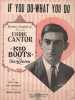
Etat moyen Format Américain Piano
Sur les fondements de la théorie des ensembles transfinis
2005 Editions Jacques Gabay - 2005 - 2e tirage - In-8 broché - 94 pages (343-437)
Très bon état Très bon
Bemerkung mit Bezug auf den Aufsatz: Zur Weierstrass'-Cantor'schen Theorie der Irrationalzahlen (+) Die Zusammensetzung der stetigen endlichen Transformationsgruppen.
Leipzig, B. G. Teubner, 1889. 8vo. Bound in recent full black cloth with gilt lettering to spine. In ""Mathematische Annalen"", Volume 33., 1889. Entire volume offered. Library label pasted on to pasted down front free end-paper. Small library stamp to lower part of title title page and verso of title page. Very fine and clean. P. 476"" Pp. 1-48. [Entire volume: IV, 604 pp.].
First printing of CANTOR'S important comment to Illigens paper from the same year: ""Zur Weierstrass'-Cantor'schen Theorie der Irrationalzahlen"". He states that: ""The squareroot of 3 is thus only a symbol for number which has yet to to be found, but is not its definition. The definitions is, however, satisfactorily given by my method as, say (1.7, 1.73, 1.732, ...). [From the present paper]. First publication of KILLING'S important second paper (of a total of four) in which he laid the foundation of a structure theory for Lie algebras.""In particular he classified all the simple Lie algebras. His method was to associate with each simple Lie algebra a geometric structure known as a root system. He used linear transformation, to study and classify root systems, and then derived the structure of the corresponding Lie algebra from that of the root system.""(Companion Encyclopedia of the History and Philosophy of the Mathematical Sciences)Unfortunately for Killing a myth arose that his work was riddled with error, which later has been proved untrue. ""As a result, many key concepts that are actually due to Killing bear names of later mathematicians, including ""Cartan subalgebra"", ""Cartan matrix"" and ""Weyl group"". As mathematician A. J. Coleman says, ""He exhibited the characteristic equation of the Weyl group when Weyl was 3 years old and listed the orders of the Coxeter transformation 19 years before Coxeter was born.""The theory of Lie groups, after the Norwegian mathematician Sophus Lie, is a structure having both algebraic and topological properties, the two being related.
Philippe Cantor Baryton Poulenc Philippe Cantor Baryton
Reference : 30206
(2026)
ISBN : 3760130510226
Poulenc melodies
Anima Records 2026 14x13x1cm. 2026. CD.
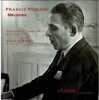
Expédié soigneusement dans une enveloppe à bulles depuis la France
Revue d'Histoire des Sciences - Michel Pinault sur Frédéric Joliot - Martha Cecila Bustamante sur Jacques Salomon - Benoit Lelong sur Paul Villard et J.-J. Thomson - Jean-Pierre Belna sur Frege, Cantor et Dedekind - Myriam Scheidecker-Chevallier sur Avogadro et d'Ampère
Reference : 100284
(1997)
Revue d'Histoire des Sciences - Tome 50, n° 1/2 - Janvier-Juin 1997 , (Naissance d'un dessein : Frédéric Joliot et le nucléaire français, août 1944 - septembre 1945 - Jacques Salomon, 1908-1942 : Profil d'un physicien théoricien dans la France des années trente - Paul Villard, J.-J. Thomson et la composition des rayons cathodiques - Les nombres réel: Frege critique de Cantor et de Dedekind - L'hypothèse d'Avogadro (1811) et d'Ampère (1814) : La distinction atome / molécule et la théorie de la combinaison chimique)
Presses Universitaires de France - P.U.F. , Revue d'Histoire des Sciences Malicorne sur Sarthe, 72, Pays de la Loire, France 1997 Book condition, Etat : Bon broché, sous couverture imprimée éditeur blanche, titre en bleu et noir grand In-8 1 vol. - 235 pages
1ere édition, 1997 Contents, Chapitres : Michel Pinault : Naissance d'un dessein : Frédéric Joliot et le nucléaire français, août 1944 - septembre 1945 - Martha Cecila Bustamante : Jacques Salomon, 1908-1942 : Profil d'un physicien théoricien dans la France des années trente - Benoit Lelong : Paul Villard, J.-J. Thomson et la composition des rayons cathodiques - Jean-Pierre Belna : Les nombres réel: Frege critique de Cantor et de Dedekind - Myriam Scheidecker-Chevallier : L'hypothèse d'Avogadro (1811) et d'Ampère (1814) : La distinction atome / molécule et la théorie de la combinaison chimique - Comptes rendus couverture à peine jaunie avec une infime trace de pliure au coin supérieur droit du plat supérieur, sinon très bon état, intérieur frais et propre - paginé 1 à 235
Sur une propriété du systéme de tous les nombres algébriques réels. [Translated from the German: Über eine Eigenschaft des Inbegriffes aller reellen algebraischen Zahlen]. - [FIRST CONTRIBUTION TO SET THEORY AND THE BIRTH OF THE THEORY OF THE TRANSFINITE]
[Berlin, Stockholm, Paris, F. & G. Beijer, 1883]. 4to. Without wrappers as extracted from ""Acta Mathematica. Hrsg. von G. Mittag-Leffler."", Bd. 2. Fine and clean. Pp. 305-328.
First French [and general] translation of Cantor's famous and exceedingly influential paper which contains the first proof that the set of all real numbers is uncountable"" also contains a proof that the set of algebraic numbers is denumerable. ""This article is Cantor's first published contribution to the theory of sets. The deep and epoch-making result of the paper is not the easy theorem alluded to in the title - the theorem that that the class of real algebraic numbers is countable - but rather the proof, in 2, that the class of real numbers is not countable [...]. And that marks the start of the theory of the transfinite. [Ewald, Pp. 839-40].""The first published writing on set theory [the present paper], contained more than the title indicated, including not only the theorem on algebraic numbers but also the one on real numbers, in Dedekind's simplified version, which differs from the present version in that today we use the ""diagonal process,"" then unknown"" (DSB)
Cantor Eddie - Gold Joe,Gibson Joe,Ribaud Joe - Gibson Joe,Ribaub Joe,Gold Joe
Reference : 108700
(1920)
Partition de la chanson : Grieving for you Edition originale américaine , partition piano et chant; en couverture photo de l'interprète Eddie Cantor Midnight Rounders
Leo Feist inc. 1920
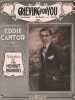
Bon état Format Américain Piano
Partition de la chanson : My Blackbirds are Bluebirds now Edition originale américaine , partition piano et chant; photo de l'interprète Eddie Cantor en couverture Whoopee
Leo Feist inc. 1928

Bon état Format Américain Piano,Ukulélé
Partition de la chanson : Scandinavia ( Sing dose song and make dose music ) Edition originale américaine , partition piano et chant; en couverture photo de l'interprète Eddie Cantor Midnight Rounders
Stark and Cowan 1921
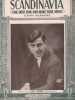
Bon état Format Américain Piano
Cantor Eddie - Friend Cliff,Tobias Charlie - Tobias Charlie,Friend Cliff
Reference : 109607
(1941)
Partition de la chanson : We did it before and we can do it again Edition américaine originale de cette partition piano, chant; photo de couverture en fond, drapeau Américain puis photo avec Eddie Cantor ainsi que l'ensemble des vedettes . " We did it before " cette chanson fut l'une des premières du genre durant l'engagement américain pendant la seconde guerre mondiale Banjo Eyes
Partitions sur la Seconde guerre mondiale Witmark 1941
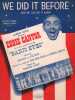
Bon état Format Américain Piano
Partition de la chanson : Someone loves you after all Avec Mary Eaton , Photo d'Eddie Cantor en blackface ou grimage en Noir ( minstrel show ) Rain song (The) Adhésif interieur Kid Boots
Leo Feist inc. 1923

Etat moyen Format Américain
"L'étonnante méthode psychosomatique ""Slumber"" perte de poids rapide du Docteur Cantor"
S.I.P.. Non daté. In-8. Broché. Bon état, Couv. convenable, Dos satisfaisant, Intérieur frais. 63 pages. Non daté.. . . . Classification Dewey : 613-Hygiène
Classification Dewey : 613-Hygiène

Revue Isis - Anthony Stranges - G. N. Cantor - Douglas R. Weiner
Reference : 32452
(1984)
Isis - volume 75, n°279 - December 1984 , International Review devoted to the History of Science and its cultural Influences
Isis , History of Science Society Malicorne sur Sarthe, 72, Pays de la Loire, France 1984 Book condition, Etat : Bon paperback grand In-8 1 vol. - 173 pages
few figures "Contents, Chapitres : Articles : Anthony Stranges : Friedrich Bergius and the Rise of the German Synthetic Fuel Industry - G. N. Cantor : Berkeley's The Analyst Revisited - Douglas R. Weiner : Community Ecology in Stalin's Russia : ""Socialist"" and Bourgeois"" Science. - Critiques and Contentions : Mary Jo Nye : Scientific Decline : Is Quantitative Evaluation Enough?- News of the Profession : Eloge : M. T. D'Alverny : Maria Luisa Righini Bonelli, 11 Nov. 1917-18 Dec. 1981. - Essay Reviews : Henrika Kuklick. on James Clifford's Person and Myth : Maurice Leenhardt in the Melanesian World - Sir Edward Evan Evans-Pritchard's History of Anthropological Thought, edited by Andre Singer. - Ian Langham's The Building of British Anthropology : W. H. R. Rivers and his Cambridge Disciples in the Development of Kinship Studies 1898-1931 - Lorraine Daston on Philip Kitcher's The Nature of Mathematical Knowledge. - Book reviews, 57 reviews, and a special section ""History of Technology"", 22 reviews - Notes on Contributors - Index to volume 75." working copy from Pierre Thuillier, few annotations at ink on cover and on page 740, otherwise fine copy
McCormmach (Russell), ed. - Kenkichiro Koizumi - Geoffrey Cantor - Barbara Giusti Doran - Salvo d'Agostino on Heinrich Hertz - J.G. McEvoy and J.E. McGuire on Priestley - John Hedley Brooke on Laurent and Gerhardt - Robert E. Kohler, Jr. on Lewis-Langnuit - Roger H. Stuewer on G.N. Lewis - Thaddeus J. Trenn on Rutherford
Reference : 100626
(1975)
Historical Studies in the Physical Sciences - Annual volume n° 6 - Sixth Annual Volume , (The emergence of Japan's first physicists, 1868-1900 - The reception of the Wave Theory of Light in Britain : A case study illustrating the role of methodology in scientific debate - Origins and consolidation of Field Theory in Nineteenth century Britain : From the mechanical to the electromagnetic view of nature - Hertz's researches on Electromagnetic Waves - God and nature : Priestley's way of rational dissent - Laurent, Gerhardt, and the Philosophy of Chemistry - The Lewis-Langnuit Theory of Valence and the chemical community, 1920-1928 - G.N. Lewis on Detailed Balancing, the Symmetry of Time, and the Nature of Light - Rutherford and Recoil Atoms : The metamorphosis and success of a once Stillborn Theory)
Princeton University Press , Historical Studies in the Physical Sciences Malicorne sur Sarthe, 72, Pays de la Loire, France 1975 Book condition, Etat : Bon hardcover, editor's binding, under editor's printed dust-jacket clear blue and black grand In-8 1 vol. - 564 pages
1 plate in frontispiece, Japanese, Kanagaki Robun, few black and white illustrations 1st edition, 1975 Contents, Chapitres : Contents, Editor's Foreword, xiv, Text, 550 pages, Contributors - Kenkichiro Koizumi : The emergence of Japan's first physicists, 1868-1900 - Geoffrey Cantor : The reception of the Wave Theory of Light in Britain : A case study illustrating the role of methodology in scientific debate - Barbara Giusti Doran : Origins and consolidation of Field Theory in Nineteenth century Britain : From the mechanical to the electromagnetic view of nature - Salvo d'Agostino : Hertz's researches on Electromagnetic Waves - J.G. McEvoy and J.E. McGuire : God and nature : Priestley's way of rational dissent - John Hedley Brooke : Laurent, Gerhardt, and the Philosophy of Chemistry - Robert E. Kohler, Jr. : The Lewis-Langnuit Theory of Valence and the chemical community, 1920-1928 - Roger H. Stuewer : G.N. Lewis on Detailed Balancing, the Symmetry of Time, and the Nature of Light - Thaddeus J. Trenn : Rutherford and Recoil Atoms : The metamorphosis and success of a once Stillborn Theory near fine copy, the dust-jacket is complete and near fine, but with minor wear (folding tracks mainly), the top of the right part is lightly torn on 2 cms, inside is fine, no markings
Gooding (David) and James (Frank J.L.) on Michael Faraday - David M. Knight - Sophie Forgan - Geoffrey N. Cantor - Brian Bowers - Nancy J. Nersessian - Ryan D. Tweney - Elspeth Crawford
Reference : 100093
(1985)
Faraday Rediscovered - Essays on the Life and Work of Michael Faraday, 1791-1867 , (Davy and Faraday : Father and Sons - Faraday, from Servant to Savant, the institutional context - Reading the Book of Nature : The relation between Faraday's religion and his science - In Nature's school : Faraday as an experimentalist - The optical mode of investigation : Light and matter in Faraday's Natural philosophy -Faraday, Wheatstone and electrical engineering - Faraday's field concept - Faraday's discovery of induction - Learning from experience)
Stockton Press Malicorne sur Sarthe, 72, Pays de la Loire, France 1985 Book condition, Etat : Bon hardcover, editor's binding, under editor's blue printed dust-jacket, illustrated by a photograph of Michael Faraday In-8 1 vol. - 272 pages
1 plate in frontispiece (Faraday's Laboratory) and 15 other plates (complete of the 16 plates) 1st edition, 1985 Contents, Chapitres : Contents, List of plates, Notes on contributors, Foreword by Professor Sir George Porter, xiv, Text, 258 pages - David Gooding and Frank A.J.L. James : Faraday rediscovered - David M. Knight : Davy and Faraday : Father and Sons - Sophie Forgan : Faraday, from Servant to Savant, the institutional context - Geoffrey N. Cantor : Reading the Book of Nature : The relation between Faraday's religion and his science - David Gooding : In Nature's school : Faraday as an experimentalist - Frank A.J.L. James : The optical mode of investigation : Light and matter in Faraday's Natural philosophy - Brian Bowers : Faraday, Wheatstone and electrical engineering - Nancy J. Nersessian : Faraday's field concept - Ryan D. Tweney : Faraday's discovery of induction - Elspeth Crawford : Learning from experience - Bibliographical notes, Collected bibliography and index dust-jacket complete, unmarked and near fine, small part of the bottom right corner is lightly torn, without missings, inside is fine, no markings, a French publisher retailer sticker inside the front cover (Lavoisier), it's NOT an ex-library copy, a rather nice copy
CANTOR Georg - Ernst ZERMELO ( editor ) - Adolf FRAENKEL ( biography ) :
Reference : 56701
Georg Cantor Gesammelte Abhandlungen Mathematischen un Philosophischen Inhalts. Mit erläuternden Anmerkungen sowir mit Ergänzungen aus dem Briefwechsel Cantor-Dedekind.
Hildesheim, Olms Verlag, 1966, (facsimile edition of the Berlin 1932 edition), softcover.
Jean-Pierre Astolfi-Maryline Cantor- Andre Laugier
Reference : RO40058534
(1995)
ISBN : 2091200689
Sciences et technologie, cycle 3, niveau 1 - collection gulliver
NATHAN. 1995. In-4. Relié. Bon état, Couv. convenable, Dos satisfaisant, Intérieur frais. 95 pages illustrées en couleurs + contreplats illustrés en couleurs.. . . . Classification Dewey : 372.8-Livre scolaire : autres matières
Jean-Pierre Astolfi, Maryline Cantor, André Laugier, Elisabeth Ple, Charles Rongier, Patricia Schneeberger Classification Dewey : 372.8-Livre scolaire : autres matières
Yves Arvieu, Jean-Pierre Astolfi, Maryline Cantor
Reference : RO40058538
(2000)
ISBN : 2091200727
Sciences et technologie - collection gulliver cycle 3, niveaux 2 et 3
NATHAN. 2000. In-4. Relié. Bon état, Couv. convenable, Dos satisfaisant, Intérieur frais. 175 PAGES illustrées en couleurs.. . . . Classification Dewey : 372.8-Livre scolaire : autres matières

Yves Arvieu, Jean-Pierre Astolfi, Maryline Cantor, André Laugier, Xavier Pattyn, Patricia Schneeberger. Classification Dewey : 372.8-Livre scolaire : autres matières
Journal of the History of Ideas - Judith Kegan Gardiner - Noretta Koertge - Don Parry Norford - G.H. Cantor - G.H.R. Parkinson - Agnieszka Morawinska -William Baker - Paul E. Corcoran - Andrew J. Lynch - J.D. Coates - Elmer H. Duncan and Robert M. Baird - Geoffrey G. Field
Reference : 27345
(1977)
Journal of the History of Ideas - Volume XXXVIII - number 3 - July-September 1977
Temple University, Philadelphia , Journal of the History of Ideas Malicorne sur Sarthe, 72, Pays de la Loire, France 1977 Book condition, Etat : Bon paperback grand In-8 1 vol. - 181 pages
Contents, Chapitres : Judith Kegan Gardiner : Elizabethan psychology and Richard Burton - Noretta Koertge : Galileo and the problem of accidents - Don Parry Norford : Microcosm and macrocosm in 17th century literature - G.H. Cantor : Berkeley , Reid and 18th century optics - G.H.R. Parkinson : Hegel , Pantheism and Spinoza - Agnieszka Morawinska : 18th century Paysages moralisés - Notes : William Baker : Herbert Spencer and Evolution - Paul E. Corcoran : The Bourgeois and other villains - Andrew J. Lynch : Montesquieu 's ecclesiastical critics - J.D. Coates : Coleridge 's debt to Harrington : a discussion on Zapolya - Elmer H. Duncan and Robert M. Baird : Thomas Reid on Adam Smith 's theory of morals - Geoffrey G. Field : Nordic racism - Review article : Paul Kashap : Some recent works on Spinoza 's thought ex-library copy
Sur les séries trigonométriques (transl. of Über trigonometrische Reihen) (+) Extension d'un théoréme de la théorie des séries trigonométriques.
Berlin, Stockholm, Paris, Beijer, 1883. 4to. As extracted from ""Acta Mathematica, 2. band."", Clean and fine. Pp. 329-348.
First transation of Cantor's important papers on trigonometric series.

