 Write to the booksellers
4 books for « bede le venerable »Edit
-
Topics
Comic strip (2)
History (2)
Philosophy (1)
Religions (1)
Tea (1)
-
Countries
Belgium (2)
Denmark (1)
France (1)
Venerabilis Bedae Presbytiri anglo-saxons viri sua aetate doctissimi Opera quotquot reperiri potuerunt omnia. Hac ultima impressione ornatius in lucem edita.
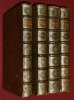
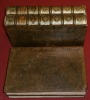
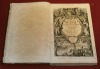
Coloniae Agrippinae : sumptibus Antonij Hieratus Gymnici, 1612, 8 tomes reliés en 4 volumes de 250x390 mm environ, Volume 1, tome I. (7) ff. (page de titre gravée, vie de Bède, table), 452 pages ; tome II. Philosophie, (1)f. (page de titre), 238 pages, (1)f., - Volume 2, tome III. Histoire, (3) ff. (titre, table, au Roi, au lecteur), 500 pages, (1) f. ; tome IV. Commentaires Ancien Testament, (2) ff. (titre, table), 916 pages, (1) f., - Volume 3, tome V. (1) f. (titre), 816 pages annoncées (erreurs de pagination, 855 pages) ; tome VI. (1) f. (titre), 852 pages, (1) f., - Volume 4, tome VII. (2) ff. (titre, table) 486 pages ; tome VIII. Ancien Testament, (2) ff. (titre, table), 968 pages, (64) ff. (index), (1) f., reliures plein cuir granité brun, dos à 6 nerfs portant titres et tomaisons dorés, sur pièces de titre en veau fauve, ornés de caissons à riches motifs dorés, tranches mouchetées de rouge. Avec de nombreuses figures, tableaux, diagrammes, calendriers. Ex-libris manuscrits sur les page de titre. Fréquentes erreurs de pagination, le nombre de pages annoncés est parfois erroné, mais ces volumes sont bien complet avec pagination des cahiers cohérente, rousseurs mouillures, des pages brunies, léger manque de papier sur la dernière page du tome II, épidermures, frottements, coiffes ébréchées avec début de fente sur les mors, des tampons de bibliothèque, bon état pour le reste.
Bède, dit le Vénérable (en latin : Beda Venerabilis, en anglais : Bede, prononcé /bi:d/), est un moine et lettré anglo-saxon né vers 672/673 en Northumbrie et mort le 26 mai 735. Son uvre la plus célèbre, l'Histoire ecclésiastique du peuple anglais, lui a valu le surnom de « Père de l'histoire anglaise ». Il est également linguiste et traducteur, et ses traductions des uvres grecques et latines des premiers pères de l'Église ont joué un rôle important dans le développement du christianisme en Angleterre. En 1899, Bède est proclamé docteur de l'Église par le pape Léon XIII ; il est à ce jour le seul natif de Grande-Bretagne à avoir été ainsi honoré, mais il est notamment connu comme fondateur du comput (science de la datation et du calcul de la date des fêtes mobiles dans la religion chrétienne) et a été le premier à introduire un système de datation prenant comme référence la naissance du Christ. Merci de nous contacter à l'avance si vous souhaitez consulter une référence au sein de notre librairie.
Opera qoutquot reperiri potuerunt omnia: Hac ultima impressione ornatus in lucem edita. 8 Tomi. - [THE FIRST COMPLETE BEDE]
Coloniae Agrippinae (Köln), Sumptibus Anton. Hierati et Ioan. Gymnici, 1612. Folio. Bound in two contemporary, uniform full vellum bindings with remains of silk-ties on boards. Some traces of use to extremities. Some pages evenly browned, some brownspotted. First two volumes richly illustrated with woodcut diagrams, musical notes, earth- and heaven-maps etc. in the text, numerous woodcut initials throughout, engraved title-page. (10) pp, columns 1-168 (84 pp.), pp. 169 - 322, columns 323 - 452 (65 pp.) + (1) f., 238 pp. + (2) ff., columns 1 - 500 (250 pp.) + (2) ff., columns 1 - 916 (458 pp.) + (1) f., columns 1 - 816 (408 pp) + (1) f., columns 1 - 852 (426 pp.) + (2) ff., columns 1 - 485 (243 pp.) + (2) ff., columns 1 - 968 (484 pp.), 55 ff. (Index).
Very rare, early, and apparently first complete edition of the seminal works by the ""Father of English History"", the venrable Bede. Bede’s most famous work, his ""An Ecclesiastical History of the English People"" (Historia Ecclesiastica Gentis Anglorum)? begins with the invasion of the British Isles by Roman forces and is considered one of the most important historical records documenting Roman rule, Anglo-Saxon settlement and the evolution of the Church on the island. With its focus on Anglo-Saxon history, the work is considered a key foundational text in the forming of a national English identity. The ""Ecclesiastical History"" contains stories that serve as the only source documenting the conversion to Christianity of the Anglo-Saxon tribes. It tells the story of Britons from Julius Caesar’s invasion, to the time of Bede himself . He tells the story of battles, conversions and miracles performed by monks and bishops, and details Britain’s early history from the Roman invasion. He furthermore describes the organization and establishment of Christianity in the English church and covers the personal history of ?Holy Ethelwald and miracles of growth within the English church, such as the development of the bishopric. ""Bede’s works fall into three groups: grammatical and “scientific,” scriptural commentary, and historical and biographical. His earliest works included treatises on spelling, hymns, figures of speech, verse, and epigrams. His first treatise on chronology, De temporibus (“On Times”), with a brief chronicle attached, was written in 703. In 725 he completed a greatly amplified version, De temporum ratione (“On the Reckoning of Time”), with a much longer chronicle. Both these books were mainly concerned with the reckoning of Easter. His earliest biblical commentary was probably that on the Revelation to John (703?–709)" in this and many similar works, his aim was to transmit and explain relevant passages from the Fathers of the Church. Although his interpretations were mainly allegorical, treating much of the biblical text as symbolic of deeper meanings, he used some critical judgment and attempted to rationalize discrepancies. Among his most notable are his verse (705–716) and prose (before 721) lives of St. Cuthbert, bishop of Lindisfarne. These works are uncritical and abound with accounts of miracles a more exclusively historical work is Historia abbatum (c. 725" “Lives of the Abbots”). In 731/732 Bede completed his Historia ecclesiastica. Divided into five books, it recorded events in Britain from the raids by Julius Caesar (55–54 BCE) to the arrival in Kent (597 CE) of St. Augustine of Canterbury. For his sources, he claimed the authority of ancient letters, the “traditions of our forefathers,” and his own knowledge of contemporary events. Bede’s Historia ecclesiastica leaves gaps tantalizing to secular historians. Although overloaded with the miraculous, it is the work of a scholar anxious to assess the accuracy of his sources and to record only what he regarded as trustworthy evidence. It remains an indispensable source for some of the facts and much of the feel of early Anglo-Saxon history."" (Encycl. Britt). Only three editions of Bede's Opera Omnia are known before Dr. Giles' edition from 1843 - 44. The first was printed in 1563 and the third in 1688. The 1688-edition constitutes the second edition of the present 1612-edition which is ""According to Dr. Henry, the only complete edition"" (Lowndes I:143). These three editions are also the only ones known to have been printed in folio (though Lowndes mentions the 1688-edition as 4to). The 1612-edition is the rarest. Some of the works contained in this edition are said not to be Bede's own, as some of the many scientific, richly illustrated works on geography, the heavens, the universe, music etc. bear small resemblance to his other works. Lowndes I:143, Brunet 1:731.

Venerabilis Bedae Presbyteri Anglo-Saxonis viri sua aetate doctissimi OPERA quotquot reperiri potuerunt omnia.
" Coloniae Agrippina (Köln) , Sumptibus Joannis Wilhelmi Friesem, 1688, 8 part bound in 4 volumes, in-folio, 39 x 24 cm. Volume I (tomus I and II) ; engraved title with view of Cologne (A. Braun), typographical title printed in red and black + (6)nn pp + 322 pp + 64 pp (numbered columns 323-452) , title + (1) nn pp + 238 pp. Volume II (tomus III and IV) ; title + (3) nn pp + 250 pp (numbered columns 1-500) , title + (3)(2 bl) nn pp + 408 pp (numbered columns 1-916) + (3)(bl) nn pp . Volume III (tomus V and VI) ; title + (1) nn pp + 408 pp (numbered columns 1-816) , title + (1) nn pp + 426 pp (numbered columns 1-852). Volume IV (tomus VII and VIII) ; title + (3)(2 bl) nn pp + 243 pp (numbered columns 1-486) + (1)(bl) , title + (3)(2 bl) nn pp + 484 pp (numbered columns 1- 968) + (108)(index) nn pp + (2)(bl). (Complete). With many woodcut and copper engraved illustrations and diagrams printed in the text, especially in the first two parts. Bound in 4 uniform full contemporary leather bindings, all volumes uniformly rebacked, gilt raised spines with two labels, endpapers renewed, bookblocks untouched, with edges painted red. Some old waterstains at some pages, most pages a bit browned due to paper quality, but never obtrusively. In all a well preserved set in very sound bindings. Ex-library with only 8 stamps , each time on the verso of the title. There are known three European continental folio editions of the collected works (Opera omnia) of Bede (672 - 735) , the Father of English History. The first was published in Basel 1563, the two others at Cologne in 1612 and 1688. According to Charles Plummer ( Enc. Britt. 11th ed.) all these editions contain works which cannot by any possibility be Bede's. Especially the first two volumes contain many scientific treatises ; on cosmology, music, etc."
Historical Works Baedae Opera Historica in 2 volumes. Loeb Classical Library Series.Ecclesiastical History of the English Nation... Lives of the Abbots. Letter to Egbert.
London, Heinemann . Cambridge , Harvard U.P., 1971 reprint, 2 vols small in-8°, 17 x 11 cm, [1] xxxv pp + 505 pp + folding map. [2] ix pp + 517 pp. publisher's cloth with dustwrapper. Apart from price clipping mint copies !.

