 Write to the booksellers
15 books for « arnobius »Edit
-
Language
French (13)
Latin (2)
-
Century
16th (1)
17th (1)
18th (1)
19th (2)
20th (4)
-
Countries
Belgium (6)
Denmark (1)
France (4)
Netherlands (2)
Switzerland (2)
-
Syndicate
ILAB (4)
NVVA (2)
SLACES (2)
SLAM (1)
Ioannis Meursii Criticus Arnobianus tributus in libros septem. Item Hypocriticus Minutianus, & Excerpta MS. Regii Parisiensis. Editio altera, & melior.
Leiden (Lugduni Batavorum), Ex officina Ludovici Elzevirii, 1599.
8vo. (XX),167,(23)(1 blank) 18th century half calf 17.3 cm (Ref: STCN ppn 119504200; Dibdin 1,215: 'an indispensable work to peruse, for those who are curious in the learning of the author'. Willems 44; Rahir 26; Berghman 1283; Schoenemann 1,166/67) (Details: Back gilt and with 5 raised bands. Red shield in second compartment. Colophon at the end: 'Lugduni Batavorum, Excudebat Ioannes Balduini. Anno 1599, mense Julio') (Condition: Binding worn at the extremes. Joints split, but still tight. Small piece at the head of the spine gone. Ownership inscription on the front flyleaf. Stamp on the title. Foxed) (Note: Arnobius, a teacher of rhetoric at Sicca Veneria in Numidia 'was suddenly converted to Christianity (ca. A.D. 295) and a year or 2 later, at the instance of his bishop, wrote seven books 'Adversus Nationes', Against the Pagans. His work throws light on the Christian-pagan debate immediately before the Great Persecution, while the venom of his attack on traditional Roman paganism shows that this was by no means dead'. (OCD 2nd edition p. 122) His style is easy-flowing. Arnobius makes little use of the New, and none of the Old Testament. His view of God is platonic. The unintended side effect of the efforts Arnobius and other Church Fathers to ridicule or crush paganism, was that their writings form an archive which preserves knowledge and practices of polytheism in the years of its decline in late antiquity. Just as the early christians bolstered their piety by contrasting it with the demonic foulness of pagan religion, so the protestants of the 16th century used their knowledge of pagan idolatry to scourge their catholic adversaries. Critics of Catholicism, like Calvin, compared catholic mass e.g. with the bloody rituals of the pagans, and used the sacrifices of the ancients to score theological points against their opponents. 'Protestants detected in the Catholic cult of images, the pagan idols so well described by late antique critics like Arnobius'. (The Classical Tradition, Cambr. Mass., 2010, p. 678, s.v. Paganism) The work of Arnobius was first published in Rome in1542 (although the preface is dated 1543), containing as Book Eight the 'Octavius' of Minucius Felix. Other editions followed in 1546, 1560, 1580, 1582, 1583 & 1586. Joannes Meursius, or in Dutch 'Jan de Meurs', 1579-1639, was only 19 years old when he published the first edition of this celebrated 'Criticus Arnobianus' in Leyden in 1598. He was a pupil of the genius J.J. Scaliger, who helped him to publish it. It was a work of philology and not of theology, and it enjoyed a mixed reception. Schoeneman observes that the book showed indeed the 'acumen' of the author's genius, but that it is more on others classical authors than on Arnobius and Minucius Felix. Meursius offers for the greater part animadversions, critical notes, conjectures and emendations. He did not consult manuscripts, but used his 'ingenium'. The next year, 1599, Elsevier published this second improved edition of the 'Criticus Arnobianus'. It was not 'augmented', as is usual with second editions, on the contrary, Meursius wisely cut a number of his rash suggestions. In 1610 Meursius became professor of Greek in his own university. There, in Leyden, he produced the 'editiones principes' of a number of Byzantine authors, the 'editio princeps' of the 'Elementa Harmonica' of Aristoxenus (1616), and edited the 'Timaeus' of Plato with the commentary and translation of Chalcidius (1617). He wrote much on the antiquities of Athens and Attica. (J.E. Sandys, 'A history of classical scholarship', 1964, p. 311)) (Provenance: In ink on the front flyleaf: 'Robinson Ellis from I. Bywater, Oct. 1887'. Robinson Ellis, 1834-1913, is a crucial figure in the history of textual and literary criticism of Catullus. He was elected to a fellowship at Trinity College, Oxford, in 1858, appointed professor of Latin at Univerisity College London (1870-1876). In 1893 he succeeded Henry Nettleship as Corpus Professor of Latin. (DBC 1,285) See for a charming portrait of Ellis his Wikipedia lemma. Ingram Bywater, 1840-1914, succeeded in Oxford Benjamin Jowett as Regius professor of Greek in 1893. He was a noted bibliophile whose collection now rests in the Bodleian Library. He 'occupies an important place in the modern history of ancient philosophy in Britain. (...) He is best known for his contribution to Aristotelian studies. His text of the Nicomachean Ethics (1890) was used as a model for the series, Oxford Classical Texts, inaugurated in 1898'. (DBC 1.145) On the front flyleaf also in ink: 'Ex libris Gal. Barrovi, 18o mensis Iunii 1948'. This is probably Walter Barrow, 1867-1954, Pro-chancellor, 1933-1939, of the University of Birmingham) (Collation: +10, A-M8 (leaf M8 verso blank)) (Photographs on request)
Arnobii Disputationum adversus gentes libri septem, recogniti & aucti. Ex bibliotheca Theodori Canteri Ultraiectini, cuius etiam notae adiectae sunt.
Antwerpen (Antverpiae), Ex officina Christophori Plantini, 1582.
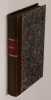
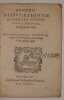
8vo. 285,(1 errata, & 2 blank) p. Tasteful modern half calf. 18 cm (Ref: Belg. Typ. 172; STC Dutch p. 14; Adams A1996; Voet 596 variant A; Sorgeloos 113; Dibdin 1,215: 'An excellent edition, in which the modesty and learning of its editor are successfully opposed to the rashness of his predecessor Gelenius' (in his edition of 1546); Ebert 1219; not in Brunet) (Details: Woodcut printer's device on the title. Red morocco letterpiece on the back. The binder used a broad strip of vellum as spine lining; this strip was probably cut from an old manuscript contract) (Condition: Name on the title. Very small tear near the right lower corner of the title. Occasional old ink underlinings on ca. 70 pages. Right margin of the last 60 pages slightly waterstained, the last gathering however more so) (Note: Arnobius, a teacher of rhetoric at Sicca Veneria in Numidia, 'was suddenly converted to Christianity (ca. A.D. 295) and a year or two later, at the instance of his bishop, he wrote seven books 'Adversus Nationes', 'Against the Pagans'. 'His work throws light on the Christian-pagan debate immediately before the Great Persecution, while the venom of his attack on traditional Roman paganism shows that this was by no means dead'. (OCD 2nd edition p. 122) His style is easy-flowing. Arnobius makes little use of the New, and none of the Old Testament. His view of God is platonic. The unintended side effect of the efforts of Arnobius and other Church Fathers to ridicule or crush paganism, was that their writings form an archive which preserves knowledge and practices of polytheism in the years of its decline in late antiquity. Just as the early christians bolstered their piety by contrasting it with the demonic foulness of pagan religion, so the protestants of the 16th century used their knowledge of pagan idolatry to scourge their catholic adversaries. Critics of Catholicism, like Calvin, compared catholic mass e.g. with the bloody rituals of the pagans, and used the sacrifices of the ancients to score theological points against their opponents. 'Protestants detected in the Catholic cult of images, the pagan idols so well described by late antique critics like Arnobius'. (The Classical Tradition, Cambr. Mass., 2010, p. 678, s.v. Paganism) The work of Arnobius was first published in Rome in 1542 (although the preface is dated 1543). Other editions followed in 1546, 1560 and 1580. Our edition of 1582 was produced by the Dutch scholar Theodorus Canterus (Dirk Canter), 1545-1617. He followed the edition of Gelenius of 1546, who sometimes rewrote the text 'ope ingenii' to make difficult passages intelligible. Canterus inserts some modifications of his own, and returns for readings to the 'editio princeps' of 1542, edited by Faustus Sabaeus. This was a wise policy and a sensible thing to do. Canter's textual and exegetical notes appear as endnotes. (See for Canter and his Arnobius edition 'History of Scholarship: A Selection of Papers from the Seminar on the History of Scholarship Held Annually at the Warburg Institute', edited by Christopher Ligota, Jean-Louis Quantin. Oxford University Press, 2006, page 97-100). The history of classical philology saw strange creatures, and Dirk Canter sure was one. He was the brother of the great classical scholar Willem Canter, studied classics in Paris under Lambinus, but was the rest of his life primarily a political and religious adventurer in his hometown, the city of Utrecht. He was there mayor, political agitator, religious opportunist and extremist, a conspirator to overthrow the government of the city to seize power. He was banished in 1611. Still he managed to find time to produce this excellent scholarly edition and other philological work, such as 'Variarum lectionum libri duo', Antwerp 1574) (NNBW 1,558) (Provenance: the signature on the first and last page is probably of a member of the Soissy family, originating from the Champagne) (Collation: A-S8 (leaf S8 blank) (Photographs on request)
Arnobii disputationum adversus gentes libri septem. M.Minucij Felicis Octavius. Editio nova , ad editionem Romanam expressa ; quibusdam tamen inlocis e ms.Reg.aucta & emendata. Desiderii Heraldi ad Arnobii Libros VII animadversiones , & Castigationes
1605 Parisiis, Apud Marcum Orry ,1605 , Petit in huit ( 12 x 17,5 cm ) , (12) -378 pp , 428 pp, reliure d'époque en plein parchemin avec le titre manuscrit au dos, bon état,
.

Arnobius Iunior, Praedestinatus
, Brepols, 2022 Paperback, 256 pages, Size:156 x 234 mm, Language(s):English, Latin. ISBN 9782503596761.
Summary For the first time in English, the Praedestinatus represents a moment in the fifteen-century old theological conversation in Latin Christianity about the topics of grace, predestination and free will. Written as a response to Augustine's growing theological influence, this book should not merely be regarded as a work of apologetics, despite the author's intention, but seen as breaking controversial new ground because of his claim that a small circle of heretics was acting as a 'fifth column' within the Church, undermining orthodox beliefs concerning God, his providence and all-inclusive love. The introduction sheds light on the authorship, dating and historical context of this work. It documents how this text was received and critically assessed for a period of over twelve centuries: from the time of Augustine in the fifth century to that of the bitter Jansenist controversy in the seventeenth. It entered those latter debates shortly after its rediscovery by Jacques Sirmond in the library of the Reims cathedral in a manuscript that, in the ninth century, was in the possession of Hincmar - the archbishop of Reims who in his time had revived disputes about grace and free will. Sirmond named the text '[the] Praedestinatus' when he published its first edition in 1643. After a three hundred year hiatus, interest in the Praedestinatus revived in the twentieth century thanks to German and French scholars who studied the book's theological trajectory and claims. Its critical edition was eventually accomplished in 2000 by Italian scholar Franco Gori. The present translation is based on Gori's edition.
[Apud Paul Mellier] - Dionysius, d'Alexandrie Saint; Grégoire, Thaumaturge Saint Evêque de Neocaesarea; Hegemonius.; Arnobius, de Sicca.; Pamphilus, Saint
Reference : 38335
(1844)
Sancti Dionysii Alexandrini Episcopi et Confessoris et S. Pamphyli Opera. Editio nova.
D.A.B. Caillau, 1 vol. in-8 br., Apud Paul Mellier, Paris, 1844, 600 pp.
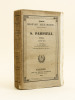
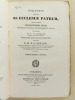
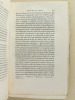
Bon état (dos lég. frotté avec petit mq. en queue, bel exemplaire par ailleurs)
Arnobii Iunioris Opera Omnia, Pars II : Opera Minora [in: Corpus Christianorum Series latina, XXVA (25a)]
Turnhout, Brepols 1992 352pp., 25cm., in the series "Corpus Christianorum Series latina" volume 25a, publisher's hardcover in orange cloth with gilt lettering, text is clean and bright, ISBN 2-503-00253-6, [introduction in German, text in Latin], very good condition, R67675
Arnobii Iunioris Opera Omnia, Pars I : Commentarii in Psalmos [in: Corpus Christianorum Series latina, XXV (25)]
Turnhout, Brepols 1990 xl + 258pp., 25cm., in the series "Corpus Christianorum Series latina" volume 25, publisher's hardcover in orange cloth with gilt lettering (lower cornbers bit bumped), text is clean and bright (looks unread), small ex-libris stamp at title page, ISBN 2-503-00251-x, [introduction in German, text in Latin], good condition, R118701
Arnobii Iunioris Opera Omnia, Pars II : Opera Minora [in: Corpus Christianorum Series latina, XXVA (25a)]
Turnhout, Brepols 1992 352pp., 25cm., in the series "Corpus Christianorum Series latina" volume 25a, publisher's hardcover in orange cloth with gilt lettering, text is clean and bright, small ex-libris stamp on blanco endpaper and at verso of title page, ISBN 2-503-00253-6, [introduction in German, text in Latin], good condition, R118702
Opera Tertulliani et Arnobii quotquot ab interitu vindicari summorum virorum industria potuerunt, cum veterum exemplarium, tum recentiorum collatione restituta, locis scripturae auct & illustrata commentariis quae alias authoribus subibscuris & difficillimis non mediocrem lucem afferre poternt. Omnia studio et labore renati Laurentii de la Barre. Additis indicibus sidissimis & amplissimis.
1580 Parisiis, Apud Michaelem Julianum, ad montem diui Hilarii, sub insigni stellae coronatae, Cum Privilegio Regis - M.D.LXXX (1580) - Grand in-quarto, reliure pleine peau d'époque, dos à cinq nerfs, étiquette de titre dorée, tranches rouges - 12 pages + 728 pages + 84 p. (index) + 240 pages + 16 p. (index) - Texte en latin avec belles lettrines
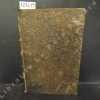
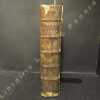
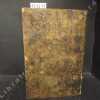
Très bel état de conservation - Erosion du cuir (craquelures) - Coins émoussés - Coiffes érodées - Charnière du premier plat en cours de désolidarisation - Auréoles de mouillures au verso du premier plate et sur la première de garde - Rares inscriptions manucrites en marge du texte - Petit accroc sur le cuir au centre du premier plat
Opera omnia
Turnhout, Brepols 1992 107pp.+ 12 microfiches (2437pp.), 24cm., fine condition, in the series "Corpus Christianorum. Instrumenta lexicologica latina" Fasc.73 (SL 25-25A) series A: Formae, ISBN 978-2-503-60252-3
ARNOBIUS Rhetor ( main author ) - Geverhard ELMENHORST - Marcus MINUTIUS FELIX - Joseph SCALIGER (contributors ) :
Reference : 40083
Arnobii Disputationum Adversus Gentes Libri Septem.
" Hanoviae ( Hannover ), Typis Wechelianis, Marnius, 1603 , in-8°, 445 pp. Signature A-Z8, Aa-Dd8, Ee7. (collation identical with VD17 23 ;270535U but for the last blank leaf (1) which is present in our copy but is clearly not leaf (E8). Bound in contemporary overlapping vellum, manuscript title on spine, lower inner joint loose, binding somewhat loosening ,some worming in the endpapers, still a good complete copy. This is the only text known by Arnobius, who lived in Northern Africa (ca. 300 A.D.) The first edition of this work was published in Rome in 1542. It is a vehement defense of Christianity and a detailed attack upon ancient paganism."
Arnobii 'Adversus Nationes' 3, 1-19. Uitgegeven met inleiding en commentaar. Diss.
1970 in-4to, VII + 150 p. Original-Broschüre.

(SLACES, NVVA)
Phone number : 41 (0)26 3223808
DISPUTATIONUM ADVERSUS GENTES libri septem.
De Licentia Superiorum: Romae, Ex Typographia Dominici Basae, M D LXXXIII. (à la fin: Romae Excudebat Franciscus Zannettus), 1583, in-8vo, (19.5x14 cm), 8 ff. + 255 p. + 21 p. n.n. (Index), titre avec grande vignette gravée, taches d’eau, qqs lettrines gravées sur bois, ex libris M.F. Théremin Pasteur, page de garde avec notice ms. sur l’auteur. Sur titre: tampon ovale ‘Fs Theremin Pasteur’ (XIXè) et manuscr. ‘D. R. Bridellus’ (XVIè), parchemin d’époque, dos noirci, charnière int. au verso fendue (montrant des bouts de manuscrit ancien à l’intérieur).
Adams 1997. Image disp.
(SLACES, NVVA)
Phone number : 41 (0)26 3223808
Arnobii Afri Adversus Gentes Libri VII. Et Julii Firmici Materni de Errore profanarum Religionum ad Constantium et Constantem Augg. Libellus.
Wirceburgi (Würzburg), Stahl, 1783. Contemp. hcalf. Richly gilt back. XXIV,343 pp.
Contains Anobius' famous work ""Adversus Nationes"" with his attack on traditional Roman paganism. - Firmicius Maternus converted to Christianity and wrote this harsh letter to the Roman emperors (Constantius and Constans) urging them to eradicate paganism.(Opera Omnia Sanctorum Patrum Latinorum Vol. V).
[Sumtibus Frid. Christ. Guil. Vogelii [ Vogel ]] - ARNOBIUS ; [ ARNOBE ]
Reference : 37090
(1816)
Arnobii Afri Disputationum Adversus Gentes Libri VII. Recognovit Notis priorum interpretum selectis aliorumque et suis illustravit Io. Conradus Orellius. Pars I et Pars II [ Suivi de : ] Appendix Editionis Lipsiensis Arnobii Afri continens varias cum priorum interpretum tum aliorum virorum doctorum (2 Tomes et Appendix - Complet)
2 vol. in-8 reliure demi-chagrin brun, Sumtibus Frid. Christ. Guil. Vogelii [ Vogel ], Lipsiae [ Leipzig ], 1816-1817 (Appendix), Vol. I : lxiv-363 pp. et 3 ff. ; Vol. II : 535 pp. et 2 ff., vi pp., 1 f., 78 pp. : Rappel des titres : Arnobii Afri Disputationem Adversus Gentes Libri VII. Recognovit Notis priorum interpretum selectis aliorumque et suis illustravit Io. Conradus Orellius. Pars I et Pars II [ Suivi de : ] Appendix Editionis Lipsiensis Arnobii Afri continens varias cum priorum interpretum tum aliorum virorum doctorum (2 Tomes et Appendix - Complet)
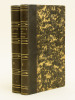
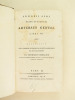
Complet. Bon exemplaire, bien complet de l'appendice publié en 1817 (des rouss.). Brunet, I, 147

