Write to the booksellers
20464 books for « alexander a f o d »Edit
-
Type
Art print (2)
Autograph (2)
Book (20367)
Engraving (1)
Magazine (5)
Maps (1)
Music sheets (81)
New book (5)
-
Latest
Last 24h (3)
Last 3 days (108)
Last month (949)
Last week (112)
-
Language
Dutch (6)
English (34)
French (2677)
German (13)
Italian (1)
Japanese (1)
Latin (3)
Russian (17729)
-
Century
16th (4)
17th (3)
18th (70)
19th (158)
20th (1130)
21st (224)
-
Countries
Belgium (220)
Brazil (4)
Canada (21)
China (9)
Côte d'Ivoire (5)
Denmark (92)
France (1823)
Germany (4)
Greece (4)
Netherlands (47)
Switzerland (420)
United Kingdom (14)
United States of America (17801)
-
Syndicate
ALAC (16)
CLAM (20)
CLAQ (3)
ILAB (1254)
NVVA (83)
SLACES (83)
SLAM (939)
SNCAO (1)
Topics
- Africa (13)
- Alsace (7)
- Archaeology (17)
- Architecture (52)
- Army (8)
- Astronomy (7)
- Belgium (9)
- Bible (10)
- Biography (19)
- Children’s books (33)
- China (9)
- China (21)
- Cinema (18)
- Circus (9)
- Comic strip (7)
- Detective novels (15)
- Early printed books (10)
- Economics (9)
- England (12)
- English (50)
- English literature (8)
- Engravings (10)
- Entomology (9)
- Europe (8)
- Fine arts (34)
- First edition (43)
- Flora (8)
- Fox (7)
- Furniture (8)
- Furniture (8)
- Geography (21)
- Germanic languages (75)
- Germany (16)
- Greece (10)
- Guittoneau ben (10)
- Helvética (43)
- Hermeticism (8)
- History (169)
- Industrial arts & crafts - fine arts (10)
- Instruments (7)
- Japan (7)
- Java (8)
- Language (8)
- Latin (18)
- Law (12)
- Lernet-holenia alexander (10)
- Linguistics (9)
- Literature (136)
- Magazine (8)
- Mc kee alexander (23)
- Medicine (36)
- Mendelssohn (7)
- Music (13)
- Navy (17)
- Newspapers press (10)
- Painters (7)
- Painting (13)
- Paris (8)
- Philosophy (31)
- Photography (25)
- Physics (8)
- Poetry (11)
- Pope alexander (22)
- Prokofiev (21)
- Psychiatry neurology (7)
- Psychoanalysis (13)
- Psychology (26)
- Religions (23)
- Review (10)
- Reviews (7)
- Revue de l'art (8)
- Russia (28)
- Sciences (34)
- Scores (100)
- Sculpture (10)
- Shapes & colours (7)
- Silversmith’s trade (9)
- Songs (78)
- Spying (7)
- Switzerland (34)
- Symbolism (8)
- Tea (66)
- Technology (7)
- Theatre (7)
- Theology (21)
- Translation (10)
- Travel (15)
- United kingdom (7)
- United states (11)
- Ussr (15)
- Various (23)
- Walker alexander (7)
- Waltz (21)
- War (58)
- Werth alexander (23)
- Western (7)
- Williams tennessee (8)
- Woods & woods’ price lists (7)
- Zoology (8)
Quaestiones naturales, De Anima, Morales: sive Difficilium dubitationum & solutionum Libri IIII. nuncc primùm in lucem editi. Gentiano Herveto Aureliano interprete. Cum gratia & privilegio Imperiali quinquennium. - [THE HERVET-EDITION OF ALEXANDER'S ""QUAESTIONES""]
Basel, (Iohnnes Oporinus, 1548 - on colophon). 8vo. Contemporary full limp vellum. A bit of soiling and light brownspotting to title-page, otherwise very nice and clean. The printer's name has been removed from the colophon, causing two small holes, which have been neatly repaired from verso. Two small holes corresonding to these to the second-last leaf, causing loss of a couple of letters. All in all a very nice copy. Woodcut initials. (16), 297, (6 - Life of Aristotle) pp.
The scarce first edition of leading French Humanist Catholic Gentian Hervet's important translation of Alexander's hugely influential ""Quaestiones"", presumably with this fourth part (which is not the ""De Fato"" as in other Renaissance editions) for the first time in print. Hervet's edition of Alexander's ""Questiones"" came to have a profound influence on the development of Renaissance Aristotelianism. The ""Questiones"" had appeared earlier, e.g. in 1541, and were by no means unknown to Renaissance thinkers at the time, but Hervet was an authority of a certain character, which meant that his edition was both read in a certain light and preferred by a great deal of thinkers. Furthermore, it seems that the 4th part, being 30 answers to the traditional 69 questions, here appears for the first time in print, making this a very important edition. In addition to the first three parts, it became customary to add a fourth part to Alexander's ""Questiones"", but that traditional fourth part was his ""De Fato"", and not as here the 30 solutions. It is worth noting that Hervet had in fact already translated Alexander's ""De Fato"", which he published in 1544. Alexander's, also known as simply as ""The Commentator"", impact upon the development of philosophy can hardly be overestimated, and his various ""Problems and Questions"", all aimed at establishing the views of Aristotle, came to influence all reading of Aristotle in the Renaissance. ""He was read in the classroom of Plotinus, who probably drew on him to a greater extent than we will ever be able to tell"" and when later Platonists show themselves critical of Aristotle's arguments, they can often be shown to attack Alexander's interpretation of Aristotle rather than Aristotle himself. The physician Galen, whose logic, epistemology and physics bear a distinctive Peripatetic stamp, chose to disagree with Alexander on, for instance, issues of dynamics and psychology."" (p. 244).Although his ""Questions"" were aimed at understanding the views of Aristotle, he established the views of the Stagirite in a version updated to take account of Stoic and other alternatives, as the best and most defensible current (i.e. 2nd-3rd cent.) ideas on their subjects. ""For Alexander, the inspired genius of Aristotle's writings was a sufficient basis, if they were properly interpreted, explicated, and fleshed out, to resolve with complete satisfaction all the questions debated among philosophers of varying schools in his own time."" (Cambr. Comp.). In his seminal ""Questiones"", he quarrelled with both Platonism and Stoicism in his attempts to develop Peripatetic answers to questions Aristotle had not dealt with in any detail.It is a curious but generally accepted conception that with the rise of the Renaissance came the fall of Aristotle. Weather this is actually true can be disputed, but it is a fact that with the recovery of many lost works of ancient literature, the widening of the range of classical studies and the renewed interest in Plato, Aristotle was no longer the sole authority on a huge number of fields. That this should mean a total ignorance of the teachings of Aristotle must be considered somewhat of a myth (though a very frequently repeated one), and in fact with the grand humanists of the late 15th and early 16th century, the study of Aristotle fits perfectly with the broader comprehension of scholarship. The great humanists like Ficino, Pico and Pomponazzi had not forgotten about Aristotle, and the revival of learning did not mean the neglect of the prince of philosophers. On the contrary, with the appreciation of the knowledge of Greek and the invention of the printing, works were being translated and printed like never before, which meant that the greatest of the humanists, many of whom did not themselves know Greek, could be acquainted with the Greek texts of Aristotle and the Greek commentaries of ""The Commentator"", Alexander of Aphrodisias, in Latin translation. ""Equally important for the continued growth of the Peripatetic synthesis was the recovery and diffusion of the Greek commentaries on Aristotle. These treatises, about ten times longer than the works they discuss, were written by pagans and Christians, Platonists and Peripatetics in late antiquity, between the second and seventh centuries in the Greek world of the Eastern Mediterranean, and then again in twelfth-century Byzantium. The most important of the two dozen commentators were Alexander of Aphrodisias, Ammonius, Simplicius, Themistius and John Philoponus. Of these five, only Alexander and Themistius were Aristotelians..."" (Copenhaver & Schmitt, p. 68).One of the most important of these Renaissance Humanists, who with his translations helped spread the knowledge and understanding of Aristotle and his commentators, was Gentian Hervet, who came to play a dominant role in the course of 16th century thought. ""Gentian Hervet (d. 1584) was a committed churchman, who after studies in the universities of Orleans and Paris lived in the household of Reginald Pole, later to become Archbishop of Canterbury and Cardinal, at first in England then - as Pole had, because of the Reformation, to leave England - in Padua, Venice and Rome. Hervet took part with Marcello Cervini (later Pope Marcellus II) in the first sessions of the Council of Trent. He returned to France in 1555 as vicar general to the bishop of Noyon and wrote pamphlets against the Huguenots. In 1561 he entered the service of the Cardinal of Lorraine, Charles de Guise, whom he accompanied to the third period of the Council of Trent (1562-3). In 1564 he took part as canon of the cathedral in the provincial council of Rheims, in which the cardinal published the decrees of the Council of Trent. About the time of his activity in the Council of Trent the focal point of Hervet's translations shifted. He translated not only the Greek Fathers of the Church, but in addition, under the influence of academic scepticism as represented also by Reginal Pole, Sextus Empiricus' ""Adversus Mathematicos"" (Paris, 1569). He had long been active as translator of works connected with the Aristotelian philosophy. During an earlier sojurn in Rome, he published a number of philosophical texts which concerned the controversies surrounding Pietro Pomponazzi. In 1544 he translated into Latin Aristotle's ""De anima"", together with the commentary of Johannes Philoponus. There followed translations of Alexander of Aphrodisias's ""De fato"" (1544) and ""Quaestiones naturales et morales"" (1548) and of Zacharias Scholasticus's ""Ammonius: Dialogus quod mundus non sit Deo coaeternus"" (1546). In these works Hervet described those who denied the immortality of the soul as atheists and as opponents of Aristotle and his commentators."" (Lohr, p. 36). ""Since the Renaissance had to discover or rediscover the tools of philology and history needed for such detective work, the pioneering labours of obscure humanist scholars - Gentian Hervet, who translated sextus, or William Canter, who first published a Greek text of the ""Eclogae"" of Stobaeus - certainly deserve our memory and admiration. It was they who first edited, organized, translated, printed, and disseminated the philosophical remains of antiquity that succeeding centuries have come to take for granted. If Thales and his successors were the fathers of Western philosophy, the humanist scholars of the Renaissance were the midwives of its rebirth in a classical form."" (Copenhaver & Schmitt, p. 18). Adams A:678" Graesse: I:69.
Alexander Hamilton: Writings (LOA #129) (Library of America Founders Collection Band 4)
Library of America 2001 1108 pages 12 954x3 302x20 066cm. 2001. Cartonné jaquette. 1108 pages.
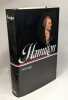
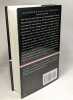
Comme neuf avec sa jaquette intérieur propre bonne tenue
Alexander Alexander of Arkhangelsk. Alexander I. In Russian /Arkhangelskiy Alek
Alexander Alexander of Arkhangelsk. Alexander I. In Russian /Arkhangelskiy Aleksandr. Aleksandr I.M.: VAGRIUS. 2000.We have thousands of titles and often several copies of each title may be available. Please feel free to contact us for a detailed description of the copies available. SKUalb4507404bc8232ccc.
Komponist und Bundesrichter. - Alexander Reichel wurde 1853 in Paris als Sohn von Adolf Reichel (1820 - 1896) und Maria Reichel-Ern geboren. Der westpreussische Vater war nach dem Musikstudium in Berlin als Komponist und Dirigent in Paris und Dresden tätig. Aus gesundheitlichen Gründen zog er 1867 in die Schweiz nach Bern. Dort wirkte er als Dirigent und Direktor der Musikschule. Das Umfeld in dem Alexander Reichel aufwuchs, war international geprägt und in kultureller, gesellschaftlicher wie politischer Hinsicht äusserst anregend. - Alexander Reichel immatrikulierte im Sommer 1872 an der philosophischen Fakultät der Universität Bern. Im Wintersemester 1874/75 wechselte er die Fakultät und studierte Rechtwissenschaften, welche er bereit 1876 abschloss. 1877 erwarb er das Fürsprecherpatent. 1884 eröffnete er in Bern eine eigene Kanzlei. Politisch war Alexander Reichel akitv in der SPS (Sozialdemokratische Partei der Schweiz) tätig. Er wurde 1890 Parteipräsident. An einer Wahl in den Nationalrat scheiterte er knapp. 1905 wurde Reichel als erstes Mitglied der SPS von der Bundesversammlung als Richter ins Bundesgericht gewählt. Er war bis 1920 als Bundesrichter tätig. - Alexander Reichel lernte noch in Dresden das Klavierspiel und das Violoncello. Von 1891 - 1899 wirkte er als Präsident des Cäcilienvereins, dem heutigen Oratorienchor in Bern. Er verfasste Werke für Klavier, Bläser, Chor und arrangierte bekannte Musikstücke für den Hausgebrauch. Reichel befasste sich auch mit musikwissenschaftlichen Fragen und veröffentlichte seine Studien regelmässig in der schweizerischen Musikzeitung.
1830 - 1920
Grosse Anzahl von gedruckten und handgeschriebenen Partituren. Die handgeschriebenen Stücke wurden meistens für einen Anlass oder für eine Person komponiert unt gewidmet. Unzählige Fotografien, Fotoalben, Tagebücher von Alexander Reichel, Marie Reichel (seine Mutter), Dokumente, Reiseunterlagen (vor allem für die Reisen nach Russland), etc.

Phone number : 41 (0)44 261 57 50
DAS HOHE LIED: In der Nachdichtung Goethes mit Zehn Lithographien von Georg Alexander Mathey. (Daedalus-Drucke Herausgegeben von Georg A. Mathey, Zweiter Druck)
1924 Berlin 1924 Verlag Dietrich Reimer Ernst Vohsen, - Original vellum spine and maroon pastepaper over boards; quarto (9 x 11.5 inches); upaginated. Illustrated with 10 lithographs by Georg Alexander Mathey From an edition of 1000 copies printed at the Staatliche Akademie fur Graphische Kunst und Buchgewerbe zu Leipzig. inscribed in the colophon by Georg Alexander Mathey to master wood engraver and Akademie director Hans Alexander Mueller Very good; quite clean and unworn
Remise de 20% pour toutes commandes supérieures à 200 €
Pypin A.N. Religious Movements under Alexander I + Essays on Literature and Publ
Pypin A.N. Religious Movements under Alexander I + Essays on Literature and Public Affairs under Alexander I. In Russian (ask us if in doubt)/Pypin A.N. Religioznye dvizheniya pri Aleksandre I + Ocherki literatury i obshchestvennosti pri Aleksandre Pervom. Short description: In Russian (ask us if in doubt).This work occupies a special place in the work of the researcher. It is almost the most coherent and harmonious of his works. The book includes a series of essays first published in periodicals since the 1870s which present articles about religious movements under Alexander I. The history of the Russian Bible Society the movement that arose around Mrs. Kruedner the history of Emperor Alexander's contacts with Quakers and the activities of the biblical Kotelnikov sect. We have thousands of titles and often several copies of each title may be available. Please feel free to contact us for a detailed description of the copies available. SKUalb014ead5bae01d6aa
[Giovanni Bologna called Giambologna] - Rudigier, Alexander, Blanca Truyols
Reference : 114711
ISBN : 9782901837640
Jean Bologne et les jardins d'Henri IV. Bulletin Monumental. Tome 174-III, septembre 2016
Rudigier, Alexander, Blanca Truyols: Jean Bologne et les jardins d'Henri IV. Paris: Societe francaise d'editions d'art, Series: Bulletin Monumental. Tome 174-III, septembre 2016. 176 pages (pp 249 - 418) with 21 colour and 163 black and white illustrations. Paperback. 27 x 22cms. Contents:Les presÃnts de Ferdinand I de MÃdicis á Henri IV pour ses Jardins de Saint-Germain-en-Laye by Blanca Truyols.Les bronzes envoyÃs de Florence á Saint-Germain-en-Laye, la VÃnus de 1597 et le derniÚres oeuvres de Jean Bologne by Alexander Rudigier.Additional information by Alexander Rudigier: Le non finito dans la sculpture Florentine et la notion de disegno. With a foreword by Bertrand Jestaz and a bibliography. Text in French.
Contents:Les presÃnts de Ferdinand I de MÃdicis á Henri IV pour ses Jardins de Saint-Germain-en-Laye by Blanca Truyols.Les bronzes envoyÃs de Florence á Saint-Germain-en-Laye, la VÃnus de 1597 et le derniÚres oeuvres de Jean Bologne by Alexander Rudigier.Additional information by Alexander Rudigier: Le non finito dans la sculpture Florentine et la notion de disegno. With a foreword by Bertrand Jestaz and a bibliography. Text in French
Alexander Block. Alexander Block. In Russian /Blok Aleksandr. Aleksandr Blok.
Alexander Block. Alexander Block. In Russian /Blok Aleksandr. Aleksandr Blok. The Great Poets of the World series. Moscow: Eksmo. 2014 year. We have thousands of titles and often several copies of each title may be available. Please feel free to contact us for a detailed description of the copies available. The delivery of this book might be delayed beyond the usual timeframe due to extended processing and preparation before shipment, and faster shipping options are not offered. Please inform us if you need the order by a certain date or have a deadline. SKUalbd44c147520c8be93
Orlov Alexander, Polunov Alexander, Tereshchenko Yuri. Fundamentals of the Russ
Orlov Alexander, Polunov Alexander, Tereshchenko Yuri. Fundamentals of the Russian History Course. In Russian /Orlov Aleksandr, Polunov Aleksandr, Tereshchenko Yuriy. Osnovy kursa istorii Rossii. M. Prospekt 2013. You are welcome to reach out to us for a detailed description of the copies currently available. Delivery of this book may take longer than usual including extended processing and pre-shipping time, no expedited shipping is available. Please advise us if you have a set date or a deadline to receive your order.SKUalb41ed461984a3bd3b
[William Alexander] - BRETON DE LA MARTINIERE, Jean-Baptiste (1777-1852), William ALEXANDER (1767-1816)
Reference : PHO-2299
(1815)
Vues de la chine et de la Tartarie, gravées en taille douce par Simon d’après les dessins de W. Alexander..., tome second seul
Paris, Chez Nepveu, 1815, in-8 oblong (20x13,5cm), 44pp. et 26 gravures (25), cartonnage d’attente rose de l'époque, avec titre manuscrit sur le plat (coiffes absentes). Déchirure marginale avec léger manque atteignant deux gravures, déchirure sans manque à une gravure.
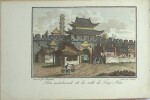
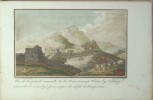
Second tome consacré aux paysages, bâtiments et autres, le premier volume comprenait les costumes et personnages. Illustré de 26 gravures, en couleurs d’époque, représentant des villes, villages, monuments et palais, comprenant une planche supplémentaire non comprise dans la liste, « Barques chinoises de l’Ambassade passant par une écluse sur le grand canal » En 1792, Alexander rejoignit l'ambassade britannique de Lord Macartney en Chine en tant que dessinateur. Bien que la mission diplomatique n'ait pas permis d'établir des relations commerciales durables avec l'empereur Qianlong, elle offrit à Alexander une documentation de première main exceptionnelle. À une époque où la chinoiserie fascinait l'Europe, ses aquarelles détaillées de paysages, d'architecture et de scènes de la vie quotidienne chinoises furent largement saluées. Nombre d'entre elles furent gravées pour les comptes rendus officiels de l'ambassade et pour des publications telles que « View of the Headlands, Islands, etc. » (1798) et « A Voyage to Cochin China » de John Barrow (1806). The illustrations in the two-volume China work are after the English painter, illustrator and engraver William Alexander, who travelled to China as draughtsman with Lord Macartney's Embassy to the Emperor in 1792-1794. M2-Et3
Alexander Block. A Dream of Passion. Alexander Block, Lyubov Mendeleev-Block, A
Alexander Block. A Dream of Passion. Alexander Block, Lyubov Mendeleev-Block, Andrey Belyi. Letters, Diaries. In Russian /Blok Aleksandr. Son strasti. Aleksandr Blok, Lyubov Mendeleeva-Blok, Andrey Belyy. Pisma, dnevniki. Prepared text, foreword, comment by Timofey Prokopov. Series: The People, Epoch, Destiny of the ACT in 2019. You are welcome to reach out to us for a detailed description of the copies currently available. Delivery of this book may take longer than usual including extended processing and pre-shipping time, no expedited shipping is available. Please advise us if you have a set date or a deadline to receive your order.SKUalb233c605f2cc52bb9
Plate. 28. : PUNISHMENT OF THE TCHA [le supplice de la La cangue (ou TCHA)], gravure tirée de : Lord Macartney's Embassy to China, Published in London, 1796. [ Macartney, George (1737-1806) : An Authentic account of an embassy from the king of Great Britain to the emperor of China... taken chiefly from the papers of... the earl of Macartney... by Sir George Staunton.. London : G. Nicol, 1796]
London G. Nicol 1796 une gravure ancienne dessinée par William Alexander et gravée en noir par John HALL, Format : 38 x 31 cm, Plate. 28. : Punishment of the Tcha [le supplice de la La cangue (ou TCHA)], gravure tirée de : Lord Macartney's Embassy to China, Published in London by G. Nicol, 1796.
Engraving recording a journey through China .....le supplice de la La cangue (ou TCHA), est un châtiment similaire au pilori en Occident, à la différence que la planche de la cangue n'était pas fixée à une base et devait être portée par le prisonnier ....... L'Ambassade de Lord Macartney, mission britannique qui s'est rendue en Chine en 1792-1793 pour tenter d'obtenir des relations commerciales et diplomatiques plus favorables pour le Royaume-Uni. Dirigée par George Macartney, elle a été envoyée par le roi George III auprès de l'empereur Qianlong. La mission a été marquée par une série de malentendus entre les Britanniques et les Chinois, et l'État Qing a finalement rejeté toutes les demandes britanniques, un résultat qui s'est avéré être l'un des facteurs qui ont contribué au début des guerres de l'opium au XIXe siècle ...... superbe GRAVURE ......... en trés bon état ( very good condition). William Alexander, engraved by John Hall. trés bon état
Alexander Pouschkine. (Alexander Pushkin). La fille du capitaine. (Captains daug
Alexander Pouschkine. (Alexander Pushkin). La fille du capitaine. (Captains daughter). In Russian (ask us if in doubt)/Alexandre Pouschkine. (Aleksandr Pushkin). La fille du capitaine. (Kapitanskaya dochka). Short description: In Russian (ask us if in doubt).Roman traduit du russe par Louis Viardot. Illustrations da. Paris. Deuxieme edition. (Roman translated from Russian into Louis Viardot. Illustrations by A. Paris. Second edition). Paris. Librairie Hachette et Cio. 1895. 173 3s. We have thousands of titles and often several copies of each title may be available. Please feel free to contact us for a detailed description of the copies available. SKUalb161c008967dcb464
BAYLY (Thomas Haynes), BISHOP (Henry R.), HEMANS, LODGE (J.), LOVER (Samuel), LEE (Alexander), MOORE (Thomas), STEVENSON (Sir John), PRAED (Winthrop M.), FITZ GERALD (Mrs Edward), BRAHAM, BLACKWOOD (Price), MILLARD (Mrs Philip), HARRIS (G. F.), PLANCHE (J. R.), COOKE (T.), L.E.L.,FLOWER (Eliza), MURRAY (W. S.), DEWAR (James), LINLEY (George), BALFE (M. W.), HEMANS, BELLINI,
Reference : 12627
Collection of 64 Musical Scores / Recueil de 64 partitions de musique : In Happier Hours! by Thomas Haynes Bayly and Henry R. Bishop. / Ruth, by Georgiana Bloomfield and Miss Davis. / If Thou Hast Crush'd a Flower, Ballad, by Mrs Hemans and J. Lodge. / The Fairy Tempter, n° 6 of the Songs of The Superstitions of Ireland, by Samuel Lover. / Winter and Summer, A Ballad, by Thomas Haynes Bayly and Alexander Lee. / Flow on thou Shining River, for Two Voices, by Thomas Moore and Sir John Stevenson. / Angel of Charity [ibid]. / I Remember, I Remember how my Childhood Fleeted by, by Winthrop M. Praed and Mrs Edward Fitz Gerald. / Had I A Heart For Falsehood Fram'd, sung by Mr. Braham. / The Charming Woman, by Mrs Price Blackwood. / Alice Gray, A Ballad, by Mrs Philip Milliard. / Where's the Snow, the Summer Snow? by G. F. Harris. / Love's Ritornella (The Brigand), by J. R. Planché and T. Cooke. / L.E.L.'s Song Sleep, Heart of Mine! by Eliza Flower. / A Brave Old Country Gentleman, by W. S. Murray and James Dewar. / Look Forth, (Watherine Gray), by George Linley and M. W. Balfe. / The Bird's Release, by Mrs Hemans. / A te o Cara Amor Talora, by Bellini. / etc. etc.
London, Gouldinf & D'Almaine, s.d. / Dublin, Marcus Moses, s.d. / London, C. Lonsdale, s.d. / London, J. Duff & Co, s.d. / London, Alexander Lee & Lee, s.d. / London, Cramer, Addison & Beale, s.d. / s.d. / London, J. Balls & Son, s.d. / Edinburgh, Alexander Robertson, s.d. / London, J. Dean, s.d. / London, S. Chappell, s.d. / London, Royal Harmonic Institution, s.d. / London, J. Alfred Novello, s.d. / London & Edinburgh, Cramer, Addison & Beale, Alexander Robertson, s.d. / London, Cramer, Addison & Beale, s.d. / London, Lensdale & Mills, s.d. / London, R. Mills, Paris, Pacini, s.d. / etc., etc. 2 volumes in-4, 107 ff. et 133 ff. numérotés (encre et plume), reliure plein maroquin bordeaux de l'époque, dos et plats ornés (dos un peu frottés). Ex-dono à Mademoiselle Bréald (?).
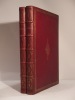
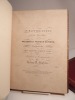
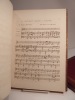
A collection of 64 musical scores of the XIXth century, finely bound in 2 volumes. / Recueil de 64 partitions musicales du XIXe siècle, bien reliées en deux volumes. * Voir photographies / See pictures. * Membre du SLAM et de la LILA / ILAB Member. La librairie est ouverte du lundi au vendredi de 14h à 19h. Merci de nous prévenir avant de passer,certains de nos livres étant entreposés dans une réserve.
ERICH DIECKMANN.
Weil am Rhein, Vitra Design Museum, 1990 ; in-4, 182 pp., br. BROCHÉ en bon état - Praktiker der avantgarde, mobelbu 1921-1933, bauhaus Weimar, bauhochschule Weimar, burg giebichenstein -[publisher: Vitra Design Museum] Erich Dieckmann - Möbelbau 1921-1933 Bauhaus Weimar, Bauhochschule Weimar, Burg Giebichenstein. Ausstellungskatalog von Alexander von Vegesack (Herausgeber) Anita Bach, Angela Dolgner, Angelika Emmrich Mitarbeit: Alexander von Vegesack, Wolf D Thiem, Otakar Má?el Vitra Design Museum In deutscher Sprache. 182 pages.
BROCHÉ en bon état - Praktiker der avantgarde, mobelbu 1921-1933, bauhaus Weimar, bauhochschule Weimar, burg giebichenstein -[publisher: Vitra Design Museum] Erich Dieckmann - Möbelbau 1921-1933 Bauhaus Weimar, Bauhochschule Weimar, Burg Giebichenstein. Ausstellungskatalog von Alexander von Vegesack (Herausgeber) Anita Bach, Angela Dolgner, Angelika Emmrich Mitarbeit: Alexander von Vegesack, Wolf D Thiem, Otakar Má?el Vitra Design Museum In deutscher Sprache. 182 pages.
IMAGES DE L'EMPIRE IMMOBILE par William Alexander,... ; réunies et présentées par Alain Peyrefitte,.
Paris] : Fayard, 1990,IN FOLIO cartonné sous jacquette ill.,209 p.-[8] p. de pl. dépl. en coul. : ill. en coul. ; 33 cm,bon etat
ISBN 2-213-02383-2 (rel.) : 490 F,ALEXANDER ( William ) (1767-1816 ) peintre-reporter de l'expédition Macartney , Remise de 20% pour toutes commandes supérieures à 200 €
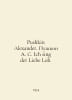
Pushkin Alexander. Pushkin A. S. Ich sing der Liebe Lob. In German /Pushkin Al
Pushkin Alexander. Pushkin A. S. Ich sing der Liebe Lob. In German /Pushkin Alexander. Pushkin A. S. Ich sing der Liebe Lob. In German. Berlin 1974. You are welcome to reach out to us for a detailed description of the copies currently available. Delivery of this book may take longer than usual including extended processing and pre-shipping time, no expedited shipping is available. Please advise us if you have a set date or a deadline to receive your order. SKUalb28606f26321f0b91
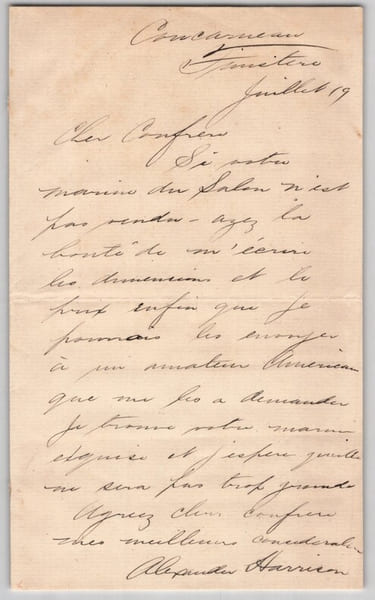
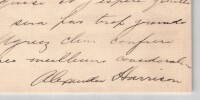
Alexander Harrison - Lettre autographe signée, Achat d'une marine du Salon - XIX
Lettre autographe signée de Alexander Harrison, peintre mariniste américain postimpressionniste rattaché aux colonies artistiques de Bretagne. La lettre est datée du 19 juillet sans année. Rédigée à l'encre noire sur feuillet de papier vergé beige. Dans cette lettre adressée à un confrère, Alexander Harrison s'enquiert du prix et des dimensions d'une marine exposée au Salon afin de la proposer à un collectionneur américain intéressé par l'œuvre. Dimensions : 12,3 x 20,4 cm État : Très bon état général. Une pliure centrale horizontale inhérente à la mise sous pli. Quelques rousseurs éparses. Voir photos pour plus de détails. Nombre de pages : 1 page Envoi soigné dans un emballage rigide et étanche.

Alexander Romanovich Belyaev. Amphibian Man. Underwater Farmers. In Russian /Be
Alexander Romanovich Belyaev. Amphibian Man. Underwater Farmers. In Russian /Belyaev Aleksandr Romanovich. Chelovek-amfibiya. Podvodnye zemledeltsy. Series: Books by Alexander Belyaev. M. Ast. 2016. You are welcome to reach out to us for a detailed description of the copies currently available. Delivery of this book may take longer than usual including extended processing and pre-shipping time, no expedited shipping is available. Please advise us if you have a set date or a deadline to receive your order.SKUalb64abc98b84bfc547
Imperator Aleksandr III. In Russian /Emperor Alexander III
Short description: In Russian. Popov, Alexander Dmitrievich. Emperor Alexander III. St. Petersburg: Teaching Council of the Holy Synod, 1908. You are welcome to reach out to us for a detailed description of the copies currently available. Delivery of this book may take longer than usual including extended processing and pre-shipping time, no expedited shipping is available. Please advise us if you have a set date or a deadline to receive your order.SKU3180199
Aleksandr Sergeevich Pushkin. In Russian /Alexander Pushkin
Short description: In Russian. Pushkin, Alexander Sergeevich. Alexander Sergei Pushkin: St. Petersburg: N. S. Askarkhanov, Census 1903. You are welcome to reach out to us for a detailed description of the copies currently available. Delivery of this book may take longer than usual including extended processing and pre-shipping time, no expedited shipping is available. Please advise us if you have a set date or a deadline to receive your order.SKU3716151
Aleksandr Sergeevich Pushkin. In Russian /Alexander Pushkin
Short description: In Russian. Pushkin, Alexander Sergeyevich. Alexander Pushkin. St. Petersburg: St. Petersburg City Duma, 1910. You are welcome to reach out to us for a detailed description of the copies currently available. Delivery of this book may take longer than usual including extended processing and pre-shipping time, no expedited shipping is available. Please advise us if you have a set date or a deadline to receive your order.SKU3772362
Aleksandr Konstantinovich Glazunov. In Russian /Alexander Konstantinovich Glazu
Short description: In Russian. Ossovsky, Alexander Vyacheslavovich. Alexander Konstantinovich Glazunov: St. Petersburg: A. Ziloti's Concerts, 1907. You are welcome to reach out to us for a detailed description of the copies currently available. Delivery of this book may take longer than usual including extended processing and pre-shipping time, no expedited shipping is available. Please advise us if you have a set date or a deadline to receive your order.SKU3742925
Pushkin Alexander. The Copper Rider. The St. Petersburg Tale. In Russian /Pushk
Pushkin Alexander. The Copper Rider. The St. Petersburg Tale. In Russian /Pushkin Aleksandr. Mednyy vsadnik. Peterburgskaya povest. Illustrations by Alexander Benoit. M. Hud.Literature. 1964. 58 You are welcome to reach out to us for a detailed description of the copies currently available. Delivery of this book may take longer than usual including extended processing and pre-shipping time, no expedited shipping is available. Please advise us if you have a set date or a deadline to receive your order.SKUalb4d8f9a2e4f7b98a2
Belyaev Alexander. Sovereign of the World. Aircraft (compilation) In Russian /B
Belyaev Alexander. Sovereign of the World. Aircraft (compilation) In Russian /Belyaev Aleksandr. Vlastelin Mira. Vozdushnyy korabl (sbornik) Series: Books by Alexander Belyaev M. AST 2020, 320 You are welcome to reach out to us for a detailed description of the copies currently available. Delivery of this book may take longer than usual including extended processing and pre-shipping time, no expedited shipping is available. Please advise us if you have a set date or a deadline to receive your order.SKUalb45f2140ed364e91b