Bulgari, Constantino G. and Anna Calissoni Bulgari: Argentieri Gemmari e Orafi d'Italia & Maestri Argentieri Gemmari e Orafi and supplements. 5 volumes + 2 supplements. 1958-2003. By Constantino Bulgari: Argentieri Gemmari e Orafi d'Italia. Notizie storiche e raccolta dei loro contrassegni con la riproduzione dei punzoni individuali e dei punzoni di stato. 5 vols. Rome: Fratelli Palombi, 1958-1987. Volumes I and II: Parte prima: Roma; Vol. III: Parte prima: Roma. Parte seconda Lazio-Umbria; Vol. IV: Parte terza: Marche-Romagna; Vol. V: Parte quarta: Emilia. Unifoumly bound in cloth 30x22cms. And Stato Pontificio : raccolta dei bolli di garanzia per l'argento e per l'oro usati nelle varie cittaÂŽ dello Stato Pontificio in ordine cronologico. Palombi Rome: 1974. Adjunct to the series Argentieri Gemmari e Orafi d'Italia. Bound in card. 14x9.75cms. With: Supplement by Constantino and Anna Bulgari Calissoni : Regolamenti bolli e bollatori della Citta' di Roma. Supplemento no.1. Palombi, Rome: 1977 Paperback. 29.5x21.5cms. Together with: Anna Bulgari Calissoni, Maestri Argentieri Gemmari e Orafi di Roma. Palombi Rome: 1987 and Maestri Argentieri Gemmari e Orafi Degli Stati Della Chiesa. Cornelia Edizioni Rome: 2003 both bound in cloth 30x22cms. Text in Italian.
Text in Italian
[Giacomo Raffaelli] - Anna Maria Massinelli ed; Laura Biancini, Tassinari Gabriella et al
Reference : 117789
(2018)
ISBN : 9788875422943
Anna Maria Massinelli ed; Laura Biancini, Tassinari Gabriella et al: Giacomo Raffaelli (1753-1836). Maestro di stile e di mosaico. Florence: Aska Edizioni, 2018. 376 pages with 400 colour illustrations and several b&w illustrations. Hardback. 24.5x31cms. Monograph dedicated to the micro-mosaic works of Giacomo Raffaeli. The title aims to cover the full breadth of the artist's career and output from his time working in Rome in the late 18th century through to his move to Milan at the start of the 19th. These extraordinarily detailed works are illustrated in colour throughout. Text in Italian.
Monograph dedicated to the micro-mosaic works of Giacomo Raffaeli. The title aims to cover the full breadth of the artist's career and output from his time working in Rome in the late 18th century through to his move to Milan at the start of the 19th. These extraordinarily detailed works are illustrated in colour throughout. Text in Italian
[Sir Anthony van Dyck] - Orlando, Anna, et al.
Reference : 126158
(2026)
ISBN : 9789493416840
Orlando, Anna, et al.: Van Dyck, the European. His Journey from Antwerp to Genoa and London. Exhibition: Genoa, Palazzo Ducale, 2026. 352 pages, illustrated in colour. Hardback. 30 x 24cms. Catalogue of 59 works in the exhibition, proposing a new chronology of van Dyck's time in Italy. His portraits of Antwerp citizens, Genoese aristocrats and courtiers from the circle of Charles I, are discussed in terms of technique, Rubens' influence and van Dyck's personal relationship to his patrons.
Catalogue of 59 works in the exhibition, proposing a new chronology of van Dyck's time in Italy. His portraits of Antwerp citizens, Genoese aristocrats and courtiers from the circle of Charles I, are discussed in terms of technique, Rubens' influence and van Dyck's personal relationship to his patrons. Text in English
Bovero, Anna: L'Opera Completa del Crivelli. Milan: Rizzoli, 1974. Series: Classici dell'Arte. 104pp with 64 colour plates and 213 monochrome illustrations. Hardback. 31.5x24.5cms. Text in Italian.
Text in Italian
Chandrasekaran, Sujatha, Kouremenos, Anna eds: From Pella to Gandhara. Hybridisation and Identity in the Art and Architecture of the Hellenistic East:. Oxford: BAR, 2011. 193 pages, black and white figures and illustrations. Paperback.
Text in English
Capuis, Loredana, Anna Maria Chieco Bianchi: Este II La Necropoli di Villa Benvenuti. Rome: Giorgio Bretschneider, 2006. 536 pages of text, 64 black and white illustrations. Hardback. Text in Italian.
Text in Italian
Ferrari, Anna: Versailles: Science and Splendour. Exhibition: London, Science Museum, 2025. 128 pages, illustrated throughout in colour and black & white. Hardback. Examining how the French monarchy harnessed science to enhance its prestige and extend its global influence under Louis XIV, XV, and XVI. 16 essays explore Henri Testelin's painting of the Royal Academy of Sciences, Isaac Thuret and clockmaking, astronomer Jean-Dominique Cassini's map of the moon, hydraulic engineering and the Marly machine, the cultivation of pineapples at Versailles, Louis XV's rhinoceros, Pierre-Joseph Buc'hoz and the Trianon Garden, Claude-Simeon Passemant's clock of the creation of the world, a portrait of Emilie du Chatelet, Abbe Jean-Antoine Nollet's inventions, Madame du Coudray's obstetric teaching model, portraits of Denis Diderot, the chemistry laboratory model for the King's sons, the expedition of La Perouse, and the flight of the Montgolfiere hot air balloon.
Examining how the French monarchy harnessed science to enhance its prestige and extend its global influence under Louis XIV, XV, and XVI. 16 essays explore Henri Testelin's painting of the Royal Academy of Sciences, Isaac Thuret and clockmaking, astronomer Jean-Dominique Cassini's map of the moon, hydraulic engineering and the Marly machine, the cultivation of pineapples at Versailles, Louis XV's rhinoceros, Pierre-Joseph Buc'hoz and the Trianon Garden, Claude-Simeon Passemant's clock of the creation of the world, a portrait of Emilie du Chatelet, Abbe Jean-Antoine Nollet's inventions, Madame du Coudray's obstetric teaching model, portraits of Denis Diderot, the chemistry laboratory model for the King's sons, the expedition of La Perouse, and the flight of the Montgolfiere hot air balloon
Jávor, Anna: Johann Lucas Kracker. Ein Maler des SpÀtbarock in Mitteleuropa. Budapest: Enciklopedia Publishing House, 2005. 396pp with 65 colour plates and 210 monochrome illustrations. Boards. 26.3x23cms. Monograph on this 18th-century painter, who specialised in grand late baroque ceiling paintings from Austria, Prague and Slovakia. Includes his frescoes, oil paintings and drawings. Text in German.
Monograph on this 18th-century painter, who specialised in grand late baroque ceiling paintings from Austria, Prague and Slovakia. Includes his frescoes, oil paintings and drawings. Text in German
Banti, Anna: Giovanni da San Giovanni Pittore della Contraddizione. Florence: Sansoni, 1977. 253pp with 31 colour and 113 monochrome plates. Cloth, 27x21cms. Catalogue of the life and work of this 17th-century Italian painter and draughtsman (1592-1636), one of the most distinguished artists working in fresco in Florence at that time. With catalogue of works, bibliography and indices. Text in Italian.
Catalogue of the life and work of this 17th-century Italian painter and draughtsman (1592-1636), one of the most distinguished artists working in fresco in Florence at that time. With catalogue of works, bibliography and indices. Text in Italian
Mango, Marlia Mundell and Anna Bennett: The Sevso Treasure. Part One: Art Historical Description and Inscriptions; Methods of Manufacture and Scientific Analyses. Ann Arbor: Ann Arbor, 1994. Series: Journal of Roman Archaeology Supplementary Series Number 12. 480pp with 626 monochrome illustrations and figures, numerous line drawings throughout. Cloth. 28.5x22cms. The first volume devoted to this remarkable treasure contains an introduction, two sections on technical examination and conservation, and the inscriptions, weights and dimensions, followed by the descriptive catalogue. The catalogue itself is divided into 15 parts - each silver object (plate, amphora, ewer, basin, or casket) is examined, as well as the copper cauldron in which the treasure was discovered. Included is a copy of the New York Supreme Court's order and judgement in the case (entered 18 November 1993).
The first volume devoted to this remarkable treasure contains an introduction, two sections on technical examination and conservation, and the inscriptions, weights and dimensions, followed by the descriptive catalogue. The catalogue itself is divided into 15 parts - each silver object (plate, amphora, ewer, basin, or casket) is examined, as well as the copper cauldron in which the treasure was discovered. Included is a copy of the New York Supreme Court's order and judgement in the case (entered 18 November 1993). Text in English
Koopstra, Anna: Jean Bellegambe Making, Meaning and Patronage of His Works. Turnhout: 2022. 155 pages, 119 colour and black and white illustrations. Hardback. 30.5x21.5cms. A case study of five paintings by Jean Bellegambe, with a focus on patronage. Eight chapters trace Bellegambe's career and discuss his materials and working methods for commissions such as the Cellier Altarpiece, the Diptych of the Virgin and Child with Saint Bernard and an Unidentified Cistercian Monk, Triptych of the Annunciation, Triptych of the Last Judgement and the Pottier Triptych.
A case study of five paintings by Jean Bellegambe, with a focus on patronage. Eight chapters trace Bellegambeâs career and discuss his materials and working methods for commissions such as the Cellier Altarpiece, the Diptych of the Virgin and Child with Saint Bernard and an Unidentified Cistercian Monk, Triptych of the Annunciation, Triptych of the Last Judgement and the Pottier Triptych. Text in English
[Sir Peter Paul Rubens] - Buttner, Nils, Anna Orlando
Reference : 122428
(2022)
ISBN : 9788892822795
Buttner, Nils, Anna Orlando: Rubens a Genova. Exhibition: Genoa, Palazzo Ducale, 2022. 413 pages. Fully illustrated in colour. Paperback. 28x24cms. A consideration of Rubens' production in Genoa. Six chapters discuss his relationship with the city, its architecture, court life and political and social context. Also considers Rubens' depiction of women, important clients like Ambrogio Spinola and his treatment of the sacred and the profane. Each chapter includes a catalogue of exhibition highlights including illustrations, comparanda, provenance and bibliographies. Concludes with an exhibition checklist and layout. Text in Italian.
A consideration of Rubens' production in Genoa. Six chapters discuss his relationship with the city, its architecture, court life and political and social context. Also considers Rubens' depiction of women, important clients like Ambrogio Spinola and his treatment of the sacred and the profane. Each chapter includes a catalogue of exhibition highlights including illustrations, comparanda, provenance and bibliographies. Concludes with an exhibition checklist and layout. Text in Italian
Cavina, Anna Ottani: Carlo Saraceni. Milan: Mario Spagnol, 1968. 189pp with 10 colour plates plus 155 monochrome illustrations. Cloth. 27x21cms. Standard reference work, including a catalogue of works, documentation, bibliography. Text in Italian.
Standard reference work, including a catalogue of works, documentation, bibliography. Text in Italian
Nocentini, Serena; Anna Padoa Rizzo: Benozzo Gozzoli e Cosimo Rosselli nelle terre di Castelfiore.Pittura devozionale in Valdelsa. 2011. 199 pages. Hardback.
[Benvenuto Tisi called il Garofalo] - Baraldi, Anna Maria Fioravanti
Reference : 048733
(1993)
ISBN : 8885050727
Baraldi, Anna Maria Fioravanti: Il Garofalo Benvenuto Tisi pittore (c.1476-1559) Catalogo Generale. Rimini: Luise Editore, 1993. 309 pages, fully illustrated in black & white, with 30 colour plates. Cloth. 31.5x23.5cms. Comprehensive study on the artist, including a catalogue of 193 paintings and 19 drawings. Text in Italian.
Comprehensive study on the artist, including a catalogue of 193 paintings and 19 drawings. Text in Italian
Jolly, Anna: Seidengewebe des 18. Jahrhunderts II: Naturalismus. Riggisberg: 2002. Series: Die Textilsammlung der Abegg-Stiftung. Band 3. 432pp., with 13 colour plates, 135 colour and 119 monochrome illustrations. Cloth, 31.5 x 23.8cms. Catalogue of the natural style silks of around 1730 to 1745 in the Abegg-Stiftung. First produced in France by Jean Revel, who used gradual colour transitions and shading to create a 'natural' look, many of these textiles were originally intended to be made into ladies' dresses and are filled with colourful flower motifs and designs for formal gardens and landscapes set with castles and follies. Text in German with English summary.
Catalogue of the natural style silks of around 1730 to 1745 in the Abegg-Stiftung. First produced in France by Jean Revel, who used gradual colour transitions and shading to create a 'natural' look, many of these textiles were originally intended to be made into ladies' dresses and are filled with colourful flower motifs and designs for formal gardens and landscapes set with castles and follies. Text in German with English summary
Massinelli, Anna Maria: Il Mobile Toscano 1200-1800. Milan: Electa, 1993. 226pp with 75 colour and 42 monochrome plates, 120 colour and 212 monochrome illustrations. Cloth. 28.5x26cms. Well illustrated study of furniture from Tuscany, divided by century. With index of craftsmen; bibliography. Text in Italian.
Well illustrated study of furniture from Tuscany, divided by century. With index of craftsmen; bibliography. Text in Italian
[Francesco Menzocchi] - Ferretti, Anna Colombi and Luciana Forli
Reference : 082234
(2003)
ISBN : 8888051309
Ferretti, Anna Colombi and Luciana Forli: Francesco Menzocchi: Forli 1502-1574. Exhibition: Forli, Pinacoteca Civica, 2003. 348pp with 348 illustrations. Cloth. 30x21cms. Life and work of the 16th century Italian artist. Text in Italian.
Life and work of the 16th century Italian artist. Text in Italian
[Stefano della Bella] - Tempesti, Anna Forlani
Reference : 117661
ISBN : 9788897142027
Tempesti, Anna Forlani: Stefano della Bella (1610-1664) : disegni della Biblioteca Marucelliana di Firenze. 190 pages, illustrated. Paperback. 24 x 17cms. Text in Italian.
Text in Italian
[Robert de Longe] - Arisi, Ferdinando, Anna Coccioli Mastroviti, Raffaella Colace, et al
Reference : 099083
(2013)
Arisi, Ferdinando, Anna Coccioli Mastroviti, Raffaella Colace, et al: Roberto de Longe. Piacenza: 2013. 480 pages, illustrated throughout in colour. Hardback. 31.5 x 22.5cms. Text in Italian.
Text in Italian
""Skagen 14de Februar 1895"". 1 side 8vo. ""Desværre ser jeg mig ikke istand/ til at modtage nogen Be-/ stilling paa Portrætter, som/ De har været saa venlig at/ tiltænke mig. jeg har nemlig/ en lille Pige og vil ikke blive/ længere borte fra hende end/ de Dage jeg rejser for at se/ Billeder"" jeg rejser da for at/ friske mit Syn lidt og maa/ saa have uindskrænket Frihed./ Takkende for Deres gode Me-/ ning om mig er jeg Deres/ ærbødige/ Anna Ancher.""
Et vidunderligt originalt håndskrevet og signeret brev fra en af de mest elskede og hædrede Skagensmalere, der både afslører, hvordan Anna Ancher arbejdede og fik inspiration samt hvordan hun så på rollen som mor. ""Blandt de danske Skagensmalere står Anna Ancher (1859-1935) som den mest populære. I en periode, hvor kun meget få kvinder fik mulighed for at gøre sig gældende som kunstnere, havde hun modet til at træde ud af skabet, det skab, som 1800-tallets mandsdominerende offentlighed havde anbragt så mange talentfulde kvinder i. Men Anna Ancher var for original en kunstner til, at hun kunne gemmes af vejen og gøres til en hemmelighed. Med sine lysfyldte og koloristisk følsomme billeder beherskede hun kvinders verden som kun få - om overhovedet nogen.""
[Schippert & Co] - MARJULA, Anna ; [ BEEKHUIS, Hanna ] ; ( HANNAH, Barbara )
Reference : 57805
(1967)
A human document, with an Introduction by Barbara Hannah, 8vo paperback, Schippert & Co, Zurich, s.d. [ 1967 ], XII-128 pp. with 12 original colored drawings under an envelope pasted on guard, and autograph text in flemish on 14 leaves (letters, poems) in another one. Full Tite : The healing influence of Active Imagination in a Specific Case of Neurosis [ Unique and exceptional copy with autograph manuscripts and 12 original drawings: Anna Marjula mystery solved ! ]
Unique copy with 12 original colored symbolical drawings sometimes (3 of them with comments in english) and 14 leaves with manuscript text (3 letters and poems) in flemish. Most of this extra-material is not signed except three letters (two dated 13-5-73 and 28-10-74) signed "Tante Han" or “Hanna”, clearly original work by "Anna Marjula", pseudonym used to protect the identity of the author (The letter "E". On an envelop is written : "These drawings illustrate the fifth conversation with the Great Mother pages 26-27". Many early jungian analysts worked with Anna Marjula (Toni Wolff, Emma Jung or Barbara Hannah), but her real name remained unknown, until now (but we knew it was a pianist). Indeed, our research allowed us to identify the recipient, Ms. Parvati Chavoix-Jodjana ("Vati") but especially the author, who hides behind the pseudonym of Anna Marjula : the famous dutch pianist and composer Hanna Beekhuis (1889-1980) ! A newspaper clipping is joined on a postcard, (that we join), titled : "Gouden medaille voor Hanna Beekhuis" and here's the translation : "Gold medal for Hanna Beekhuis: Arnhem, 3 Oct. - The Dutch composer of chamber music works and songs, Hanna Beekhuis from Ellecom, who currently resides in Zurich, has won a gold medal and an honorary diploma with "Reflet du Japon", a composition for viola and viola at an international competition held in Buenos Aires". It is known she won this medal in 1961.Hanna Beekhuis resided in Zurich, and was previously in relationship with Carl Jung (28 letters or copy of letters between Jung and Hanna Beekhuis, from 1942 until 1960, would be kept in the ETH-Bibliothek). Barbara Hannah explains in her preface that “Professor Jung had, however, once spoken to Anna of including it in a volume of case histories, and, as he died before he had collected the other cases, she was naturally disappointed”. We identify well the identical writing of "Aunt Hanna" with that present on the handwritten drawings, and with the only autograph word reproduced in the work - "Eve".Our incredible copy comes from Parvati Chavoix-Jodjana, daughter of a famous javanese dancer in France, Raden Mas Jodjana (1893-1972) and his wife Raden Ayou. Hanna Beekhuis accompanied the dancer in the 1920s. Another interesting relation with Jungian Psychanalysis is that the Jodjana were friends with Kurt Binswanger and his wife Erica since 1935.Here's some translated extract on a signed letter : “You said me that your Father has become your Guru. What is a guru ? [… ] Your father told me that he was a free thinker. I am that too but Christianity [ … ] is still in blood”. In another one : "The Jodjanas" have meant a lot to me in the course of my life, especially your father, [ … ] your mother too”.
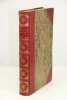
Paris, Calmann Lévy, [1901]. In-12 (184 x 118 mm), 1 f. bl., 3 ff. n.ch., 192 pp., 1 f. n. ch., 1 f. bl. Maroquin bleu foncé, large dentelle florale dorée en encadrement des plats, dos à nerfs, double filet doré en encadrement des caissons décorés de décor floral doré, ligne pointillée dorée sur chaque nerf, auteur et titre dorés, date dorée en pied, double filet doré sur les coupes et les coiffes, triple filet et fers dorés en écoinçon en encadrement des contre-plats, tranches dorées, signet en soie rouge, couvertures et dos conservés, étui bordé (Ad. Lavaux).
Edition originale du premier recueil de poèmes de la comtesse de Noailles.Celle-ci s’inspire des grandes figures du romantisme, notamment Alfred de Vigny, Alphonse de Lamartine et Victor Hugo. Sa poésie en alexandrins, au rythme classique, est imprégnée de lyrisme et de romantisme. La nature (L'Offrande à la Nature), la mythologie grecque (Offrande à Pan, L’Enfant Eros), l’acceptation de la mort (La Mort fervente, La Mort dit à l’Homme…), sont des thèmes qui traversèrent toute son oeuvre. La référence au titre se retrouve dans son dernier poème, Le Temps de vivre :"Combien s'en sont allés de tous les coeurs vivants[…]— Toi, vis, sois innombrable à force de désirs"L'ouvrage rencontra le succès dès sa publication. "Il semblait qu’Anna redonnait le goût de la poésie à un public lassé de tous les excès comme de tous les conformismes, issus du Parnasse, du symbolisme et du naturalisme" (François Broche). Exemplaire enrichi au premier feuillet d'un poème manuscrit signé par la comtesse. Il reproduit Chanson pour Avril, issu du recueil (p.155). Il est signé par la Comtesse de Noailles et est fidèle au poème imprimé. Il fut ensuite modifié dans les publications postérieures : l’adjectif "tiède" du premier vers de la deuxième strophe fut remplacé par "triste".D'origine grecque et d’une famille aristocratique roumaine, Anna Elisabeth Bassaraba de Brancovan (Paris, 1876-Paris, 1933) entra dans la noblesse française par son mariage avec le comte Mathieu de Noailles. Elle devint une figure incontournable de la vie parisienne de la Belle époque, marquée par l’exposition universelle à Paris en 1889 avec la construction de la Tour Eiffel, mais également par la polémique autour de l’affaire Dreyfus, en 1894, dont Anna de Noailles prit la défense. Poétesse et romancière, elle compta de nombreux amis écrivains, parmi eux, Anatole France, Colette, André Gide, Robert de Montesquiou, Paul Valéry et Marcel Proust. Celui-ci immortalisa le mariage, en 1897, d’Anna et du comte de Noailles dans Le Côté de Guermantes. "Un cousin de Saint-Loup avait épousé une jeune princesse d’Orient qui, disait-on, faisait des vers aussi beaux que ceux de Victor Hugo et d’Alfred de Vigny…" La comtesse de Noailles fut la première présidente du prix Vie heureuse, qui devint le prix Femina en 1922, et la première femme commandeur de la légion d’honneur (1931). Elle reçut, en 1921, le Grand Prix de Littérature de l’Académie française. Une élégante reliure d'Adrien Lavaux au décor raffiné.Relieur parisien, successeur de l’atelier de Garaud en 1910, Adrien Lavaux exerça jusqu’à sa mort, en 1937. À la fin de la première guerre mondiale, à la réouverture de son atelier, il travailla pour Boucheron, Roland Dorgelès, Francis Carco… (Fléty). Ex-libris au monogramme "H" et petit tampon mentionnant "édition originale", sur le feuillet de garde.Très bel exemplaire en maroquin richement décoré. François Broche, Anna de Noailles, un mystère en pleine lumière, Robert Laffont, 1989, p.165. Proust, Le Côté de Guermantes, édition Gallimard, 1921, p.131. Fléty p.106.
Tallandier, 2000, in-4°, 205 pp, plus de 100 documents inédits, 89 illustrations, photos et fac-similés en noir et en couleurs, reliure cartonnée illustrée de l'éditeur, bon état. Sans le CD audio
“Elle fit de son talent une arme pour la France.” (Charles de Gaulle) — Née le 30 octobre 1917 dans les beaux quartiers de Saint-Pétersbourg, Anna Marly – de son vrai nom Betoulinsky – va connaître bien des errances à travers les bouleversements de l'Europe. Exilée de la Russie devenue soviétique, direction la Côte d'Azur ; danseuse dans le corps des Ballets russes ; chanteuse-vedette dans les cabarets parisiens ; la guerre va révéler son talent à des milliers d'hommes et de femmes qui résistent à l'occupant allemand. Pourtant, lorsque Anna Marly arrive à Londres en 1941, personne ne la connaît. Elle s'engage comme cantinière au sein des Volontaires de la France Libre. Le soir, elle compose des chants que lui inspire le gigantesque combat. Elle les interprète devant des soldats et des marins qui sont bouleversés par la beauté et la force des mélodies. “La Chanson des V”, “Le Chant des partisans”, “La Complainte du partisan”, “Paris est à nous” – autant d'hymnes à la liberté, chantés, entonnés, sifflés d'abord par les maquisards, puis repris par tous à la Libération. À son retour en France, en 1945, Anna Marly connaît la gloire. Couvertures de magazine, galas, un tourbillon qu'elle fuit en 1947. Brésil, Argentine, Chili, Pérou... Anna Marly devient l'ambassadrice de la chanson française en Amérique latine. Puis, de 1955 à 1959, elle sillonne le continent africain toujours accompagnée de sa guitare, avant de s'installer aux États-Unis. Durant sa carrière de troubadour, Anna Marly a composé près de 300 chansons. Elle s'est éteinte le 17 février 2006, en Alaska, à l'âge de 88 ans. Désormais les frais d'envoi sont de 6 € seulement pour les livres jusqu'à 1 kg (colissimo suivi), pour la France métropolitaine.