 Write to the booksellers
FLEUTIAUX Pierrette
L'Expédition
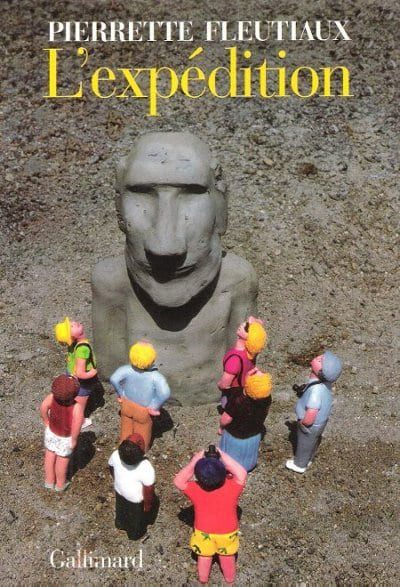
Paris NRF Gallimard 1999 In-8 Collection " Blanche " . Expédition à l'île de Pâques pour percer le mystère du monde par Angèle Lapérierre qui tient son journal et dont le modèle de voyageur est Lapérouse . - 458 p. , 650 gr.
Reference : 012085
Couverture souple Parfait État . Jaquette en parfait état 1° édition
Bookseller's contact details
Au vert paradis du livre
Claire ( Anne Marie ) Dréau
9 place de la Mairie
34530 Aumes
France
04 67 98 96 91
Payment mode

Sale conditions
CONDITIONS DE VENTE : Vente par correspondance dans le monde entier ( régie par la loi de la VPC ) 7 jours sur 7 . Pour recevoir le devis des frais de port vous devez veiller à bien rédiger votre email . Emballage sous carton et enveloppe kraft ou bulles si livre très léger , départ par Poste ou Mondial Relay . Expédition dès réception du règlement par Paypal ou par virement bancaire ou par chèque de banque française , libellé à l'ordre de Mme DREAU , adressé à la Librairie : Au vert paradis du livre , 9 place de la Mairie 34530 AUMES . France . Achat-Vente sur le site et par email ou téléphonique au 04 67 98 96 91 .
5 book(s) with the same title
Fragen an eine Gesellschaft Gelehrter Männer, die auf Befehl Ihro Majestät des Königes von Dännemark nach Arabien reisen. - [THE HANDBOOK OF NIEBUHR'S ARABIA-EXPEDITION]
Frankfurt am Mayn, Garbe, 1762. 8vo. Very nice contemporary full mottled calf with five raised bands to richly gilt spine. Titlelabel with gilt lettering. A bit of wear to spine, causing slight loss of leather and a neat restoration to lower compartment. A paperlabel pasted on top of spine. Small loss of leather to back board. A stamp on title-page (Holstein=Holsteinborg). (70), 397 pp., 4 folded tables, paginated 391-97. Internally clean, some quires printed on thick paper.
The rare first edition of the founding work of Niebuhr's Arabia-expedition, which would gain world-wide fame and establish the scientific description of the Arabian peninsula. The present work consists in 100 questions, the answers to which constitute the purpose of the Royal Danish Arabia Expedition. In fact, the present work is the handbook of Niebuhr's travel to Arabia Felix, as its author is the spiritual father of it. The work is extraordinary in many ways, and it not only served as the basis for the Arabia-expedition, it also constitutes a forerunner of modern bible science that would begin to emerge a few decades later. Johann Davis Michaelis (1717-19) was a theologian and orientalist, whose fame today rests upon the present work and upon the fact that he was responsible for the first scientific expedition to Arabia Felix, namely that of Niebuhr. In 1753, he had come up with the idea for the the Royal Danish Arabia Expedition (1761-1767) and had gotten the Danish minister Bernstoff to agree to it. In 1760, when the expedition was becoming a reality, Michaelis recommended Niebuhr as a participant, and he outlined the entire purpose of the trip - namaly the list of 100 questions that he prepared and published for the members of the expedition, in order for them to answer in the course of the voyage. For all intents and purposes, Michaelis was the spiritual father of the Arabia-expedition. As a theologian and an orientalist, many of Michaelis' questions have root in the Bible. But unlike many other theolgians of the time, Michaelis sought to shed light over biblical themes through sources outside of the Bible - especially from the Middle East, not least Arabia. In this regard, his 100 Questions also came to be a precursor to the emergence of modern bible science.Although the expedition would have never taken place had it not been for Michaelis and his 100 questions - many of which are also purely naturalistic - he could not quite have foreseen the scientific outcome of the expedition. He had not foreseen that Niebuhr would become the founder of the scientific description of the Arabian peninsula and that Niebuhr's notes would become the basis for the first decipherment of Mesopotamian and Persian cuneiform. On the contrary, he was probably quite disappointed that his questions were not all answered as thoroughly as the had anticipated. Adding to that, Niebuhr's answer to the questions ""only"" takes up six pages in the preface to ""Description of Arabia"", although the text itself contains many detailed explanations and answers to Michaelis' questions.

The Geographical Work of the Greely Expedition [Greely] (+) The Configuration of Grinnell Land and Ellesmere Land [Boas] (+) [Large folded map:] North America polar regions : Baffin Bay to Lincoln Sea, showing the most recent discoveries including tho... - [FIRST ACCOUNT OF THE LADY FRANKLIN BAY EXPEDITION]
(New York, 1885). 4to. In later half cloth with gilt lettering and stamp to front board. In ""Science"", Vol. 5, No. 108, Feb. 27. Paper label pasted on to front board. The two titles underlined in blue pencil. Stamp to verso of map and almost parted in two, long tear in foldings, otherwise internally fine and clean. Pp. iii-iv, 163-185 + large folded map: ""North America polar regions : Baffin Bay to Lincoln Sea, showing the most recent discoveries including those of U.S.S. Polaris Expedition in 1871-2, under Captain C.F. Hall, British Arctic Expedition in 1875-6, under Captain G.S. Nares, R.N., The Lady Franklin Bay Expedition in 1881-4, under Lieutenant A.W. Greely, U.S.A""
First edition of Lieutenant A. W. Greely's first short account of the fatal Lady Franklin Bay Expedition (Also known as the Greely expedition). The present account is presented as a commentary to the accompanying map. A more extensive account was published in 1886 (Three Years of Arctic Service) and the full official account was published in 1888 (Report on the Proceedings of the United States Expedition to Lady Franklin Bay, Grinnell Land)The Lady Franklin Bay Expedition of 1881-1884 to Lady Franklin Bay in the Canadian Arctic was led by Lieutenant Adolphus Greely and its purpose was to establish a meteorological-observation station as part of the First International Polar Year, and to collect astronomical and magnetic data. During the expedition, two members of the crew reached a new Farthest North record, but of the original 25 men, only seven survived to return.""The United States expedition during the First International Polar Year, based at Fort Conger, Lady Franklin Bay, about 81°45' N, on the east coast of Ellesmere Island, explored the north coast of Greenland from Cape Bryant to Cape Washington, about 82°30'-83°30"" N, the interior and west coast of Grinnell Land (northern Ellesmere Island), and extended the maping of Hayes Sound, about 79° N, on Ellesmere. As relief ships failed to reach them, members of the party made a march out of the Hall Basin area, all but seven dying of starvation before rescue at Cape Sabine, Smith Sound"" (Arctic Bibliography).
Die Oesterreichisch-Ungarische Nordpol-Expedition in den Jahren 1872-1874, nebst einen Skizze der zweiten deutschen Nordpol-Expedition 1869-1870 und der Polar-Expedition von 1871. Mit 146 Illustrationen und 3 Karten.
Wien, Alfred Holder, 1876 ; fort in-8 ; cartonnage de l'éditeur bleu-noir-or décoré d'images "polaires" : navire, ours blanc, chien de traineaux, explorateurs en fourrure, toutes tranches dorées (reliure signée H. Scheibe) ; CVI, 696 pp., 3 cartes dépliantes lithographiées en couleurs et 146 dessins gravés sur bois.
EDITION ORIGINALE du récit de l'expédition polaire austro-hongroise du "Tegetthoff" commandé par le célèbre cartographe et scientifique Julius von Payer et Karl Weyprecht, qui permit la découverte de la Terre François-Joseph, archipel inconnu découvert lors de la dérive du navire pris dans les glaces au nord de la Nouvelle Zemble. Le navire, pris dans les glaces depuis août 1872, fut abandonné en mai 1874 et, grâce à des traineaux, les membres de l'expédition atteignirent les eaux libres et furent recueillis par des pêcheurs russes. Cette expédition permit une sérieuse avancée dans la découverte du passage nord-est par Nordenskiold et entraina aussi une meilleure coopération internationale dans les explorations suivantes ; elle avait aussi permis de mieux connaitre les aurores boréales, le magnétiste, etc.

Narrative of a second expedition to the shores of the polar sea in the years 1825, 1826 and 1827, by John Franklin captain commander of the expedition, including an account of the progress of a detachment by John Richardson, surgeon and naturalist of the expedition. Illustrated by numerous plates and maps.
London: John Murray, 1828 in-4, xxiv-320-clvii-(2), 30 planches hors texte, 6 cartes. Demi reliure du 20è siècle dans le style des reliures du début 19è siècle, dos à nerfs, caissons dorés, pièces de titres de cuir rouge et vert. Très bel exemplaire. EDITION ORIGINALE. (Nous disposons aussi du récit de la première expédition, en édition originale dans une reliure uniforme).
Narrative of a second expedition to the shores of the polar sea in the years 1825, 1826 and 1827, by John Franklin captain commander of the expedition, including an account of the progress of a detachment by John Richardson, surgeon and naturalist of the expedition. Illustrated by numerous plates and maps. (London: John Murray, 1828) [M.C.: voyages, pôles, Canada]
Relation du Voyage des Francois Fait au Cap de Nord en Amerique, Par les soings de la Compagnie establie à Paris, & sous la conduite de Monsieur De Royville leur General ; Avec une ample description du Pays, des Mœurs & façon de vivre des Sauvages, & l’observation des hauteurs. Dédiée à Madame la Duchesse d’Esguillon. Par L. de Laon Sieur Daigremont ; Ingénieur du Roy, & Capitaine dans les Troupes de France Equinoctialle. Edition originale du récit de la malheureuse expédition de Royville
Édition originale de la plus grande rareté de cette relation connue à quelques exemplaires seulement, contenant le récit de la malheureuse expédition de Royville au «Cap de Nord en Amérique française» réalisée en 1652, avec pour objectif de «porter la connoissance de nôstre Dieu parmy les peuples sauvages & infidels», et les coloniser. L’exemplaire du Comte de Toulouse et du roi Louis Philippe. Paris, Antoine de Sommaville, 1654.In-8 de (8) pp., 200, et 2 planches gravées à pleine page. 2 ff. intervertis sans manque, sans la carte qui manque presque toujours. Maroquin bordeaux, encadrement à la Du Seuil avec fleurons à l’oiseau aux angles, dos orné de fleurons de même, coupes décorées, dentelle intérieure, tranches dorées. (Lortic). 159 x 100 mm.
Édition originale de la plus grande rareté de cette relation connue à quelques exemplaires seulement, contenant le récit de la malheureuse expédition de Royville au « Cap de nord en Amérique française », réalisée en 1652 afin de « porter la connoissance de Dieu parmy les peuples sauvages & infidels », et les coloniser. Manque comme généralement la carte. Brunet, III, 20 ; Ternaux-Compans, 740 ; Church, 533 ; Sabin, 38951 ; Graesse, Trésor de livres rares et précieux, III, 103. C’est après avoir appris en France les désastres et la tragédie du despotique Charles Poncet de Bretigny, mort en 1645 massacré par des indigènes, ainsi que ses compagnons, que Royville résolut de fonder une nouvelle compagnie pour coloniser ces contrées, ayant œuvré au préalable pour que le roi déchût de son privilège celle de Rouen. Associé à l'abbé de la Boulaie, intendant général de la marine sous le duc de Vendôme et à l'abbé de l'Isle Marivaut, ainsi qu’à dix autres associés, la compagnie dite des Douze seigneurs nomma Royville général de l’expédition et ceux restés en France seraient chargés de faire passer les renforts de vivres et des munitions. Constituée par des hommes inaptes aux besoins de l'entreprise, l’assassinat de Royville durant le voyage, les dangers liés à l’expédition, ainsi que les querelles internes mirent fin à l’aventure. Paul Boyet et Jean de Laon, chroniqueurs des deux malheureuses tentatives de colonisation de la Guyane : celle de Brétigny en 1643, et celle de Royville en 1652, toutes deux publiées à Paris en 1654, appellent Cap de Nord la Guyane, tout comme les historiens portugais et espagnols. Ces deux chroniques constituent les deux plus précieuses relations de la colonisation française en Amérique centrale. Le volume s’ouvre sur une dédicace « A Madame la duchesse d’Esguillon » et le texte décrit l’expédition dans le détail, les mœurs et coutumes des Indigènes, la nature et la géographie du pays parcouru. « This is an account of an expedition sent out under De Roiville, in 1651. The greater part of the colonists, seven hundred or eight hundred in number, perished in the space of fifteen months, from hunger and the fury of the Indians”. (Sabin).L’illustration, généralement absente, comprend 2 belles planches gravées en taille-douce et une carte: 1/ Représentation d’un aborigène nu tenant un arc face à la page 88, ici présente. 2/ Représentation du même aborigène tenant une masse face à la page 89, ici présente. 3/ Carte de l’isle de Cayenne, ici absente. Précieux exemplaire, fort bien relié par Lortic en maroquin rouge à la Duseuil, de cette édition originale plus rare encore que celles de Champlain ou de Lescarbot. Church, dans sa bibliographie consacrée à la découverte du continent américain, ne cite que deux exemplaires: British Museum et Lenox Libraries. L’exemplaire provient des bibliothèques du Comte de Toulouse et du roi Louis Philippe avec son cachet sur le feuillet de titre.

