 Write to the booksellers
SALLUSTE (Crispus)
C. Sallustius Crispus, cum veterum Historicorum fragmentis.
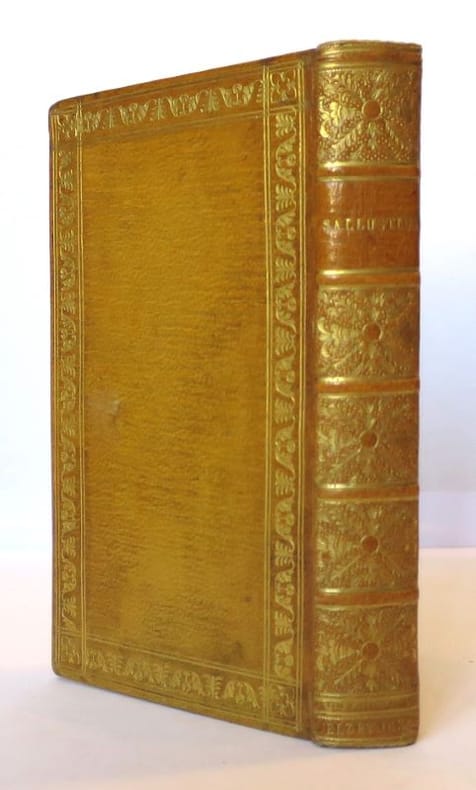
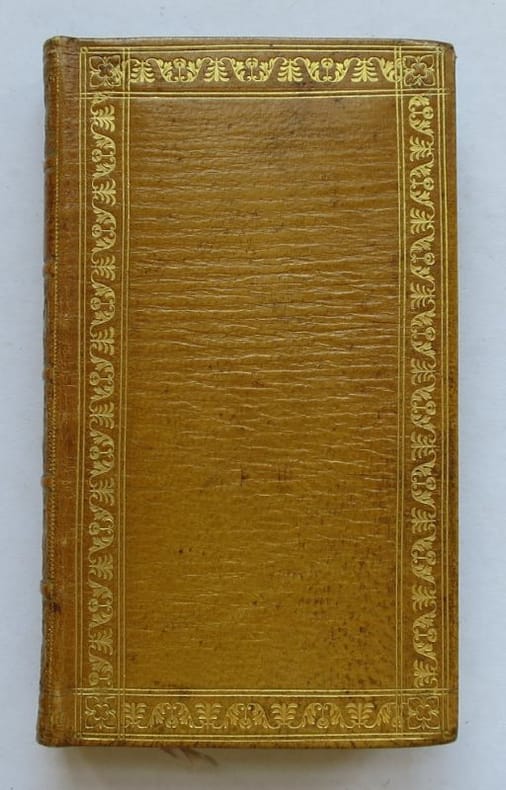
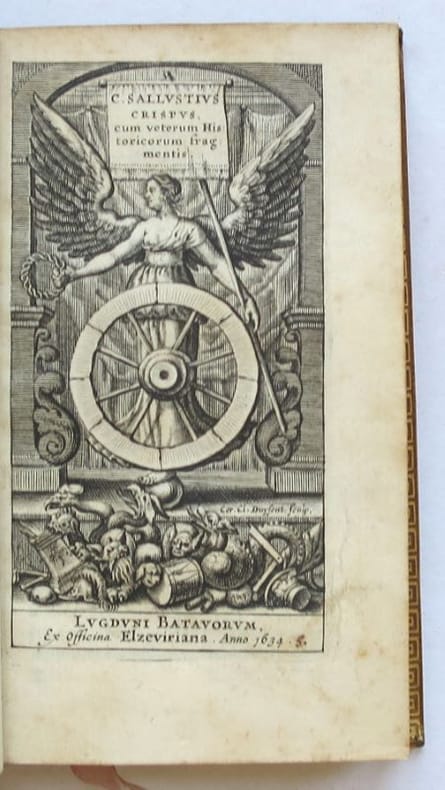
Lugduni Batavorum (Leyde) ex Officina Elzeviriana 1634 Petit in-12 maroquin citron de l'époque, plats ornés d’un triple filet or et écoinçons en angle, dos lisse orné de fers dorés, pièce de titre marron, filet doré sur les coupes, dentelle dorée intérieure, tranches dorées. (12 ff)-310 pp-19 ff d’index.
Reference : 22660
Superbe exemplaire d'une des réimpressions à la date de l'originale elzévirienne (Pieters, page 91, n°15). Celle-ci présente une particularité encor différente des trois réimpressions répertoriées par Pieters et Brunet, on y lit en haut de la dernière page de l'index : Index rerum memorab., alors que les éditions décrites par ces bibliograhes portent soit la phrase non abrégée, soit Index rer. Memorabilium. Cette subtile différence porte donc à quatre le nombre des réimpressions en 1634 de ce texte important.
Bookseller's contact details
Librairie Jeanne Laffitte
Mme Jeanne Laffitte
25, Cours d'Estienne d'Orves
13001 Marseille
France
04 91 59 80 49
Payment mode


Sale conditions
Nos conditions sont conformes aux usages de la librairie ancienne et moderne.
5 book(s) with the same title
C. Sallustius Crispus cum veterum Historicorum fragmentis
Lugduni Batavorum (Leiden), Elzevir, 1634, petit in 12 de 1 titre gravé par Cl. Duysent d'une jolie composition allégorique, (14)-310-(34) pp., 1 portrait de salluste gravé d'après une médaille antique, rel. d'ép. XVIIIe de plein veau brun, dos lisse à nerfs orné de fers dorés, pièce de titre de maroquin vetrt, encadrements de triple-filets dorés sur les plats, tranches dorées, bel ex.
Jolie édition Elzévirienne peu commune. (Willems, 412).
C. Sallustius Crispus, cum veterum Historicorum fragmentis. (Bound with:) Colloques d'Érasme, fort curieusement. Traduits de Latin en François, pour l'usage des amateurs de la langue .
Ad 1: Leiden (Lugduni Batavorum), Ex officina Elzeviriana, 1634. Ad 2: Leiden (A Leyden), Chez Adrian Vingart, 1653.
12mo. 2 volumes in 1: vol. 1: (XVI),310,(34 index); vol. 2: (XII),360,(12 table) p. Overlapping vellum 13 cm (Ref: Ad 1: Willems 412, note: this is the second of the 3 reissues of this text in that year; Bergman 2115; Rahir 399; Schweiger 2,877: 'Sehr saubere u. gesuchte Ausg.'; Dibdin 2,384. Ad 2: Willems 1675, 'Annexes de la collection Elzevirienne': 'assez jolie édition. La traduction est de Samuel Chappuzeau'; Bergman 1357: 'édition fort jolie et d'une insigne rareté') (Details: Ad 1: Title engraved by Cor.Cl. Duysent. Woodcut portrait of Sallustius at the end of the preface. Ad 2: Woodcut printer's mark on the title, depicting a man climbing a palmtree, the motto is 'Ardua quae pulchra', already mentioned in the Adagia of Erasmus) (Condition: Binding worn & soiled. Front hinge loosening, but still hanging on 2 ropes. The hinge in the rear hangs on 1 rope. Tiny part of the vellum on the front joint gone. Edges of the first & last gathering thumbed. Caput numbers in the margins of the Bellum Catilinum & the Bellum Iugurthinum, alternately written in ink & red pencil) (Note: Ad 1: 'One of the most widely read and influential of Roman historians, along with Caesar, Livy, and Tacitus, Sallust (86-34 BC) has been studied, quoted, and imitated not only as a historian but also as a moral philosopher, political thinker, and stylist.' Until 1600 more than 200 editions of his work appeared. Sallust was used in the 16th and 17th century to support absolute theories of government. But, 'on the other hand, it was the republican Sallust, 'ennemy of tyrants,' whom John Milton admired and who bolstered the cause of liberty in the Lowlands during the war with Spain and, later, in France and on the American continent'. (The Classical tradition, Cambr. Mass., 2010 p. 856) Sallustius furnished indeed weapons to the supporters and opponents during the rebellion of the Netherlands against the Spaniards, a war of independence that lasted 80 years, from 1568 till 1648. Numberless pamphlets appeared during this war, and many are full of reminiscences and quotations of classical authors. Sallust also was widely used, everyone chose his favourite argument. This was possible because Sallustius preached party politics under a cloak of grave and philosophic impartiality. This 1634 edition was edited, while the Eighty Years' War was raging on, by the wellknown Dutch scholar, Neolatin poet, and editor of Latin classics, Marcus Zuerius Boxhornius, 1602-1653. A year before, in 1633 he was appointed professor of Rhetoric at Leiden, and later he filled the chair of Daniel Heinsius. Ad 2: 'The Colloquia, like the Adagia, were written over a period of years and constantly enlarged as edition succeeded edition. From their earliest form of short models of Latin conversation and formulae of etiquette (composed at Paris in 1497 for the use of some pupils and first printed in 1518) they grew into 'a rich and motley collection of dialogues, each a master piece of literary form, well-knit, spontaneous, convincing, unsurpassed in lightness, vivacity and fluent Latin, each one a finished one-act play' (Huizinga). The Colloquia, full of witty and penetrating observations on ordinary day-to-day happenings as well as on the basic weakness of Church and society, are an invaluable mine of information about 16th century customs, institutions and social problems. Besides, their success as a schoolbook was unrivaled and the stream of editions and translations flowed almost uninterruptedly down to modern times'. (Gilhofer & Ranschburg GmbH, Catalogue 50, Erasmus, published on the 500th anniversary of his birth', Luzern, ca. 1967, p. 34) This translation of 1653 contains only 10 colloquia: 1, La Caresme; 2, Le point du jour; 3, Les Hotelleries; 4, Le mensonge et la Vérité; 5, L'Épithalame; 6, L'Épicurien; 7, Le Maquignon; 8, Du nom & de la chose; 9, Le Secret des sciences; 10, Le Banquet des sobres. And: Apologie d'Érasme, aux théologiens de Louvain. This choice from the colloquia was translated by the French scholar, author, poet and playwright Samuel Chappuzeau, 1625-1701, whose best-known work today is 'Le Théâtre François', a description of French Theatre in the 17th century. (See for him Wikipedia 'Samuel Chappuzeau') (Provenance: In pencil on the front pastedown: 'J. v. Dijck') (Collation: *8, A-O12, P6 (minus the blank leaves P5 & P6); *4, 2*2, A-P12, Q6) (Photographs on request)
C. Sallustius Crispus, cum veterum Historicorum fragmentis.
Lugduni Batavorum (Leyde) ex Officina Elzeviriana 1634 Petit in-12 de 12 ff. lim.n.ch., 310 pp. et 19 ff. d'index, maroquin rouge de l'époque, dos lisse orné, triple filet doré sur les coupes, dentelle dorée int., tr. Dor.
Brunet, V, 85-86, cat des Elzevier, 399; Pieters, les Elzevier, p. 91, n°15. Première édition elzevirienne des œuvres de Salluste. La conjuration de Catilina et la Guerre de Jugurtha comptent parmi les plus beaux morceaux écrits par un historien latin. Véritable édition originale, Bonaventure et Abraham Elzevier en ayant fait trois réimpressions la même année; ces dernières n'ont que 8 ff. lim. Et 17 ff. d'index. Beau titre-frontispice gravé par C.C. Duysent, et portrait de Salluste en médaillon au verso du dernier feuillet liminaire. Superbe exemplaire, en parfait état int. Dans une très élégante reliure de l'époque.


Sallustius Crispus cum veterum Historicorum Fragmentis
ELZEVIRIANA. 1634. In-18. Relié plein cuir. Etat d'usage, Couv. légèrement passée, Mors fendus, Intérieur frais. 309 pages. Frontispice en noir et blanc hors-texte. Bandeaux et lettrines. Ouvrage en latin. Relié plein cuir marron. Tranches rouges. Pièce de titre bordeaux. Titre ert caissons dorés sur le dos à 5 nerfs. Epidermures. Manque la page de titre. . . . Classification Dewey : 470-Langues italiques. Latin
Classification Dewey : 470-Langues italiques. Latin
C SALLUSTIUS CRISPUS CUM VETERUM HISTORICORUM FRAGMENTIS.
Lugduni Batavorum ex Officina Elzeviriana Anno 1634. Peti in-12 8ff n ch 310pp 17ff n ch. Plein vélin ivoire, plats encadrés d'un filet bleu, relié au début du XIXe siècle. Orné d'un beau frontispice gravé par CC Duysent et d'un portrait de Salluste d'après une médaille de l'époque.
Willems 412. Brunet V, 85. Jolie édition élzévirienne peu commune.

