 Write to the booksellers
Garner Philippe
Design
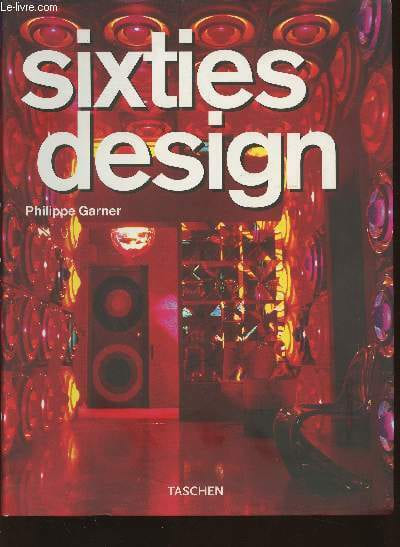
Taschen. 2003. In-4. Relié. Bon état, Coins frottés, Dos satisfaisant, Intérieur frais. 176 pages. Texte en anglais, allemand, français. Couverture souple. Nombreuses photos et illustrations en noir et blanc et en couleurs, in et hors texte. Rares rousseurs.. . . . Classification Dewey : 740-Dessin, arts décoratifs et mineurs
Reference : RO60149939
ISBN : 3822829374
Classification Dewey : 740-Dessin, arts décoratifs et mineurs
Bookseller's contact details
Le-livre.fr / Le Village du Livre
ZI de Laubardemont
33910 Sablons
France
05 57 411 411
Payment mode


Sale conditions
Les ouvrages sont expédiés à réception du règlement, les cartes bleues, chèques , virements bancaires et mandats cash sont acceptés. Les frais de port pour la France métropolitaine sont forfaitaire : 6 euros pour le premier livre , 2 euros par livre supplémentaire , à partir de 49.50 euros les frais d'envoi sont de 8€ pour le premier livre et 2€ par livre supplémentaire . Pour le reste du monde, un forfait, selon le nombre d'ouvrages commandés sera appliqué. Tous nos envois sont effectués en courrier ou Colissimo suivi quotidiennement.
5 book(s) with the same title
Design, Design, Design, Design, Design the Poor
, Notice Notice, 2012 Paperback, 108 pages, ENG, 210 x 155 x 10 mm, front and backside have been wet in the past, rest of the book is as New, images in colour /b/w. ISBN 9780615694986.
Notice Notice, 2012. Design, Design, Design, Design, Design the Poor. The book presented the literal interpretation of seemingly innocuous communications as a source of truth, lessons in value along the silk road, architecture against poor women, Robin Hood appropriation, respect to the ghosts we walk all over every day in our developing cities, listening to the radio, and resurrection. Contributions from Peter Fend, Jana Leo, Temporary Services, Shillz da Realz, Jill Freedman, Chris Leo, Mich le Champagne, David N. Hartt, Freeman House.
Blocks on the Road to Instructional Design Prescriptions. A Methodology for I.D.-Research Exemplified.
Leuven, Universitaire Pers, 1995 Paperback, English, original editor's jacket, 16x24 cm., xii-274 pp. ISBN 9789061867081.
Studia Paedagogica : 8. The development of instructional design as a linking science and, more specifically, the formulation of theoretically sound, empirically valid, and applicable prescriptions may contribute to bridge the gap between theory and practice. In this study, a heuristic approach is proposed that conceptualizes the steps involved in prescriptive research. It is assumed that prescriptions are tight to learning or cognitive tasks, which represent instructional problems in a specific instructional setting. Furthermore, it is argued that prescriptions are to be embedded in an overarching framework. This framework determines the meaning of the prescriptions, restricts their applicability, and may guarantee their mutual compatibility. I.D.-models have been argued to offer such frameworks. The first step of the proposed approach, then, consists of the construction of an I.D.-model. In a second step, this model is elaborated in order to tune it to the learning or cognitive tasks for which prescriptions will be formulated. An analysis of both the available research embedded in the descriptive knowledge base and the specifications of the referent system, results in a number of problem detection- and prediction-rules. These rules provide indications on problems learners may encounter in their efforts to execute the selected task, or link learner characteristics and instructional interventions to learning outcomes. The last step consists of the validation of the prespecified rules in an ecological setting. This empirical validation may lead to prescriptions which applicability is restricted to the settings specified in the referent system. The approach above is followed as an exemplar of prescriptive I.D.-research. A definition of instructional design is provided and five structural components (descriptive knowledge base, referent system, design parameters, design procedures, and design/development processes) of I.D.-models are identified. An analysis of the influence of cognitive research outcomes on instructional design and the elaboration of the approach for prescriptive instructional design research (Chapter 1), precedes the construction of a cognitive oriented instructional design model (C.I.D.-model). The model is completed by outlining design/development processes and the features of some design procedures (Chapter 2). The model gets further elaborated by taking the referent system more fully into account and specifying the model toward a specific cognitive task: determining importance of information-elements in printed instructional materials (Chapter 3). Considering the outcomes of descriptive research about the influence of both learner and text characteristics on both learning from text and text comprehension, an empirical validation study is presented (Chapter 4). Arguing that descriptive research outcomes cannot be directly transformed into prescriptions, but can help to detect problems students eperience and may suggest possible solutions, problem detection- and prediction-rules are identified. Application of problem detection- and prediction-rules leads to the implementation of three types of interventions or support devices: printing important information bold, integrating important information elements in summaries, and restructuring the text. Results (Chapter 5) indicate that (1) overall, students determine importance by applying a 'safety'-strategy; (2) interventions do not lead to improved performance on determining importance or learning outcomes tests, and (3) content prior knowledge influences performance on learning outcomes tests. Overall, no valid prescriptions can be formulated. The overall non-significant results may be due to a variety of reasons. Retrospective interviews suggest that the results may be explained by the non-use or inappropriate function-attribution of instructional interventions by students. This study does not result in valid prescriptions. In addition, questions are to be raised about the C.I.D.-model and, more specifically, the selection of learner-related design parameters. However, these conclusions pertain only to the hypothesis-testing part of the study and do not consider contributions made with regard to the development of cognitive instructional design, and, more methodologically, the explorative aspects of this prescriptive study.
BELGISCH DESIGN BELGE / Gustave Serrurier-Bovy, Huib Hoste, Jacques Dupuis, Willy Van Der Meeren, Jules Wabbes, Maarten Van Severen, Meurop, Alain Gilles, Christophe Gevers,
, Design Museum Brussels, 2021 softcover, 275 x 200 mm, 160 pages, Illustrated. EN-FR-NL edition . /new/NEUF ISBN 9782875720689.
Van art noveau tot hedendaagse creaties via het naoorlogse functionalisme - deze tentoonstelling verkent onder andere het werk van ontwerpers en de productie van Belgische bedrijven en uitgeverijen zoals Gustave Serrurier-Bovy, Huib Hoste, Jacques Dupuis, Willy Van Der Meeren, Jules Wabbes, Maarten Van Severen, Meurop, Alain Gilles, Christophe Gevers, . De l'Art nouveau la cr ation d'aujourd'hui en passant par le fonctionnalisme d'apr s-guerre, cette exposition explore entre autres le travail des designers et la production d'entreprises et de maisons d' ditions belges. Parmi ces designers et producteurs citons : Gustave Serrurier- Bovy, Huib Hoste, Jacques Dupuis, Willy Van Der Meeren, Jules Wabbes, Maarten Van Severen, Meurop, Alain Gilles, Christophe Gevers, . Comment raconter le design aujourd'hui ? En consid rant les objets non seulement dans leur mat rialit mais aussi la mani re dont ils fa onnent notre environnement (im)mat riel, nos interactions sociales et notre perception visuelle. Comment raconter un design vivre et voir ? Comment parler au 21e si cle de l'histoire du design en Belgique? C'est avec ces interrogations que Belgisch design belge, l'exposition au Design Museum Brussels et ce livre qui l'accompagne, souhaitent initier une forme de r flexion. Apr s les livres Panorama et Designing the night, ce projet initie un cycle de propositions sous la forme de pop-ups qui se succ deront dans le temps. Les s lections de pi ces tant t subjectives jamais exhaustives se voudront repr sentatives du design en Belgique depuis les premiers pas de celui-ci jusqu' ses repr sentants actuels les plus passionnants. C'est ici l'occasion de red couvrir certains parmi les designers les plus talentueux comme Maarten Van Severen ou Christophe Gevers et de retracer bri vement leur parcours. Les pi ces d' poques, de mat riaux, de statuts et de natures diff rentes se succ dent telles que les accessoires en bois ou en m tal con us dans les ann es 1950 par Jules Wabbes, Jacques Dupuis et L on Stynen, ou les premiers gadgets en mati re plastique, ustensiles de cuisine d velopp s par les films ACEC ou NOVA ou encore les tabourets de bar en vinyle aux motifs bicolores et ludiques de Willy Van Der Meeren. Ce tour d'horizon confirme par ailleurs, l'importance de la manufacture Boch Keramis ou de la firme Meurop et permet de se pencher, entre autres, sur les carri res de Huib Hoste, Xavier Lust ou Gustave Serrurier-Bovy. Belgisch design belge, une exposition en cours au Design Museum Brussels, jusque fin 2021
Éléments de design industriel.
Maloine, 1984, gr. in-8°, xvii-478 pp, biblio, index, reliure cartonnée illustrée de l'éditeur, bon état. Edition originale
Ce livre est un ouvrage fondamental pour les étudiants, les designers professionnels, les ingénieurs, les industriels et tous les partenaires de la conception qu'ils soient spécialistes de la communication, du marketing, du management, de l'ergonomie de produits, de l'analyse de la valeur, de la qualité. Ce volume encyclopédique apporte les bases théoriques nécessaires à la connaissance et à la compréhension du design industriel en s'appuyant sur près d'un millier d'illustrations. Une première partie retrace l'évolution de la conception des produits industriels depuis la première moissonneuse batteuse jusqu'au design d'aujourd'hui. Une deuxième partie explicite les différentes théories importantes pour l'analyse des objets et produits (Gestaltthéorie, théorie de la communication, sémiotique). La troisième partie aborde la pratique du design proprement dite dans une démarche pluridisciplinaire (stratégie de communication d'entreprise, design et ergonomie, design et marketing, design et qualité, design et environnement). “Éléments de design Industriel” est le véritable ouvrage de référence pour tous ceux qui sont concernés par l'innovation et par la conception de produits. — Danielle Quarante est designer industriel. Elle introduisit, à l'Université de Technologie de Compiègne, la nouvelle formation d'ingénieurs-designers puis créa le premier 3e cycle DESS en Design Industriel/conception de produits. Elle a conduit de nombreuses actions et apporté sa contribution en faveur du design que ce soit avec le ministère de l'Industrie ou avec le ministère de la Recherche. Ancienne Présidente de l'UFDI (Union Française des Designers Industriels), elle est aussi membre fondateur de CONFERE (Collège d'Études et de Recherches en Design et Conception de Produits). Ayant participé aux travaux de l'ICSID (Conseil International des Sociétés de Design Industriel), elle a acquis une position et une reconnaissance internationale. Désormais les frais d'envoi sont de 6 € seulement pour les livres jusqu'à 1 kg (colissimo suivi), pour la France métropolitaine.
PROCESS EQUIPMENT DESIGN, VESSEL DESIGN
John Wiley & Sons. 1959. In-4. Relié. Etat d'usage, Tâchée, Dos satisfaisant, Intérieur frais. 408 pages. Illustré de nombreux graphiques et schémas, et de nombreuses photos en noir et blanc dans le texte. Texte sur 2 colonnes. Annotation en page de garde.. . . . Classification Dewey : 420-Langue anglaise. Anglo-saxon
Contents: Factors Influencing the Design of Vessels Criteria in Vessel Design. Design of Shells for Flat-Bottomed Cylindrical Vessels. Design of Bottoms and Roofs for Flat-Bottomed Cylindrical Vessels. Proportioning and Head Selection for Cylindrical Vessels with Formed Closures. Stress Considerations in the Selection of Flat-Plate and Conical Closures for Cylindrical Vessels. Stress Considerations in the Selection of Elliptical, Torispheri-cal, and Hemispherical Dished Closures for Cylindrical Vessels. Design of Cylindrical Vessels with Formed Closures Operating under External Pressure. Design of Tall Vertical Vessels. Design of Supports for Vertical Vessels. Design of Horizontal Vessels with Saddle Supports. Design of Flanges. Design of Pressure Vessels to Code Specifications. High-Pressure Monobloc Vessels. Multilayer Vessels. Appendix: Design Conventions. Welding Conventions, etc. Classification Dewey : 420-Langue anglaise. Anglo-saxon



