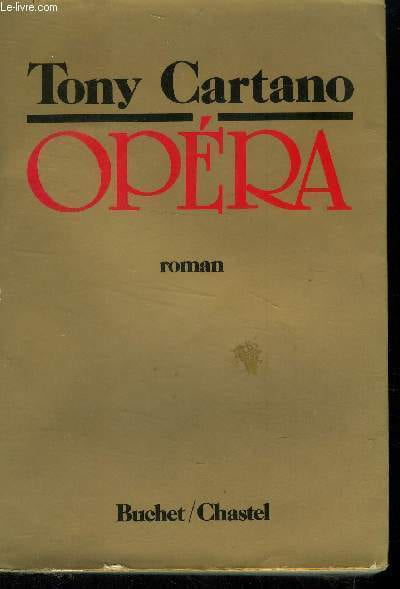
‎Cartano Tony‎
‎Opéra‎

‎Buchet/Chastel. 1981. In-12. Broché. Bon état, Couv. convenable, Dos satisfaisant, Intérieur frais. 313 pages avec couverture illustrée en couleur. Un léger accroc sur la jaquette au dos.. Avec Jaquette. . . Classification Dewey : 850-Littératures italienne, roumaine, rhéto-romane‎

Reference : RO40005823


‎ Classification Dewey : 850-Littératures italienne, roumaine, rhéto-romane‎

€19.80
Bookseller's contact details

Le-livre.fr / Le Village du Livre

ZI de Laubardemont
33910 Sablons
France

serviceclient@le-livre.fr

05 57 411 411

Contact bookseller

Payment mode
Others
Cheque
Others cards
Sale conditions

Les ouvrages sont expédiés à réception du règlement, les cartes bleues, chèques , virements bancaires et mandats cash sont acceptés. Les frais de port pour la France métropolitaine sont forfaitaire : 6 euros pour le premier livre , 2 euros par livre supplémentaire , à partir de 49.50 euros les frais d'envoi sont de 8€ pour le premier livre et 2€ par livre supplémentaire . Pour le reste du monde, un forfait, selon le nombre d'ouvrages commandés sera appliqué. Tous nos envois sont effectués en courrier ou Colissimo suivi quotidiennement.

Contact bookseller about this book

Enter these characters to validate your form.
*
Send

5 book(s) with the same title

‎LIPSIUS,J. ‎

Reference : 11182

‎Iusti Lipsii opera, quae velut in partes ante sparsa, nunc in certas classes digesta; nunc in gratiam & utilitatem legentium, in novum corpus redacta, & II Tomis comprehensa. (...) Accuratae inspectionis & novae formae editio; nec non ad mentem autoris typosque, figurarum elengantia omni perpolita. Cum privilegio Regis. ‎

‎Lyon, Apud Horatium Cardon, 1613. ‎


‎Folio. 2 volumes: (XII),84,(8),882 (recte 884),(2 blank); (XII),899,(1 blank) p., engraved title, portrait, illustrations. Calf. 36 cm 'The First Opera Omnia edition' (Ref: Bibliotheca Lipsiana Bruxellensis, p. 96, no.66) (Details: Backs with 5 raised bands. Boards decorated with rows of blind-stamped rolls, comprising floral motives. The somptuous architectural title to the first volume was engraved by Jacques de Fornazeris. It depicts a kind of triumphal arch, overloaded with symbols of power, abundance and wisdom; left and right of the way through stands between pillars a statue, of the goddess Roma, and a woman personifying Greece and Athens; on top of the arch a scene that looks like the 'deification' of 'the book'. De Fornazeris also engraved a full-page portrait of Lipsius. The title of volume 2 shows Cardon's printer's mark, also by De Fornazeris. Many engravings and woodcut illustrations in the text) (Condition: Bindings scuffed. Heads of the spines chafed. Joints of the first volume splitting at the head of the spine. Boards scratched, corners bumped. Some remnants of the original 4 green ties. As pastedowns have been used 4 leaves from an incunable (?) of the 'Speculum Iudiciale' of the French bishop of Mendo Guillaume Durand (William Durand). Both front flyleaves are worn) (Note: Justus Lipsius, 1547-1606, was the greatest Latin scholar of his time in the Low Countries. In 1579 he came to the recently founded University of Leiden (1575) to teach Latin. He resided there with great distinction as honorary Professor of History from 1579 till 1591. These twelve years were the period of his greatest productivity. It was during this time that he prepared his Seneca, and perfected, in successive editions, his Tacitus, and brought out a series of other works. Some were pure scholarship, some were collections from classical authors, and others were of general interest. Lipsius' greatest strength lay in textual criticism and exegesis. 'His masterpiece in this respect was his Tacitus, of which two editions appeared in his life-time (1574, 1600)' (J.E. Sandys, History of Classical Scholarship, N.Y., 1964, vol. 2, p. 303) Lipsius left the Dutch republic, converted to Catholicism, and finally settled in Leuven to teach as professor of Latin in the 'Collegium Buslidianum'. In an autobiographical letter to his pupil Johannes Woverius, dated 1 Oct. 1600 Lipsius presents himself 'as a true humanist, whose uneventful life is filled by reading, teaching and writing. His life, he tells, was not to be compared to that of real great men, whose political or military deeds (res gestae) merit description. He kept away from politics, depicting his scholarly career as a succession of political innocent travels to interesting places like Italy, Vienna and Jena, and then returning to his beloved fatherland for which he had really longed for all this time. His long stay at Leiden University he portrayed as a period spent in refuge while the civil war was raging in the Netherlands. In the end he felt forced to return to his native country, the Southern Netherlands. He tells us in the autobiographical letter that this decision was mainly inspired by the religious condition of the rebellious provinces and by the attacks he had to suffer on his reputation (Religio et Fama)'. (N. Mout, 'Justus Lipsius between war and peace', in 'Public Opinion and Changing Identities in the Early Modern Netherlands', Leiden/Boston 2007, p. 150) Lipsius lived in turbulent times. He wrote a number of works which were to revive the philosophy of ancient Stoicism in a form that was acceptable to Christianity. The earliest and most famous of these is 'De Constantia in publicis malis' ('On constancy in times of public calamity'), first published Leiden/Antwerpen 1584) The appearance of the 'Opera Omnia' of Lipsius in Lyon took the Antwerp publisher's firm of Plantin/Moretus, that had published nearly all works of Lipsius, by surprise. There existed a great demand for Lipsius' works after his death, but the firm was reluctant to publish the complete works, because it still had great quantities of separate titles of Lipsius in stock. Furthermore the firm believed that his works were protected from competition of other publishers by their 'privilegium'. Plantin/Moretus' counter offensive came a year later, with a quarto edition of the 'Opera Omnia' in 5 parts. In it the firm simply swept together the old separate titles, and added a new title page, dated 1614. ('Lipsius en Leuven', Leuven 1997, p. 317/18)) (Provenance: On the flyleaves: 'Godfi. Bosvile, 1681'. This must be one Godfrey (Geoffrey) Bosvile, a member of the noble Bosvile family, who owned between the 16th and 19th centuries Ravenfield Park, Ulverscroft, Leicestershire, Thorpe Hall, Lincolnshire, and other estates. Godfrey bought this book in 1681 for 1 pound and 5 shillings. On the front flyleaf in ballpoint the name of 'Lennart Hakanson', 1939-1987, professor of Latin at the university of Uppsala) (Collation: Volume 1: +6 (Portrait on leaf +6 verso); â6, ê6, î6, ô6, û6, ââ6, êê6, îî4; A-3P6, 3Q4 (leaf 3Q4 blank, is not included in the page numbering), 3R-4D6, 4E8 (leaf 48 blank). Volume 2: *6, A-4F6 (leaf 4G6 verso blank)) (Heavy set, may require extra shipping costs) ‎

Phone number : +31 20 418 55 65

EUR1,100.00 (€1,100.00 )

‎SANNAZARIUS. ‎

Reference : 154825

‎Actii Sinceri Sannazarii Patricii Neapolitani Opera omnia, latine scripta, ex secundis curis J. Broukhusii. Accedunt Gabrielis Altilii, Danielis Cereti, & fratrum Amaltheorum carmina; vitae Sannazarianae, & notae Petri Vlamingii. ‎

‎Amsterdam (Amstelaedami), Apud viduam Gerardi onder den Linden, 1728. ‎


‎8vo. (II),(XVI),(II errata),632,(20 index & errata) p., frontispiece, 1 engraved plate, 1 text engraving. Green vellum. 20 cm (Ref: STCN ppn 189042265; Brunet 5,127: 'Bonne édition'; Graesse 6/1,265; Ebert 20263) (Details: This book has 2 different title pages. This anomaly tell us about a publisher's death, and the efforts of his widow to continue the firm. The very first title, bound before the frontispiece, is printed in black, has no printer's mark, and shows the impressum: 'Amstelaedami, Apud Gerardum Onder de Linden, 1727'. The second title, bound after the frontispiece, is printed in red and black, has a printer's mark, but is now dated 1728, and published 'apud Viduam Gerardi Onder de Linden'. Gerard Onder de Linden died in 1727, leaving Vlaming's Opera edition of Sannazarius unfinished. In the 'Boekzaal der geleerde waerelt' volume 25, of december 1727, the public was informed that the widow, who hoped to continue the business with the help of God, was planning to publish the Sannazarius' edition soon. ('De Weduwe Gerard Onder de Linden, (die in afwagtinge van Godts hulp met hare winkel enz., in alles zal continueren), zal in 't kort uitgeven 'Actii Sinceri Sannazarii ... Opera') We couldnot find in the STCN, and KVK, any copy of Vlaming's edition dated 1727. The title page of 1727 was apparantly removed in most copies. In the mean time the widow had apparantly decided to print a more posh red-and-black title adorned with a printer's mark. She added also a nice frontispiece with her name on it, designed and executed by 2 wellknown Dutch artists. She did so in cooperation with the Amsterdam printer Hermannus Uytwerf, who brought copies on the market with his own imprint. The rest is identical. Vellum dyed green. Back with 5 raised bands, and a red morocco shield in the second compartment. Edges dyed red. The frontispiece, designed by J. Goeree and executed by J. Houbraken, depicts a bare-breasted Fama holding in her right hand her trumpet and a shield with the portrait of Sannazarius; on the shield his name: Actius Sincerus Sannazarius; under the left arm of Fame rests a scroll with the table of contents. Printer's mark on the title, depicting Fama flying above symbols of wisdom, and blowing her trumpet. The motto is derived from Martial X,2,12 and reads: 'Non norunt haec monumenta mori', 'These monuments donot know how to die'. Text engraving on page 491, at the beginning of a biography of Sannazarius by Joannes Antonius Vulpius; depicted are both sides of a bronze medallion, on the recto the portrait of Sannazarius and on the verso a scene with the birth of Christ, referring to Sannazarius' 'De partu Virginis'. At p. 526 has been inserted a full page engraving of the 'Sannazaro Monument', in the church 'Santa Maria de Parto', a church built on the initiative of Sannazarius, on a piece of land donated by king Frederick (Frederigo) of Aragon. The mausoleum, erected in 1537, is a highlight of Napolitan Renaissance art. It was probably made after a design by Sannazarius himself) (Condition: Binding scuffed, and worn at the extremes. Head and tail of the spine chafed. Corners bumped & slightly creased. Both joints splitting, but strong. An old ink insciption on the 1728 title has been wiped out, resulting in some stains. Paper yellowing) (Note: The Italian and Neo-latin poet Jacopo Sannazaro, 1458 -1530, in Latin Jacobus Sannazarius, also known as Actius Sincerus, was of noble birth, and a courtier at the court of the royal House of Aragon, kings of Naples. Here he found a humanist atmosphere favourable for the development of his talents. The humanist Giovanni Gioviano Pontano, 1426-1503, advisor and chancellor of the Aragonese dynasty, became his intellectual mentor. He took his young student in his Academy, the 'Accademia Pontaniana', under the name of 'Actius Sincerus'. There he deeply influenced his pupil's philological approach to antiquity and his knowledge of classical culture. After Pontanus' death Sannazarius became the head of this Academy. Sannazarius' masterwork 'Arcadia', written in Italian, exercised a great influence on European poetry, instituting the theme of the idyllic land Arcadia. After having written the 'Arcadia' in vernacular, Sannazarius devoted the last decades of his literary activity exclusively to Neo-Latin poetry, modelled on Vergil. In the normative 'Tati Renaissance Library' Sannazarius is advertised as 'the finest Neo-Latin poet of the Italian Renaissance'. His 'corpus' of Latin poetry, written in an elegant style, was small but nevertheless very influential and widely read. We counted in KVK ca. 30 editions of his 'Opera Omnia' printed before 1730, the first of which was published by Aldus in 1535. His 'De partu Virginis', an epic of ca. 1450 verses, published in 1526, brought him the title of the 'Christian Vergil'. His style is said to be equal to Vergil, with whom he emulated. In his other works he also emulated with Ovid and Horace. In this edition of 1728 we find in the first half Sannazaro's poetry; the collection opens with: 'De partu Virginis', a poem which Erasmus is said to have liked, though he found this poem on the birth of Christ too secular. Follows a short 'De morte Christi Domini ad mortales lamentatio', then 6 'Eclogae', which renewed the bucolic genre, the traditional shepherds of Virgil being replaced here by fishermen. Follow 3 books of Sannazarius' 'Elegiae', and 3 books of 'Epigrammata'. The section on Sannazaro ends with a number of 'Carmina de Sannazario et ad Sannazarium'. The second half of the book contains the short 'Epithalamium' of Gabriel Altilius, called 'Sannazarii sodalis', and the even shorter 'Salix' of Daniel Ceretus. The greater part of the second half is filled with the 'Carmina' of the brothers Hieronymus, Jo. Baptista and Cornelius Amaltheus (Jeronimo, born 1507, Giambatista, born 1525, and Cornelio Amaltheo) together 175 pages, edited previously in 1689 by J. Graevius under the title 'Trium fratrum Amaltheorum Carmina'. Graevius' preface is also repeated here. All 3 brothers were skilled and highly appreciated neo-latin poets. Hieronymus so excelled in Latin poetry that he is placed by the French humanist Muretus, 1526-1585, among the most talented poets. Giambatista's Latin poems gave him a reputation equal to his brother. After this section follows a biography of Sannazarius written by the Italian classical scholar Giovanni Antonio Volpi, 1686-1766, in Latin Johannes Antonius Vulpius. After the biography we find on 54 pages a collection of select 'testimonia' concerning Sannazarius. The book concludes with 50 pages filled with the notes of the Dutch scholar Pieter Vlaming, 1686-1733. Vlaming, a minor poet, had a life long interest in Sannazarius. In 1710 he began with his translation into Dutch of the 'Arcadia', and he later produced the notes (in Latin) to the present edition of the Latin poems of Sannazaro, edited by the Dutch scholar Janus Broukhusius. In the introduction to this 1728 edition, written by Vlaming, he tells about his interest in Sannazarius: 'ab ineunte aetate, imo pene puer, unice semper sum admiratus, maturiore hac mea, veneror, suspicio, & colo'. (p. *6 recto) Vlaming's edition still has great value, for the Dutch researcher Corine Flinterman proves in her master paper 'In vergetelheid geraakte epigrammen van Iacopo Sannazaro' (Amsterdam 2013), that the latest edition of Sannazaro's Latin works, 'Jacopo Sannazaro. Latin Poetry,' by Michael C.J. Putnam (Cambridge Massachusetts, 2009, The I Tatti Renaissance Library 38), suffers from many omissions and mistakes. A sad thing, because Putnam's work is considered an authorative point of reference for experts in Renaissance studies. Putnam based his sloppy edition, Flinterman reveals, on some incomplete 18th century italian editions, which lacked 13 anti-papal epigrams. This title of 1728 seems to be rare, for in American Exchange we found only 2 copies, both auctioned by Sothebys, in 1952 and in 1959) (Collation: pi1 (title 1727), 2pi2, *8 (minus the leaves *1 & *2), chi1 (errata), A-2S8 (minus the blank leaves 2S7 and 2S8; plate bound after p. 526) The STCN copy doesnot have the 1727 title, nor the errata leaf at the end of the preliminaries. This errata leaf is almost identical to the errata leaf at the end)) (Photographs on request) ‎

Phone number : +31 20 418 55 65

EUR350.00 (€350.00 )

‎SENECA. ‎

Reference : 150629

‎L. Annaei Senecae Opera quae extant omnia, a Iusto Lipsio emendata et scholiis illustrata. Editio quarta, atque ab ultima Lipsi manu. Aucta Liberti Fromondi scholiis ad Quaestiones Naturales, & Ludum de morte Claudii Caesaris, quibus in hac editione accedunt eiusdem Liberti Fromondi ad Quaestiones Naturales excursus novi. ‎

‎Antwerp (Antverpiae), Ex officina Plantiniana Balthasaris Moreti, 1652. ‎


‎Folio. (XVI),XXXVI,911,(1 blank) p.; portrait of Lipsius; engraved title; a bust of Seneca, and a plate of Seneca standing in a tub, both plates by C. Galle after Rubens. Calf 41 cm. (Ref: STCV: 6608951; Schweiger 2,902: 'Gesuchteste Ausgabe des Lipsius, aber nicht weiter als Wiederholung der von 1632'; Brunet 5,276/77: 'Édition estimée. Les 3 premières éditions, Antverpiae, ex off. Plantiniana, 1605, 1615 et 1632 sont moins complètes.'; Dibdin 2,397: 'excellent notes of Lipsius'; Moss 2,578: 'it is certainly a very elegant publication'; Fabricius-Ernesti 2,115; Ebert 20860: 'Beste und gesuchteste der von Lipsius besorgten Ausg.'; Graesse 6/1, 348/49: 'très recherchée'; Spoelder 642, Middelburg 4) (Details: Prize copy, but lacking the prize. Gilt back with 7 raised bands, red morocco shield in the second compartment. Borders of both boards gilt, and with the coat of arms of Middelburg in the center. Portait of Lipsius engraved by Cornelius Galle. Engraved architectural title, the text of it is flanked by the statues of Greek philosopher Zeno, the founder of the Stoic school, whose doctrine of suicide as a 'reasonable exit' from life in response to incurable disease or inexorable pain Seneca accepted, and Zeno's pupil Cleanthes; in the upper frieze reside pictures of Hercules, Pallas and Ulysses, at the feet of Cleanthes and Zeno are the portraits of Seneca and Epictetus. The full page 'Seneca standing in his bath', is engraved by Cornelius Galle, and made after the famous painting of Rubens, 'the death of Seneca'. The full page portrait of Seneca was engraved after a drawing of Rubens. A smaller engraved portrait of Seneca, 11.5x13.5 cm, on page XXIV after the Italian scholar and antiquarian Fulvius Orsinus (imago quae a Fulvio quidem Ursino prodita est). Woodcut initials. The 'Officina Plantiniana' issued 2 'Opera' editions of Seneca in 1652. This is the second issue, probably printed by Petrus III Bellerus for Balthasar Moretus. Bellerus printer's device is found on f. X6 verso and f. Y4 recto) (Condition: Binding somewhat scuffed and scratched. Front joint beginning to split. Head and tail of the spine chafed. Corners slightly bumped. The school prize has been removed. Edges of both flyleaves browning. Some leaves yellowing, a few are browning. Faint waterstain in the right margin of the last 6 gatherings) (Note: The Roman philosopher and politician Lucius Annaeus Seneca, ca. 4 BC - 65 AD, has ever since antiquity been controversial. He was 'attacked for his Latin style, his political compromises, and his wealth. (...) Seneca (...) devoted himself to philosophy, finally being charged with complicity in the conspiracy of Piso in 65. His suicide (ordered by Nero) is described by Tacitus (...). The death scene, 'imago vitae suae', 'the image of his life', has been a significant element in Seneca's influence on posterity. (...) His style was urgent, colourful and pointed, appropriate for the fragmented ethical and political ambiguities of his time, and it ultimately proved to be an effective vehicle for the Latin Church Fathers'. ('The classical tradition', Cambridige Mass., 2010, p. 873) By the 4th century Seneca's reputation, as an author and as a philosopher, had recovered. He is praised by Boethius (d. ca. 524), and has through the works of Cassiodorus (d. ca. 585) and Martin of Braga (d. ca. 579) influenced medieval and Renaissance philosophy. From the 13th century onward he was widely read, especially after the invention of printing. A Senecan Renaissance was advanced with the editions of Erasmus, who did much to improve the text. Seneca's reputation was further enhanced by the magnificent edition of his 'Opera', produced by the Flemish scholar Justus Lipsius, and published in 1605 by the Flemish 'Officina Plantiniana', lead by Balthasar Moretus. This edition and the later ones of 1615, 1632 and 1652 were adorned with elaborate title pages and portraits engraved by T. Galle and C. Galle. The worth of Lipsius' editions lies in the preface and commentary. 'His commentary, while economical by modern standards, was fuller than that by Erasmus. Lipsius died before he could finish his commentary on 'Quaestiones Naturales'. The first edition of Lipsius' Seneca (1605) included a commentary by M.A. Muretus (d. 1585), replaced by that of Libertus Fromond in later editions. The introductory paragraphs to each section of Seneca's prose were lucid, concise, and often enthusiastic. 'Legite iuvenes senesque!' is a frequent exhortation, typical of Lipsius' primary goal, which was to teach'. (Idem, p. 875) 'Moretus had been Lipsius' student, and he was a friend of Peter Paul Rubens whom he commissioned to design, for the 1615 edition and its successors, a portrait of Lipsius and two full-page engravings of Seneca, one of an ancient bust believed to be of Seneca, and owned by the artist, and the other of Seneca entering the bath in which he died. The latter engraving was related to Rubens's 1608 painting of Seneca's death, which further spread the fame of Seneca as a martyr to tyranny who died true to his philosophical principles'. (Idem, ibidem) Justus Lipsius, the greatest Latin scholar of his time, came in 1579 to the recently founded University of Leyden (1575) to teach Latin. He resided there with great distinction as honorary Professor of History from 1579 till 1591. According to J.E. Sandys his greatest strength lies in textual criticism and exegesis. (J.E. Sandys, History of Classical Scholarship, N.Y., 1964, vol. 2, p. 303). Lipsius edited only Latin prose writers. He was not attracted to Latin verse. The 'Opera omnia' of this edition do not include Seneca's tragedies) (Collation: (*)-2*4, A-C6, A-4G6 (leaf 4G6 verso blank); leaf *1 portr. Lipsius, *2 engraved title, 2*3 Seneca in bath, 2*4 bust of Seneca) (Photographs on request) (Heavy book, may require extra shipping costs) ‎

Phone number : +31 20 418 55 65

EUR950.00 (€950.00 )

‎ Cristina Ricci, Isabelle Tanner-Egg‎

Reference : 65883

‎Basilea Patristica. Praefationes in Ambrosii, Augustini, Gregorii Magni Opera. Humanistische Vorreden zu Basler Kirchenv ter-Gesamtausgaben‎

‎, Brepols, 2019 Hardback, 365 pages, Size:156 x 234 mm, Languages: Latin, Greek, German. ISBN 9782503580685.‎


‎Summary Was blicherweise am Rande einer Ausgabe steht, r ckt in den Mittelpunkt des vorliegenden Bandes: die praefationes zu den Basler Gesamtausgaben von drei prominenten Kirchenv tern der lateinischen Tradition (Ambrosius von Mailand, Augustinus von Hippo und Gregor der Gro e). In der fr hen Neuzeit (bis ca. Mitte 16. Jh.) war Basel ein europaweit bekanntes Zentrum f r die Buchproduktion und die Edition antiker und fr hchristlicher Autoren. Die Vorreden bzw. Widmungsbriefe der Ausgaben dieser Schriftsteller beleuchten das geistlich und philologisch gepr gte Interesse f r die genannten Autoren, die in der Zeit des Humanismus und der Reformation wiederentdeckt und neu gelesen wurden. Diese praefationes sind kulturhistorisch aufschlussreiche und sprachlich oft kunstvoll gestaltete Paratexte. Sie lagen bisher zumeist nur in den jeweiligen Fr hdrucken vor; hier werden sie zum ersten Mal kritisch ediert und durch eine deutsche bersetzung sowie einen knappen Kommentar erschlossen. TABLE OF CONTENTS Einleitung 1. Die praefationes in Patres 2.Aufbau der vorliegenden Edition 2.1. Bibliographischer berblick 2.2. Kritischer Text: Editionsprinzipien 2.2.1. Kritischer Apparat 2.2.2. Weitere Apparate 2.2.3. Kommentar 2.3. bersetzung Abk rzungen Text, Kommentar und bersetzung Ambrosii Opera, Basel, Johann Amerbach, 1492 Ioannes de Lapide, praefatio in Ambrosii Opera 1492 Ambrosii Opera, Basel, Johannes Petri, 1506 Conradus Leontorius, praefatio in Ambrosii Opera 1506, P. 1 Conradus Leontorius, praefatio in Ambrosii Opera 1506, Registrum (Si tibi) Conradus Leontorius, praefatio in Ambrosii Opera 1506, Registrum (Accipe quicunque) Ambrosii Opera, Basel, Johannes Petri, 1516 Andreas Hartmanni, praefatio in Ambrosii Opera 1516 Ambrosii Opera, Basel, Johann Froben, 1527 Erasmus, praefatio in Ambrosii Opera 1527, T. 1 (Prisci mortales) Erasmus, praefatio in Ambrosii Opera 1527, T. 1 (Primus hic) Erasmus, praefatio in Ambrosii Opera 1527, T. 2 Erasmus, praefatio in Ambrosii Opera 1527, T. 3 Erasmus, praefatio in Ambrosii Opera 1527, T. 4 Ambrosii Opera, Basel, Froben, 1538 Sigismundus Gelenius, praefatio in Ambrosii Opera 1538, T. 1 Ambrosii Opera, Basel, Froben, 1555 Ioannes Costerius, praefatio in Ambrosii Opera 1555, T. 1 Anonymus (Ioannes Costerius), praefatio in Ambrosii Opera 1555, T. 1 Ioannes Costerius, praefatio in Ambrosii Opera 1555, T. 2 Ioannes Costerius, praefatio in Ambrosii Opera 1555, T. 3 Martinus Stella, praefatio in Ambrosii Opera 1555, Index Augustini Opera, Basel, Johann Amerbach, 1506 Conradus Leontorius, praefatio in Augustini Opera 1506, P. 1 Ioannes Amorbachius, praefatio in Augustini Opera 1506, P. 1 (Etsi iuxta) Ioannes Amorbachius, praefatio in Augustini Opera 1506, P. 1 (Ecce igitur) Ioannes Amorbachius, praefatio in Augustini Opera 1506, P. 2 Ioannes Amorbachius, praefatio in Augustini Opera 1506, P. 3 Ioannes Amorbachius, praefatio in Augustini Opera 1506, P. 4 Ioannes Amorbachius, praefatio in Augustini Opera 1506, P. 5 Ioannes Amorbachius, praefatio in Augustini Opera 1506, P. 6 Conradus Leontorius, praefatio in Augustini Opera 1506, P. 7 Conradus Leontorius, postfatio in Augustini Opera 1506, P. 7 Ioannes Amorbachius, praefatio in Augustini Opera 1506, P. 8 Ioannes Amorbachius, praefatio in Augustini Opera 1506, P. 9 Ioannes Amorbachius, praefatio in Augustini Opera 1506, P. 10 Ioannes Amorbachius, praefatio in Augustini Opera 1506, P. 11 Ioannes Amorbachius, postfatio in Augustini Opera 1506, P. 11 Augustini Opera, Basel, Froben, 1528/29 Erasmus, praefatio in Augustini Opera 1528/29, T. 1 Erasmus, praefatio in Augustini Opera 1528/29, T. 2 (Erasmus), praefatio in Augustini Opera 1528/29, T. 3 Erasmus, praefatio in Augustini Opera 1528/29, T. 6 Anonymus, praefatio in Augustini Opera 1528/29, T. 8 Erasmus, praefatio in Augustini Opera 1528/29, T. 9 (Erasmus), praefatio in Augustini Opera 1528/29, T. 10 Augustini Opera, Basel, Froben, 1541/43 Anonymus (Sigismundus Gelenius?), praefatio in Augustini Opera 1541/43, T. 1 Anonymus (S. Gelenius?), praefatio in Augustini Opera 1541/43, Indices Augustini Opera, Basel, Froben, 1556 Anonymus (Hieronymus Frobenius?), praefatio in Augustini Opera 1556, T. 1 Gregorii Magni Opera, Basel, Froben, 1551 Huldrichus Coccius, praefatio in Gregorii Magni Opera 1551 Autorenverzeichnis Kirchenv ter Vorredenverfasser Drucker Quellenverzeichnis Literaturverzeichnis Personenregister‎

ERIK TONEN BOOKS - Antwerpen

Phone number : 0032495253566

EUR105.00 (€105.00 )

‎MARY ELLIS PELTZ- LAWRENCE ROBERT- SEREBRIAKOFF A.‎

Reference : RO20253932

(1940)

‎The metropolitan opera guide - opera is born, opera comes of age, opera shows off the voice, opera dresses up, opera becomes music drama, opera waves the flag, opera takes it personally, opera invades the countryside, opera turns to crime, opera at the...‎

‎THE MODERN LIBRARY / The metropolitan opera guild, inc.. 1940. In-8. Relié toilé. Etat d'usage, Couv. convenable, Dos satisfaisant, Quelques rousseurs. 512 pages - nombreux bouts de partitions - nombreuses illustrations en noir/blanc type bandeaux et culs de lampe - en anglais - dos insolé - tranche de tête teinte en noir. . . . Classification Dewey : 420-Langue anglaise. Anglo-saxon‎


‎MARY ELLIS PELTZ- LAWRENCE ROBERT- SEREBRIAKOFF ALEXANDRE (illustrations) - sommaire : opera is born, opera comes of age, opera shows off the voice, opera dresses up, opera becomes music drama, opera waves the flag, opera takes it personally, opera invades the countryside, opera turns to crime, opera at the crossroads, the mechanics of opera production, metropolitan summary, ... Classification Dewey : 420-Langue anglaise. Anglo-saxon‎

Logo SLAM Logo ILAB

Phone number : 05 57 411 411

EUR29.80 (€29.80 )
Get it on Google Play Get it on AppStore
The item was added to your cart
You have just added :

-

There are/is 0 item(s) in your cart.
Total : €0.00
(without shipping fees)
What can I do with a user account ?

What can I do with a user account ?

  • All your searches are memorised in your history which allows you to find and redo anterior searches.
  • You may manage a list of your favourite, regular searches.
  • Your preferences (language, search parameters, etc.) are memorised.
  • You may send your search results on your e-mail address without having to fill in each time you need it.
  • Get in touch with booksellers, order books and see previous orders.
  • Publish Events related to books.

And much more that you will discover browsing Livre Rare Book !