Write to the booksellers
SAUSSURE, Ferdinand.
Cours de linguistique générale. Publié par Charles Bally et Albert Séchehaye. Avec la collaboration de Albert Riedlinger.
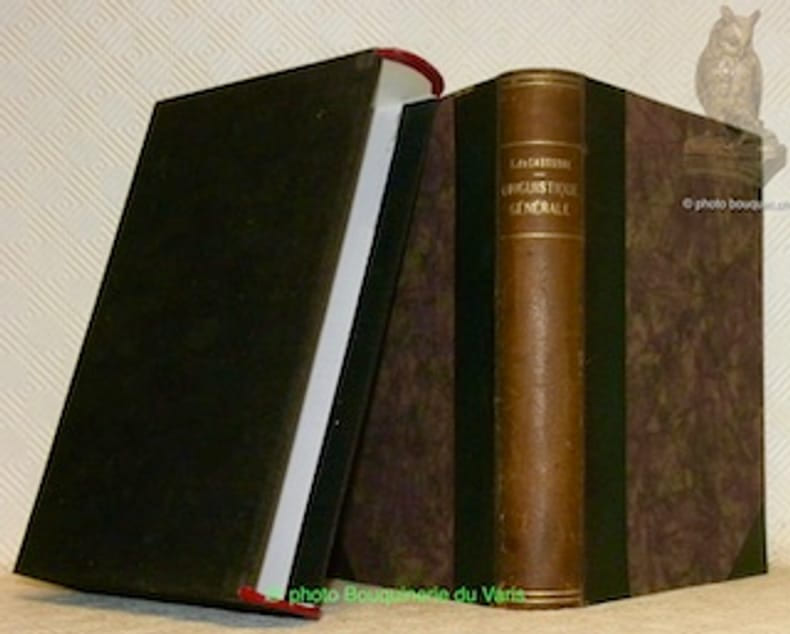
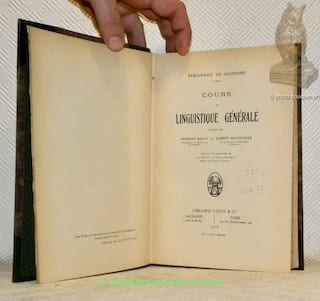
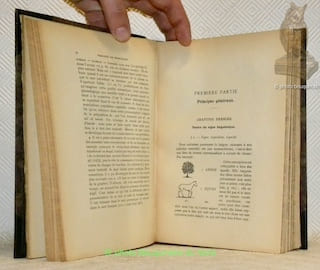
Lausanne - Paris, Librairie Payot & Cie. 1916, 245x170mm, 336pages, reliure demi-chagrin à coins avec titre, auteur et filets dorés au dos. Plats et gardes papier marbré. Tranches marbrées. Sous étuit en velour. Hormis dos insolé (fréquent et casiment inévitable avec ce type de reliure), bel exemplaire, inscriptions manuscrites sur le haut de la page de garde supérieure: “comptes rendus, M(aurice). Grammont RLR 59 p. 402 - 410”.
Reference : 110071
illustrations n/b in texte, avec la page d’errata à la fin de l’ouvrage, Pour un paiement via PayPal, veuillez nous en faire la demande et nous vous enverrons une facture PayPal
Bookseller's contact details
Bouquinerie du Varis
M. Jacquier Julien
Route de Léchelles 36
1773 Russy
Canton de Fribourg Switzerland
41 26 323 23 43
Payment mode


Sale conditions
Nous expédions les livres dès réception de votre paiement. Paiement sous facture PayPal. Virement bancaire ou Cartes de Crédits. Les chèques ne sont pas acceptés. Vous avez la possibilité de nous retourner les livres commandés. Aux conditions suivantes: • Si le titre ne correspond pas à votre commande. • Si l’état du livre ne correspond pas à la description que nous en avons faite. • Si le retour est fait dans les 15 jours. • Si le retour est fait dans le même emballage, comme vous l’avez reçu. • Si le retour est accompagné d’un écrit mentionnant les motifs. Ces conditions étant remplies, nous nous engageons à rembourser au client le prix des livres, sans les frais de port. Uniquement pour la Suisse, possibilité de payer sur facture sous 30 jours dès réception de la commande.
3 book(s) with the same title
Cours de linguistique générale publié par Charles Bally et Albert Sechehaye avec la collaboration de Albert Riedlinger. Edition critique ptéparée par Tullio de Mauro
Paris, Librairie Payot, 1982 gr. in-8vo, 509 p., brochure originale. / Softcover

(SLACES, NVVA)
Phone number : 41 (0)26 3223808
Cours de linguistique générale, publié par Charles Bally et Albert Sechehaye. Avec la collaboration de Albert Riedlinger. Edition critique préparée par Tullio de Mauro.
1949 Paris, Payot, 1968, in 8, broché, 331 pages.
...................... Photos sur demande ...................

Phone number : 04 77 32 63 69
Cours de linguistique générale. Publié par Charles Bally et Albert Sechehaye. Avec la collaboration de Albert Riedlinger. - [FOUNDING STRUCTURAL LINGUISTICS]
Lausanne & Paris, 1916. Lex 8vo. Uncut in the orig. printed wrappers. Minor wear w. minor loss to capitals and corner of front wrapper, otherwise an exceptionally nice copy. A few pages w. underlining. Text-illustrations. 336, (1, -errata) pp.
The first edition of Saussure's seminal main work, which marks a turning point in the history of linguistics and had a monumental impact on related fields such as philosophy, logic, sociology, literary theory, etc. Because of this work, Saussure is considered the father of 20th century linguistics, and the influence of his ideas on the development of linguistic theory in the first half of the 20th century can hardly be overstated.After having published his ""Mémoire sur le système primitif des voyelles dans les langues indo-européenes"" in 1878, Saussure did not publish another full-length work in his life-time, and his ""Course in General Linguistics"" is a summary of the three lecture-courses he gave on linguistics at the University of Geneva in 1906-07, 1908-09 and 1910-11. The work was published posthumously by two of his former students and based on lecture notes. In this monumental work, based on his lectures, Saussure sets out to examine the relationship between language (langue) and speaking (parole), both as the relation of a social phenomenon to an individual phenomenon, and as the relation of a system to the concrete use of this system. He determines that there is a structured system of common signs between the users of a language, and that language can be analyzed as a formal system of elements. These elements are signs, signs that again can be divided into expression (signifiant) and content (signifié). This theory of language has deeply influenced all later theories of language.With this work, Ferdinand Saussure (1857-1913) thus came to occupy a seminal place in the history of language theory. In this work he is strongly focused on creating a science of language, free of its former embedment in archaeology, psychology, and also -or perhaps especially- the history of language. And he succeeds. Before his work, linguistics had had been dominated by a historical, though also partly structural, understanding of language, but now, Saussure introduced and determined the purpose and meaning of linguistics, the universal science of language. With Sausurre, linguistics now became, not only the study of the history of languages and of the influences that determine the development of it, but also, and primarily, the study of language and the study of the manifestations of human speech, of what makes human speech possible.Thus, there is no doubt as to the monumental impact of this groundbreaking work, and almost all language theoreticians ever since have been deeply influenced by it. In Europe, the Prague School with e.g. Roman Jakobson and the Copenhagen School with e.g. Louis Hjelmslev, and in America, Leonard Bloomfield and his followers (later Noam Chomsky), were all influenced by Saussure's theories and based their formings of structural linguistics on his basic notions.Saussure's work reached much farther, though, and the principles of structuralism came to deeply influence thinkers such as Jacques Lacan, Claude Lévi-Strauss etc., etc.