‎Charles Blanc‎
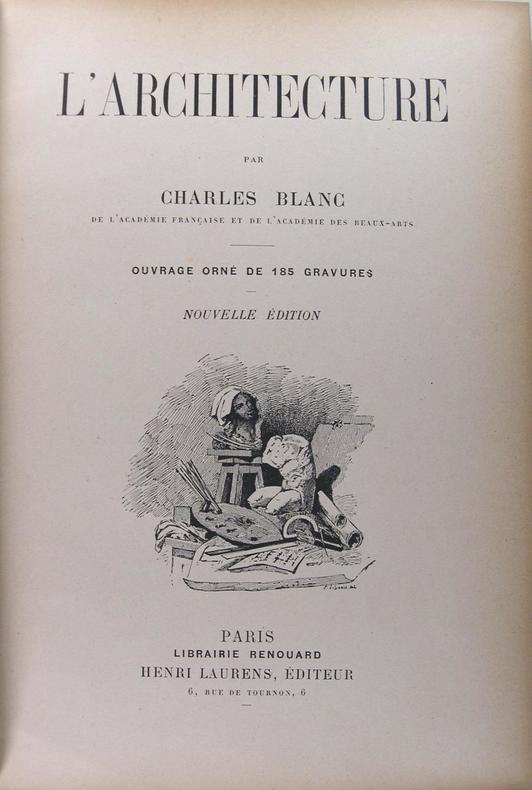
‎L'Architecture.‎

‎ Paris Librairie Renouard, Henri Laurens éditeur, s.d, 1903, petit in/4 en reliure en demi chagrin rouge, 280 pages. Ouvrage orné de 185 gravures, nouvelle édition.‎

Reference : 28423


‎‎

€33.00 (€33.00 )
Bookseller's contact details

Librairie ancienne Philippe Lucas
M. Philippe Lucas
9 Quai de la Pêcherie
69001 Lyon
France

phlucas2@gmail.com

04 78 30 94 84

Contact bookseller

Payment mode
Cheque
Others cards
Others
Sale conditions

Pour nous commander un livre : Notez le numéro de référence. Pour 1kg 5€ en fréquenceo, 2kg 8€ RIB : Sur demande.

Contact bookseller about this book

Enter these characters to validate your form.
*
Send

5 book(s) with the same title

‎[ARCHITECTURE]. ‎

Reference : 240838

‎Lettres patentes du Roi. portant nouveaux statuts & règlemens pour l'Académie royale d'architecture. Données à Versailles au mois de novembre 1775‎

‎Paris, Pierre-Guillaume Simon, 1776 in-4, 12 pp., en feuilles. ‎


‎Fondée en 1671, l'Académie royale d'architecture reçut par ces lettres patentes une nouvelle organisation : elle fut désormais composée de 32 architectes, divisés en deux classes, dont la première a un directeur, un professeur d’architecture et un professeur de mathématiques ; de 10 membres honoraires, associés libres ; et de 12 correspondants ou associés étrangers. Le surintendant des bâtiments continua, comme par le passé, de nommer le secrétaire. perpétuel. - - VENTE PAR CORRESPONDANCE UNIQUEMENT - LIEN DE PAIEMENT, NOUS CONSULTER.‎

Logo SLAM Logo ILAB

Phone number : 06 46 54 64 48

EUR60.00 (€60.00 )

‎PERRET (Jacques)‎

Reference : 215560

‎Des Fortifications et artifices, architecture et perspective. de Iaques Perret gentilhomme savoysien‎

‎S.l. [Paris], s.d. (1620) in-folio, titre-frontispice gravé par Thomas de Leu, [12] ff. n. ch. de texte, avec 22 belles planches à double page gravées sur cuivre par le même Thomas de Leu (plans ou élévations), nombreuses petites réparations de papier angulaires, veau fauve marbré, dos à nerfs cloisonné et fleuronné à l'imitation, pièce de titre cerise, double encadrement de dent-de-rat, triples filets et pointillés dorés avec fleurons d'angle sur les plats, encadrement de guirlande, filets et dent-de-rat dorés sur les contreplats (Samblanx-Weckesser). ‎


‎Troisième édition, rare.Le feuillet de dédicace au Roi, daté du 1er juillet 1620, permet de reconstituer la date : il s'agirait donc de la troisième édition en français (mais la seconde parisienne), après l'originale parisienne de 1601 et la reprise de 1602 à l'adresse de Francfort (contenant 7 planches additionnelles). Une traduction allemande par de Bry parut également, à l'adresse d'Oppenheim, et connut au moins deux éditions.L'ouvrage de cet architecte savoisien aux dates incertaines (vers 1540 - vers 1620), converti au protestantisme vers 1580, forme à la fois une réussite esthétique indéniable, et une surprenante anticipation formelle. Trois thèmes se partagent le texte et les planches : villes fortifiées plus idéales que concrètes ; architecture religieuse ; architecture provée. Une vision d'avant-garde.Perret propose d'abord une série de cinq villes régulières fortifiées composées de différentes bases (allant du carré aux polygones), et inspirées à la fois par les citadelles de Turin et de Milan, et les programmes royaux initiés par Henri IV (places royales parisiennes par exemple). Puis l'auteur s'intéresse à la construction de temples huguenots, dont il propose trois modèles, vision originale que l'on ne trouve ordinairement pas mêlée aux traités de pure fortification militaire. Enfin, il se tourne vers différentes réalisations d'architecture privée : métairies, habitations, châteaux.Paradoxalement, la nouveauté et l'extrême sophistication des dessins a nui à la réception de l'ouvrage, considéré par les spécialistes comme un mixte peu propice à la réalisation concrète. Puis il a été classé dédaigneusement parmi les "curiosités" architecturales, recherchées pour la seule perfection ou joliesse des planches.Il est aujourd'hui considéré comme un ouvrage novateur, à coup sur avant-gardiste eu égard à sa date de parution.Brunet IV, 511-512 (édition de 1601). Jordan 2855 (idem). Marini, pp. 37-38 (donne une première édition de 1594 qui ne semble pas attestée, et qui doit provenir d'une confusion avec la date apposée sur la figure du frontispice représentant le siège de Paris).Cf. Laprade (Jacques de) : Un architecte méconnu du temps d'Henri IV, l'édition originale "Des fortifications et artifices, architecture et perspective" Paris 1601 de Jacques Perret, in : Revue française d'histoire du livre, n° 25, 1979.Bel exemplaire, avec armes des princes de Ligne (d'or à la bande de gueules) poussées au centre des plats.Relié en Belgique vers 1900, par Charles-Philippe de Samblanx (Bruxelles 1855-1943). Ce dernier avait fait son premier apprentissage chez le relieur Coppens, où il entra à l'âge de onze ans. Il passa bientôt chez Pierre Eenhaes, puis chez Dubois d'Enghien, qui l'employa de 1873 à 1876. Au sortir de cet atelier, il alla s'engager chez Josse Schavye ; mais après quelques mois, en 1877, il tenta de s'établir à son compte. Sa tentative ayant échoué, il rentra chez Schavye en qualité de premier ouvrier. Cinq ans plus tard, il s'établit à nouveau, et cette fois définitivement, cela, paraît-il, grâce aux encouragements et à l'aide de l'un de ses premiers clients, le ministre catholique Van den Peereboom. Il alla s'installer rue de Cologne, et les premières reliures qu'il signa portent cette adresse. Dès ses débuts, en 1882, il fit la connaissance de Jacques Weckesser, sujet suisse, encore novice dans le métier, mais bon dessinateur et fort zélé pour l'apprentissage de la dorure. En 1883, il épousa une cousine germaine de ce dernier, et devint ainsi le cousin par alliance de Weckesser, avec qui il s'associa. Samblanx demeura cependant seul titulaire de la firme jusqu'en 1889, date du décès de sa première femme. A partir de cette date, et jusqu'à la fin de l'association, en 1909, les reliures furent signées De Samblanx-Weckesser., ce qui permet donc de dater avec une certaine précision notre reliure. - - VENTE PAR CORRESPONDANCE UNIQUEMENT - LIEN DE PAIEMENT, NOUS CONSULTER.‎

Logo SLAM Logo ILAB

Phone number : 06 46 54 64 48

EUR6,500.00 (€6,500.00 )

‎Kathryn Moore, Hasan-Uddin Khan (eds)‎

Reference : 65110

‎Religious Architecture of Islam. Volume I: Asia and Australia‎

‎, Brepols, 2021 Hardback, 488 pages, Size:220 x 280 mm, Illustrations:300 col., Language: English. ISBN 9782503589350.‎


‎Summary The Religious Architecture of Islam is a wide-ranging multi-author study of the architectural traditions associated with the religion of Islam across the globe. A total of 59 essays by 48 authors are presented across two volumes, Volume 1: Asia and Australia and Volume 2: Africa, Europe, and the Americas. Essays address major themes across historical and contemporary periods of Islam and provide more focused studies of developments unique to specific regions and historical periods. The essays cover Islamic religious architecture broadly defined, including mosques, madrasas, saints' shrines, and funerary architecture. The Religious Architecture of Islam both provides an introduction to the history of Islamic architecture and reflects the most recent scholarship within the field. TABLE OF CONTENTS Hasan-Uddin Khan and Kathryn Blair Moore - Introduction Background Themes Heba Mostafa - Locating the Sacred in Early Islamic Architecture Nezar AlSayyad and ?pek T reli - The Mosque in the Urban Context D. Fairchild Ruggles - Gardens as Places of Piety and Faith Imdat As - Complex Patterns and Three-Dimensional Geometry in Islamic Religious Architecture Matthew Saba and Michael A. Toler - Archives and Archival Documents in the Study of Islamic Religious Architecture West and Central Asia Abeer Hussam Eddin Allahham - The Holy Mosque of Mecca Akel Ismail Kahera - The Mosque of the Prophet at Medina Kathryn Blair Moore - The Dome of the Rock through the Centuries Mattia Guidetti - The Great Mosque of Damascus through the Medieval Period Mattia Guidetti - Early Islam and Byzantine Churches Melanie Michailidis - Early Mosques in Iran and Central Asia Matthew Saba - Funerary Architecture in Iraq under the Abbasids and their Successors, 750-1250 Megan Boomer and Robert Ousterhout - Muslims, Byzantines, and Western Christians on the Haram al-Sharif Stephennie Mulder - Mosques under the Ayyubids Stephennie Mulder - Shrines in the Central Islamic Lands Melanie Michailidis - Shrines and Mausolea in Iran and Central Asia Sheila Blair - The Ilkhanids and their Successors Bernard O'Kane - Religious Architecture of Central Asia under the Timurids and their Successors Farshid Emami - Religious Architecture of Safavid Iran Oya Pancaro?lu - Islamic Architecture in Medieval Anatolia, 1150-1450 Zeynep Y rekli - Three Sufi Shrines under the Ottomans Ali Uzay Peker - Seljuk and Ottoman Mosques Imdat As - Kocatepe: The Unbuilt State Mosque of Turkey James Steele - Regionalist Expressions of the Mosque in the Arabian Peninsula and Middle East South and East Asia Alka Patel - The Sultanates in South Asia, 700-1690 Laura E. Parodi - Mughal Religious Architecture Kamil Khan Mumtaz - Badshahi Masjid, Lahore Kamil Khan Mumtaz - The Architecture of Sufi Shrines in Pakistan Imran bin Tajudeen - Pre-Islamic and Vernacular Elements in the Southeast Asian Mosques of Nusantara Nancy S. Steinhardt - The Mosque in China Hasan-Uddin Khan - The Great Mosque of Xi'an (Qing Zhen Si) Australia Tammy Gaber - New Australian Mosques‎

ERIK TONEN BOOKS - Antwerpen

Phone number : 0032495253566

EUR150.00 (€150.00 )

‎Lex Bosman‎

Reference : 68496

‎Interpreting Architecture, Selected Writings on Architectural History‎

‎, brepols, 2026 Paperback, Pages: 421 pages, Size:216 x 280 mm, Illustrations:65 b/w, 102 col. Language :English, NEW. ISBN 9782503610368.‎


‎ Summary In the broad field of architectural history, many different approaches are possible. The collection of articles in this book covers a variety of themes, with the meanings of architecture as a central theme in most contributions. The articles are grouped into four main themes: Interpreting Architecture, Design and Construction, Spolia and Historiography. The ways in which attention can shift in architectural history are nicely highlighted in this volume. For instance, the ability to interpret architecture in its variety of meanings is not in doubt today, but was a real point of contention in the second half of the 20th century. Apart from as an enclosure of space, architecture in the past could carry diverse meanings, expressed, for instance, through a specific choice of architectural concepts, or through the use of spolia. The different ways in which medieval architecture in particular could be interpreted are the focus of several articles. Thereby, the application of spolia occupies a special place in both meaning-making and interpretation of architecture. The Historiography section analyses various changes in the way medieval architecture was and is studied. TABLE OF CONTENTS Foreword Introduction, by Petra Brouwer and Gabri van Tussenbroek Interpreting Architecture The Sensus Allegoricus of Medieval Buildings, or: Architectural Iconology in Historical Perspective The Past as a Determining Factor in the Architectural Concepts of Li ge Cathedral (Eleventh and Twelfth Centuries) Architecture and Quotation. The Historicity of Buildings from the Past S. Giovanni in Laterano and Medieval Architecture. The Significance of Architectural Quotations The Choir Ambulatory. On the History and Reception of a Type of Ground Plan in Medieval and Post-Medieval Times Design and Construction The Dilemma of Pope Julius II. How to Preserve the Old St Peter?s While Building a New St Peter?s Proportion and Building Material or Theory versus Practice in the Determination of the Module Designing the Villa Pliniana at Lago di Como. Pellegrino Tibaldi and Political Iconography under Habsburg Rule Spolia Spolia in the Fourth-Century Basilica Spolia and Coloured Marble in Sepulchral Monuments in Rome, Florence and Bosco Marengo. Designs by Dosio and Vasari Spolia from Rome?s Past as a Contribution to Roman or Romanesque Architecture The Significance of Tradition. About the Spolia in the Choir Area of Magdeburg Cathedral The Veneration of Spolia. The Madonna della Colonna in St Peter?s in Rome Dutch Colonial Architecture Stabroek in Demerara: The Emergence of the City Plan of Georgetown (Guyana) in the Eighteenth Century From Amsterdam to Berbice. Colonial Administration Buildings as a New Design Task for Abraham van der Hart Government Buildings in the Dutch Colonies (Seventeenth and Eighteenth Centuries) Historiography Dutch Architectural Historians and International Contacts until around 1960 The History of Architectural History in the Netherlands. Medieval Architecture M. D. Ozinga?s Inaugural Lecture (1948). The Origins of Gothic Architecture and the Problem of Period Styles The Invention of Gothic. Abbot Suger since Erwin Panofsky There is no Such Thing as Gothic. The Concept of ?Renewal? as an Art Historical Problem Bibliography of Lex Bosman‎

ERIK TONEN BOOKS - Antwerpen

Phone number : 0032495253566

EUR129.00 (€129.00 )

‎VIOLLET-LE-DUC (Eugène)‎

Reference : 184033

‎Essai sur l'architecture militaire au Moyen Age.. Extrait du Dictionnaire raisonné de l'architecture française du XIe au XVIe siècle‎

‎Paris, Lib. d'Architecture de Bance, 1854 gr. in-8, 236 pp., nbses gravures et plans in-t., demi-veau prune, dos lisse, pointillés dorés et filets à froid (rel. de l'époque). Dos frotté.‎


‎ - - VENTE PAR CORRESPONDANCE UNIQUEMENT - LIEN DE PAIEMENT, NOUS CONSULTER.‎

Logo SLAM Logo ILAB

Phone number : 06 46 54 64 48

EUR230.00 (€230.00 )
Get it on Google Play Get it on AppStore
The item was added to your cart
You have just added :

-

There are/is 0 item(s) in your cart.
Total : €0.00
(without shipping fees)
What can I do with a user account ?

What can I do with a user account ?

  • All your searches are memorised in your history which allows you to find and redo anterior searches.
  • You may manage a list of your favourite, regular searches.
  • Your preferences (language, search parameters, etc.) are memorised.
  • You may send your search results on your e-mail address without having to fill in each time you need it.
  • Get in touch with booksellers, order books and see previous orders.
  • Publish Events related to books.

And much more that you will discover browsing Livre Rare Book !