Write to the booksellers
VIRGILE
Opera omnia
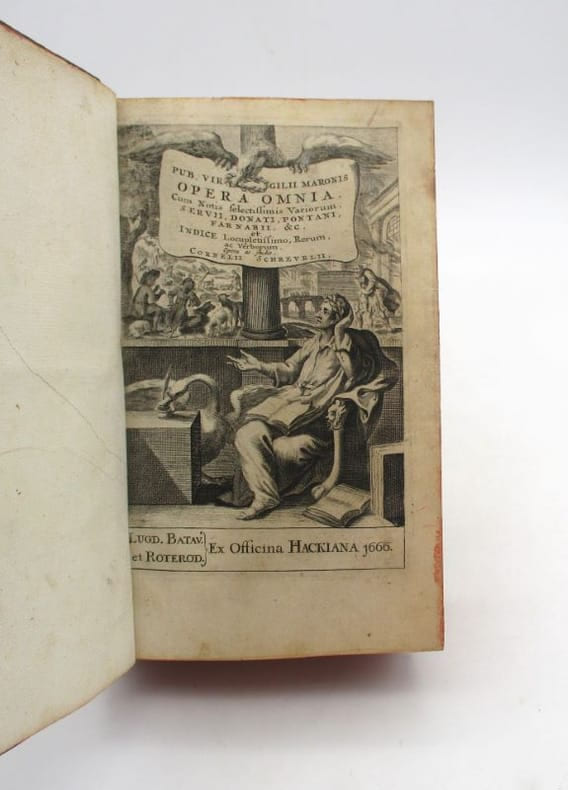
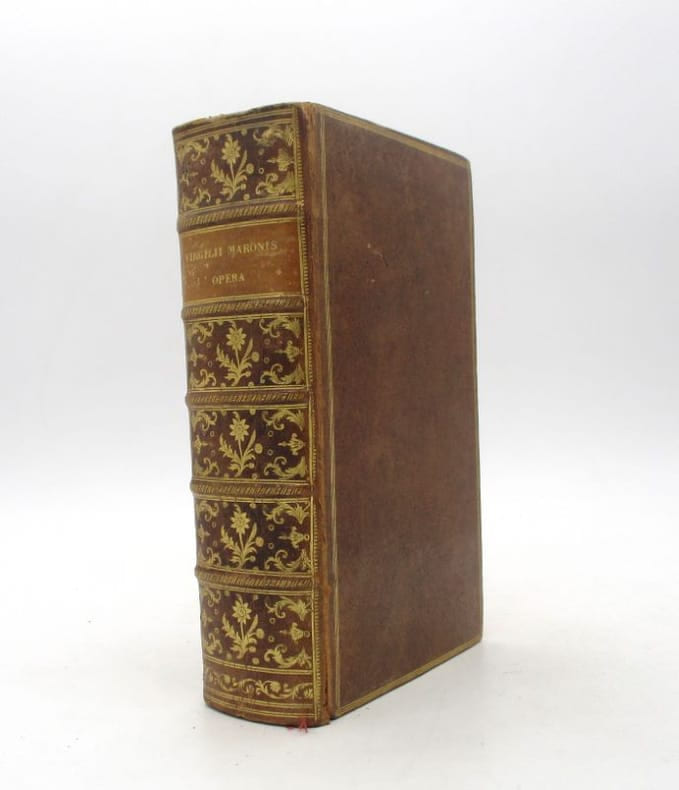
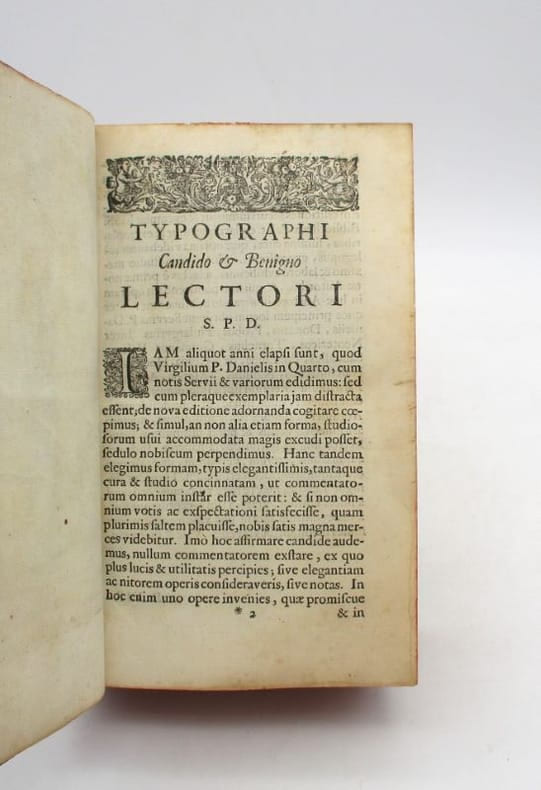
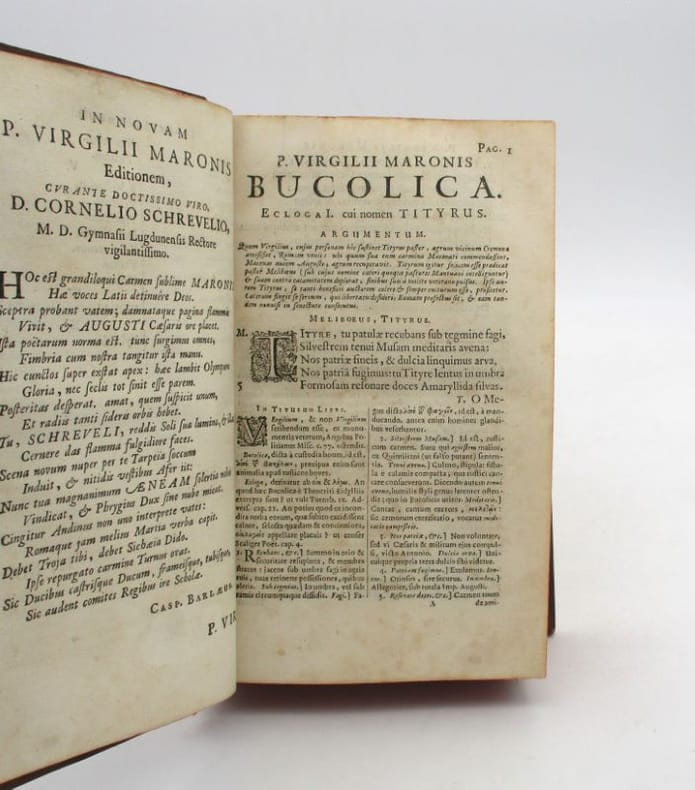
Leyde et Rotterdam, Ex Officina Hackiana, 1666. In-8, [16]-1015-[36] pp., veau moucheté havane, triple filet doré en encadrement sur les plats, dos à nerfs orné de caissons dorés, tranches rouges (petits manques et épidermures, rares rousseurs et taches).
Reference : 20527
Jolie édition hollandaise des oeuvres de Virgile annotée par Cornelius Schrevelius. Elle est ornée d'un titre gravé. * Membre du SLAM et de la LILA / ILAB Member. La librairie est ouverte du lundi au vendredi de 14h à 19h. Merci de nous prévenir avant de passer,certains de nos livres étant entreposés dans une réserve.
Bookseller's contact details
L'Ancienne Librairie
M. Alban Caussé
3 Rue Pierre l'Ermite
75018 Paris
France
librairie.ancienne.paris@gmail.com
09 78 81 38 22
Payment mode


Sale conditions
conforme aux règles du SLAM
5 book(s) with the same title
Platonis opera omnia
Les deux éditions originales des Œuvres de Platon – 1484 et 1491 – sont fort rares et de plus en plus recherchées. Précieux et bel exemplaire complet conservé dans sa reliure de l’époque estampée à froid – condition rarissime – de la seconde originale des Œuvres de Platon achevée d’imprimer le 13 aout 1491. In-folio de (4) ff., 444 ff. à 2 col. de 62 lignes. Veau brun estampé à froid avec inscription à l’encre sur le plat supérieur, dos à nerfs, traces d’usure et gardes renouvelées. Reliure d’époque d’origine. 310 x 216 mm. Platon (428-347). Platonis opera omnia, latine, ex vers. Marsilii Ficiui. Venetiis, per Bern, de Choris de Cremona et Simon de Luero, 1491. Seconde édition originale – rarissime – des Œuvres de Platon achevée d'imprimer le 13 août 1491 conservée dans sa reliure de l'époque. La première fut publiée en 1484. Second edition of the complete works of Plato, in Latin translation by Marsilio Ficino. After the first edition produced twenty-six pages of errata, this edition “pleased Ficino with its typographical correctness” (Ford). The importance of the translation and dissemination of the Platonic dialogues to the transformation of Renaissance thought cannot be overstated. Also included here is the second edition of Ficino’s masterpiece: the Theologia platonica, first printed in 1482, which attempts to harmonize Platonic philosophy with Christian theology in order to create “religion which would join wisdom and faith” (Hankins). Thus, this edition brings together the most important Renaissance interpretation of Platonism alongside its fundamental texts. HC 13063; BMC V 465; BSB-Ink P-569; Bod-inc P-346; IGI 7861; Klebs 785.2; Goff P-772; ISTC ip00772000; Ford BPH 159. “From the Conway edition (p. 17 ff.) we learn that on January 25, 1484 the San Jacopo di Ripoli monastery press signed a contract for 1 025 copies of Plato’s Opera. The edition was funded by Francesco Berlinghieri and Filippo Valori, and was to be printed by Fra Domenico and his chief worker Lorenzo. Printing began on February 8, and by the end of September parts two to five of the five part work were completed. During this period, probably sometime in August, Fra Domenico died, and the responsibility for the project passed to Lorenzo, who had worked his way up from apprentice to full partnership in the press. Because Lorenzo issued the completed work under his name alone, and he went on to become an important printer of humanistic and Greek texts in Florence, the fundamental role of the monastic press of San Jacopo di Ripoli— the first press to employ women— in this project, is often forgotten.The first collected edition of Plato's Dialogues was justifiably a bestseller. Copies were also probably very heavily used, as a high percentage of the roughly 100 extant copies are incomplete. On August 13, 1491 a second edition of Ficino's translation was issued in Venice by Bernardinus de Choris, de Cremona and Simon de Luere, for Andreas Torresanus, probably even more copies of this edition are preserved than the first edition, and notably fewer copies of the 1491 edition are incomplete” (J. Norman). “That Plato should be the first of all the ancient philosophers to be translated and broadcast by the printing press was inevitable… It has been truly said that the germs of all ideas can be found in Plato. Zeno, Epicurus, Plutarch all depended on him… By fifteen century standards, Plato’s edition was a best seller; it is a fame which succeeding ages have not diminished” (PMM). Cette seconde édition originale des Œuvres de Platon est complétée par la seconde édition de l’œuvre principale de Ficin, la Platonica theologia. Marsile Ficin commença la traduction de la philosophie platonicienne en 1463 à la demande et sous la protection de Côme de Médicis. Ce travail fut achevé en 1468. Des manuscrits circulèrent jusqu'à la première édition de 1484, déjà accompagnée du commentaire. L'édition originale de la Platonica theologia avait paru en 1482. Dans cette œuvre majeure, Ficin essaie de prouver l'harmonie entre la théologie chrétienne et la philosophie platonicienne. Cette édition combine les textes les plus importants de la renaissance de l'interprétation platonicienne avec les textes fondamentaux. Cette édition est plus soignée que la première de 1482. Le Quattrocento est une époque où se manifeste un regain d’intérêt considérable pour Platon, comme en témoignent les traductions latines des dialogues platoniciens dues aux humanistes italiens. L’activité de ces humanistes culmine avec l’œuvre de Marsile Ficin, qui publie en 1484 la première traduction de l’ensemble des Œuvres de Platon, agrémentée d’un argumentum pour chaque dialogue. L’histoire des Platonis opera omnia de Ficin commence en septembre 1462, lorsque l’humaniste reçoit de Côme de Médicis un manuscrit contenant tous les dialogues de Platon en grec. Quelques jours plus tard, Amerigo Benci fournit à Ficin un second codex de Platon en grec, mais incomplet. Le 11 janvier 1463, Ficin a déjà traduit neuf dialogues de Platon et, à la mort de Côme de Médicis le 1er août 1464, Ficin en a ajouté un dixième, ainsi qu’un argumentum pour chaque dialogue. En avril 1466, vingt-trois dialogues sont traduits. En 1474 Ficin retourne à son étude de Platon, révise ses traductions jusqu’en 1483, et trouve en la personne de Filippo Valori un mécène pour financer l’impression de son œuvre. Aussi, en janvier 1484, Filippo Valori et Francesco Berlinghieri s’associent avec le frère Domenico da Pistoia et Lorenzo Veneto, afin de tirer 1025 exemplaires de la version ficinienne de Platon à l’imprimerie du couvent bénédictin de San Jacopo di Ripoli. À la fin de l’année, l’editio princeps des Platonis opera omnia sort de presse. Notons au préalable que cette édition de 1484, dont Ficin lui-même ne fut pas satisfait, contient de nombreuses erreurs, qui sont en partie corrigées par les quatorze pages des Emendationes jointes au second volume. La seconde édition originale, publiée à Venise le 13 août 1491, et imprimée par Bernardino de Cori et Simone da Lovere est plus correcte et insère dans le texte les Emendationes de l’édition de 1484. Cette seconde originale de 1491, « plus correcte que la première » se vendait sensiblement plus cher au XIXe siècle selon Brunet : 10 Fr. OR l’exemplaire Boutourlin de l’édition de 1484 et 60 F Or l’exemplaire Brienne-Laire de l’édition de 1491 (Brunet, IV, col 697-698) – Christie’s New York vendait le 23 avril 2021 un exemplaire de l’édition de 1484 pour US$ 1,026,000 en reliure moderne ainsi décrit : « 561 leaves (of 562, without blank [rum]6). Woodcut diagrams (some soiling and spotting, especially at ends, few tiny wormholes at ends ; a number of small marginal paper repairs to corners and closed tears, larger marginal tear from dd2). Modern sienna morocco with c.1510-40 fore-edge decoration of putti on all three edges (fading and the resewin when bound obscure the fore-edge). » Précieux exemplaire de la seconde édition originale, l'un des rarissimes conservé dans sa reliure de l'époque estampée à froid, à grandes marges (310 x 216 mm) pour 277 x 210 mm pour l’exemplaire vendu US$ 1,026,000 de l’édition de 1484.
édition_originale


Reference : albd2f264aba96ca67d
Nencki Marceli. Opera Omnia. 1869 1885 1886 1901. Collection of works. In 2 volumes In German (ask us if in doubt)./Nen
Nencki Marceli. Opera Omnia. 1869 1885 1886 1901. Collection of works. In 2 volumes In German (ask us if in doubt)./Nencki Marceli. Opera Omnia. 1869 1885 1886 1901. Sobranie sochineniy. V 2 tomakh In German. Brunswick Vieweg 1904. 840 and 893c. SKUalbd2f264aba96ca67d.
SUAREZ Francisco S.J. (ANDRE M. & BERTON Carolus, eds.) / NOEL Franciscus S.J.
Reference : R66464
(1856)
Opera omnia (Francisci Suarez). Editio nova [complete in 28 volumes] / Added: Theologiae R.P.Fr. Suarez Summa, seu Compendium (a Francisco Noel) [2 volumes]
Parisiis [Paris] / Petit-Montrouge, apud Ludovicum Vivès / J.-P. Migne 1856-1878 (1963) / 1858 'Opera omnia' complete in 28 volumes: 26 volumes + 2 volumes of indices, text in latin, original 1856-1878-edition (except 'Indices'), Editio nova (second edition, the first of which was printed in 1740-1751 in Venice), 27cm., text printed in 2 columns, all vols. including the compendium are uniformely bound (cart.cover with marbled plates, gilt lettering & decorations on leather spines, marbled endpapers) except for the indices (vols.27-28, anastatic reprint of the Paris 1878-edition: Bruxelles, Culture et civilisation, 1963, 29cm., full cloth), few foxing, small library stamp at titlepages, nice set in a beautiful binding, to which is added: 'Summa seu Compendium' by Fr.Noel (complete in 2 volumes, original Migne-edition of 1858), [Opera omnia: cfr. De Backer & Sommervogel, VII col.1680 no.24, Suarez Franciscus S.J., Grenada 1548 - Lisbon 1617 / Compendium: cfr. De Backer & Sommervogel V col.1793 no.12, Franciscus Noel, Hestrud 1651 -Lille 1729], R66464
Opera omnia. Ex recensione Jo. Augusti Ernesti cum ejusdem notis et clave Ciceroniana [Avec :] Delectus commentariorum in M. T. Ciceronis Opera omnia, ad editionem Jo. Aug. Ernesti accomodatus, ex editione Josephi Oliveti
Londres, R. Priestley, 1819 11 forts vol. in-8, demi-veau havane, dos lisses ornés de filets et guirlandes dorés, ainsi que de fleurons à froid, pièces de titre et de tomaison, tranches marbrées (reliure de l'époque). Dos un peu frottés, rousseurs.
Réimpression de la grande édition de Cicéron donnée par Ernesti (1707-1781) en 1737-1739, et continuellement réimprimée jusqu'au milieu du XIXe siècle.I. Rhetoricum (XXXV-14-[2]-683 pp., avec un portrait-frontispice). - II.-III. Orationes (XV-1578 pp. en numérotation continue). - IV. -V. Epistolae ad diversos (VIII-1072 pp. en numérotation continue). - VI.-VII. Opera philosophica (IV-1119 pp. en numérotation continue). - VIII. Clavis Ciceroniana sive indices rerum et verborum philologico-critici in opera Ciceronis. Accedunt Graeca Ciceronis necessariis observationibus illustrata (483 pp.). - IX.-XI. Delectus commentariorum (XX-675 et 956 pp. en numérotation continue pour les deux derniers volumes).Il arrive que soient joints à cette série les trois volumes du Lexicon Ciceronianum Marii Nizolii (même adresse, même date), mais nous ne les avons pas.Brunet II, 12-13. - - VENTE PAR CORRESPONDANCE UNIQUEMENT - LIEN DE PAIEMENT, NOUS CONSULTER.
Actii Sinceri Sannazarii Patricii Neapolitani Opera omnia, latine scripta, ex secundis curis J. Broukhusii. Accedunt Gabrielis Altilii, Danielis Cereti, & fratrum Amaltheorum carmina; vitae Sannazarianae, & notae Petri Vlamingii.
Amsterdam (Amstelaedami), Apud viduam Gerardi onder den Linden, 1728.
8vo. (II),(XVI),(II errata),632,(20 index & errata) p., frontispiece, 1 engraved plate, 1 text engraving. Green vellum. 20 cm (Ref: STCN ppn 189042265; Brunet 5,127: 'Bonne édition'; Graesse 6/1,265; Ebert 20263) (Details: This book has 2 different title pages. This anomaly tell us about a publisher's death, and the efforts of his widow to continue the firm. The very first title, bound before the frontispiece, is printed in black, has no printer's mark, and shows the impressum: 'Amstelaedami, Apud Gerardum Onder de Linden, 1727'. The second title, bound after the frontispiece, is printed in red and black, has a printer's mark, but is now dated 1728, and published 'apud Viduam Gerardi Onder de Linden'. Gerard Onder de Linden died in 1727, leaving Vlaming's Opera edition of Sannazarius unfinished. In the 'Boekzaal der geleerde waerelt' volume 25, of december 1727, the public was informed that the widow, who hoped to continue the business with the help of God, was planning to publish the Sannazarius' edition soon. ('De Weduwe Gerard Onder de Linden, (die in afwagtinge van Godts hulp met hare winkel enz., in alles zal continueren), zal in 't kort uitgeven 'Actii Sinceri Sannazarii ... Opera') We couldnot find in the STCN, and KVK, any copy of Vlaming's edition dated 1727. The title page of 1727 was apparantly removed in most copies. In the mean time the widow had apparantly decided to print a more posh red-and-black title adorned with a printer's mark. She added also a nice frontispiece with her name on it, designed and executed by 2 wellknown Dutch artists. She did so in cooperation with the Amsterdam printer Hermannus Uytwerf, who brought copies on the market with his own imprint. The rest is identical. Vellum dyed green. Back with 5 raised bands, and a red morocco shield in the second compartment. Edges dyed red. The frontispiece, designed by J. Goeree and executed by J. Houbraken, depicts a bare-breasted Fama holding in her right hand her trumpet and a shield with the portrait of Sannazarius; on the shield his name: Actius Sincerus Sannazarius; under the left arm of Fame rests a scroll with the table of contents. Printer's mark on the title, depicting Fama flying above symbols of wisdom, and blowing her trumpet. The motto is derived from Martial X,2,12 and reads: 'Non norunt haec monumenta mori', 'These monuments donot know how to die'. Text engraving on page 491, at the beginning of a biography of Sannazarius by Joannes Antonius Vulpius; depicted are both sides of a bronze medallion, on the recto the portrait of Sannazarius and on the verso a scene with the birth of Christ, referring to Sannazarius' 'De partu Virginis'. At p. 526 has been inserted a full page engraving of the 'Sannazaro Monument', in the church 'Santa Maria de Parto', a church built on the initiative of Sannazarius, on a piece of land donated by king Frederick (Frederigo) of Aragon. The mausoleum, erected in 1537, is a highlight of Napolitan Renaissance art. It was probably made after a design by Sannazarius himself) (Condition: Binding scuffed, and worn at the extremes. Head and tail of the spine chafed. Corners bumped & slightly creased. Both joints splitting, but strong. An old ink insciption on the 1728 title has been wiped out, resulting in some stains. Paper yellowing) (Note: The Italian and Neo-latin poet Jacopo Sannazaro, 1458 -1530, in Latin Jacobus Sannazarius, also known as Actius Sincerus, was of noble birth, and a courtier at the court of the royal House of Aragon, kings of Naples. Here he found a humanist atmosphere favourable for the development of his talents. The humanist Giovanni Gioviano Pontano, 1426-1503, advisor and chancellor of the Aragonese dynasty, became his intellectual mentor. He took his young student in his Academy, the 'Accademia Pontaniana', under the name of 'Actius Sincerus'. There he deeply influenced his pupil's philological approach to antiquity and his knowledge of classical culture. After Pontanus' death Sannazarius became the head of this Academy. Sannazarius' masterwork 'Arcadia', written in Italian, exercised a great influence on European poetry, instituting the theme of the idyllic land Arcadia. After having written the 'Arcadia' in vernacular, Sannazarius devoted the last decades of his literary activity exclusively to Neo-Latin poetry, modelled on Vergil. In the normative 'Tati Renaissance Library' Sannazarius is advertised as 'the finest Neo-Latin poet of the Italian Renaissance'. His 'corpus' of Latin poetry, written in an elegant style, was small but nevertheless very influential and widely read. We counted in KVK ca. 30 editions of his 'Opera Omnia' printed before 1730, the first of which was published by Aldus in 1535. His 'De partu Virginis', an epic of ca. 1450 verses, published in 1526, brought him the title of the 'Christian Vergil'. His style is said to be equal to Vergil, with whom he emulated. In his other works he also emulated with Ovid and Horace. In this edition of 1728 we find in the first half Sannazaro's poetry; the collection opens with: 'De partu Virginis', a poem which Erasmus is said to have liked, though he found this poem on the birth of Christ too secular. Follows a short 'De morte Christi Domini ad mortales lamentatio', then 6 'Eclogae', which renewed the bucolic genre, the traditional shepherds of Virgil being replaced here by fishermen. Follow 3 books of Sannazarius' 'Elegiae', and 3 books of 'Epigrammata'. The section on Sannazaro ends with a number of 'Carmina de Sannazario et ad Sannazarium'. The second half of the book contains the short 'Epithalamium' of Gabriel Altilius, called 'Sannazarii sodalis', and the even shorter 'Salix' of Daniel Ceretus. The greater part of the second half is filled with the 'Carmina' of the brothers Hieronymus, Jo. Baptista and Cornelius Amaltheus (Jeronimo, born 1507, Giambatista, born 1525, and Cornelio Amaltheo) together 175 pages, edited previously in 1689 by J. Graevius under the title 'Trium fratrum Amaltheorum Carmina'. Graevius' preface is also repeated here. All 3 brothers were skilled and highly appreciated neo-latin poets. Hieronymus so excelled in Latin poetry that he is placed by the French humanist Muretus, 1526-1585, among the most talented poets. Giambatista's Latin poems gave him a reputation equal to his brother. After this section follows a biography of Sannazarius written by the Italian classical scholar Giovanni Antonio Volpi, 1686-1766, in Latin Johannes Antonius Vulpius. After the biography we find on 54 pages a collection of select 'testimonia' concerning Sannazarius. The book concludes with 50 pages filled with the notes of the Dutch scholar Pieter Vlaming, 1686-1733. Vlaming, a minor poet, had a life long interest in Sannazarius. In 1710 he began with his translation into Dutch of the 'Arcadia', and he later produced the notes (in Latin) to the present edition of the Latin poems of Sannazaro, edited by the Dutch scholar Janus Broukhusius. In the introduction to this 1728 edition, written by Vlaming, he tells about his interest in Sannazarius: 'ab ineunte aetate, imo pene puer, unice semper sum admiratus, maturiore hac mea, veneror, suspicio, & colo'. (p. *6 recto) Vlaming's edition still has great value, for the Dutch researcher Corine Flinterman proves in her master paper 'In vergetelheid geraakte epigrammen van Iacopo Sannazaro' (Amsterdam 2013), that the latest edition of Sannazaro's Latin works, 'Jacopo Sannazaro. Latin Poetry,' by Michael C.J. Putnam (Cambridge Massachusetts, 2009, The I Tatti Renaissance Library 38), suffers from many omissions and mistakes. A sad thing, because Putnam's work is considered an authorative point of reference for experts in Renaissance studies. Putnam based his sloppy edition, Flinterman reveals, on some incomplete 18th century italian editions, which lacked 13 anti-papal epigrams. This title of 1728 seems to be rare, for in American Exchange we found only 2 copies, both auctioned by Sothebys, in 1952 and in 1959) (Collation: pi1 (title 1727), 2pi2, *8 (minus the leaves *1 & *2), chi1 (errata), A-2S8 (minus the blank leaves 2S7 and 2S8; plate bound after p. 526) The STCN copy doesnot have the 1727 title, nor the errata leaf at the end of the preliminaries. This errata leaf is almost identical to the errata leaf at the end)) (Photographs on request)