 Write to the booksellers
MONTAIGNE (Michel de)
Les Essais
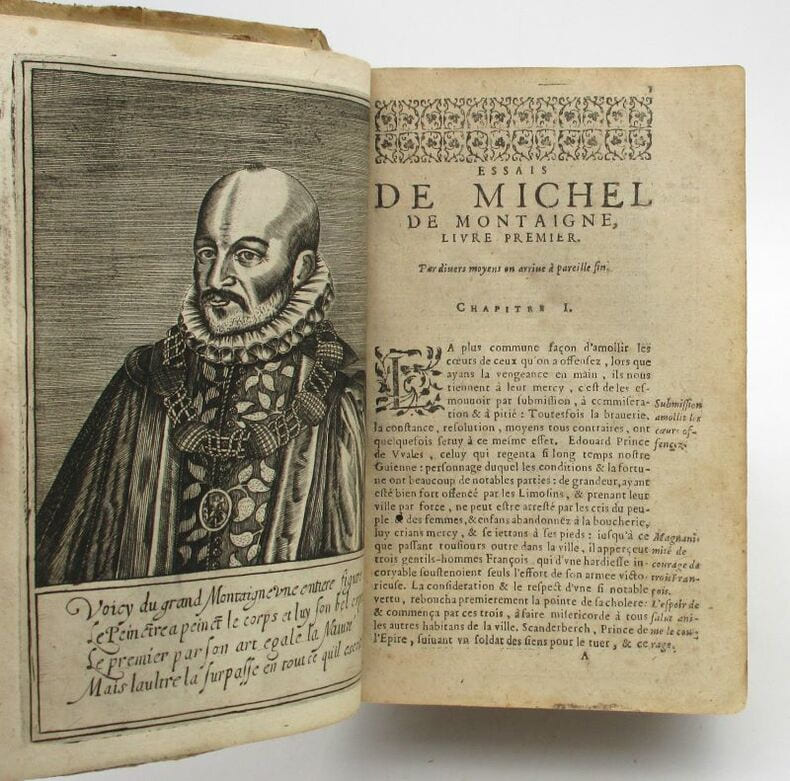
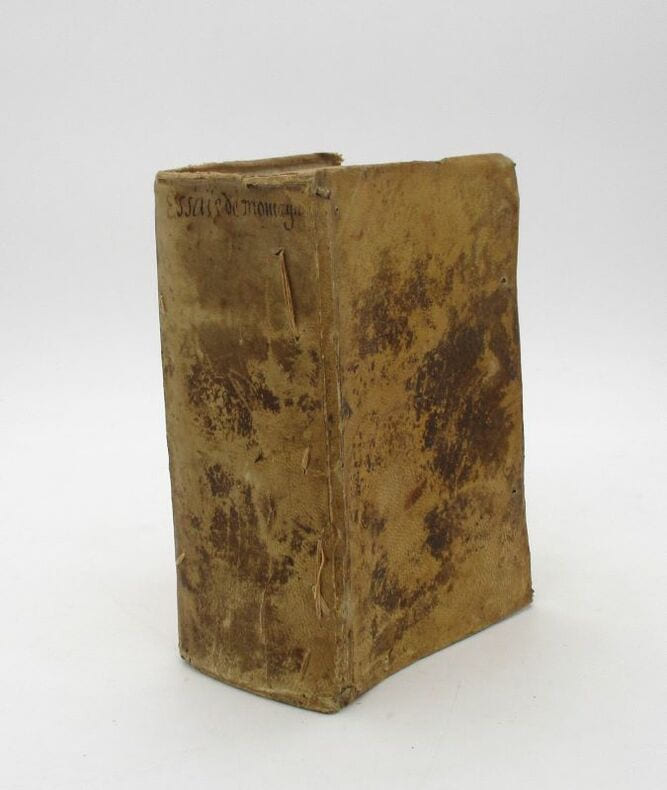
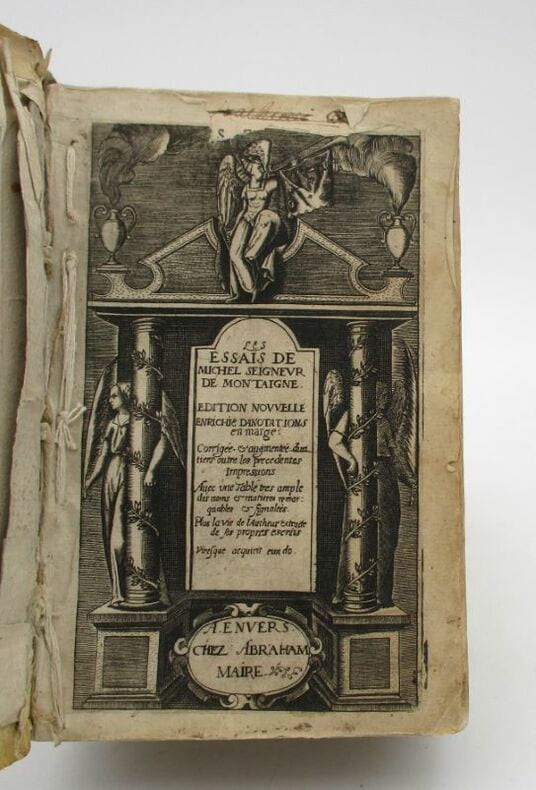
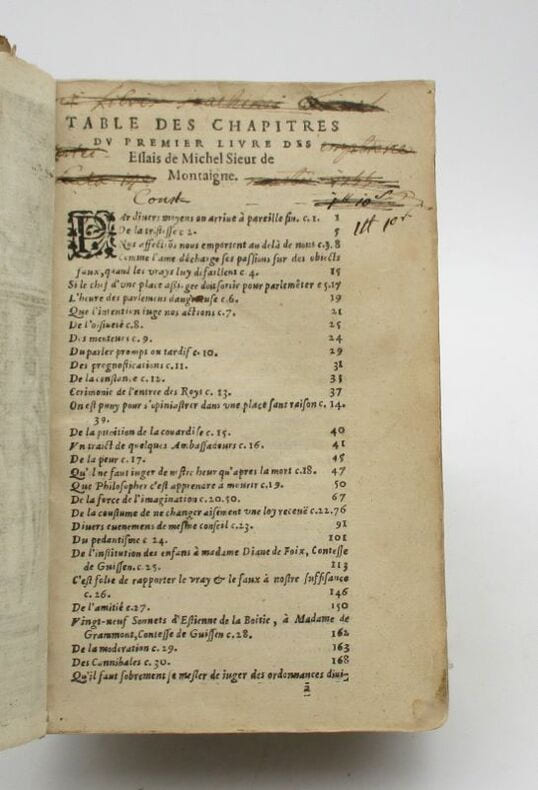
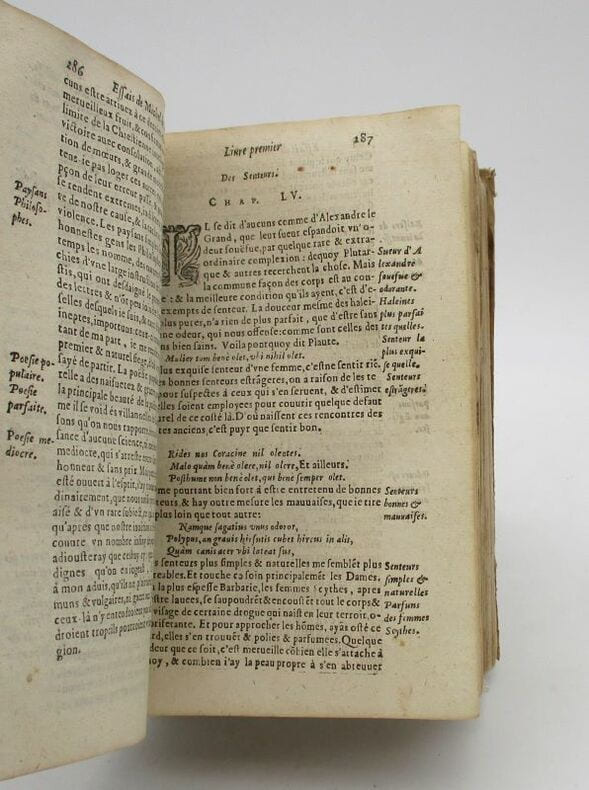
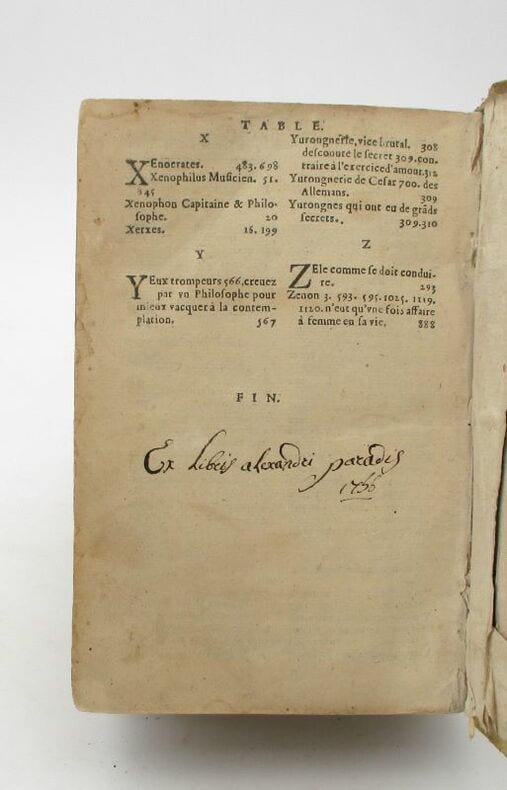
Anvers, chez Abraham Maire, s.d. [1649 ?] Petit in-8, [10]-1129-[37] pp. 1 pl., parchemin souple de l'époque, titre manuscrit au dos ( petits manques, liens manquants, taches, rebroché, manque et quelques petites déchirures au titre, annotations biffées à la table des chapitres, trous de ver).
Reference : 17456
Nouvelle édition des Essais de Montaigne. Elle est ornée d'un titre-frontispice gravé par Edme Charpy et d'un portrait de l'auteur par Thomas de Leu repris de l'édition parisienne partagée de 1608. Payen date la présente édition de 1649. Elle ne comprend pas la préface de Montaigne, ni celle de Gournay mais elle contient un "Sommaire discours sur la vie de Michel, Seigneur de Montaigne, extrait de ses propres écrits". Ex-libris Alexandre Paradis, 1756. Tchemerzine, VIII, 414; Brunet, III, 1837; Payen, 30. Voir photographie(s) / See picture(s) * Membre du SLAM et de la LILA / ILAB Member. La librairie est ouverte du lundi au vendredi de 14h à 19h. Merci de nous prévenir avant de passer,certains de nos livres étant entreposés dans une réserve.
Bookseller's contact details
L'Ancienne Librairie
M. Alban Caussé
3 Rue Pierre l'Ermite
75018 Paris
France
librairie.ancienne.paris@gmail.com
09 78 81 38 22
Payment mode


Sale conditions
conforme aux règles du SLAM
5 book(s) with the same title
Les Essais de Michel de Montaigne, nouvelle édition enrichie et augmentée aux marges du nom des autheurs qui y sont citez avec les versions des passages grecs, latins et italiens.
Paris : Christophe Journel (tome I) ; Rondet, Journel, Chevillon (tome II et III), 1659 (tome I) ; 1669 (tome II et III). INFLUENTE ÉDITION DES ESSAIS AUX ARMES DE JEAN LE CAMUS
3 vol. in-12° (150 x 92 mm) [32] ff. - 556 pp. - [14] ff. + [1] f. - 827 pp. - [15]ff. + [1] f. - 610 pp. - [17] ff., veau blond, dos à 5 nerfs orné, armes sur les plats, roulette sur les coupes, tranches rouges (reliure de l'époque). Entrepris en 1572, continués et remaniés jusqu'à sa mort, les Essais de Michel de Montaigne constituent l'un des monuments de la littérature française. On compte, parmi ceux qu'inspirèrent ce singulier projet d'une description de la condition humaine à travers un récit intimiste, Pascal, Nietzsche, ou encore Shakespeare. Le texte de la présente édition, augmenté de traductions et des noms des auteurs cités, fut repris par Foppens à Bruxelles la même année. Elle est bien complète des titres gravés, au portrait de l'auteur et à sa devise « Que scay-je », par Nicolas de Larmessin. Elle comprend la préface de Marie de Gournay ainsi que la dédicace au cardinal de Richelieu. Comme parfois, les tomes 2 et 3 sont à la date de 1669. Les éditions anciennes des Essais aux armes sont rares. Michel de Montaigne (1533-1592), magistrat bordelais puis maire de Bordeaux, est l'auteur des Essais, entrepris en 1572 et remaniés jusqu'à sa mort. Moraliste et humaniste de la Renaissance, il y invente un genre nouveau, où il se prend lui-même pour matière afin d'interroger la condition humaine, dans un esprit nourri de scepticisme. Provenance : Jean Le Camus (1637-1710) d'après OHR, frère cadet d'Etienne, évêque de Grenoble. Il fut successivement conseiller à la Cour des Aides, maître des requêtes, intendant d'Auvergne et lieutenant civil au Châtelet de Paris. Bibliographie : OHR - 2199; Tchemerzine - VIII, 439. Habiles restaurations anciennes à une coiffe et à plusieurs coins. Frottements, notamment sur les nerfs. Vol. 1: quelques petites taches noires sur les plats. Petit manque marginal sans atteinte au texte aux pp. 389-90, quelques indications marginales au crayon rouge; vol. 2: petite greffe ancienne en tête du plat supérieur. Les pp. 504-505 manquent à la numérotation sans manque au texte. Vol. 3: amas de petites taches ponctiformes en gouttière sur le plat supérieur.


NOTES SUR LES HÉLICES AÉRIENNES : ÉTUDE TECHNIQUE, TRACÉ, CONSTRUCTION, ESSAIS - 1911
Paris H. Dunod et E. Pinat 1911 in-8 bradel pleine percale un volume, reliure bradel pleine percale vert-foncé éditeur in-octavo (hard-back percale editor)(22 x 14 cm), cartonnage éditeur (hard-back editor) à plaques spéciales monochromes pour le dos et le 1er plat (with specials covers editor for the spine and the cover), dos long (spine without raised bands) titre frappé or (gilt title), premier plat titré "or" (plaque spéciale Editeur), toutes tranches lisses, abondamment illustré (plentifully illustrated) de 95 figures in et hors-texte en noir, XXI + 301 pages,1911 Paris H. Dunod et E. Pinat Editeurs,
AU SOMMAIRE : Préface (p.r15) - Avant-propos (p.r19)-Première partie. Étude technique (p.1)- Chapitre I (p.1)- Hélice géométrique (p.1)- Surface hélicoïdale (p.3)-Aile de propulseur hélicoïdal (p.5)-Chapitre II (p.9)-Notations (p.9)-Résistance à la pénétration du bord de l'aile (p.11)- Influence du frottement de l'air (p.19)-Influence de l'inertie et de la force centrifuge sur l'air (p.23)-Vitesse de rotation de l'hélice (p.26)-Chapitre III (p.31)-Recul. Rendement. Rendement maximum (p.31)-Rapport de la poussée à la traînée (p.37)- Angle d'attaque optimum. Conditions optima (p.40)-Module. Variations du pas le long du rayon (p.51)-Variations du recul le long du rayon (p.53)- Chapitre IV (p.59)-Influence de l'angle d'attaque et de l'angle d'inclinaison sur le rendement (p.59)-Rendement de construction. Rendement d'appropriation (p.69)-Influence du vent sur le fonctionnement de l'hélice (p.72)- Chapitre V (p.76)- Poussée et traînée d'une section. Poussée totale et traînée totale pour une aile (p.76)-Surfaces équiactives. Détermination de A (p.77)-Rayon moyen. Poussée totale. Conditions de possibilité (p.79)-Calcul de la surface. Principales dimensions (p.84)- Résistance de l'hélice aux efforts de traction et de flexion (p.86)-Détermination des autres dimensions principales (p.91)- Application de cette méthode de calcul (p.95)-Chapitre VI (p.107)-Efficacité de Renard ; Efficacité de Wellner; Puissance (p.107)-Hélices semblables (p.113)-Qualité des ailes (p.114)-Expressions de [P1] et [T] en fonction de n et de d (p.116)-Deuxième partie. Tracé de l'hélice (p.123)-Chapitre I (p.123)-Tracé (p.123)-Forme longitudinale de l'ailette (p.125)-Forme des sections (p.134)-Nombre des ailes (p.137)-Chapitre II (p.146)-Épures de quelques-unes des principales hélices connues (p.146)- Hélice « Intégrale » de L. Chauvière (p.146)- Hélice « L. E. » de Lioré (p.148)-Hélice « Levasseur » (p.150)-Hélice « Normale » de Ratmanoff (p.152)-Hélice « Perfect » de Fougeron (p.155)-Hélice « Perfecta » de L. George (p.155)-Hélice « Progressive » de Passerat et Radiguet (p.157)-Hélice « Rapid » de B. Montet (p.159)-Hélice « Rationnelle » de L. Pelliat (p.161)-Chapitre III (p.164)- Tracé d'une hélice à construire. Exemple (p.164)-Troisième partie. Construction (p.171)-Chapitre I (p.171)- Fabrication des hélices métalliques (p.171)-Fabrication des hélices en bois (p.172)-Procédé monobloc (p.174)-Procédé en superposés (p.177)-Chapitre II (p.181)-Des bois à employer (p.181)- Les colles, l'insolubilisation, le collage (p.187)-Entoilage, toiles à employer (p.191)-Vernissage, laquage (p.193)-Chapitre III (p.196)-Effets gyroscopiques ; Équilibrage ; Rôle comme volant (p.196)-Chapitre IV (p.206)-Fabrication de quelques-unes des hélices les plus connues (p.206)- Hélice « Intégrale » de L. Chauvière (p.206)-Hélice « Normale » de Ratmanoff. Licence Drzewiecki (p.220)-Autres hélices (p.232)-Quatrième partie. Essais (p.236)- Chapitre I (p.236)-Recul en plein vol (p.236)-Essais au point fixe (p.237)-Méthode du tunnel (p.248)- Essais sur l'hélice en mouvement (p.253)- Chapitre II. Résultats d'essais (p.262)-Essais au point fixe (p.262)-Essais du Conservatoire des Arts et Métiers, par M. Boyer-Guillon (p.262)-Essais comparatifs d'une « Intégrale » et d'une « Perfect » de modèle réduit (p.264)-Essais des hélices « Intégrales » (p.265)-Essais d'une hélice « Normale ». Proportions usuelles (p.267)- Essai d'une hélice « Perfecta » (p.271)-Essai d'une hélice « Progressive » (p.271)-Essais d'hélices « Rationnelles », « Tellier », « Levasseur », « Lioré », « Rapid » (p.273)-Essais de MM. Lumet et Auclair (p.274)-Essais sur l'hélice en marche (p.275)-Essais du capitaine Dorand à Chalais-Meudon (p.275)-Essais de M. Legrand et de M. Gaudart (p.280)-Appendice (p.287)-Études récentes de M. Drzewiecki (p.287)-Aperçus nouveaux sur notre théorie (p.288)-Exemple (p.292)-Table des matières (p.297) ........ bel exemplaire ......... RARE .... en trés bon état (very good condition). en trés bon état
Les Essais - Journal
Exceptionnelle réunion, en très belle reliure homogène en maroquin du temps, de l'édition originale in-4 du Journal de Montaigne et de la première édition complète des Essais. 2 ouvrages en 4 volumes in-4 de : I/ (1) f. pour le portrait, (2) ff., XV pp., (4) ff., 363 pp., (6) ff., XVIII pp., (1) f. bl., (1) f., 95 pp. ; II/ 538 pp., (8) ff. de table. ; III/ (1) f.,411 pp., (12) pp. de table ; IV/ (1) f. pour le portrait, (4) ff., LIV et 416 pp. Maroquin bleu nuit, triple filet or encadrant les plats, dos lisses richement ornés, pièces de titre et de tomaison en maroquin rouge, double filet or sur les coupes, roulette intérieure dorée, tranches dorées. Reliure de l'époque. 289 x 230 mm. Montaigne, Michel de. Les Essais de Michel, Seigneur de Montaigne. Nouvelle édition, Faite sur les plus anciennes & les plus correctes : augmentée de quelques Lettres de l’Auteur… & de nouveaux Indices plus amples & plus utiles que ceux qui avoient paru jusqu’ici. Par Pierre Coste. Londres, J. Tonson & J. Watts, 1724. Suivi de : Montaigne, Michel de. Journal du voyage de Michel de Montaigne en Italie, par la suisse & l’Allemagne, en 1580 & 1581 ; Avec des Note sâr M. de Querlon. Rome et se trouve à Paris, Le Jay, 1774. Exceptionnelle réunion, en très belle reliure homogène en maroquin du temps, de l’édition originale in-4 du Journal de Montaigne et de la première édition complète des Essais. I/ Édition originale in-4 du « Journal » de Montaigne. Tchemerzine, IV, 914 ; Bibliotheca Desaniana, n°111. « Édition parue presque en même temps que l’édition in-12 » (Tchemerzine). « Le manuscrit original a disparu peu de temps après sa découverte et l’édition de 1774 représente donc aujourd’hui le seul texte « original » à notre disposition. Cette première édition du Journal de voyage, qui est dédiée à Buffon, fut publiée en trois formats différents, tous imprimés à quelques semaines d’intervalle : in-12 en 2 volumes, in-4 en 1 volume et in-12 en 3 volumes. En accord avec le goût bibliophilique du XVIIIème siècle, le format in-4 est considéré comme le plus désirable et la plupart des exemplaires connus dans ce format sont en veau blond raciné ou moucheté avec des dos ornés et dorés « (Philippe Desan). II/ Première édition complète des « Essais » de Montaigne. Tchemerzine, IV, 909 ; Brunet, III, 1838-1839 ; Bibliotheca Desaniana, n°95 ; Catalogue André Pottiée-Sperry, n°19 ; Lowndes, III, 1588 ; Graesse, IV, 580. « L’une des plus belles et des meilleures de Montaigne, la première qu’ait donnée Pierre Coste » (Tchemerzine). « La remarquable édition de Pierre Coste » (A. Pottiée-Sperry). Exemplaire bien complet du supplément relié dans le tome I. « La plus belle édition que l’on eut de Montaigne » (Graesse). « Première édition non tronquée des « Essais » depuis leur mise à l’Index en 1676. Protestant réfugié à Londres, Pierre Coste (1668-1747) avait déjà publié de courts extraits des « Essais » en 1708. Il édita ce qu’il est permis de considérer comme la première édition des œuvres de Montaigne. En effet, pour la première fois, des lettres de Montaigne (au nombre de sept) sont incluses dans cette édition des « Essais ». Huit nouvelles éditions élaborées à partir de son texte seront publiées après son décès survenu en 1747. Coste dit avoir suivi l’édition L’Angelier de 1595 et a joint des notes explicatives qui font de cette édition une véritable édition critique » (Bibliotheca Desaniana). « Les admirateurs de Montaigne conserveront toujours une grande reconnaissance pour les travaux de Coste ; ses éditions généralement bonnes, ses notes trop prolixes peut-être, mais exactes, ses traductions ont popularisé les Essais, et les ont rendus accessibles à une classe nombreuse de lecteurs » (Payen, n°38 et 39). Les éditions anciennes des « Essais » de Montaigne en maroquin de l’époque ont de tout temps été recherchées. Superbe et précieux exemplaire, grand de marges (hauteur : 289 mm), sur grand papier, conservé dans son maroquin bleu nuit de l’époque. L’exemplaire répertorié par Philippe Desan mesurait 283 mm de haut et l’exemplaire répertorié par André Pottiée-Sperry : 285 mm. Tchemerzine ne cite que 3 exemplaires, tous reliés en veau ancien : « Bénard, 4000 frs ; Roussel, 1300 frs ; De Backer, 3650 fr. ». Exceptionnelle réunion des Essais et du Journal de Montaigne conservés dans leur reliure homogène en superbe maroquin bleu nuit du temps.
édition_originale
Essais
“In 1588 a new edition of the Essais, the last published in the author’s life time, included a third volume, and this became the definitive text on which all later editions are based” (PMM). Les Essais de Montaigne de 1588 conservés dans leur reliure du XVIIe siècle. Paris, 1588. In-4 de (4) ff. y compris le titre-frontispice et 504 ff. (mal chiff. 496). Basane havane, dos à nerfs orné de fleurons dorés, coupes décorées, tranches mouchetées, anciennes restaurations d’usage. Reliure du XVIIe siècle. 236 x 188 mm. Montaigne, Michel Eyquem de. Essais. Cinquiesme édition, augmentée d'un troisième livre et de six cens additions aux deux premiers. Paris, Abel l'Angelier, 1588. Dernière édition publiée du vivant de Montaigne, avec le 3è livre en édition originale et les importantes corrections qu’il a apportées aux deux premiers. Tchemerzine, IV, 873 ; Sayce, 4 ; Philippe Desan, Bibliotheca Desaniana, 14 ; Le Petit, 101 ; Picot, Catalogue du baron James d erothschild, n°140 ; Catalogue du baron Ruble, n°63 ; Bulletin Morgand et Fatout, n°9937 ; En Français dans le texte, n°73 ; PMM, n°95. « In 1588 a new edition of the Essais, the last published in the author’s life time, included a third volume, and this became the definitive text on which all later editions are based” (PMM). Elle « donne le dernier texte dont Montaigne ait arrêté la rédaction d’une façon définitive » (R. Dezeimeris, Recherches sur… les Essais) … avant les corrections de Mademoiselle de Gournay, la fille d’alliance de Montaigne, qui l’orienta vers une interprétation teintée de stoïcisme chrétien. « Augmentée d’un troisième livre avec plus de 600 additions aux deux premiers livres, cette « cinquiesme » édition des Essais – en comptant la célèbre « édition manquante » (édition de 1587)- possède 30 % de signes supplémentaires par rapport à l’édition de 1582. Abel L’Angelier figure parmi les plus grands imprimeurs-éditeurs parisiens de la fin du XVIème siècle et la publication des essais chez cet éditeur donne à Montaigne ses lettres de noblesse en tant qu’auteur. Si Montaigne n’ajoute que 13 % de texte aux deux premiers livres, par contre le troisième représente à lui seul plus de 75 % des additions rédigées entre 1580 et 1588 avec presque 100 000 mots dans l’édition de 1588. Le format, plus grand que l’in-4 habituel de L’Angelier, donne au livre de Montaigne un certain prestige. La plupart des exemplaire sont été habillés de maroquin au XIXe siècle » (Philippe Desan). Les livres I et II ne comprennent pas moins de 641 additions importantes. Le livre III qui paraît ici pour la première fois développe sa philosophie laissée jusqu'ici au stade embryonnaire par les publications des deux premiers livres et donne tout son sens à l'œuvre. « En 1588, Les Essais font l’objet d’une nouvelle édition, entièrement revue et corrigée, augmentée du troisième Livre. Montaigne devait conserver jusqu’à sa mort un exemplaire de cette édition qu’il surchargera de remarques diverses, réflexions et citations ; Pierre de Brach et Marie de Gournay, la « file d’alliance » de l’auteur, établirent l’édition posthume de 1595 à partir de celui-là. Aux deux premiers Livres, garants du succès originel de Montaigne, vint s’adjoindre, en 1588, une troisième pièce ; l’approche plus rigoureusement personnelle, plus intimiste de celle-ci devait assurer, mieux que tout, la pérennité des Essais » (Francis Pottiée-Sperry, En Français dans le texte). Les trois éditions importantes des Essais sont celle de 1580, dans laquelle apparaissent les deux premiers livres, celle-ci qui présente le troisième livre en édition originale et enfin, dans une moindre mesure, l’édition de 1595. Précieux exemplaire en reliure du XVIIe siècle, condition rare.
Les Essais
Précieuse et plaisante édition des Essais du XVIIe siècle. In-8 de (4) ff., 1031 pp., (1) p., (31) ff., (1) f. bl. Vélin souple à recouvrement, traces d’attache, dos lisse, titre calligraphié au dos, qq. mouillures éparses. Reliure de l’époque. 174 x 105 mm. Montaigne, Michel de. Les Essais de Michel Seigneur de Montaigne. Édition nouvelle prise sur l’Exemplaire trouvé apres le deceds de l’Autheur, reveu & augmenté d’un tiers oultre les precedentes impressions. Enrichis de deux Tables curieusement exactes et elabourées. Viresq acquirit eundo. Paris, Abel L’Angelier, 1604. Précieuse et plaisante édition des Essais du XVIIe siècle. Tchemerzine, IV, 881 ; Sayce & Maskel, 13 ; Bibliotheca Desaniana, n°35. « Sixième et dernière édition des Essais au nom d’Abel L’Angelier, avec un titre gravé « au portique », en partie imprimée à partir des éditions pirates dites de Leyde A et Leyde B [Genève] publiées en 1602. Cette édition résulte probablement d’une saisie d’exemplaires invendus auxquels L’Angelier aurait mis une nouvelle page de titre. En 1604 L’Angelier possédait encore un privilège pour les Essais. Toutefois les contrefaçons genevoises ne lui permettaient plus d’entreprendre la publication de nouvelles éditions coûteuses dans un marché désormais trop ouvert à la concurrence et saturé. L’Angelier abandonnera bientôt les Essais » (Ph. Desan). « Dernière réimpression des trois éditions in-8 de Abel L’Angelier » (Tchemerzine). « Montaigne n’a cessé d’annoter ce qu’il avait écrit et ces annotations qui parfois d’ailleurs contredisent quelque peu le texte primitif font partie des Essais tels que nous les lisons (…) Les Essais qui ont assimilé et nous ont transmis sous une forme abordable tout l’acquis de l’Antiquité sont en même temps la première en date et la plus décisive des œuvres modernes » (Dictionnaire des Œuvres). A propos de nos plus grands chefs-d’œuvre on évoque Montaigne, parce que, le premier, il représente avec éclat la tendance fondamentale du génie français qui, de Pascal à Bergson, en passant par Racine, Vauvenargues ou Stendhal produisit tant de psychologues et de moralistes. Les éditions anciennes des Essais de Montaigne en reliure de l’époque ont de tout temps été recherchées. Exemplaire conservé dans son vélin à recouvrement de l’époque.
édition_originale

