 Write to the booksellers
Maurin André Héraud Alain
La justice
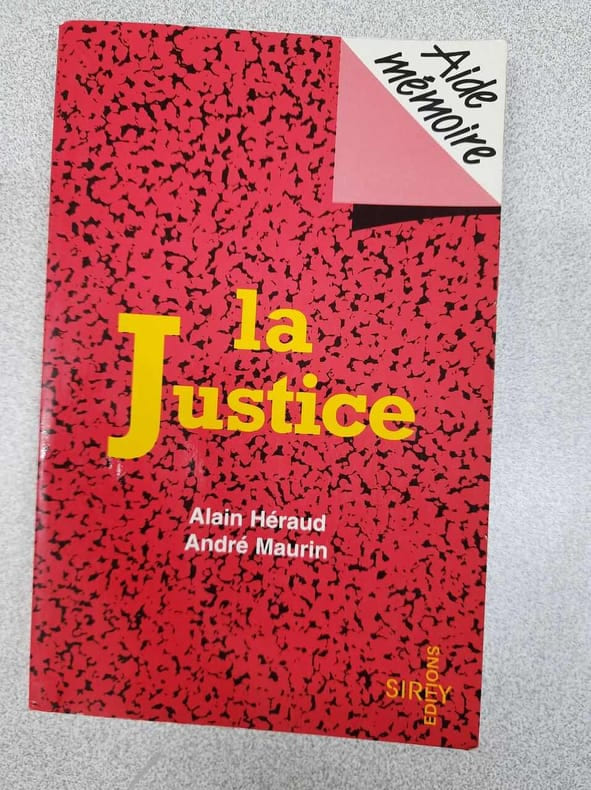
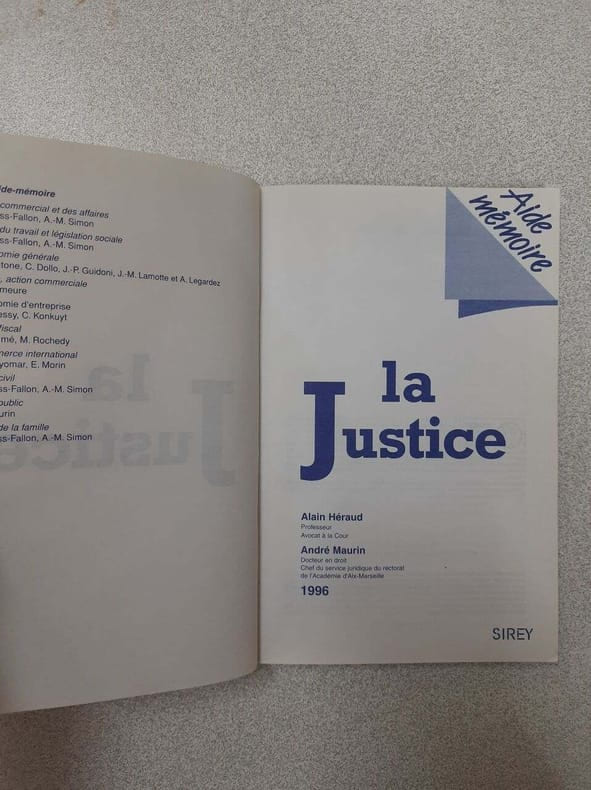
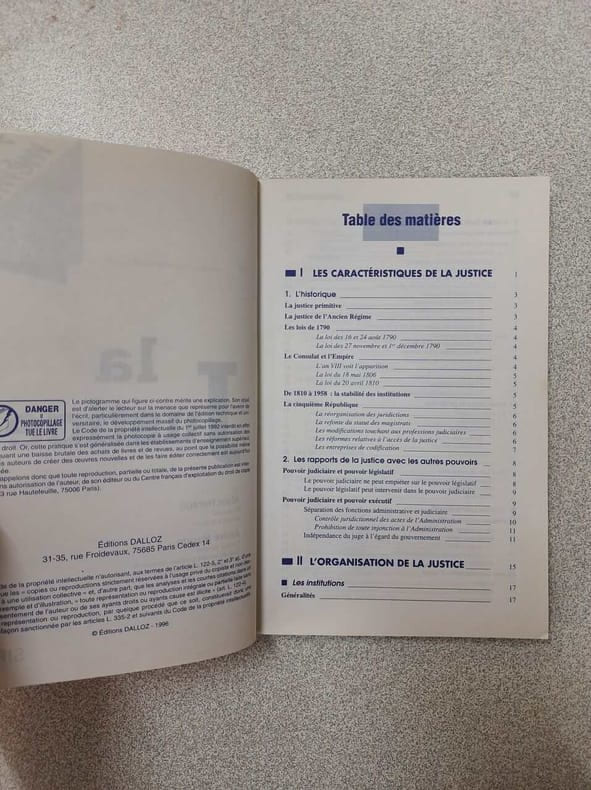
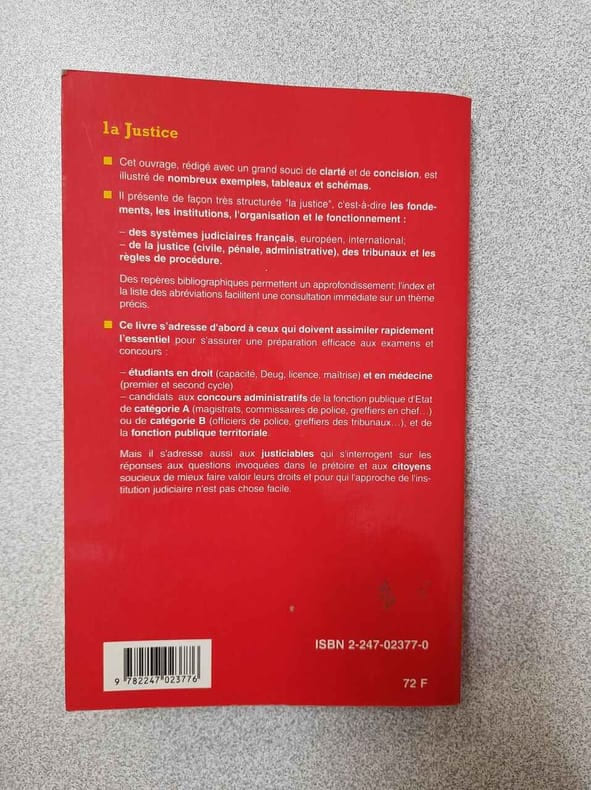
Dalloz-Sirey 1997 256 pages in8. 1997. Broché. 256 pages.
Reference : 500084318
ISBN : 9782247023776
Bon état
Bookseller's contact details
Démons et Merveilles
M. Christophe Ravignot
contact@demons-et-merveilles.com
07 54 32 44 40
Payment mode

Sale conditions
Rapidité d'envoi Tous nos articles sont expédiés le jour même de la confirmation de la commande Soin de l'emballage Un soin particulier est apporté à l'emballage, vos objets voyagent en toute sécurité. A votre écoute Si toutefois un incident devait survenir lors de l'acheminement de votre paquet, n'hésitez pas à nous contacter, nous mettrons tout en oeuvre pour vous satisfaire, en vous proposant un retour, un remboursement ou toute autre soluton à votre convenance. Professionnalisme Les livres que nous vendons sont pour la plupart des livres anciens, nous tâchons d'être le plus objectif possible quant à leur état.
5 book(s) with the same title
Notes du premier président Pellot sur la Normandie. Clergé - Gentilshommes et terres principales - Officiers de justice (1670-1683)
Rouen et Paris, A. Lestringant et Auguste Picard, 1915. 1000 g In-8, demi chagrin brun, tête dorée, couvertures conservées, xxxiv-400 pp.. Initiales M. L. C. au bas du dos. Ex-libris héraldique aux armes d'une famille Scherer. Bel exemplaire. Quelques frottements. . (Catégories : Normandie, Noblesse, )
Le palais de justice de Rouen
Rouen, Edet et Surville, 1842. 555 g In-8, demi chagrin noir à coins, xi-212 pp., [1] ff., frontispice par Alexis Drouin.. Petits frottements, quelques rousseurs. . (Catégories : Normandie, )
Visualizing Justice in Burgundian Prose Romance. Text and Image in Manuscripts of the Wavrin Master (1450s-1460s)
, Brepols, 2020 Hardback, 389 pages, Size:178 x 254 mm, Illustrations:140 col., Language: English. ISBN 9782503586335.
Summary This is the first monograph devoted to manuscripts illuminated by the mid-fifteenth-century artist known as the Wavrin Master, so-called after his chief patron, Jean de Wavrin, chronicler and councillor at the court of Philip the Good of Burgundy. Specializing in the production of pseudo-historical prose romances featuring the putative ancestors of actual Burgundian families, the artist was an attentive interpreter of these texts which were designed to commemorate the chivalric feats of past heroes and to foster their emulation by noble readers of the day. Integral to these heroes' deeds is the notion of justice, their worth being measured by their ability to remedy criminal acts such as adultery, murder, rape, and usurpation. In a corpus of 10 paper manuscripts containing the texts of 15 romances and over 650 watercolour miniatures, the stylized, expressive images of the Wavrin Master bring out with particular clarity the lessons in justice which these works offered their contemporary audience, many of whom, from the Burgundian dukes downwards, would have been responsible for upholding the law in their territories. Chapters are devoted to issues such as the nature of just war and how it is linked to good rulership; what forms of legal redress the heroines of these tales are able to obtain with or without the help of a male champion; and what responses are available in law to a spouse betrayed by an adulterous partner. The book will be of interest to scholars of medieval art, literature, legal and cultural history, and gender studies. TABLE OF CONTENTS List of figures Foreword and acknowledgements Introduction This chapter sets out the rationale for the monograph. First, it situates its approach to study of the works of the Wavrin Master in relation to past and current scholarship in the field of Burgundian manuscript illlumination. Second, it explains and briefly illustrates the methodology it adopts, this being the analysis of the interplay between text and image in manuscripts of these prose romances, from the particular perspective of how this interplay inflects the issues of justice that are raised in the narrative. Third, it outlines in detail the precise research questions that will be addressed in the monograph and explicates the order of the chapters, justifying which texts have been selected from the corpus for detailed treatment. Chapter 1: Artist, Corpus, Patrons, Court This chapter provides a detailed context for analysis of the manuscripts in the Wavrin Master corpus by outlining who the artist was, what his body of work consisted of, who his chief patrons were, what books they held in their libraries, and how these texts contributed to the wider ideological project of legitimising the Burgundian polity as a personal union between the lord and his subjects, particularly during the reigns of the third and fourth dukes, Philip the Good and Charles the Bold. It thus sees these romances as forming part of a "literature of statecraft" teaching princely virtues, especially on matters of justice, alongside moralising works such as mirrors for princes, military treatises, and the many different types of historiographical texts that found favour at the Burgundian court. Chapter 2: Justice, Warfare, and Rulership in Florimont, the Seigneurs de Gavre and Saladin This chapter focuses on three texts whose presentation of the hero's military exploits can be read as a demonstration of medieval just war theory in action and of the link between just war and just rulership. It argues that the first two tales, Florimont and the Seigneurs de Gavre, can be seen as paradigmatic of the Wavrin Master's corpus in depicting an unequivocally exemplary hero as a just warrior and later ruler pitted against a series of antagonists whose illegitimate wars destroy their credibility as governors of their lands. By contrast, the third text, Saladin, is much more ambivalent in its portrayal of a hero whose undoubted status as a model of just conduct in war is fatally undermined by his reasons for going to war in the first place, being chiefly motivated by an insatiable desire for conquest, a lesson which may well have had a particular pertinence for Charles the Bold whose territorial ambitions far outstripped those of all three of his ducal predecessors. Translating these texts' often abstract ideas about just war and just rulership into the realm of the visual, the Wavrin Master plays with the extent to which the hero as a chivalric leader can be contrasted with his opponents in terms of both his appearance and his physical domination of space as a way of underlining the rightfulness or wrongfulness of the military causes he espouses. Chapter 3: Poor Judgements: Righting Wrongs against Women in Gérard de Nevers, the Fille du comte de Pontieu, and Florence de Rome This chapter examines three romances that deal with the righting of wrongs perpetrated by men against women and the ways in which these female victims of injustice find legal redress. In the first of these texts, Gérard de Nevers, justice for the wronged heroine is obtained by the male figure who had endangered her in the first place, as he fights a series of judicial duels to clear her name. Nevertheless, the heroine herself is not simply a passive receiver of this justice but herself has to use the workings of the law in order to regain her rightful place in society, in particular through her eloquence in pleading in court. The doubly wronged heroine of the second text, the Fille du comte de Pontieu, victim of a gang-rape and of her own father's punishment of her for having supposedly dishonoured her family, gains legal redress through her own efforts, pardoning the father who had wronged her but also making him swear a solemn oath never to reproach her again for her misfortune. Finally, in Florence de Rome, the heroine is abducted by her brother-in-law and subjected to multiple attempts at rape but eventually attains justice through herself exercising judgement over her transgressors. In his treatment of these women in relation to justice, the Wavrin Master places particular emphasis on representing scenes of crimes so as to establish the heroine's innocence and the different forms of judicial process by which she regains her honour and status. Valorising women in relation to justice through their demonstration of eloquence as well as through their capacity to make just judgements, these romances play their part in legitimising the role that high-status women such as the duchesses in particular were playing de facto in the good governance of the Burgundian polity. Chapter 4: Domestic Betrayals: Adultery and the Problem of Lawful Response in the Chastellain de Coucy and the Comte d'Artois This chapter, which deals with two romances that focus on the question of adultery, seeks to correct a scholarly misconception about the prevalence of extramarital relationships in Burgundian chivalric literature being a reflection of the licence that members of the male elite, particularly Philip the Good himself, allowed themselves in their own adulterous relations. It argues that, in fact, rather than celebrating extramarital love, the Chastellain de Coucy and the Comte d'Artois are concerned to teach their noble readers, both male and female, about the dangers of adultery. In particular, the way in which the domestic betrayals within these romances are treated textually and visually rejects the idea of adultery as an ennobling passion (as found in the Tristan legend, for example) and instead examines the lawful or unlawful response on the part of the betrayed spouse to the fact of their betrayal, thus addressing the wider social and legal repercussions of such extramarital passions. In his treatment of these two texts, the Wavrin Master draws on multiple pictorial traditions and runs a gamut of emotions from the courtly to the bathetic and from the erotic to the tragic in order to show that adultery, as an act of private domestic betrayal, can only lead to further forms of injustice. Conclusion: Text, Image, Ideology, Justice This chapter summarises the case made for seeing the Wavrin Master as a highly original interpreter of an unusually homogeneous body of works, ones in which the interplay of text and image is integral to the way that its lessons in statecraft, particularly on the issue of justice, would have been received at the court of Burgundy by both a male and a female audience. Appendix 1: Corpus of manuscripts Bibliography Index
Raising Claims. Justice and Commune in Late Medieval Italy
, Brepols, 2022 Hardback, 255 pages, Size:178 x 254 mm, Illustrations:7 b/w, 18 tables b/w., 3 maps b/w, Language: English. ISBN 9782503590066.
Summary Ceccholo, making a claim against Nello for the payment of unpaid land rent. Jacopo, Giovanni and Turi, appealing for an exemption from tax. The long queue of claimants that formed in front of the communal palace was an everyday scene in fourteenth century Lucca. What is remarkable is the enormous ubiquity of such claims. In this Tuscan city of only twenty thousand people, an average of ten thousand claims were filed at the civil court each year. Why did local residents submit claims to the commune in such numbers? And what effect did this daily accumulation have on the development of the commune? In the fourteenth century, Italian communes, the established public authorities that governed the populace, underwent a shift toward becoming oligarchic regimes. The communes' character as a form of government in which power was held 'in common' by 'the public' seemed be on the verge of disappearing. At this time, political leaders and judicial magistrates began to rely on their own discretion when rendering their decisions, a practice that was recognized as legitimate even when such decisions deviated from positive law. By the beginning of the fifteenth century, this shift in the underlying logic of the legitimacy of rulings became entrenched in the jural and political character of the commune, portending the advent of the modern era. Based on the archival records from law courts and councils, this book elucidates the process of the emergence and shaping of a new form of justice and the transformation of the commune by focusing on everyday practices that unfolded in the spheres of civil and criminal justice by inhabitants who raised claims and the governors who heard them. TABLE OF CONTENTS Introduction Part I: Civil Justice and the Commune Chapter 1: Why did people go to the courts? 1. The high volume of claims heard by civil courts 2. Civil trials 3. Conflict resolution extra iudicium 4. The significance of judicial orders 5. The commune within society Chapter 2: Realisation of the Commune through Claims 1. Interaction between the Commune and Its Inhabitants 2. Exceptio in the courts 3. Speaking out to the Anziani 4. The creativity of claims Chapter 3: A shift in the modality of justice in the civil courts: From formalism to arbitrium 1. Changes to civil trials over the fourteenth century 2. A qualitative shift in the identity of decision makers 3. A shift in judicial principle in the realm of procedural law 4. The decline of local jurists 5. Exceptio among litigants and arbitrium procedendi among judges 6. The Doge and 'proper' summary justice 7. The commune's appropriation of the realm of civil law Part II: Criminal Justice and the Commune Chapter 4: Criminal Justice in fourteenth-century Lucca 1. The rise of criminal justice 2. Volume of maleficia brought before the criminal court 3. Maleficia 4. Procedures 5. Sentences 6. After sentencing 7. Validity of gratia Chapter 5: Gratia, the Commune, and Justice 1. Gratia and the commune 2. Amnesty under foreign masters 3. Individual gratia under Pisan rule 4. Prohibition of gratia in the republican period 5. Gratia in communal Lucca Chapter 6: The Commune and Politics in the Practice of Extraordinary Justice 1. The commune and extraordinary justice 2. Captain ser Scherlatto's lawsuit for the restitution of property 3. Maintenance of territorial security by the bargello 4. The podestà and the Anziani in the republican period 5. The 1392 regime and the Capitano del Popolo 6. Extraordinary justice and the extension of politics Conclusion
Les Cahiers Français n°156-157 Sept. déc. 1972 - La justice : Les français et la justice - Le système judiciaire français - Les professions judiciaires - L'avocat et la justice en 1973 - Le citoyen et la justice civile - La justice pénale et le justiciabl
La Documentation Française. 1972. In-4. Broché. Bon état, Couv. convenable, Dos satisfaisant, Intérieur frais. 96 pages - nombreuses photos en noir et blanc dans le texte. Texte sur plusieurs colonnes + 40 pages environ de supplément, en feuillets.. . . . Classification Dewey : 70.49-Presse illustrée, magazines, revues
Sommaire : La justice : Les français et la justice - Le système judiciaire français - Les professions judiciaires - L'avocat et la justice en 1973 - Le citoyen et la justice civile - La justice pénale et le justiciable - Le jugement pénal - La justice et le libertés individuelles - Les juridictions administratives et la protection du citoyen - La délinquance - Adaptation des structures aux finalités du droit moderne.. Classification Dewey : 70.49-Presse illustrée, magazines, revues



