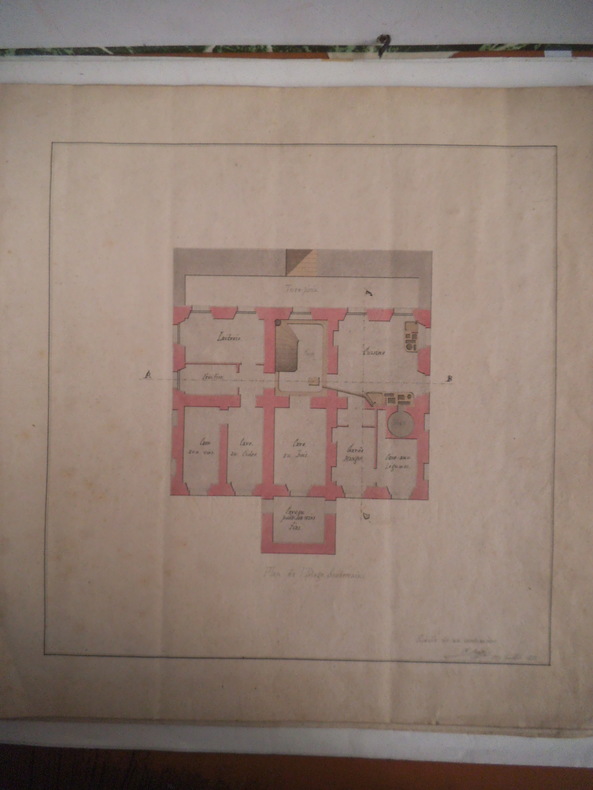
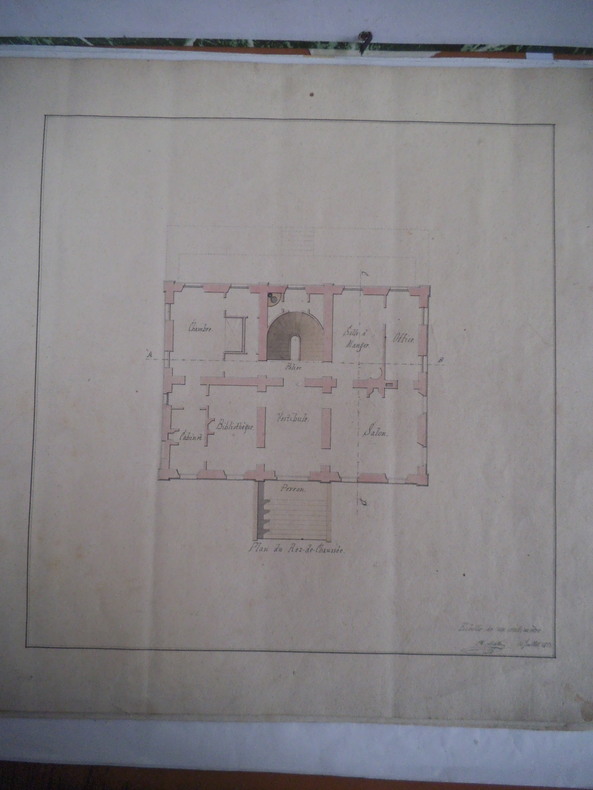
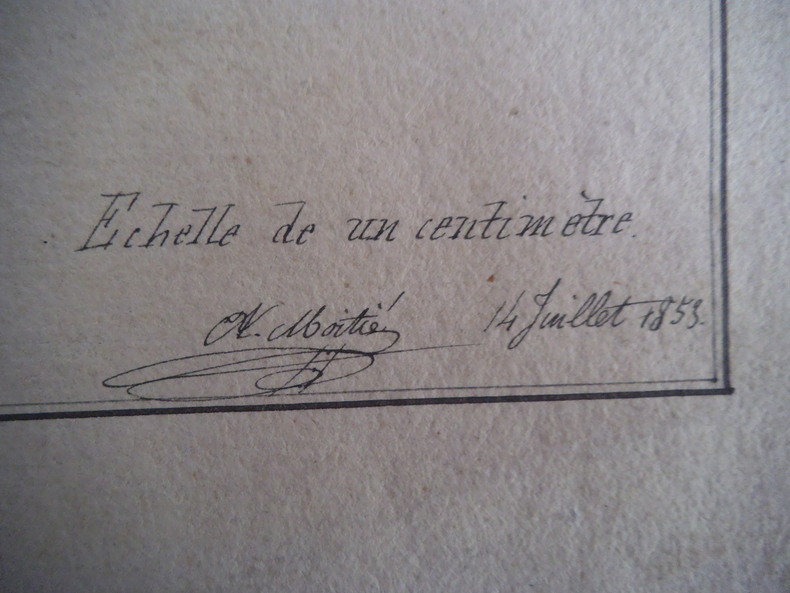
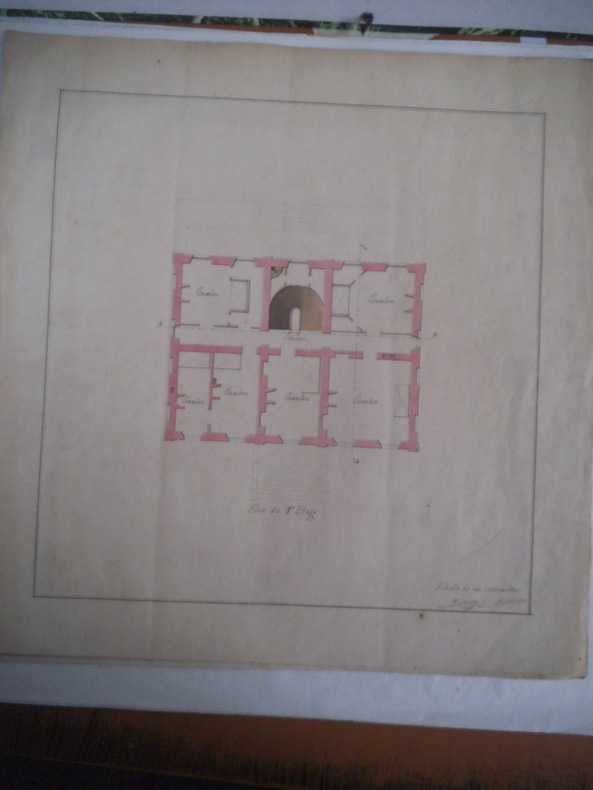
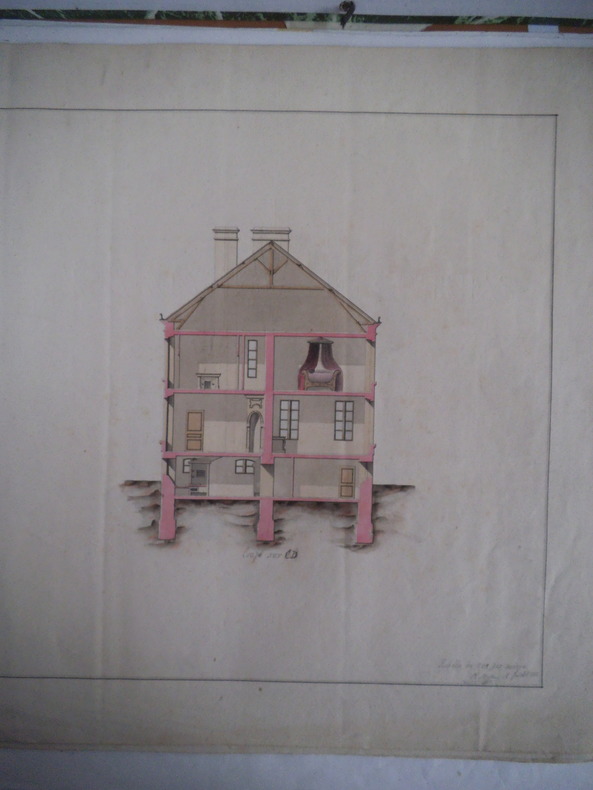
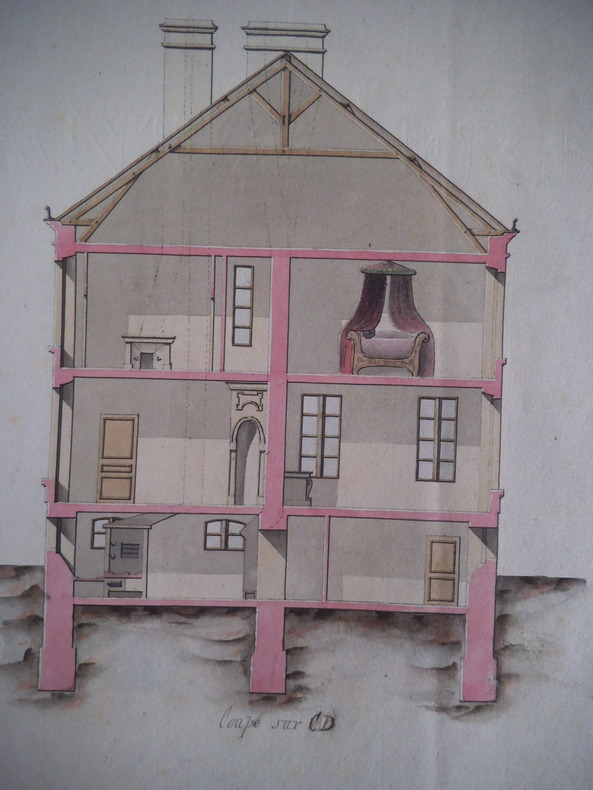
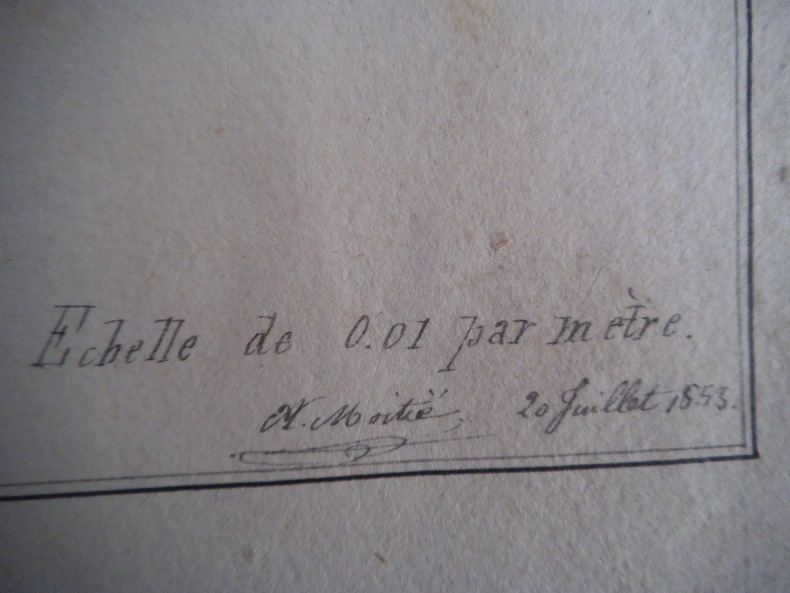
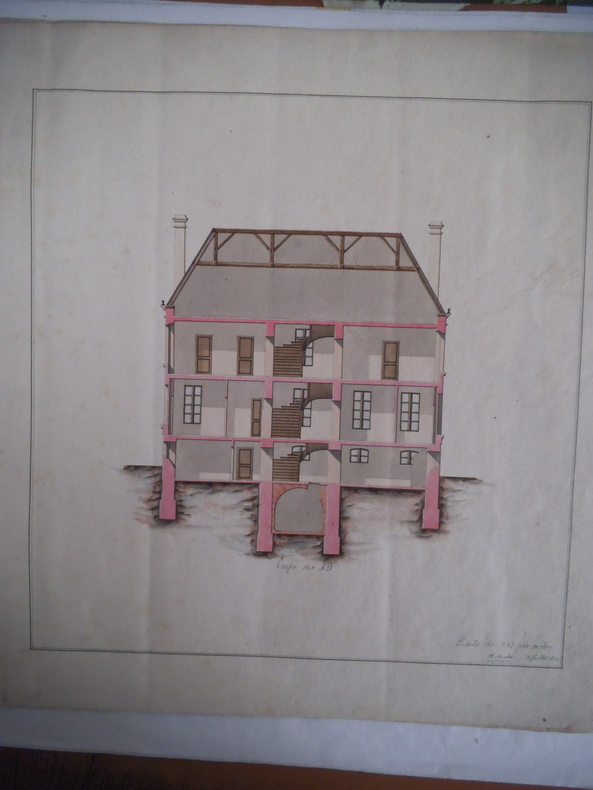
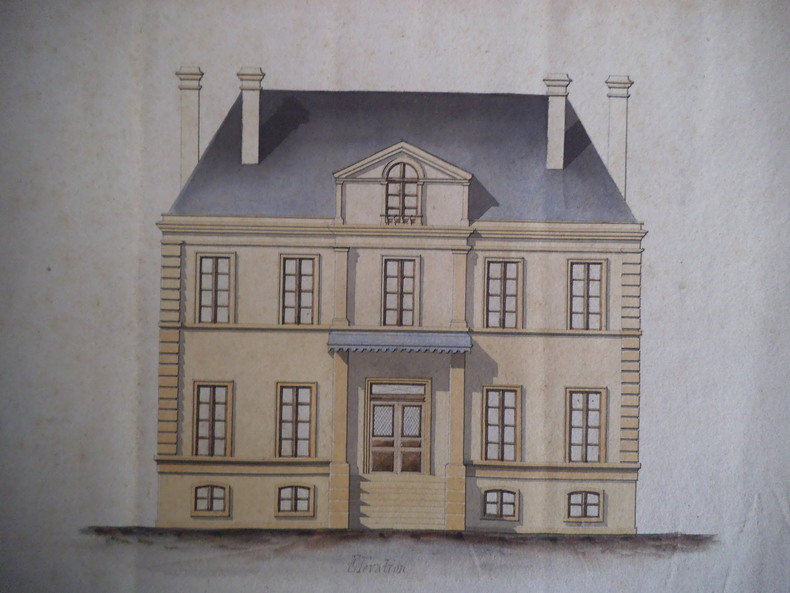
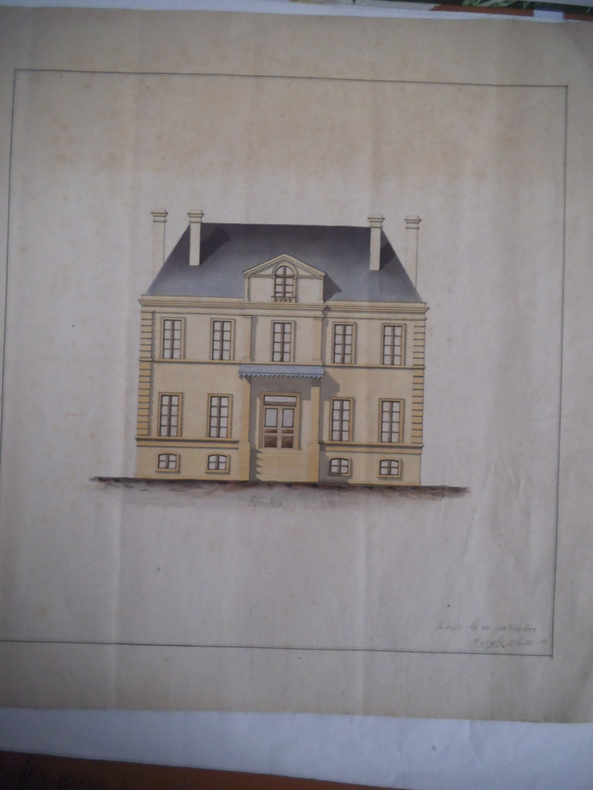
Dessins originaux, aquarellés, d’une maison bourgeoise. Juillet 1853 signature et date en bas à gauche. Format 404x418 mm 1) plan de l’étage souterrain 12 juillet 2) Plan du rez de chaussée 14 juillet 3) Plan du premier étage 16 juillet 4) coupe sur coté droit 18 juillet 5 coupe sur AB 20 juillet 6 élévation 22 juillet dessin, architecture, maison, étage, aquarelle, lavis, plan coupes, élévation, XIXème siècle, Napoléon, Second Empire style
Reference : 11198
Charbonnel
M. Sylvain Charbonnel
2, rue du Champ de Mars
55000 Bar le Duc
France
03 29 79 40 63
Les commandes se font de préférence par e-mail ou par courrier.Tous les livres proposés sont en bon état sauf indications contraires mentionnées dans la description.Les prix sont nets,port en sus à la charge du destinataire.Les envois,après entente concernant les frais de port pour la France s'effectuent dès réception par chèque bancaire,mandat ou virement bancaire.Pour la zone euro par virement bancaire. Me demander mon RIB-IBAN-BIC.Hors Europe Règlement par carte bancaire accepté uniquement par l'intermédiaire de pay pal,les frais sont à la charge de l'acheteur.Les livres voyagent aux risques et périls du destinataire,l'emballage soigné est gratuit.Afin d'éviter tout litige il est expressément conseillé l'envoi en recommandé.Passé un délai d'une dizaine de jours à partir de la date de commande,les ouvrages non réglés seront remis en vente.
Paris, Librairie d’architecture de A. Lévy fils, sans date [vers 1850]. In-folio – 36,5 x 28 cm. Reliure de l’époque en demi-basane fauve, dos lisse orné de doubles filets dorés, d’une ancienne étiquette en papier, titre frappé à l’or. Faux-titre, titre, 24 planches. Exemplaire bien complet de ses 24 planches lithographiées à double page, montées sur onglet, par A. Collette d’après les dessins de Fernando Quaglia. Précieux ouvrage consacré aux monuments funéraires parisiens, remarquables par leur architecture, par Fernando Quaglia (1780-1853), peintre, miniaturiste et lithographe italien. Il s'installe à Paris en 1805 et est protégé par l'impératrice Joséphine, qui l'attache à sa maison. Chaque planche comprend l’élévation de plusieurs monuments avec le détail des ornements et inscriptions, et l’échelle.
Modeste exemplaire à la reliure usée, et aux nombreuses piqûres, certains onglets renforcés. - Clients Livre Rare Book : Les frais postaux indiqués sont ceux pour la France métropolitaine et la Corse, pour les autres destinations, merci de contacter la librairie pour connaître le montant des frais d'expédition, merci de votre compréhension. Livre Rare Book Customers : The shipping fees indicated are only for France, if you want international shipping please contact us before placing your order, thank you for your understanding. - Frais de port : -Colissimo France 11 € -Colissimo International (Union Européenne + Suisse : 23 €) (Reste du Monde : 55 €)
Phone number : +33 6 18 71 03 67
Paris, chez Moutard, 1782. In-8 - 13 x 20 cm. Reliure de l’époque en plein veau moucheté, dos à 5 nerfs orné de petits fers, filets et pointillés dorés, filet à froid en encadrement des plats, roulette dorée sur les coupes, tranches mouchetées. 212 pp, 3 pl. Complet de ses 3 planches dépliantes, finement gravées, et regroupées en fin de volume. Édition originale et unique de ce traité composé par l'architecte Pierre Patte (1723-1814), qui fut l'assistant de Jacques-François Blondel, dont il termina et publia le Cours d'architecture. Envoyé par Louis XV en Italie pour étudier l'architecture des théâtres italiens, il leur consacre entièrement cet ouvrage. Les plans figurent sur les 2 dernières planches. La première présente son projet personnel qui répond à un cahier des charges exigeant : acoustique, éclairage, sécurité, portée des voix, etc.
Petites traces de frottements sur la reliure, quelques rousseurs éparses, sinon bel exemplaire. - Clients Livre Rare Book : Les frais postaux indiqués sont ceux pour la France métropolitaine et la Corse, pour les autres destinations, merci de contacter la librairie pour connaître le montant des frais d'expédition, merci de votre compréhension. Livre Rare Book Customers : The shipping fees indicated are only for France, if you want international shipping please contact us before placing your order, thank you for your understanding. - Frais de port : -Colissimo France 9,5 € -Colissimo International (Union Européenne + Suisse : 20 €) (Reste du Monde : 40 €)
Phone number : +33 6 18 71 03 67
Histoire de l'architecture, par Jean-Charles Moreux – Architecte en chef des Bâtiments civils et Palais nationaux. Petit in-8° 128 pp broché, n°18 de la collection «Que sais-je ?», éditions des Presses universitaires de France, Paris 1973. Onzième édition revue et complétée par André Chastel, Professeur au Collège de France (1re édition : 3e trimestre 1941). Imprimé en 1973 à Vendôme (64e mille). Très bon état (4/5).
Dans la Table des matières : après l'Introduction, l'architecture préhistorique ; l'architecture en Egypte ; l'architecture en Chaldéen et en Assyrie ; l'architecture en Perse ; l'architecture dans l'Inde ; l'architecture en Chine et au Japon ; l'architecture en Amérique ; les architectures préhelléniques ; l'architecture grecque ; l'architecture romaine ; l'architecture chrétienne du bas-Empire ; l'architecture musulmane ; l'architecture romane ; l'architecture gothique ; l'architecture de la Renaissance en Italie ; l'architecture de la Renaissance en France et à l'étranger ; l'architecture aux XVIIe et XVIIIe siècles et au début du XIXe siècle ; le XVIIe, le XVIIIe et le XIXe siècles à l'étranger ; l'architecture depuis 1850 en France ; l'architecture dans le monde au XXe siècle, par André Chastel
Phone number : 06 71 05 07 87
, Brepols, 2021 Hardback, 488 pages, Size:220 x 280 mm, Illustrations:300 col., Language: English. ISBN 9782503589350.
Summary The Religious Architecture of Islam is a wide-ranging multi-author study of the architectural traditions associated with the religion of Islam across the globe. A total of 59 essays by 48 authors are presented across two volumes, Volume 1: Asia and Australia and Volume 2: Africa, Europe, and the Americas. Essays address major themes across historical and contemporary periods of Islam and provide more focused studies of developments unique to specific regions and historical periods. The essays cover Islamic religious architecture broadly defined, including mosques, madrasas, saints' shrines, and funerary architecture. The Religious Architecture of Islam both provides an introduction to the history of Islamic architecture and reflects the most recent scholarship within the field. TABLE OF CONTENTS Hasan-Uddin Khan and Kathryn Blair Moore - Introduction Background Themes Heba Mostafa - Locating the Sacred in Early Islamic Architecture Nezar AlSayyad and ?pek T reli - The Mosque in the Urban Context D. Fairchild Ruggles - Gardens as Places of Piety and Faith Imdat As - Complex Patterns and Three-Dimensional Geometry in Islamic Religious Architecture Matthew Saba and Michael A. Toler - Archives and Archival Documents in the Study of Islamic Religious Architecture West and Central Asia Abeer Hussam Eddin Allahham - The Holy Mosque of Mecca Akel Ismail Kahera - The Mosque of the Prophet at Medina Kathryn Blair Moore - The Dome of the Rock through the Centuries Mattia Guidetti - The Great Mosque of Damascus through the Medieval Period Mattia Guidetti - Early Islam and Byzantine Churches Melanie Michailidis - Early Mosques in Iran and Central Asia Matthew Saba - Funerary Architecture in Iraq under the Abbasids and their Successors, 750-1250 Megan Boomer and Robert Ousterhout - Muslims, Byzantines, and Western Christians on the Haram al-Sharif Stephennie Mulder - Mosques under the Ayyubids Stephennie Mulder - Shrines in the Central Islamic Lands Melanie Michailidis - Shrines and Mausolea in Iran and Central Asia Sheila Blair - The Ilkhanids and their Successors Bernard O'Kane - Religious Architecture of Central Asia under the Timurids and their Successors Farshid Emami - Religious Architecture of Safavid Iran Oya Pancaro?lu - Islamic Architecture in Medieval Anatolia, 1150-1450 Zeynep Y rekli - Three Sufi Shrines under the Ottomans Ali Uzay Peker - Seljuk and Ottoman Mosques Imdat As - Kocatepe: The Unbuilt State Mosque of Turkey James Steele - Regionalist Expressions of the Mosque in the Arabian Peninsula and Middle East South and East Asia Alka Patel - The Sultanates in South Asia, 700-1690 Laura E. Parodi - Mughal Religious Architecture Kamil Khan Mumtaz - Badshahi Masjid, Lahore Kamil Khan Mumtaz - The Architecture of Sufi Shrines in Pakistan Imran bin Tajudeen - Pre-Islamic and Vernacular Elements in the Southeast Asian Mosques of Nusantara Nancy S. Steinhardt - The Mosque in China Hasan-Uddin Khan - The Great Mosque of Xi'an (Qing Zhen Si) Australia Tammy Gaber - New Australian Mosques
, brepols, 2026 Paperback, Pages: 421 pages, Size:216 x 280 mm, Illustrations:65 b/w, 102 col. Language :English, NEW. ISBN 9782503610368.
Summary In the broad field of architectural history, many different approaches are possible. The collection of articles in this book covers a variety of themes, with the meanings of architecture as a central theme in most contributions. The articles are grouped into four main themes: Interpreting Architecture, Design and Construction, Spolia and Historiography. The ways in which attention can shift in architectural history are nicely highlighted in this volume. For instance, the ability to interpret architecture in its variety of meanings is not in doubt today, but was a real point of contention in the second half of the 20th century. Apart from as an enclosure of space, architecture in the past could carry diverse meanings, expressed, for instance, through a specific choice of architectural concepts, or through the use of spolia. The different ways in which medieval architecture in particular could be interpreted are the focus of several articles. Thereby, the application of spolia occupies a special place in both meaning-making and interpretation of architecture. The Historiography section analyses various changes in the way medieval architecture was and is studied. TABLE OF CONTENTS Foreword Introduction, by Petra Brouwer and Gabri van Tussenbroek Interpreting Architecture The Sensus Allegoricus of Medieval Buildings, or: Architectural Iconology in Historical Perspective The Past as a Determining Factor in the Architectural Concepts of Li ge Cathedral (Eleventh and Twelfth Centuries) Architecture and Quotation. The Historicity of Buildings from the Past S. Giovanni in Laterano and Medieval Architecture. The Significance of Architectural Quotations The Choir Ambulatory. On the History and Reception of a Type of Ground Plan in Medieval and Post-Medieval Times Design and Construction The Dilemma of Pope Julius II. How to Preserve the Old St Peter?s While Building a New St Peter?s Proportion and Building Material or Theory versus Practice in the Determination of the Module Designing the Villa Pliniana at Lago di Como. Pellegrino Tibaldi and Political Iconography under Habsburg Rule Spolia Spolia in the Fourth-Century Basilica Spolia and Coloured Marble in Sepulchral Monuments in Rome, Florence and Bosco Marengo. Designs by Dosio and Vasari Spolia from Rome?s Past as a Contribution to Roman or Romanesque Architecture The Significance of Tradition. About the Spolia in the Choir Area of Magdeburg Cathedral The Veneration of Spolia. The Madonna della Colonna in St Peter?s in Rome Dutch Colonial Architecture Stabroek in Demerara: The Emergence of the City Plan of Georgetown (Guyana) in the Eighteenth Century From Amsterdam to Berbice. Colonial Administration Buildings as a New Design Task for Abraham van der Hart Government Buildings in the Dutch Colonies (Seventeenth and Eighteenth Centuries) Historiography Dutch Architectural Historians and International Contacts until around 1960 The History of Architectural History in the Netherlands. Medieval Architecture M. D. Ozinga?s Inaugural Lecture (1948). The Origins of Gothic Architecture and the Problem of Period Styles The Invention of Gothic. Abbot Suger since Erwin Panofsky There is no Such Thing as Gothic. The Concept of ?Renewal? as an Art Historical Problem Bibliography of Lex Bosman