 Write to the booksellers
LEYDEN Lucas Van
Le Sauveur
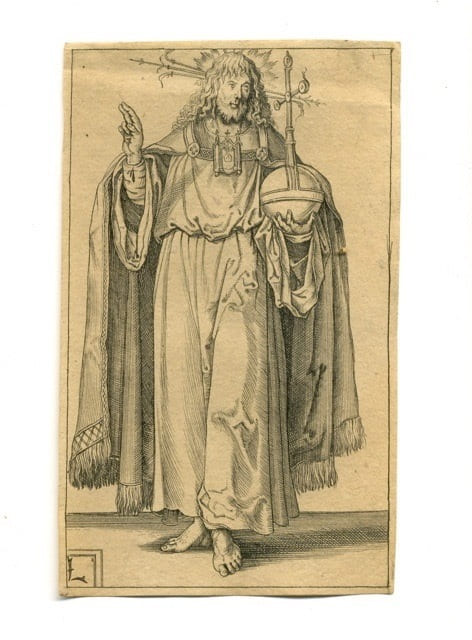
De la suite Jésus Christ et les Apôtres représentés debout. Bartsch 86. Papier vergé sans filigrane. vers 1501 12,1 x 7,4
Reference : 5128
Bookseller's contact details
Librairie Seigneur
Martine Seigneur
Payment mode

Sale conditions
Conforme aux usages de la profession.
5 book(s) with the same title
Napoléon ou le mythe du sauveur
État : Bon état - Année : 2005 - Format : in 8° - Pages : 512pp - Editeur : Le Grand Livre du Mois (Fayard) - Lieu d'édition : Paris - Type : Broché - Divers : Tranche de tête un peu salie. - Commander rapidement : https://www.bons-livres.fr/livre/jean-tulard/6321-napoleon-ou-le-mythe-du-sauveur?lrb
Oeuvre de l'un des meilleurs spécialistes de la période, cet ouvrage se lit sur trois plans: une biographie classique et très vivante, une mise au point des débats soulevés par cette histoire et un état, le plus complet à ce jour, des sources imprimées. Ainsi ce trouve comblés le simple curieux, le passionné d'histoire et le chercheur érudit. Un livre indispensable. Nouvelle édition, revue et augmentée, avec une chronologie, une filmographie et des tableaux annexes. Un ouvrage de référence qui traite de tous les aspects de la vie et de l'oeuvre de Napoléon au service d'une bourgeoisie qui avait besoin de stabiliser les acquis de la Révolution et de retrouver la première place en Europe sans omettre les cotés néfastes pour la France d'une politique de conquête et d'une ambition très personnelle.
Napoléon ou le mythe du sauveur
État : Bon état - Année : 2001 - Format : in 8° - Pages : 512pp - Editeur : Fayard - Lieu d'édition : Paris - Type : Broché - Divers : Coins légèrement frottés. Qqes rares petites pointes de tâche en tranche de tête. - Commander rapidement : https://www.bons-livres.fr/livre/jean-tulard/4618-napoleon-ou-le-mythe-du-sauveur?lrb
Oeuvre de l'un des meilleurs spécialistes de la période, cet ouvrage se lit sur trois plans: une biographie classique et très vivante, une mise au point des débats soulevés par cette histoire et un état, le plus complet à ce jour, des sources imprimées. Ainsi ce trouve comblés le simple curieux, le passionné d'histoire et le chercheur érudit. Un livre indispensable. Nouvelle édition, revue et augmentée, avec une chronologie, une filmographie et des tableaux annexes. Un ouvrage de référence qui traite de tous les aspects de la vie et de l'oeuvre de Napoléon au service d'une bourgeoisie qui avait besoin de stabiliser les acquis de la Révolution et de retrouver la première place en Europe sans omettre les cotés néfastes pour la France d'une politique de conquête et d'une ambition très personnelle.
Systeme général des Intervalles des Sons, & son Application à tous les Systèmes & à tous les Instrumens de Musique. Par M. Sauveur. - [ THE SCIENTIFIC FOUNDATION OF HARMONICS - COINING THE TERM ""ACOUSTICS""]
Paris, Jean Boudot, 1704. 4to. Without wrappers. Extracted from ""Mémoires de l'Academie des Sciences. Année 1701"". Title-page to Année 1701 with an engraved vignette. Pp. 297-364 a. Corrections & Remarques Pour le Systeme de Musique (2) pp. With 3 large folded engraved plates. A few scattered brownspots. Wide-margined.
First appearance of a founding paper in musical theory and the physics of acoustics, in which the term ""acoustique"" is coined. The paper deals with the relations of the tones of the musical scale. It established the practice of music upon a science superior to it which Sauveur calls ""Acoustics"", the subject of which is sound in general. This is Sauveur's main paper on acoustics in which he states the first clear recognition of the composite nature of the vibration of strings.""Like Mersenne and others in the Seventeenth century, Sauveur used musical experience to obtain information on sound and vibration. According to Fontenelle, Sauveur was fascinated by music, even though he had no ear for it, and consulted frequently with musicians. Despite the musical foundation of his work, Sauveur proposed the development of a new subject, which he named ""acoustique"", dealing with sound in general rather than with the ""son agréable"" of music."" (DSB XII, p. 127).""Joseph Sauveur (1653-1716) introduces the term ""acoustics"" for the study of sound and examines the relations of the tones of the musical scale in the memoir ""Systeme général des intervalles...."" (General System of sound intervals and its application to all musical systems and instruments) - the paper offered - He shows that a string can vibrate at integral multiples of a a fundamental frequency simultaneously with vibrating at the fundamental frequency itself, callinf the toned produced by the vibrations at the multiples the ""harmonics"" of the fundamental tone.""(Parkinson ""Breakthroughs"" 1701 P.

"SAUVEUR, (JOSEPH). - THE DETERMINATION OF ABSOLUTE FREQUENCY OF SOUND.
Reference : 44382
(1704)
Application des Sons Harmoniques. A la composition des Jeux d'Orgues. Par M. Sauveur.
Paris, Jean Boudot, 1704. 4to. Without wrappers. Extracted from ""Mémoires de l'Academie des Sciences. Année 1702"". Pp. 308-328 a. 2 large folded engraved plates. A few small brownspots. Wide-margined.
First appearance of a classic paper in the theory of sound (his second paper on Acoustics). Saveur had his first founding paper printed in 1701 ""Systeme général des Intervalles des Sons, & son Application à tous les Systèmes & à tous les Instrumens de Musique."" in which he developed the new subject ""acoustique"" (and coined the term), In the paper offered he was the first to use beasts to determine the frequency difference and he was thus able to calculate the absolute frequencies.""To determine absolute frequency, Sauveur used a pair of organ pipes a small half-tone apart in just intonation (frequency ratio 25:24). This interval is sufficiently small that the beats can be counted, for low pitches. Furthermore, the interval can be obtained accurately by tuning through thirds and perfect fifths (for example, by tuning up two major thirds and then down a fifth). As a results of experiments done with Deslander, and organ builder, Sauveur found that the frequency of an organ pipe five Paris feet long was between 100 and 102 cps. Sauveur claimed to have obtained consistent results from experiments done with other piopes. Newton made a rough check of Sauveurs eresults...""(DSB XII, p. 128).
Voyage dans les îles Baléares et Pithiuses ; fait dans les années 1801, 1802, 1803, 1804 et 1805, par M. André Grasset de Saint-Sauveur, jeune, Commissaire des relations commerciales de France et Consul de S. M. J. et R. aux îles Baléares. Avec planches. Edition originale imprimée sur grand papier vélin relié à l’époque pour le Prince Cambacérès Archi-Chancelier de l’Empire.
Précieux exemplaire provenant des bibliothèques Cambacérès, Jean Lhomer et Docteur Lucien-Graux. Paris, Léopold Collin, 1807. In-8 de (4) ff., xvi pp., 390 pp., 2 planches dépliantes (Vue de la ville de Palma, Autel des druides) et 1 planche à pleine page (Femmes des Iles Baléares). Cartonnage maroquiné, plats ornés d’une roulette dorée, «A. S.A.S. Monseigneur le Prince Cambacérès Archi Chancelier de l’Empire» frappé en lettres d’or sur le plat supérieur, non rogné, charnières fendillées. Reliure de l’époque. 217 x 135 mm.
Édition originale dédicacée au prince de Talleyrand ornée de 3 planches gravées dont 2 dépliantes: vue de Palma, costume des femmes des îles Baléares, autel des Druides. «Je me suis efforcé d’acquérir un nouveau titre à la bienveillance du public par des recherches suivies sur la topographie, les richesses physiques des îles Baléares et Pithiuses, et sur le caractère, les mœurs, l’industrie et le commerce de leurs habitans. Je me suis attaché à donner une description, la plus exacte et la plus détaillée qu’il m’a été possible des côtes et de l’intérieur de ces îles. Après avoir donné, dans des chapitres particuliers, la description détaillée de chacune des îles, j’ai réuni dans des chapitres généraux, tout ce qui est relatif au caractère, aux mœurs, aux usages, à l’industrie, au commerce, aux costumes et au langage des habitans de toutes ces îles. J’ai consacré un chapitre aux antiquités qui s’y sont trouvées, ou qui y existent encore. Je termine enfin, par un aperçu historique.» «Pour donner un tableau complet de ces îles, il fallait non seulement y avoir voyagé et résidé plusieurs années, il fallait encore y avoir été revêtu d’un caractère qui autorisât l’auteur à se procurer tous les renseignements possibles sur le pays et sur ses habitants; il fallait posséder l’esprit d’observation propre à tirer avantage de ces documents. M. Grasset de Saint-Sauveur a réuni ces avantages, et nous devons à ces laborieuses recherches sur les îles Baléares et Pithiuses, des lumières aussi étendues que celles qu’il nous avait procurées sur les îles vénitiennes. Son ouvrage est divisé en dix-neuf chapitres: il renferme I) La situation des îles Baléares et Pithiuses, l’origine de leurs noms, leur étendue, leur figure; la situation, les côtes et les mouillages de l’île Majorque et de Cabrera, 2) La description de l’île Majorque, qui comprend le tableau de son climat, les qualités, la culture et les productions de ses terres, 3) La description de la ville de Palma, 4) La situation, l’étendue, les côtes et les mouillages de l’île Minorque, 5) La description de la ville de Mahon et de son territoire, 6) Des observations sur le climat, les qualités et les productions des terres et côtes de l’île de Minorque, 7) La situation, l’étendue, les côtes et les mouillages des îles de Minorque, 8) Une description particulière de l’île de Formentera, et des canaux que forment entre elles les îles Pithiuses, 9) Le tableau du caractère et des mœurs, de l’industrie et du commerce des habitans des îles Baléares et Pithiuses, 10) Des recherches sur leur idiome et sur leur costume, 11) Les antiquités des îles Baléares, 12) Enfin, un aperçu historique sur les îles Baléares et Pithiuses. Dans tout le cours de l’ouvrage, de curieuses et d’instructives recherches, des remarques utiles ou piquantes, des rapprochemens heureux, font oublier l’aridité de quelques détails topographiques…» (Journal général de la littérature de France, vol. 9). Précieux exemplaire relié pour Cambacérès, imprimé sur grand papier vélin. Jean-Jacques-Régis Cambacérès, fils aîné de Jean-Antoine, conseiller à la Cour des comptes et maire de Montpellier, et de Marie-Rose Vassal, né dans cette ville le 18 octobre 1752, devint conseiller à la même Cour le 16 novembre 1774, puis conseiller au Parlement de Toulouse en 1783; favorable aux principes révolutionnaires, bien que d’origine noble, il fut nommé président du tribunal criminel de l’Hérault, puis fut élu en septembre 1792 député à la Convention, où il s’occupa surtout des questions juridiques; il en devint le président le 7 octobre 1794; il présida aussi le conseil des Cinq-Cents du 22 octobre 1796 au 20 mai 1797 et fut nommé ministre de la Justice en août 1799. Bien que n’ayant pas pris part au coup d’Etat du 18 brumaire, il fut choisi par Bonaparte comme second consul le 13 décembre 1799. Devenu empereur, Napoléon nomma Cambacérès archichancelier en 1804, président perpétuel du Sénat, officier civil de la maison impériale, membre du conseil privé, président de la Haute Cour, membre de l’Institut, où il était déjà entré en 1796, grand-aigle de la Légion d’honneur en 1805, grand commandeur de la Couronne de fer et duc de Parme, prince de l’Empire, le 24 avril 1808. Administrateur remarquable, esprit modéré, de jugement sûr, Cambacérès, dont le Code civil et le Code de procédure étaient en grande partie l’ouvrage, réorganisa l’administration judiciaire et dirigea l’organisation intérieure pendant tout l’Empire. Après avoir vécu dans la retraite pendant la première Restauration, il reprit ses fonctions d’archichancelier avec l’intérim du ministère de la Justice pendant les Cent-Jours et présida la Chambre des pairs dont il avait été créé membre. Il renonça toutefois à son titre de duc de Parme le 26 mars 1815. Exila pendant la seconde Restauration comme régicide, ce qui n’était d’ailleurs pas exact, il résida à Bruxelles et à Amsterdam, mais il fut autorisé à rentrer en France par ordonnance royale du 23 mai 1818. De retour à Paris, il vécut de nouveau dans la retraite et mourut d’apoplexie dans cette ville le 8 mars 1824. Cambacérès possédait une très belle bibliothèque, composée surtout d’ouvrages de droit et de science reliés en maroquin vert ou rouge. Tous les livres de l’archichancelier étaient marqués soit à son chiffre, soit à ses armes; les uns avaient été reliés pour son compte personnel, d’autres lui avaient été offerts somptueusement présentés. Provenance: Cambacérès, Jean Lhomer, Docteur Lucien-Graux.


